
Engagement Ring Design: The Technical Guide to Crafting a Timeless Masterpiece

Would you invest A$15,000 in a structural asset that was designed without a single engineering blueprint? While the visual allure of a diamond often takes centre stage, the long-term viability of an engagement ring design depends on technical precision and structural calculations that go far beyond basic aesthetics. You likely want a piece that feels light and elegant on the hand, yet you rightfully worry about the fragility of delicate bands or the security of a high-value stone. It's a common tension between wanting a bespoke masterpiece and fearing the structural failure that can lead to the loss of a gemstone.
We agree that a ring intended for daily wear must be engineered with the same rigour as any high-specification architectural project. This guide provides the technical clarity you need to master the balance between breathtaking beauty and structural integrity. You will gain a clear framework for evaluating prong security, understanding gallery construction, and determining the optimal stone-to-setting ratio. By following these engineering principles, you can navigate the custom design process with confidence and ensure your investment remains a permanent asset for decades to come.
Key Takeaways
- Understand the architectural principles required to ensure a sophisticated engagement ring design balances aesthetic vision with the structural durability necessary for daily wear.
- Discover why the centre gemstone serves as the primary architectural anchor and how specific shapes dictate the technical engineering of the surrounding support structure.
- Evaluate the trade-offs between security and light entry across various setting styles to optimise the stone's brilliance without compromising its physical integrity.
- Gain expert insight into the science of metal alloys, including the performance characteristics of platinum and the maintenance requirements of 18K white gold in the Australian market.
- Explore the bespoke design cycle, from initial technical consultation to the first render, to understand how conceptual visions are translated into precision-crafted reality.
The Architecture of Engagement Ring Design: Form vs. Function
Successful custom engagement ring design serves as a vital bridge between high-art aesthetics and rigorous mechanical engineering. While a ring must capture a specific emotional narrative, it's ultimately a structural component subjected to the physical stresses of 365 days of annual wear. Understanding the history of engagement ring design reveals a clear shift from purely symbolic bands to complex, multi-part assemblies engineered to secure high-value gemstones against impact and abrasion.
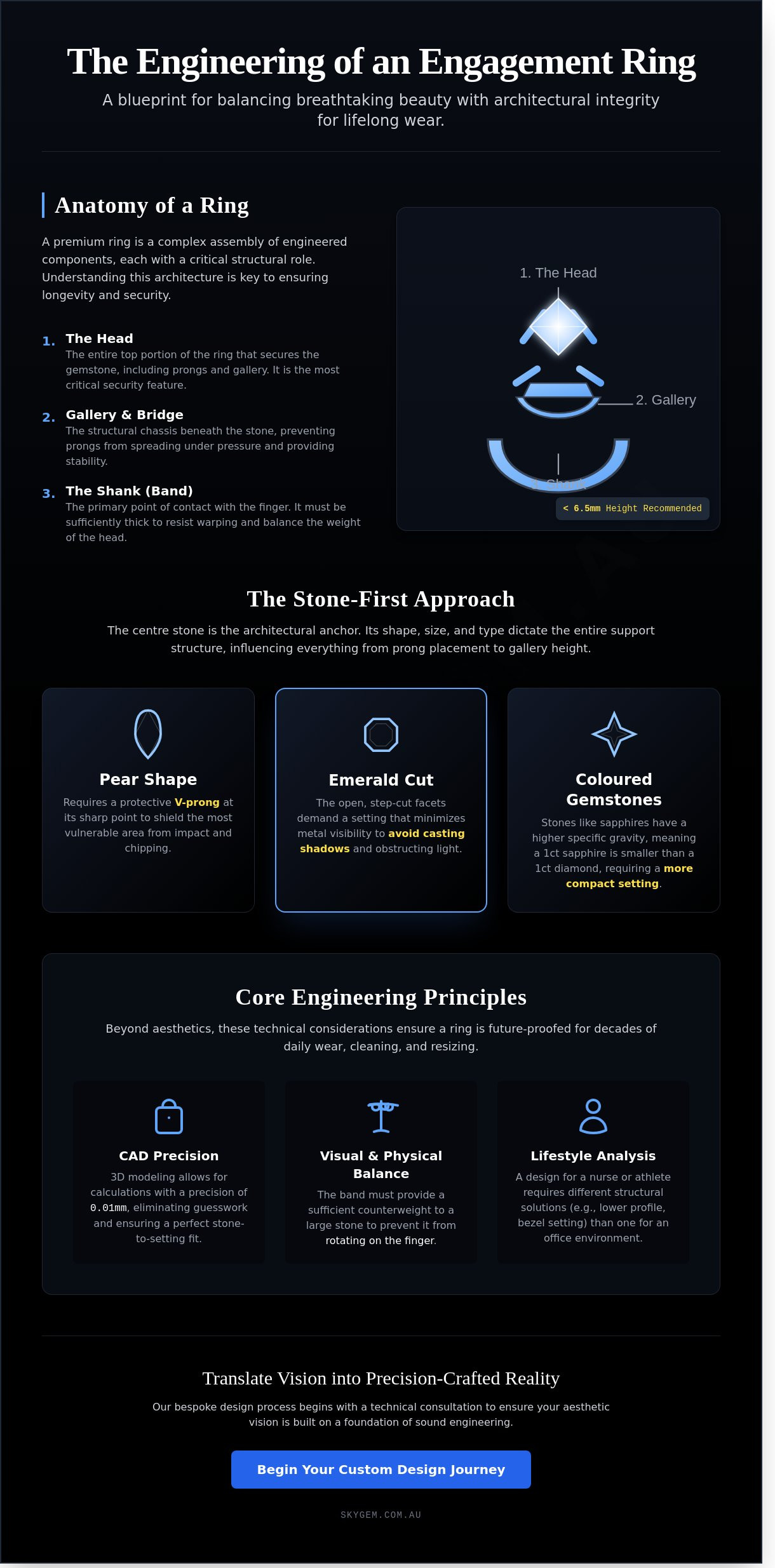
Modern manufacturing relies heavily on Computer-Aided Design (CAD) to ensure this structural longevity. By utilizing 3D modelling, designers can calculate the exact volume of metal required to support a stone's specific dimensions with a precision of 0.01mm. This technical approach eliminates the guesswork common in traditional hand-carved waxes. It allows for true future-proofing, where the piece is built to withstand decades of professional cleaning, resizing, and daily friction without compromising the integrity of the setting.
Anatomy of a High-Quality Ring
The architecture of a premium ring consists of three primary zones: the shank, the bridge, and the head. The shank, or the band, provides the primary contact point with the finger and must be thick enough to resist warping. Beneath the centre stone, the bridge and gallery act as the structural chassis, preventing the prongs from splaying under pressure. We've found that a ring height exceeding 6.5mm often increases the risk of snagging on clothing, which leads to prong fatigue. Keeping the profile lower improves both the safety of the stone and the long-term comfort for the wearer.
The Designer's Mindset: Starting with the End in Mind
Effective engagement ring design requires a thorough analysis of the wearer's daily environment. A nurse, gardener, or athlete needs a different structural solution than someone in a corporate office. Minimalist designs, while visually simple, often demand the most complex engineering. Because there's less metal to distribute the load, the alloy's density and the placement of hidden supports become critical. Balancing the visual weight is equally vital; a band that's too thin won't provide the necessary counterweight to keep a large stone from rotating awkwardly on the finger. Design should always be a partnership between visual desire and physical reality.
The Stone-First Approach: Designing Around the Centre Gem
In the technical execution of engagement ring design, the centre stone serves as the primary architectural anchor. It's not merely a decorative element; its physical dimensions dictate the engineering of the entire piece. The height of the gallery, the width of the shank, and the placement of the prongs are all calculated based on the stone's specific depth and diameter. This ensures structural integrity while allowing for maximum light entry, which is critical for achieving the desired brilliance in the Australian sun.
Different gemstone shapes require distinct support structures to ensure longevity. For instance, a pear-shaped stone necessitates a V-prong at its point to protect the vulnerable tip from impact. Emerald cuts, with their large open facets, require a setting that doesn't cast internal shadows. While natural and lab-grown diamonds share identical chemical properties, their growth patterns can influence the setting approach. Lab-grown diamonds often exhibit specific internal graining that a master setter must account for during the final tightening process. Integrating coloured gemstones introduces another layer of complexity. When selecting loose sapphires or rubies, designers must adjust for their higher specific gravity. A 1.00-carat sapphire is physically smaller than a 1.00-carat diamond, requiring a more compact setting to maintain a secure fit.
Proportions and Ratios in Gemstone Design
Applying the Golden Ratio is essential to ensure the stone maintains a harmonious relationship with the wearer's hand. A stone that's too large can feel cumbersome; one that's too small might lose its visual impact. To enhance the perceived size of the centre gem without compromising stability, we often use accent stones like baguettes or pavé. This technique draws the eye across the horizontal plane of the ring, creating a fuller look. Designing for depth is equally vital. The setting must be deep enough to ensure the culet, the bottom point of the stone, remains protected and does not come into contact with the finger, preventing both discomfort and potential damage to the gem.
Technical Stone Selection Framework
GIA certification remains the baseline for any design-led selection process. It provides the empirical data needed to choose a stone that will perform reliably over decades. When working with natural rubies, we consider their position on the Mohs scale, where they sit at a 9.0, to determine the most protective setting style. Understanding the guide to gold alloys in ring design is also essential, as the metal's hardness and composition affect how securely it holds these precious stones. To simplify this technical phase, our Ringbuilder tool allows you to visualise how different stones integrate with specific mounts before the manufacturing process begins.
Setting Styles: Engineering Beauty and Security
The technical success of an engagement ring design relies on a precise balance between gemstone security and optical performance. While the aesthetic appeal is paramount, the engineering must account for the daily stresses of wear. A solitaire setting provides the baseline for light entry, yet the introduction of a halo or trilogy structure changes the load distribution and light path significantly. A halo setting uses a perimeter of pavé diamonds to create a larger visual footprint, while also protecting the girdle of the centre stone from lateral impacts. In contrast, the Toi et Moi style has seen a resurgence in the Australian market for 2026, presenting unique engineering challenges due to its asymmetrical weight distribution and the need for balanced mounting points to prevent the stones from shifting.
Choosing between prong counts involves a direct trade-off. A four-prong setting allows for maximum light entry through the pavilion, which is ideal for smaller stones where visibility is key. However, a six-prong configuration offers superior redundancy; if one prong is damaged or snagged, the remaining five maintain the stone’s position. For clients seeking the highest level of protection, bezel settings provide a continuous metal rim that encapsulates the gemstone. This eliminates the risk of snagging and offers a sleek, modern aesthetic that aligns with contemporary architectural influences. This evolution in form is part of the comprehensive history of engagement rings, where security has moved from heavy, primitive enclosures to refined, high-performance mounts that prioritise the stone's brilliance.
Solitaire and Trilogy: The Classics Re-engineered
Modern solitaire designs often utilise a six-prong head to ensure the stone remains secure under high-impact conditions. For trilogy engagement rings, the focus shifts to structural balance and the seamless transition between the three stones. We often incorporate hidden halos into these designs. These aren't just for brilliance; they act as a structural collar that reinforces the prongs. This prevents them from spreading over time while adding a sophisticated detail visible from the profile view, ensuring the engagement ring design remains as durable as it is beautiful.
Advanced Setting Techniques
Longevity is a core metric in our design process. Cathedral settings use arches of metal to support the head, providing better resistance to bending than simple tension settings. To prevent stone loss, we integrate a 'gallery rail', which is a horizontal band of metal that connects the prongs. This rail ensures that even if a prong is pulled back, the stone cannot easily slide out. Additionally, we prioritise 'flush-fit' engineering. By raising the setting slightly, we ensure a wedding band can sit against the engagement ring without a gap. This prevents the two pieces from grinding against each other, which avoids premature metal fatigue and protects the integrity of the ensemble.
Precious Metals and Band Engineering
Selecting the correct alloy is a structural decision that dictates the long-term integrity of your engagement ring design. While aesthetic preference is often the starting point, the engineering properties of the metal determine how the piece will withstand decades of daily friction and mechanical stress. At Skygem, we view the band not just as a decorative element, but as a high-precision mounting system designed to protect your investment.
18K gold consists of 75% pure gold, combined with 25% alloy metals to increase hardness and durability. In white gold, these alloys usually include palladium or silver. Because gold is naturally yellow, white gold requires a rhodium plating, a member of the platinum group, to achieve a bright, mirror-like finish. This coating typically requires maintenance every 12 to 24 months to maintain its crisp appearance. Platinum offers a different technical profile. It's 95% pure and significantly denser than gold. When platinum is scratched, the metal is displaced rather than lost, a process known as burnishing. This makes it the superior choice for securing high-value centre stones in high-security claw settings.
Metal choice also influences the perceived colour of the diamond. A D-grade colourless stone may appear slightly tinted if set in 18K yellow gold, as the metal reflects through the facets. Conversely, using 18K rose gold can cleverly mask the slight warmth in a J or K colour grade stone, creating a harmonious and intentional aesthetic. For structural stability, we recommend a minimum band width of 1.8mm and a thickness of 1.5mm. Reducing dimensions below these thresholds increases the risk of "out-of-round" deformation during standard daily activities.
Platinum vs. White Gold: A Technical Breakdown
Platinum's high density provides a reassuring weight on the hand, weighing approximately 40% more than an identical 18K gold band. Over time, platinum develops a "patina," a soft matte finish caused by microscopic surface displacements. This is a hallmark of the metal's longevity. Unlike some white gold alloys that contain nickel, platinum is naturally hypoallergenic. This makes it the standard for clients with sensitive skin who require a permanent, non-reactive solution for lifelong wear.
The Ergonomics of Band Design
Effective band engineering balances visual daintiness with physical durability. Tapered bands provide a delicate look near the stone while maintaining a wider base for strength. We utilize inside-round engineering, commonly referred to as a comfort fit, which involves a slightly domed interior profile. This reduces the surface area contact between the metal and the finger, allowing for better airflow and easier movement over the knuckle. While 18K gold is harder than pure 24K gold, it remains susceptible to surface abrasions, making these ergonomic considerations vital for maintaining the ring's profile over time.
Explore our engineering standards for your bespoke project by viewing our custom made engagement ring services in Melbourne.
The Bespoke Design Journey at SkyGem & Co.
Our approach to engagement ring design mirrors the precision of architectural engineering. We transform a conceptual vision into a custom-made engagement ring through a methodical technical consultation process. This journey begins with an analysis of structural requirements, ensuring that the chosen aesthetic doesn't compromise the long-term durability of the piece. We treat every commission as a technical project where metal fatigue, stone security, and ergonomic comfort are primary considerations.
The first CAD render represents the most critical milestone in the bespoke cycle. This digital blueprint allows you to visualise the proportions and technical intersections of the ring before any metal is cast. It's a stage where we verify that the depth of the collet and the width of the shank meet our rigorous engineering standards. Our Australian-led design team oversees this phase to ensure full compliance with local jewellery benchmarks, focusing on precision rather than mass-market shortcuts.
Quality control at SkyGem & Co. is a multi-stage protocol. Once the casting is complete, the piece undergoes a series of technical checks. We examine the integrity of the prongs and the precision of the stone setting under high magnification. The process concludes with a final hand-polishing sequence that enhances the metal's reflective properties while maintaining the crispness of the design's geometric lines. This commitment to technical excellence ensures that the final product is a permanent asset, built to withstand daily wear for decades.
Collaborating with a Trusted Specialist
Preparation is the foundation of a successful technical consultation. We recommend bringing reference images, specific stone preferences, and an established budget range to your initial meeting. This data allows our specialists to provide accurate feedback on material feasibility and design stability. Transparency in pricing is a core tenet of our partnership; we provide detailed breakdowns showing how design complexity, such as intricate pavé work or complex filigree, influences the final investment. Most bespoke projects follow a structured timeline, typically requiring 4 to 8 weeks from the final CAD approval to the delivery of the finished masterpiece.
Next Steps: Visualising Your Design
To begin your journey, we encourage you to explore our Engagement Rings collection for inspiration on silhouettes and setting styles. For those interested in modern material science, our Ringbuilder for lab-grown diamonds offers a sophisticated interface to select high-performance stones with specific photometric qualities. Once you have a preliminary concept, booking a private consultation is the next logical step. This allows us to begin the formal engineering process and move your vision from a concept to a tangible, high-precision reality.
Engineering Your Legacy: The Path to a Masterpiece
Successful engagement ring design requires a disciplined approach that treats jewellery as a feat of precision engineering. We've explored how structural integrity ensures a lifetime of wear; from the calculated security of a four-prong setting to the deliberate selection of durable precious metals. By prioritising a stone-first methodology, you ensure that every architectural choice serves to enhance the optical performance and security of your centre gem.
SkyGem & Co. functions as your technical consultant throughout this process. Our team provides expert technical consultations to bridge the gap between your creative vision and physical durability. We specialise in sourcing GIA certified natural and lab-grown diamonds, alongside rare Australian sapphires and unheated rubies. This ensures your investment meets the highest global standards for quality and authenticity. It's about creating a piece that stands as a permanent asset, backed by local expertise and rigorous design standards. We look forward to helping you translate your inspiration into a tangible, enduring reality.
Start your bespoke design journey with SkyGem & Co. today
Frequently Asked Questions
Is it better to choose the diamond or the ring design first?
You should typically select the diamond or primary gemstone before finalising the engagement ring design. This ensures the structural components, such as the collet and claws, are engineered to the stone's exact millimetre measurements. A diamond's depth and girdle thickness influence the setting's height; choosing the stone first prevents technical misalignments that could compromise the ring's long-term durability.
How much should I expect to pay for a bespoke engagement ring design?
While costs vary based on complexity, Australian industry data indicates that bespoke design fees typically range from A$500 to A$2,500, excluding the price of materials. This investment covers professional CAD modelling, 3D wax printing, and technical consultations. The final price depends on the complexity of the engineering and the labour required for intricate stone setting. Choosing a local specialist ensures your investment meets Australian consumer protection standards.
What is the most secure setting for an active lifestyle?
The bezel setting provides the highest level of security for individuals with active lifestyles. By encircling the diamond with a continuous rim of precious metal, the stone's edges are protected from impacts and snagging. This engagement ring design reduces the risk of stone loss compared to traditional claw settings. It's a practical choice for professionals in healthcare or trades where manual labour is a daily requirement.
Can I design a ring using a family heirloom gemstone?
Repurposing a family heirloom gemstone is a standard procedure in bespoke engagement ring design. Our technical team first assesses the stone's integrity using 10x magnification to identify any existing fractures or surface reaching inclusions. Once verified, we can incorporate the stone into a modern setting that respects its heritage while ensuring the new mount provides adequate structural support for another generation of wear.
How long does the custom engagement ring design process take?
The custom engagement ring design process usually takes between 6 and 10 weeks to complete in Australian workshops. This timeline accounts for the initial design phase, CAD adjustments, casting, and the final hand-finishing stages. Rapid prototyping might shorten the early stages, but high-quality stone setting and hallmarking require a fixed amount of time to ensure the piece meets professional standards.
What is the difference between a custom design and a modified ready-to-wear ring?
A custom design is engineered from a blank slate using CAD software, whereas a modified ring involves making minor adjustments to a pre-existing cast. Customisation allows for total control over metal weight and stone positioning; modifications are often limited by the original frame's structural integrity. Choosing a full custom route ensures every technical specification is tailored to your specific aesthetic and functional requirements.
Do I need GIA certification for a lab-grown diamond design?
You should always request a GIA or IGI grading report for lab-grown diamonds to confirm their technical specifications. According to the Gemmological Association of Australia, these reports provide an objective assessment of the diamond's quality and ensure it's not a different synthetic material. Certification protects your purchase by documenting the stone's exact 4Cs, which is vital for insurance valuations and future maintenance.
How do I ensure my engagement ring will fit flush with a wedding band later?
To ensure a flush fit, you must specify a "wed-fit" design during the initial CAD phase. This technical approach elevates the setting's head to create clearance for a straight wedding band to sit against the engagement ring's shank. Without this adjustment, you might require a contoured or notched wedding band to avoid a gap, which can affect the overall symmetry and comfort of the bridal set.
Disclaimer
This article is for general informational purposes only and may include AI-assisted content. Pricing, specifications, and availability are subject to change. For accurate advice and current information, please contact SkyGem & Co. directly. Nothing in this content constitutes professional or financial advice.