
GIA Certified Ruby Meaning: Understanding the Value of a Gemological Report

Would you commit to a high-value asset based solely on a visual inspection? In a global market valued at 5 billion dollars as of 2026, the distinction between a natural unheated stone and a glass-filled imitation is often invisible to the naked eye. This technical gap is exactly where the GIA certified ruby meaning becomes critical for your acquisition strategy. While rubies don't follow the same rigid four-Cs grading scale as diamonds, the documentation provided by the Gemological Institute of America acts as a definitive technical blueprint for authenticity and long-term viability.
It's understandable to feel uncertain when faced with varying price points and complex origin claims. This article explains how GIA reports provide the technical precision needed to safeguard your investment in fine jewellery. You'll learn to interpret specific data points, such as geographic origin and treatment status, to ensure the price you pay reflects the stone's true gemological value. We will examine the specific metrics that define a ruby's performance, providing you with the confidence to verify authenticity through rigorous gemological standards.
Key Takeaways
- Understand why a GIA report serves as a technical identification of a stone's natural origin rather than a subjective diamond-style quality grade.
- Explore the technical GIA certified ruby meaning to effectively distinguish between high-value natural stones and low-quality alternatives like lead-glass filled or synthetic rubies.
- Learn to interpret physical metrics and variety classifications within a report to justify the purchase price and long-term viability of premium unheated rubies.
- Discover how the specific cutting style and measurements documented on a report directly impact the visual fire and brilliance of your chosen gemstone.
- Gain insights into why selecting a loose, certified stone provides a superior technical foundation for bespoke jewellery projects and high-precision design.
Understanding the Meaning of a GIA Certified Ruby
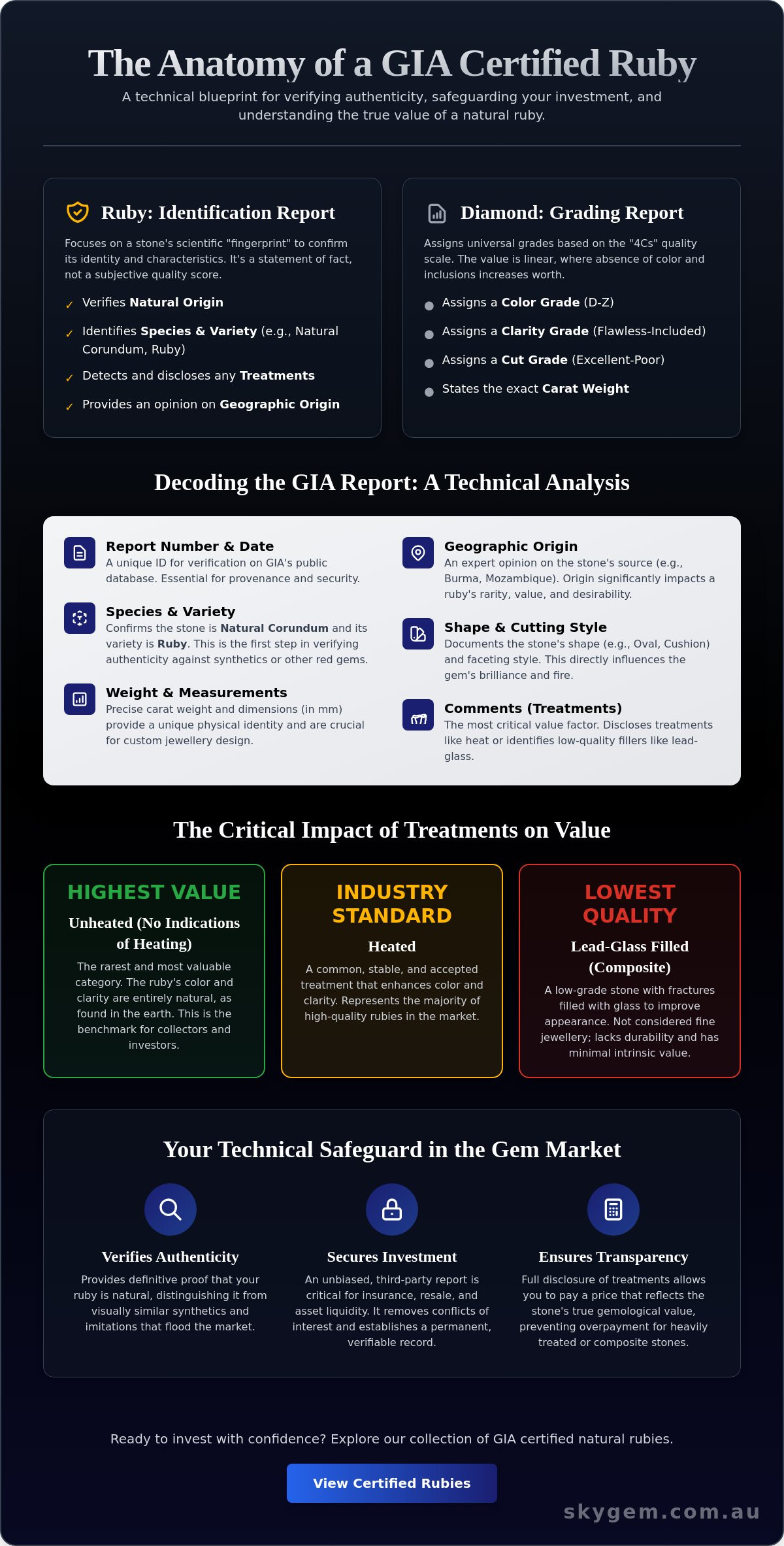
The term "certified" is often used loosely in the jewellery industry, but in a technical context, it refers to a specific document: the GIA Colored Stone Identification Report. When we discuss the GIA certified ruby meaning, we are describing a rigorous scientific audit rather than a subjective quality score. Unlike diamonds, which receive alphanumeric grades for clarity and colour, rubies are issued reports that focus on identification and origin. This document serves as a technical guarantee that the stone is a natural corundum and not a lab-grown simulant or a highly treated composite.
A GIA report provides an unbiased, third-party analysis of the stone's physical and chemical properties. This is vital because the global market for natural rubies is increasingly complex. High-quality synthetics, created via flame fusion or flux growth, can mimic the appearance of natural stones to the point of deceiving even experienced jewellers. The GIA uses advanced spectroscopy and microscopic analysis to verify the internal growth structures that only occur in nature. This level of precision ensures that your investment is backed by empirical data rather than a seller's promise.
Identification vs. Grading: The Crucial Difference
One of the most common points of confusion for investors is why rubies lack a universal "4Cs" grading scale. While diamonds are graded on a linear scale of "less is more"—where the absence of colour and inclusions increases value—the value of a ruby is driven by the depth and saturation of its red hue. These Ruby gemstone properties are influenced by trace elements like chromium, and their assessment involves a degree of human perception that doesn't fit into a rigid grading grid. GIA chooses to focus on the scientific "fingerprint" of the stone. They identify the mineral species and variety, providing a factual foundation that allows the market to determine value based on rarity and demand.
The Security of Third-Party Verification
Independent lab reports are essential for high-value gemstones because they remove the conflict of interest inherent in a retail transaction. As a non-profit entity, the GIA provides an objective assessment that isn't influenced by sales targets or inventory pressure. This objectivity is a cornerstone of the GIA certified ruby meaning for long-term collectors. Having this documentation is critical for insurance purposes and future resale. It establishes a permanent record of the stone's weight, dimensions, and treatment status, ensuring the asset remains liquid and its value remains verifiable throughout its lifetime.
The Technical Architecture of a GIA Ruby Identification Report
A GIA report begins with a rigorous quantification of the gemstone's physical properties. Beyond the basic carat weight, the document records precise millimetre dimensions and the specific cutting style, such as cushion or oval brilliant. These metrics are fundamental to the GIA certified ruby meaning because they provide a verifiable baseline for the stone's structural integrity and its eventual light performance in a setting. When you examine these figures, you aren't just looking at size; you're reviewing the technical precision with which the raw material was handled to maximise its optical potential. This data is central to GIA's ruby quality factors, which serve as the industry standard for professional evaluation.
Species and Variety Identification
The report clearly states the species as Corundum and the variety as Ruby. While this seems straightforward, it's a critical legal distinction in the trade. The boundary between a ruby and a pink sapphire is often a point of contention among collectors and traders alike. GIA determines the threshold between ruby and sapphire by using a set of master stones to assess whether the dominant hue is red; if the saturation is too low or the hue shifts too far toward pink, the stone is technically classified as a sapphire. For those seeking the highest level of rarity, ensuring the report definitively lists the variety as "Natural Ruby" is the first step in a secure acquisition.
Origin and Treatment Analysis
One of the most valuable components of a GIA report is the Origin Opinion. For stones of significant quality, GIA provides a geographic origin based on trace element analysis and the study of internal inclusion patterns. This information is a primary driver of market price. A stone identified as originating from Burma (Myanmar) often carries a higher premium due to historical prestige and unique fluorescence, while stones from Mozambique have become the modern benchmark for high-clarity, unheated material. If you are considering a significant investment, you can explore our collection of natural rubies to see how these origin factors influence the stone's character.
The report also provides a definitive statement on treatments. Most rubies in the commercial market undergo heat treatment to improve colour and clarity. GIA uses advanced spectroscopy to detect these enhancements or more invasive procedures like lattice diffusion. The most coveted status on any report is "No Indications of Heating." This confirms the stone's red hue is entirely the result of natural geological processes, making it exponentially rarer than its treated counterparts. Understanding these technical disclosures allows you to justify the purchase price based on the stone's actual rarity rather than its visual appearance alone.
Why GIA Certification is Non-Negotiable for Premium Rubies
The global ruby market is projected to reach a valuation of 5 billion dollars by 2026, creating a high-stakes environment where technical verification is the only reliable safeguard for your capital. In this landscape, the GIA certified ruby meaning extends far beyond a simple identification of the stone. It represents a comprehensive risk mitigation strategy against sophisticated deceptions that can lead to significant financial loss. For premium specimens, particularly unheated stones over 2 carats that can command prices exceeding 100,000 dollars per carat, the absence of a GIA report introduces an unacceptable level of uncertainty regarding the asset's true nature.
A primary function of the report is the verification of "Pigeon's Blood" colour claims. This specific trade term refers to a vivid, saturated red with high fluorescence, and a GIA confirmation of this grade can more than double the stone's value compared to a standard fine red ruby. Furthermore, as 68% of Millennial and Gen Z investors now demand proof of ethical sourcing, the GIA report provides the necessary documentation to ensure a stone's journey is transparent and compliant with modern standards. This data is essential for maintaining the long-term viability of your jewellery as a permanent asset.
Mitigating the Risk of Sophisticated Synthetics
The rise of lab-grown rubies has introduced stones that closely mimic the internal structures of natural gems. Modern synthetics created through flux growth or flame fusion processes often contain inclusions that can deceive a buyer using only a simple loupe. GIA technicians utilise advanced spectroscopy to detect the specific chemical signatures and growth patterns that distinguish man-made stones from the complex geological formation of ruby. Relying on visual inspection alone is no longer sufficient; scientific analysis is required to confirm that a stone is a natural product of the earth.
Unmasking Hidden Treatments
Technical reports are vital for identifying invasive treatments like lead-glass filling. This process involves infusing low-quality, fractured corundum with glass to improve transparency, a practice that significantly diminishes the stone's value and compromises its structural integrity. While traditional heat treatment is widely accepted, glass-filled stones are unstable and can be damaged during routine jewellery repairs or cleaning. For those seeking a ruby price guide that reflects true rarity, the distinction between a treated stone and an unheated one is paramount. In the current market, an unheated 1-carat Burmese ruby can cost approximately 20,000 dollars, while a similar heated stone may be valued at only 7,000 dollars. The GIA report provides the technical evidence required to justify these significant price differentials.
Evaluating Ruby Quality Factors Beyond the Certificate
A gemological report provides the technical framework for a purchase, but the aesthetic value of a ruby is ultimately experienced through the eye. While the GIA certified ruby meaning ensures you are buying a natural, authentic asset, the report text must be paired with a visual assessment of light performance. Because rubies are often "cut for colour" rather than for maximum brilliance, the proportions listed on a report can vary significantly. A stone with a shallow cut may appear larger for its weight but might suffer from "windowing," where light passes straight through the centre. Conversely, a deep cut can lead to "extinction," causing dark, lifeless areas within the stone. Balancing these technical measurements with the stone's actual fire is essential for any high-level jewellery project.
To help navigate these complexities, referencing a professional ruby price guide allows you to align the technical data points on a GIA report with current market values. This ensures that you aren't overpaying for a stone that, while natural and certified, may lack the visual saturation required for a premium setting. The goal is to find a stone where the technical pedigree and the physical beauty intersect seamlessly.
The Nuances of Ruby Colour and Saturation
GIA colour descriptions are precise, often noting secondary hues that significantly impact a ruby's character. While a pure, vivid red is the most coveted, many natural rubies exhibit purple, orange, or pink secondary hues. A slight purple modifier is often desirable as it can make the red appear richer and more "royal." However, an overly dominant orange or pink hue can shift the stone's classification toward sapphire, which changes the value proposition entirely. The most successful acquisitions involve selecting a stone where the tone—the lightness or darkness—is medium to medium-dark, allowing the saturation to remain vivid without the stone appearing black in low-light environments.
Clarity and Inclusions: The 'Fingerprints' of Nature
Inclusions are frequently viewed as imperfections, yet in the context of natural corundum, they serve as the "fingerprints" of the earth. One of the most famous inclusions is "silk," which consists of fine rutile needles. When distributed evenly, silk can actually enhance a ruby's value by softening the light and spreading colour more uniformly across the facets. This is a primary indicator of natural origin and often proves a stone has not been subjected to high-heat treatment. However, it's vital to distinguish between these "soft" inclusions and "hard" crystals or surface-reaching fractures. If an inclusion is located near the girdle or table of the stone, it may present a structural risk during the setting process or daily wear. A professional technical consultant can help you evaluate whether a stone's internal characteristics are benign markers of nature or potential liabilities for a bespoke ring.
If you are ready to apply these technical insights to a specific project, you can explore our curated selection of natural rubies to find a stone that balances visual performance with technical pedigree.
Sourcing GIA Certified Rubies for Bespoke Jewellery
Selecting a loose natural ruby before it is secured into a mounting is the most effective way to ensure the technical integrity of your investment. When a stone is already set, the metal claws or bezel can obscure inclusions or artificially enhance the colour through internal reflections. By reviewing the stone in its loose state, you can verify every detail of the GIA certified ruby meaning against the physical specimen under controlled lighting. This transparency allows for a precision-led approach where the design is built to complement the stone, rather than forcing a gemstone into a pre-existing setting that may not suit its unique proportions.
The data within a GIA report also serves as a guide for selecting the most appropriate metal for your piece. If a report identifies a ruby with a slight purplish secondary hue, setting it in 18K yellow gold can provide a warm contrast that makes the red appear more vibrant. Conversely, a stone with a pure "Pigeon's Blood" red may be better suited to platinum or white gold to maintain its cool, high-fluorescence profile. These technical decisions, informed by lab data, ensure that the final design maximises the stone's natural performance metrics.
The Role of a Technical Consultant in Stone Selection
At SkyGem & Co., we act as technical consultants to help you interpret the granular data found in GIA reports. We compare multiple stones to find the optimal balance between geographic origin and colour saturation within your specific project parameters. It's vital to view these stones in person alongside their official documentation; while the report provides the scientific blueprint, the human eye perceives the unique personality of the red hue. This partnership ensures you aren't just buying a certificate, but a gemstone that meets the highest standards of visual excellence and regulatory adherence.
Designing Around a Certified Gemstone
Once the stone is selected, the GIA report informs the entire architectural process of creating bespoke engagement rings. If a report identifies a specific inclusion near the girdle of the stone, our designers can adjust the setting to safeguard that area from potential impact. We utilise CAD (Computer-Aided Design) to ensure a precision fit based on the exact millimetre measurements documented by the lab. This methodical approach results in engagement jewellery that isn't just aesthetically superior but also engineered for long-term durability. Owning a piece with a globally recognised report provides the confidence that your asset is verifiable, ethically sourced, and built to last as a permanent legacy.
Securing the Future of Your Gemstone Acquisition
Investing in a premium ruby requires a shift from visual appreciation to technical verification. By understanding the GIA certified ruby meaning, you transition from a casual buyer to an informed collector who values empirical data over marketing claims. This documentation provides the essential evidence needed to confirm a stone's natural origin and its status regarding heat treatments. It serves as the definitive reference for insurance, resale, and the structural integrity of your bespoke jewellery design.
At SkyGem & Co., we act as your technical consultants throughout the acquisition process. Our specialists focus on sourcing unheated natural rubies that meet rigorous gemological standards. We ensure that every stone is paired with a bespoke setting designed specifically for its unique physical metrics. This methodical approach guarantees that your piece remains a permanent and evolving asset rather than a one-off purchase.
Explore our curated collection of GIA certified natural rubies to begin your journey toward a truly exceptional acquisition. We look forward to partnering with you on your next high-precision design project.
Frequently Asked Questions
Does GIA give rubies a grade like D or VVS1?
GIA does not assign alphanumeric grades like D or VVS1 to coloured gemstones. Instead, they provide a detailed narrative description of the stone's colour, variety, and transparency. This distinction is central to the GIA certified ruby meaning, as value is determined by the saturation and hue rather than a rigid linear scale. While diamond reports focus on the absence of colour, a ruby report identifies the presence and quality of the red hue.
Is a GIA report the same as an appraisal for insurance?
A GIA report is a technical identification document and not a valuation or appraisal. It describes the physical properties and treatment status of the stone but doesn't assign a dollar amount. You'll need a separate appraisal from a qualified professional for insurance purposes. The GIA report provides the empirical evidence that the appraiser uses to establish an accurate replacement value for your jewellery.
Why are Burma rubies more expensive even with similar GIA reports?
Burma rubies command a premium due to their historical prestige and unique geological properties. Most rubies from this region contain very low iron levels, which allows for higher fluorescence and a more vibrant red glow. Even if two stones have similar colour descriptions on a GIA report, the geographic origin significantly impacts rarity and market demand, as documented in the Origin Opinion section of the report.
Can GIA identify if a ruby has been heat-treated?
GIA identifies heat treatments by examining internal inclusion patterns and using advanced spectroscopy. If a stone has been heated, the report will list "indications of heating." For premium acquisitions, the most desirable status is "no indications of heating." This unheated status confirms the stone's colour is entirely natural, making it significantly more valuable and rarer than treated counterparts in the current global market.
What is the difference between a GIA Identification Report and an Origin Report?
A GIA Identification Report confirms the stone is a natural ruby and identifies any detectable treatments. An Origin Report includes all this data plus a geographic opinion on where the gemstone was mined. For high-value stones, the Origin Report is essential because the location, such as Mozambique or Myanmar, directly influences the stone's rarity and eventual market price based on historical supply and demand.
Do lab-grown rubies come with GIA reports?
GIA does issue reports for lab-grown rubies, but they are clearly distinguished from natural stone reports. These documents are titled "Laboratory-Grown Gemstone Report" and feature a different aesthetic to prevent market confusion. This transparency is part of the broader GIA certified ruby meaning, ensuring that buyers can distinguish between a natural asset and a man-made alternative created through flame fusion or flux growth processes.
How can I verify that my GIA ruby report is authentic?
You can verify any report by using the "GIA Report Check" tool on the official GIA website. By entering the unique report number engraved on the stone or printed on the document, you can view a digital version of the original data. This serves as a critical security measure to ensure the physical stone matches the technical specifications provided by the lab at the time of examination.
Is it worth buying a ruby without a GIA report?
Buying a high-value ruby without a GIA report involves significant financial risk. Without independent verification, it's nearly impossible to detect sophisticated treatments like lattice diffusion or lead-glass filling. While a report may not be necessary for low-cost fashion jewellery, it is non-negotiable for any stone intended as a long-term asset or a centerpiece for a bespoke engagement ring where authenticity is paramount.
Disclaimer
This article is for general informational purposes only and may include AI-assisted content. Pricing, specifications, and availability are subject to change. For accurate advice and current information, please contact SkyGem & Co. directly. Nothing in this content constitutes professional or financial advice.