
Gemstone Engagement Rings Melbourne: The 2026 Buying Guide

A gemstone engagement ring is a technical investment in mineralogy and light performance, far more than a simple aesthetic alternative to the traditional diamond. You likely recognize that while an Australian sapphire or a natural emerald offers a distinct personal narrative, the technical complexities of Mohs hardness and trace element treatments can make the selection process feel high-stakes. It's common to feel concerned about the structural integrity of specific stones or how origin impacts the ring's long-term value.
This 2026 guide provides the expert framework you need to master the nuances of gemstone engagement rings melbourne, ensuring your selection balances structural durability with premium aesthetic design. We'll explore why platinum now accounts for 28% of settings and how to evaluate the investment potential of unheated stones. You'll gain the technical confidence to select a bespoke piece, from Toi et Moi designs to GIA-certified rubies, that meets both your stylistic preferences and rigorous performance standards.
Key Takeaways
- Understand the technical difference between diamond grading and gemstone colour science, focusing on how hue, tone, and saturation determine a stone's premium value.
- Learn to apply the Mohs Scale of Mineral Hardness to ensure your selected stone offers the structural durability required for a lifetime of daily wear.
- Master the art of metal pairing by discovering how the technical properties of platinum and 18K white gold can enhance the natural vibrancy of gemstone engagement rings melbourne.
- Explore the rise of bespoke design trends, including the technical balance required for sophisticated "Toi et Moi" and trilogy setting configurations.
- Gain clarity on the long-term investment value of unheated rubies and sapphires versus treated stones to ensure your selection remains a permanent and evolving asset.
Beyond Diamonds: The Modern Appeal of Coloured Gemstone Engagement Rings
Selecting a gemstone engagement ring involves a deliberate shift from the monochromatic brilliance of diamonds to a sophisticated appreciation of colour performance. While diamonds are graded on the absence of colour, premium precious and semi-precious stones are valued for the depth and character of their internal hues. In 2026, the demand for gemstone engagement rings melbourne has evolved, with many couples prioritizing a technical understanding of mineral rarity over traditional marketing narratives. This shift is most evident in the resurgence of the "Big Three" gemstones: sapphire, ruby, and emerald. These stones, belonging to the corundum and beryl mineral families, offer a level of durability and spectral intensity that defines high-level jewellery design.
The modern landscape of fine jewellery design emphasizes the "Toi et Moi" and trilogy styles. These configurations allow for a technical interplay between different stone shapes and colours, such as pairing a vibrant teal sapphire with a clear diamond. This approach creates a "colour personality" that is entirely unique to the wearer, moving away from the mass-produced aesthetics of previous decades. It's a design strategy that treats the centrepiece not just as a stone, but as a technical component that must harmonize with the metal and the wearer's personal style.
Why Choose Coloured Gemstones for an Engagement Ring?
The primary advantage of a coloured gemstone is its inherent individuality. No two natural stones possess the exact same saturation or tone; even stones from the same mine will exhibit distinct spectral signatures. This uniqueness is a core requirement for bespoke design, where the stone's specific properties dictate the ring's final architecture. Beyond the visual impact, these stones carry deep historical symbolism. Sapphires are frequently associated with loyalty and integrity, while rubies represent vitality. Emeralds, with their rich verdant hues, symbolize growth and renewal. This symbolic depth provides a conceptual foundation for a ring that serves as a permanent and evolving asset.
The Investment Value of Rare Natural Stones
From a technical perspective, the scarcity of high-saturation natural gems often exceeds that of standard white diamonds. While lab-grown options provide a high-performance alternative, natural stones like unheated rubies and Australian sapphires maintain a specific heirloom quality due to their geological rarity. As market dynamics shift in 2026, savvy investors are looking toward these tangible assets for their long-term viability and physical beauty. For a deeper look at how these stones integrate into a custom design, see our article on Engagement Rings Melbourne: The Definitive 2026 Guide to Bespoke Jewellery. Choosing a stone with high clarity and a vibrant primary hue ensures the piece remains a durable, high-quality asset for generations.
Evaluating Gemstone Quality: Colour, Clarity, and Treatments
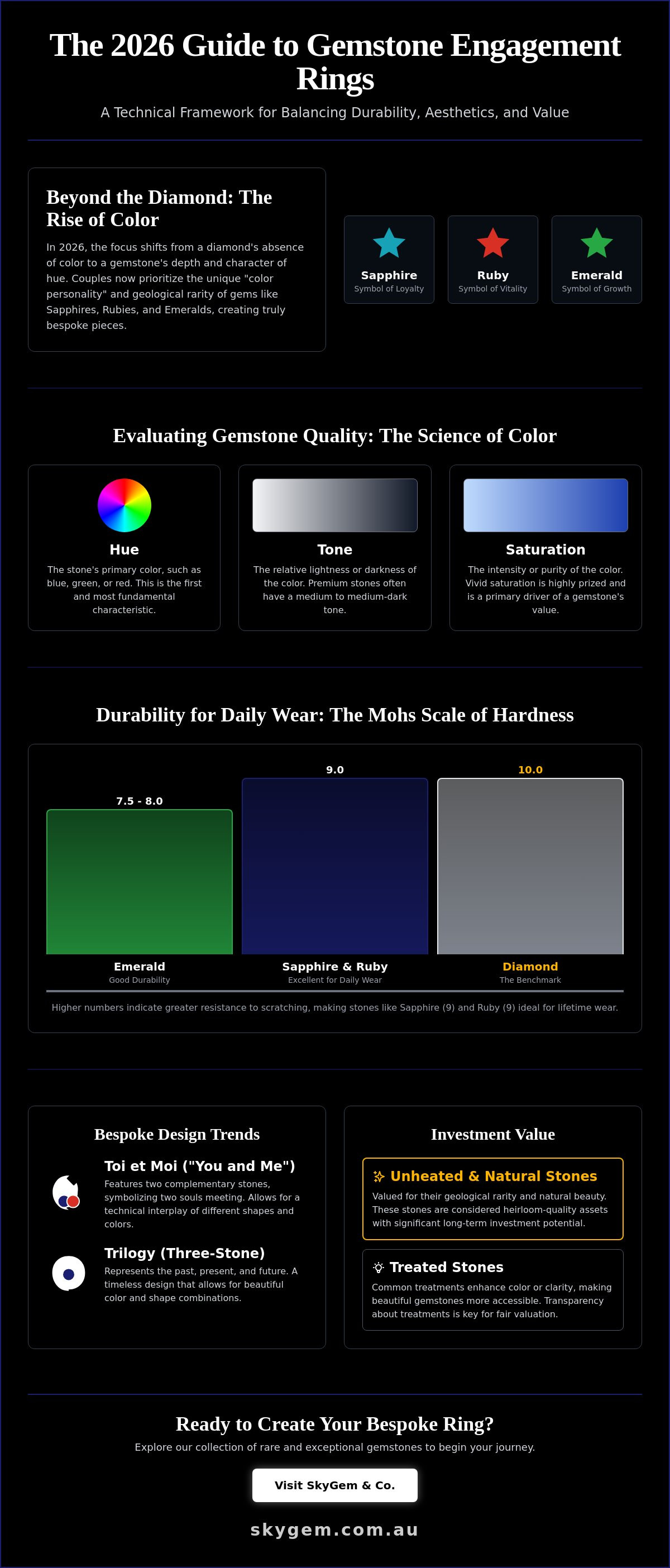
Determining the performance of a gemstone requires a different analytical framework than the one used for diamonds. While the "Four Cs" remain the foundational metrics, the hierarchy of these properties shifts significantly. For a diamond, clarity and cut precision are paramount. For gemstones, colour is the primary value driver. When evaluating gemstone engagement rings melbourne, you should focus on the interplay of hue, tone, and saturation. Hue refers to the actual colour, such as blue or green. Tone describes the relative lightness or darkness, while saturation measures the colour's intensity. An investment-grade stone typically exhibits a vivid saturation with a medium-dark tone, avoiding "extinction" where the stone appears black in certain lighting.
Clarity in gemstones is often measured by "eye-clean" standards rather than microscopic inclusions. Many precious stones, particularly emeralds, possess natural internal characteristics known as "gardens." These aren't defects but rather proof of natural origin. However, transparency must remain high; a "cloudy" stone will fail to reflect light efficiently, regardless of its colour quality. The market for gemstone engagement rings melbourne prioritises transparency in these technical specifications, as they directly correlate to the stone's scarcity and long-term value.
The Science of Gemstone Colour
Pleochroism is a critical technical factor. It's the property where a crystal shows different colours when viewed from different axes. Australian sapphires often exhibit strong pleochroism, showing flashes of teal, blue, and green depending on the orientation of the cut. If a stone is poorly faceted, it may suffer from "windowing." This occurs when light passes straight through the centre of the stone instead of reflecting back to the eye, resulting in a dull, transparent patch that diminishes the ring's overall brilliance. Ideal saturation levels for Australian sapphires should be rich and vivid, avoiding overly dark tones that mask the stone's internal fire.
Understanding Natural Treatments and Enhancements
Most stones undergo gemstone treatments to enhance their natural properties. Standard heat treatment is a stable, permanent process used to dissolve inclusions and improve colour. While heated stones are beautiful and durable, unheated sapphires and rubies command a significant premium. These stones are exactly as they were when pulled from the earth, representing a level of geological rarity that many collectors value. Emeralds are frequently treated with colourless oils to fill surface-reaching fissures, a practice that's widely accepted provided it's disclosed. You can explore our technical guide on stone origins to better understand how these treatments impact long-term asset value.
Durability and Wearability: Selecting the Right Stone for Daily Wear
An engagement ring is a high-performance asset subjected to significant mechanical stress and environmental exposure. While a stone's visual performance is a primary driver, its technical longevity depends on a balance of beauty, rarity, and durability. For gemstone engagement rings melbourne, we prioritize mineral selections that can withstand the rigours of a professional and active lifestyle. The Mohs Scale of Mineral Hardness serves as our analytical framework, acting as a relative measure of a mineral's resistance to scratching. It's a fundamental metric for determining if a stone is suitable for a lifetime of daily wear.
A hardness rating of 9 or higher is the technical gold standard for centre stones. While diamonds, rated at 10, remain the benchmark, sapphires and rubies (both belonging to the corundum family) are the most robust coloured alternatives. It's vital to distinguish between hardness and toughness. Hardness refers to the ability to resist surface abrasion, whereas toughness describes the resistance to fracturing or chipping. Even a hard stone can possess internal cleavage planes that make it susceptible to impact damage. For stones with moderate hardness, such as emeralds, specific care protocols and protective design choices are necessary to ensure the piece remains a permanent asset.
Gemstone Hardness Comparison Table
The Mohs scale provides a comparative ranking of mineral resistance. Understanding these values helps in selecting a stone that matches your intended usage levels.
| Gemstone Variety | Mohs Hardness | Daily Wear Suitability |
|---|---|---|
| Diamond | 10 | Exceptional; resistant to almost all household abrasives. |
| Sapphire / Ruby | 9 | Very High; the premier choice for coloured engagement rings. |
| Alexandrite | 8.5 | High; suitable for most daily activities. |
| Emerald / Aquamarine | 7.5 - 8 | Moderate; requires cautious wear and protective settings. |
Setting Styles that Protect Your Gemstone
Technical design can significantly mitigate the inherent vulnerabilities of softer gemstones. Bezel settings, which encase the entire perimeter of the stone in metal, offer the highest level of protection against edge-chipping. This is particularly recommended for emeralds, which are naturally more brittle due to their internal inclusions. Halo settings also provide a functional "buffer" by surrounding the centre stone with smaller, harder diamonds that absorb lateral impacts. Regardless of the stone selected, regular prong maintenance is essential for bespoke engagement rings to ensure the structural integrity of the setting isn't compromised over time. When selecting gemstone engagement rings melbourne, we recommend a configuration that balances your aesthetic goals with the physical properties of the mineral.
Designing Your Bespoke Ring: Metal Pairings and Setting Styles
The structural framework of an engagement ring acts as an optical filter that can either amplify or diminish a gemstone's spectral performance. When conceptualizing gemstone engagement rings melbourne, the choice of metal is a technical decision that influences the "bleed" of colour into the stone's facets. A metal's reflective properties can shift the perceived tone of a gem; for instance, a highly reflective white metal can brighten a dark sapphire, while a warm metal might deepen the saturation of a ruby. Achieving the correct balance requires a technical understanding of how light interacts with both the mineral and the mounting.
For those seeking a cool-toned aesthetic, the debate between 18K white gold and platinum is central to the design process. Platinum has seen a significant resurgence, now accounting for 28% of engagement ring settings in 2026. It's preferred for its natural white hue and superior density, which provides a secure, permanent housing for high-value gemstones. While 18K white gold is a sophisticated alternative, it requires rhodium plating to maintain its crisp finish. Both metals provide a neutral backdrop that allows the primary hue of blue sapphires or emeralds to remain the focal point without interference from warm reflections.
The inclusion of side stones, typically diamonds, serves a functional purpose beyond mere ornamentation. These auxiliary stones provide a high-brilliance contrast that makes the centre gem's colour "pop" by providing a reference point for white light. Whether through a traditional trilogy arrangement or a modern halo, the interplay between the coloured centrepiece and the surrounding diamonds creates a dynamic visual hierarchy that defines premium bespoke jewellery.
Pairing Metals with Specific Gemstones
Cool-toned gemstones like blue or teal sapphires excel when set in 18K White Gold or platinum, as these metals reinforce the stone's icy brilliance. Conversely, the warmth of 18K yellow gold is the technical standard for enhancing natural rubies or peach sapphires. The yellow alloys complement the red and orange secondary hues within these stones, creating a cohesive and vibrant aesthetic. We've also observed a rise in teal sapphires being set in rose gold, where the pinkish undertones of the metal create a sophisticated contrast with the stone's green-blue saturation.
The Custom Design Journey
The transition from selecting a loose stone to finalizing a bespoke setting involves precise technical mapping. Because natural gemstones don't follow the standardized dimensions of calibrated diamonds, each setting must be engineered to the unique millimetre measurements of the specific gem. We utilize CAD design to ensure the prongs and basket provide maximum security without obscuring the stone's light entry points. This level of precision is vital for solitaire styles, where the stone's clarity and cut are on full display. To begin your own technical consultation, you can start your custom-made engagement ring journey here to ensure your selection is engineered for both beauty and long-term viability.
Explore the SkyGem & Co. Gemstone Collection
SkyGem & Co. operates as a technical consultant for those seeking gemstone engagement rings melbourne, offering a curated selection from our studio in the historic Royal Arcade. Our inventory includes over 300 natural gemstones, ranging from traditional blue sapphires to rare colour-change minerals. We prioritize stones that exhibit high saturation and eye-clean clarity, ensuring each piece meets the aesthetic and structural requirements of a permanent asset. By focusing on ethically sourced sapphires, emeralds, and rubies, we provide a transparent path to acquiring a premium bespoke ring that reflects your personal narrative.
Every piece in our collection is handcrafted with a focus on individual stone character. We don't believe in a one-size-fits-all approach to setting design. Instead, we engineer each mount to accommodate the specific physical properties and refractive indices of the centre stone. This methodical process ensures that the final ring is not just a purchase, but a unique love story told through technical precision and artisanal skill. Our commitment to quality over hype means you receive a ring designed for both immediate impact and long-term viability.
Standout Products: Sapphires and Emeralds
Australian teal sapphires have become a signature of our regional design, valued for their unique bi-colour aesthetics and high durability. These stones are ideal for those who appreciate the intersection of local sourcing and modern style. Our natural emeralds, sourced from world-class Zambian and Colombian deposits, are selected for their exceptional transparency. We often recommend protective bespoke settings for these stones to safeguard their beauty against daily mechanical stress. For a softer visual impact, our peach and Padparadscha-style sapphires offer a delicate balance of pink and orange hues, perfect for refined, romantic designs.
Rare and Unheated Specialities
The search for a truly extraordinary stone often leads to our unheated varieties. Our natural rubies include rare, unheated specimens that display the coveted "Pigeon Blood" red. These stones are prized for their lack of thermal treatment, representing a level of geological purity that is increasingly scarce in the global market. Similarly, we offer Alexandrite, a remarkable mineral known for its dramatic colour-change properties. This gem acts as a sophisticated conversation piece, shifting its spectral profile from teal-green to purplish-red based on the ambient light source. We invite you to explore our full Gemstone Collection to discover a stone that meets your rigorous standards for quality and investment value.
Securing Your Technical Investment for 2026 and Beyond
Selecting a gemstone engagement ring is a technical process that balances mineralogical properties with aesthetic design. By understanding the Mohs Scale of Hardness and the impact of heat treatments on long-term value, you've established a foundation for a high-performance purchase. Whether you're drawn to the intense saturation of an unheated ruby or the unique pleochroism of an Australian sapphire, the priority remains structural integrity and optical brilliance. Every decision, from metal choice to setting style, contributes to the ring's long-term viability as a permanent asset.
At SkyGem & Co., we act as technical consultants to help you navigate these nuances. Our boutique studio specializes in expertly sourced unheated sapphires and rubies, ensuring your selection represents a rare geological asset. Each piece is handcrafted through a bespoke design process that prioritizes transparency and engineering precision. When you're ready to explore premium gemstone engagement rings melbourne, we invite you to view our curated collection.
Browse the SkyGem & Co. Gemstone Engagement Ring Collection to find a stone that meets your rigorous standards for beauty and durability. We look forward to partnering with you on your custom design journey.
Frequently Asked Questions
Which gemstone is best for an engagement ring for daily wear?
Sapphires and rubies are the premier choices for daily wear due to their Mohs hardness rating of 9. Belonging to the corundum mineral family, these stones offer the necessary resistance to surface abrasion and mechanical stress required for a lifetime of use. This structural durability makes them the most reliable centrepiece options for gemstone engagement rings melbourne, ensuring the stone doesn't lose its lustre or sustain scratches over time.
Are gemstone engagement rings cheaper than diamond rings?
While many coloured gemstones provide a lower price point per carat than natural diamonds, high-saturation precious stones like unheated rubies or rare alexandrite can command significant premiums. The value is driven by geological rarity, origin, and colour performance rather than a simple comparison to diamond metrics. For many couples, choosing a gemstone allows for a larger, more vibrant centre stone while maintaining a specific technical budget.
What is the difference between a heated and unheated sapphire?
Heat treatment is a standard, permanent industrial process used to dissolve internal inclusions and intensify a stone's colour. In contrast, unheated sapphires are exactly as they were when pulled from the earth, possessing natural colour and clarity without thermal intervention. Unheated stones are significantly rarer and act as a higher-tier investment asset, often maintaining a higher resale value due to their geological scarcity.
Can I use an emerald for an engagement ring if I am active?
Emeralds can be used for engagement rings, but they require a more cautious approach and protective setting styles. With a Mohs hardness of 7.5 to 8, they are more brittle than sapphires and susceptible to chipping if struck against a hard surface. If you lead an active lifestyle, it's best to select a bezel or halo setting to provide a metal buffer around the stone's edges.
How do I know if a gemstone is ethically sourced?
Ethical sourcing is verified through reputable laboratory certifications, such as GIA or GRS, which document the stone's geographic origin. We follow strict regulatory standards and adhere to the latest Australian AML/CTF reforms to ensure full supply chain transparency. This rigorous approach ensures that every mineral in our collection is sourced through conflict-free channels that respect both environmental standards and regional labour laws.
What is a "Teal" sapphire and why is it popular?
A teal sapphire is a variety that displays a sophisticated blend of blue and green hues, often exhibiting yellow secondary tones. Its popularity in 2026 is driven by its unique pleochroism and its ability to complement both warm and cool metal types. For those looking at gemstone engagement rings melbourne, teal sapphires provide a modern, individualistic aesthetic that doesn't compromise on the durability required for an heirloom piece.
Do gemstones hold their value over time?
High-quality natural gemstones, particularly unheated varieties with high saturation, have historically maintained their value due to their finite supply. As the market for lab-grown stones continues to expand, the scarcity of natural emeralds, rubies, and sapphires becomes a more significant value driver. These stones are viewed as permanent and evolving assets, where rarity and documented origin provide a stable foundation for long-term investment.
How do I clean and maintain a gemstone engagement ring?
Effective maintenance involves cleaning the ring with warm, soapy water and a soft-bristled brush to remove accumulated oils and environmental debris. It's important to avoid ultrasonic cleaners for stones like emeralds, as the vibrations can interfere with standard oil treatments. Professional annual inspections are recommended to verify the structural integrity of the prongs and ensure the stone's light performance remains at its peak technical level.
Disclaimer
This article is for general informational purposes only and may include AI-assisted content. Pricing, specifications, and availability are subject to change. For accurate advice and current information, please contact SkyGem & Co. directly. Nothing in this content constitutes professional or financial advice.