
Fine Jewellery & Bespoke Pieces: A Comprehensive Guide to Our Products

With the global lab-grown diamond market projected to reach $27.0 billion in 2026, the choice between engineered and natural stones has moved from a niche curiosity to a fundamental technical decision. You likely feel the weight of this shifting landscape, especially when gold prices sit near $4,600.20 per troy ounce as of May 2026. It's understandable to feel overwhelmed by the technicalities of unheated versus heated gemstones or the structural integrity of various ring settings. Selecting high-calibre jewellery products requires a balance of engineering precision and aesthetic intuition to ensure a permanent asset.
We promise to provide the clarity you need to select ethically sourced diamonds and rare gemstones that align with your specific standards. You'll gain a comprehensive understanding of our product categories, from GIA-certified natural diamonds to vibrant Australian-sourced sapphires. We also detail our bespoke design process, giving you the confidence to distinguish between different gemstone treatments and settings. This guide serves as a technical consultant for your next acquisition, focusing on architectural excellence and verified quality instead of marketing hype.
Key Takeaways
- Distinguish between the technical grades of unheated and heated gemstones to ensure your selection meets high-level quality and transparency standards.
- Examine how different setting architectures, such as halo and trilogy designs, impact the photometric performance and physical protection of your gemstones.
- Navigate the decision-making process between ready-to-ship inventory and custom-engineered jewellery products to find the optimal balance of speed and personalisation.
- Implement a rigorous maintenance schedule to future-proof your assets, focusing on technical inspections that preserve the structural integrity of your stones.
Understanding the Spectrum of Premium Jewellery Products
Fine jewellery represents the precise intersection of high-performance metallurgy and geological excellence. Unlike fashion accessories, these pieces are engineered for permanent use and long-term value retention. Throughout the history of jewellery, the focus has shifted from simple ornamentation to complex architectural assemblies that secure high-grade gemstones. Our collection of jewellery products is defined by this commitment to structural integrity. Every ring or pendant we produce serves as a technical solution for clients who value durability alongside aesthetic appeal. We reject the high-porosity casting common in mass-produced items; instead, we prioritise artisan craftsmanship that ensures superior mechanical strength. Transparency remains a core pillar of our range. With India chairing the Kimberley Process in 2026, there is a renewed global focus on digital traceability and ethical sourcing. We align with these rigorous standards to ensure every diamond and gemstone in our inventory is verified, conflict-free, and compliant with modern ethical expectations.
The Core Categories of Our Collection
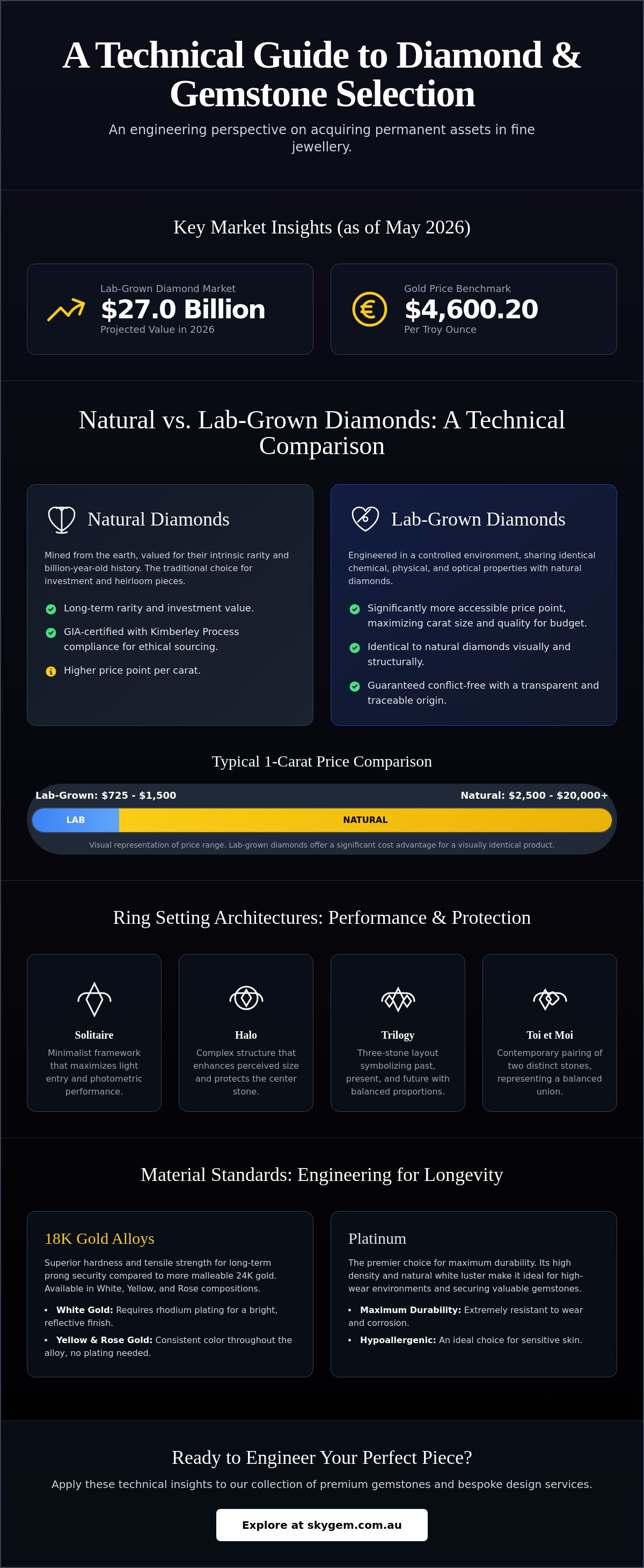
The engagement rings in our collection are defined by their architectural settings. Solitaire designs offer a minimalist framework that maximises light entry, while halo and trilogy settings provide a more complex structural layout. The Toi et Moi style has emerged as a contemporary favourite, representing a balanced pairing of two distinct stones. Beyond engagement, our precious gemstones are set into high-specification pendants, earrings, and diamond tennis bracelets. Our range of ready-to-ship products provides immediate availability for those who require a premium solution without the lead time of a custom build. We also provide both plain and diamond-set wedding bands for men and women, ensuring a seamless fit with the primary ring assembly.
Material Standards: Platinum and 18K Gold
We exclusively use 18K gold and platinum for their superior mechanical properties and longevity. While 24K gold is too malleable for complex settings, 18K gold provides the hardness required for long-term prong security. Platinum, with its high density and hypoallergenic nature, is the preferred choice for maximum durability in high-wear environments. The technical differences between our white, yellow, and rose gold involve specific alloy compositions designed for aesthetic consistency. White gold products require a rhodium plating to maintain their bright finish, whereas yellow and rose gold offer consistent colour through the entire alloy. These material choices aren't just about appearance; they're about future-proofing your investment against the rigours of daily wear. By selecting materials with high tensile strength, we ensure that your jewellery remains a permanent and evolving asset.
Evaluating Gemstone and Diamond Quality in Our Products
The technical evaluation of a gemstone is a process that prioritises empirical data over subjective appeal. When assessing jewellery products, we look at the intersection of chemical purity and light performance. Every stone in our inventory undergoes a rigorous verification process to ensure it meets our architectural standards. We don't just look for visual brilliance; we analyse the structural integrity and sourcing ethics of each piece. This methodical approach ensures that the final product serves as a reliable asset. While aesthetic preference is personal, the quality of the materials is a matter of technical compliance. By adhering to the 2026 Kimberley Process standards, we provide full digital traceability for our diamond collection, ensuring that our sourcing remains as transparent as the stones themselves.
Lab-Grown vs. Natural Diamonds: A Technical Comparison
Lab-grown and natural diamonds share identical chemical, physical, and optical properties. Both consist of carbon atoms arranged in a cubic crystal structure, making them indistinguishable to the naked eye. The primary differentiator lies in their value proposition and rarity. As of May 2026, a 1-carat natural diamond typically ranges from $2,500 to over $20,000, depending on its technical grade. In contrast, a lab-grown 1-carat diamond is significantly more accessible, costing between $725 and $1,500. This allows for a significant increase in carat weight or clarity for the same budgetary allocation. While lab-grown stones offer excellent cost-efficiency, natural GIA-certified diamonds remain the preferred choice for those seeking long-term rarity and investment value. Read our comprehensive guide to lab-grown diamonds to understand which option fits your project requirements.
Rare Coloured Gemstones: Sapphires, Rubies, and Emeralds
Our coloured gemstone collection focuses on unheated varieties that retain their natural geological characteristics. Australian sapphires, particularly teal and peach varieties, are prized for their unique dichroism and local provenance. Identifying quality in these stones requires an understanding of crystal clarity and saturation levels. Unheated rubies and sapphires represent the pinnacle of our range because they've not been subjected to thermal management to enhance their colour. This lack of treatment makes them significantly rarer than their heated counterparts. When selecting these stones, it's vital to reference GIA data to confirm the absence of artificial enhancements. You can explore our unheated ruby and sapphire price guide for a technical breakdown of how treatment affects market value. For those interested in expanding their portfolio, we invite you to browse our precious gemstone collection for current availability. Proper care is also essential for preserving these assets; following expert jewelry maintenance tips ensures your gemstones maintain their brilliance for decades.
Selecting the Perfect Ring Architecture and Style
The structural design of a ring serves as the primary framework for its photometric performance. When you evaluate various jewellery products, you aren't just choosing a style; you're selecting a technical assembly that dictates how light interacts with the centre stone. A well-engineered setting balances the security of the gemstone with the need for maximum light entry. As of 2025, rings account for 34.8% of the global jewellery market share, reflecting their status as the most significant category for both personal expression and long-term asset value. Choosing the right architecture requires an understanding of how physical proportions influence the brilliance of the stone. We prioritise designs that offer a stable foundation while maintaining a sophisticated aesthetic that bypasses fleeting trends in favour of architectural permanence.
The Solitaire and Halo: Classic Brilliance
The solitaire engagement ring remains the gold standard for diamond-centric designs. Its minimalist structure uses a four or six-prong assembly to elevate the stone, allowing for 360-degree light exposure. This maximises the stone's fire and scintillation. In contrast, halo settings utilise a perimeter of smaller diamonds to enhance the perceived size of the centre stone. While a halo offers a bolder visual profile, it requires precise metalwork to ensure the smaller pavé stones remain secure. Both styles require a focus on prong integrity; we ensure that the metal thickness is sufficient to withstand the rigours of daily wear without obstructing the gemstone's natural brilliance.
Trilogy and Toi et Moi: Symbolic Design
Multi-stone settings like the trilogy ring offer a complex narrative through their "Past, Present, Future" arrangement. These engagement rings require careful balancing of stone proportions to maintain a cohesive look. The rise of Toi et Moi designs has introduced a more contemporary aesthetic, often pairing a natural diamond with a vibrant Australian sapphire. This style relies on the contrast between two distinct stone shapes or colours. From a technical standpoint, multi-stone products demand higher precision in the casting process to ensure all stones are set at identical depths. This alignment is crucial for maintaining a symmetrical profile and preventing uneven wear on the metal over time. We focus on these granular details to ensure your ring remains a durable and evolving asset.
Selecting a style is a decision that should look ahead to the next several decades. While bold, sculptural designs are trending in 2026, the intersection of engineering and elegance is what provides lasting value. Whether you're considering a teal sapphire or a GIA-certified diamond, the architecture must support the stone's unique requirements. We act as your technical consultant during this process, ensuring your chosen product meets both your aesthetic goals and our rigorous standards for structural excellence.
Bespoke Design vs. Ready-to-Ship Products
Deciding between a custom build and a curated inventory piece is a critical step in the procurement process. The global jewellery market is projected to reach $254.13 billion in 2026, with a compound annual growth rate of 5.41%. This growth is heavily driven by a demand for personalisation and technical transparency. Bespoke design provides a solution for clients who require specific technical parameters, such as a particular depth ratio for an unheated teal sapphire or a specific metal alloy for a trilogy setting. In contrast, ready-to-ship products offer immediate availability, which is essential for time-sensitive milestones. While the bespoke process involves a longer lead time, it ensures that every architectural detail aligns with your project's unique requirements.
The Custom Design Journey
The custom journey begins with a technical consultation where we establish the primary specifications. We use Computer-Aided Design (CAD) to create a digital prototype, allowing for precise adjustments to the metalwork and stone seating before any casting occurs. This phase is vital for ensuring the structural integrity of the final piece. You have complete control over the stone selection, choosing from our inventory of natural GIA-certified diamonds or rare Australian sapphires. Learn more about our bespoke engagement ring process to understand how we integrate engineering excellence into every custom project. This methodical approach transforms a conceptual idea into a permanent asset, backed by the 2026 Kimberley Process focus on digital traceability.
Ready-to-Wear: Curated Excellence
Ready-to-wear collections represent our signature design standards in a finished format. These pieces are ideal for clients who prefer to evaluate the photometric performance and physical proportions of a ring in person before committing to a purchase. Choosing from our finished stock ensures that the jewellery has already passed our rigorous quality control inspections and is ready for immediate dispatch across Australia. If your timeline doesn't allow for a multi-week manufacturing cycle, these curated items provide a high-level solution without compromise. You can browse our full range of ready-to-ship jewellery products to find a piece that meets our strict performance criteria. For those seeking a unique architectural layout, we suggest exploring our custom-made engagement ring services to begin your design consultation.
Maintenance and Longevity of Your Jewellery Products
Maintaining a high-calibre jewellery piece requires a transition from aesthetic appreciation to technical asset management. Protecting your investment involves a structured maintenance schedule that addresses the mechanical wear and tear of daily use. While we engineer our jewellery products for maximum durability, the physical reality of metal-on-metal contact and chemical exposure necessitates regular professional intervention. Future-proofing your collection isn't just about cleaning; it's about preserving the structural integrity of the setting to prevent gemstone loss. We view our relationship with clients as a long-term technical partnership, providing the expertise required to ensure each piece remains a permanent asset for generations.
Prong tightening is the most critical aspect of regular maintenance. Over time, the metal prongs that secure your centre stone can shift or wear down due to friction. We recommend a professional inspection every six to twelve months to check for "stone rattle" or thinning metal. For daily-wear items like engagement rings, this proactive approach is essential. Home care also varies significantly depending on the gemstone's physical properties. While diamonds are the hardest natural substance and can withstand most mild detergents, emeralds require far more delicate handling. Because emeralds are often treated with natural oils to fill internal fissures, they should never be placed in ultrasonic cleaners or exposed to high heat, which can strip the oils and compromise the stone's stability.
Professional Restoration Services
Our restoration services focus on returning your product to its original engineering specifications. This includes professional metal polishing to remove surface abrasions and rhodium replating for white gold items to restore their high-reflectance finish. Resizing is another technical process we manage with precision, ensuring the shank's structural strength isn't compromised during the adjustment. For those with GIA-certified diamond rings, maintaining the metalwork is vital to keeping the stone secure within its intended architectural framework. We also specialise in restoring heirloom pieces, using modern techniques to stabilise aged settings while preserving their historical character.
Final Selection Checklist
Before finalising your acquisition, it's important to verify the technical data associated with your chosen piece. A rigorous final check ensures the product meets all regulatory and quality standards. Use the following criteria as your guide:
- Certification: Ensure natural diamonds are accompanied by a GIA report to verify their 4Cs and origin.
- Metal Purity: Confirm the presence of 18K or Platinum hallmarks, indicating compliance with high-grade metallurgical standards.
- Artisan Hallmarks: Look for the maker's mark as a signature of local craftsmanship and accountability.
- Sizing Accuracy: Verify the internal diameter for a secure fit that prevents unnecessary mechanical stress on the band.
Selecting a piece from our collection is the beginning of a decade-long journey of ownership. Whether you've chosen a bespoke build or a signature design, our commitment to quality remains constant. You can view our complete collection of handcrafted jewellery products to find a piece that aligns with your requirements for both beauty and engineering excellence.
Securing Your Legacy with Architectural Precision
Selecting a permanent asset requires a technical understanding of material performance and structural design. You now have the framework to evaluate the photometric brilliance of various settings and distinguish between the market value of lab-grown and GIA-certified natural diamonds. These insights allow you to navigate our collection with the confidence of a technical consultant. By focusing on ethically sourced gemstones and Australian-led design, you're investing in a piece that adheres to the 2026 digital traceability standards established by the Kimberley Process.
Our focus remains on the intersection of engineering excellence and architectural aesthetics. Whether you're selecting from our ready-to-ship inventory or commissioning a bespoke build, our artisan hand-finished settings provide the durability required for daily wear. Maintaining these jewellery products through regular prong inspections ensures their longevity as a multi-generational asset. We invite you to explore our full collection of premium jewellery and gemstones to find a piece that meets your rigorous standards. We're ready to assist you in selecting a design that balances technical precision with quiet confidence.
Frequently Asked Questions
What is the difference between a solitaire and a halo engagement ring?
A solitaire setting prioritises the light entry of a single gemstone, whereas a halo setting incorporates a perimeter of smaller stones to enhance the perceived diameter of the centre piece. The solitaire's four or six-prong architecture allows for maximum photometric performance. In contrast, the halo provides a more complex structural layout that offers additional protection for the centre stone's girdle while creating a bolder visual profile.
Are lab-grown diamonds considered real diamonds in your product range?
Lab-grown diamonds are chemically, physically, and optically identical to natural diamonds. They consist of a carbon crystal structure that matches the geological properties of stones mined from the earth. Within our range of jewellery products, we treat lab-grown stones with the same engineering standards as natural diamonds. This ensures you receive a stone with high luminous efficacy regardless of its origin.
How long does the bespoke jewellery design process typically take?
The custom manufacturing cycle usually spans four to six weeks from the finalisation of the CAD design. This timeline allows our artisans to source specific loose gemstones and complete the precision metalwork required for a high-calibre setting. Timeframes can vary based on the complexity of the architectural assembly or the rarity of the stones required for the project.
Do all your diamond products come with GIA certification?
All natural diamonds in our inventory are accompanied by a Gemological Institute of America (GIA) report. This certification provides an empirical breakdown of the stone's 4Cs and ensures full digital traceability. For lab-grown stones, we provide reports from recognised laboratories like GIA or IGI to confirm the stone's technical specifications and ethical sourcing.
Can I choose a specific Australian sapphire for a custom ring?
You have the opportunity to select a specific loose Australian sapphire from our inventory of teal, peach, and unheated varieties. Choosing your stone allows for complete control over the dichroism and saturation levels of the final piece. We act as a technical consultant during this selection, helping you understand how different cuts influence the stone's brilliance within a bespoke setting.
What is the best metal for a daily-wear engagement ring?
Platinum and 18K gold are the most reliable materials for daily-wear items due to their high tensile strength. Platinum is particularly favoured for its density and hypoallergenic properties; it doesn't lose metal over time when scratched. 18K gold provides the necessary hardness to secure gemstone prongs, ensuring the structural integrity of the ring remains intact across decades of use.
How do I care for my emerald or ruby jewellery products at home?
Emeralds require gentle cleaning with lukewarm, soapy water and a soft brush; you should never use ultrasonic cleaners because they can damage the stone's natural oils. Rubies are significantly harder and more resilient, but they still benefit from regular professional inspections. Maintaining your products involves avoiding harsh chemicals that can degrade the metal alloys or compromise the security of the gemstone settings.
Do you offer ready-to-ship products for last-minute gifts?
We maintain a curated selection of finished pieces available for immediate dispatch across Australia. These ready-to-ship items have already passed our rigorous quality control protocols and are ideal for time-sensitive requirements. Each piece in this collection meets our high standards for artisan craftsmanship, providing a premium solution without the lead time of a custom-designed project.
Disclaimer
This article is for general informational purposes only and may include AI-assisted content. Pricing, specifications, and availability are subject to change. For accurate advice and current information, please contact SkyGem & Co. directly. Nothing in this content constitutes professional or financial advice.