
Engagement Ring Guide: How to Choose Your Perfect Ring

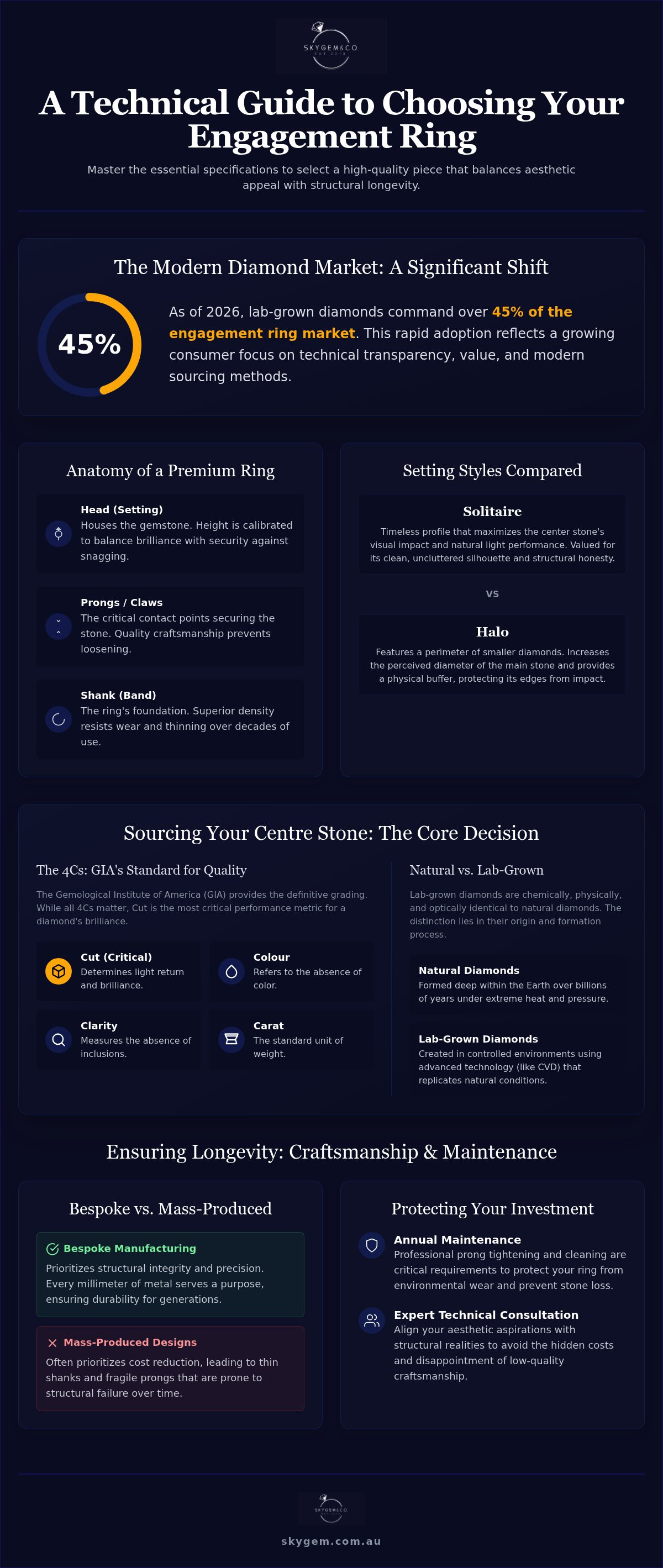
Did you know that lab-grown diamonds now account for over 45% of the market for engagement rings as of 2026? This rapid adoption reflects a broader shift toward technical transparency and value, yet it often leaves buyers feeling caught between conflicting marketing claims and complex pricing structures. Selecting a ring is more than a romantic gesture; it's a significant acquisition of a technical asset that requires a balance of aesthetic appeal and structural longevity.
It's natural to feel a sense of anxiety regarding the durability of modern settings or the true quality of a stone behind its certification. You deserve a clear, expert perspective that prioritizes education over high-pressure sales tactics. This guide will help you master the essential technical specifications required to choose a high-quality piece, ensuring your selection remains a permanent and evolving asset for generations to come. We will analyze the nuances of diamond certifications, compare the performance of various metal alloys, and provide a methodical framework for selecting a ring that meets both your financial and design requirements.
Key Takeaways
- Understand the technical distinctions between GIA certified natural diamonds and lab-grown options to ensure transparency in stone procurement.
- Evaluate the metallurgical properties of 18K gold and platinum to establish a durable foundation that secures your centre stone for the long term.
- Learn how the bespoke manufacturing process for engagement rings prioritizes structural integrity and precision over the shortcuts often found in mass-produced designs.
- Identify why annual maintenance, such as professional prong tightening, is a critical requirement for protecting your investment from environmental wear.
- Utilize expert technical consultations to align your aesthetic aspirations with structural realities, avoiding the hidden costs of low-quality craftsmanship.
Understanding the Fundamentals of Engagement Ring Design
Engagement rings are often viewed through a lens of sentimentality, yet their true value lies in the intersection of heritage and engineering. While the history of engagement rings spans centuries of cultural evolution, modern manufacturing focuses on the technical precision required to ensure a piece lasts for generations. A well-designed ring isn't merely a decorative accessory; it's a structural assembly designed to protect a high-value gemstone against the rigors of daily life. Choosing the right design requires a methodical approach that balances your aesthetic vision with the physical realities of metal stress and stone security.
Technical precision in the initial design phase is the most effective way to prevent future structural failure. Many mass-produced pieces prioritize weight reduction to lower costs, which often results in thin shanks and fragile prongs. We view the design process as a technical consultation where every millimetre of metal serves a specific purpose in the ring's overall integrity. By understanding the mechanical properties of your chosen setting, you can select a piece that accommodates your lifestyle without compromising on elegance.
The Anatomy of a Premium Engagement Ring
To understand the longevity of a piece, you must first recognize its primary components. The shank (the band) provides the structural foundation, while the head (the setting) houses the gemstone. The prongs or claws are the critical points of contact that secure the stone. High-quality rings utilize metals with superior density to resist thinning over time, and the height of the setting is carefully calibrated. A higher setting may increase diamond brilliance by allowing more light to enter the pavilion, but it also increases the risk of snagging during daily activities.
Solitaire vs. Halo: Aesthetic and Functional Differences
The choice between different engagement rings often comes down to the Solitaire and Halo configurations. A Solitaire Engagement Ring offers a timeless profile that maximizes the visual impact of the centre stone. This design is ideal for those who prioritize the diamond's natural light performance and want a clean, uncluttered silhouette. It's a choice that values simplicity and structural honesty.
Conversely, a Halo Engagement Ring features a perimeter of smaller diamonds surrounding the centre stone. From a technical standpoint, the halo serves two purposes: it increases the perceived diameter of the centre stone and provides a physical buffer that protects the edges of the main diamond from impact. When selecting between these styles, consider your daily environment. A six-prong solitaire offers maximum security for the stone, while a four-prong setting allows for a more open view of the diamond's profile. Your final decision should reflect a balance between the visual impact and the practical requirements of long-term wear.
Diamonds and Gemstones: Sourcing Your Centre Stone
The selection of a centre stone represents the most significant technical decision in the assembly of high-quality engagement rings. In 2026, the landscape of diamond sourcing has shifted significantly, with lab-grown options now accounting for over 45% of the engagement ring market. Regardless of origin, the Gemological Institute of America (GIA) remains the definitive authority for stone grading. Their guide to buying a diamond provides the essential baseline for evaluating the 4Cs: Cut, Colour, Clarity, and Carat weight. From a technical perspective, the Cut grade is the most critical performance metric. It determines the light return and overall brilliance of the stone, directly impacting its visual presence.
Evaluating stones through a technical lens requires looking beyond the certificate. While Carat weight is a measure of mass, the physical dimensions and proportions of the stone dictate how large it actually appears. For instance, oval diamonds, which were chosen by 25% of couples in 2025, often offer a larger surface area than round diamonds of the same weight. This efficiency in design allows for a more impactful aesthetic without increasing the stone's depth or mass.
Natural vs. Lab-Grown Diamonds: A Technical Comparison
Lab-grown diamonds are chemically, physically, and optically identical to their natural counterparts. They are typically created through Chemical Vapour Deposition (CVD), a process that replicates the extreme conditions of the earth's mantle. While wholesale prices for lab-grown stones decreased by approximately 74% between 2020 and 2025, they remain a high-performance choice for those prioritizing clarity and size within a specific budget. Conversely, natural GIA certified diamonds are valued for their geological rarity and historical value retention. To analyze these differences in detail, you can use our Ringbuilder tool to compare real-time specifications and certifications.
The Allure of Coloured Gemstones: Sapphires, Rubies, and Emeralds
While diamonds are the traditional choice, there is a growing demand for unique alternatives like Australian Sapphires. These stones are prized for their unique teal and peach hues, offering a distinct aesthetic that deviates from standard white stones. For those seeking maximum rarity, unheated rubies represent a premium choice. Their colour is entirely natural and hasn't been enhanced by thermal treatment, which significantly increases their investment potential. Emeralds offer a vibrant green alternative, though they require specific technical considerations. Due to their natural inclusions, emeralds have lower resistance to impact than sapphires or diamonds, necessitating a protective setting such as a bezel or a heavy prong configuration. You can explore our curated selection of Precious Gemstones to understand how different mineral properties influence the longevity of your design. If you're unsure which stone aligns with your lifestyle, our team is available to provide a detailed technical consultation on diamond sourcing.
Selecting the Metal: Durability and Aesthetic Harmony
The choice of metal is the primary engineering decision that determines the structural lifespan of engagement rings. While the visual appeal is immediate, the metallurgical properties of the alloy dictate how the piece will withstand mechanical stress over decades. Platinum and 18K gold are the industry standards, each offering distinct advantages in terms of density, tensile strength, and chemical stability. Selecting a metal isn't just about colour; it's about establishing a reliable foundation for the centre stone you've carefully sourced.
While aesthetic preferences often lead the selection process, the long-term integrity of engagement rings depends on the density and hardness of the chosen alloy. A metal's ability to hold its shape under pressure ensures that prongs remain secure and the shank resists deformation. This structural stability is essential for protecting your investment and ensuring the ring remains a permanent asset rather than a one-off purchase that requires frequent structural repair.
Platinum vs. White Gold: The Professional Verdict
Platinum is the superior choice for those prioritizing maximum density and a naturally white hue. Unlike other metals, platinum doesn't lose mass when scratched; instead, the metal is displaced, creating a "patina" effect that many collectors value for its historical character. It's also inherently hypoallergenic, making it the safest option for sensitive skin. Conversely, 18K white gold achieves its appearance through an alloy of pure gold and white metals like palladium, finished with a rhodium plating. This plating provides a brilliant, mirror-like finish but requires periodic maintenance to prevent the underlying yellowish tint from surfacing. For a deeper analysis of these materials, you can consult The Definitive Guide to Gold Jewellery, which explores purity and investment value in detail.
Rose and Yellow Gold: Warmth and Tradition
Rose and yellow gold offer different technical advantages, particularly when matching a metal to a specific gemstone. Rose gold derives its pink hue from a higher concentration of copper in the alloy. This addition increases the metal's hardness, though it's important to verify skin compatibility if you have copper sensitivities. Yellow gold remains a timeless standard, particularly for high-contrast designs. From a technical perspective, yellow gold claws can be used strategically to mask lower colour grades in diamonds. If a stone has a slight tint, such as a J or K grade on the GIA scale, setting it in yellow gold makes the diamond appear whiter by comparison. The warmth of the metal absorbs the stone's internal yellow hues, creating a more harmonious visual profile and allowing for a balance between stone size and colour grade.
The Bespoke Journey: Designing a Custom Engagement Ring
The transition from selecting a centre stone to finalising the setting marks the beginning of the bespoke journey. Unlike mass-produced engagement rings, which are often cast in bulk to fit generic stone sizes, bespoke manufacturing ensures the metal is engineered specifically for the individual properties of your diamond or gemstone. This precision is vital for maintaining structural integrity and achieving a seamless aesthetic. We treat the design phase as a technical partnership. Our role is to act as a consultant, ensuring your budget is allocated effectively toward high-performance materials and expert craftsmanship. By procuring your loose stone first, you allow the setting to be built with exact tolerances, which is a significant advantage over pre-set retail options.
Choosing a custom build allows you to bypass the compromises of "off-the-shelf" jewellery. In a technical consultation, we align your design aspirations with the mechanical realities of the materials. This process ensures that the finished piece isn't just visually stunning but is also capable of withstand the rigors of daily wear. It's a methodical approach that prioritises long-term viability over the convenience of a quick purchase.
From Concept to CAD: Visualising Your Design
Modern jewellery design relies heavily on Computer-Aided Design (CAD) to bridge the gap between abstract inspiration and physical reality. This technology allows us to create a precise 3D model that accounts for every technical specification, from the exact width of the shank to the placement of hidden gallery stones. Reviewing these renders is a non-negotiable step in the process. It provides a methodical way to verify the ring's proportions and security before any metal is cast. This phase is where we translate your aesthetic vision into a structurally sound reality, identifying any potential mechanical weaknesses before the manufacturing begins.
The Manufacturing Process: Setting and Finishing
Once the design is finalised, the piece moves into the manufacturing phase, where the difference between mass-casting and hand-finishing becomes apparent. High-level finishing involves a multi-stage polishing process that removes microscopic imperfections, ensuring a mirror-like surface that lasts. Expert stone setting is equally critical. Each prong must be hand-adjusted to the specific dimensions of the stone to guarantee long-term security. This level of detail is rarely found in mass-produced products, where stones are often forced into pre-made settings that may not offer a perfect fit. You can learn more about our Custom Made Engagement Rings process to see how these technical steps ensure a unique and durable result. If you're ready to begin your project, our specialists can help you start a bespoke design consultation today.
Ensuring Longevity: Quality Standards and Maintenance
The acquisition of a high-quality piece is only the first step in a multi-generational journey. To maintain the structural integrity of engagement rings, owners must view their purchase as a permanent asset that requires consistent stewardship. While mass-market retailers often promise lifetime coverage, these claims rarely address the underlying metallurgical fatigue that occurs with daily wear. The hidden costs of lower-quality rings typically manifest after several years of ownership, appearing as thinned shanks or lost accent stones due to insufficient metal density. Investing in a bespoke, technically sound design from the outset reduces these long-term repair liabilities and ensures the setting remains secure.
Professional maintenance is a critical requirement rather than an optional service. We recommend an annual inspection where a jeweller performs a methodical prong tightening and a structural check of the entire setting. This preventative measure ensures that the mechanical grip on your centre stone remains within the original design tolerances. While home care with mild detergents is effective for removing surface oils, it can't replace the efficacy of a professional ultrasonic cleaning. These machines use high-frequency sound waves to remove compacted debris from the pavilion and gallery, areas that are inaccessible to manual cleaning. Maintaining these internal surfaces is essential for preserving the diamond's light performance and brilliance.
The Importance of Professional Resizing and Repair
Resizing is a complex metallurgical process that requires precise thermal control and an understanding of metal stress. DIY sizing methods fail to account for the knuckle's width or the finger's daily volume fluctuations, leading to an improper fit that increases wear on the shank. A professional jeweller uses calibrated tools to ensure a precise measurement. It's particularly important to understand the technical risks associated with resizing complex pavé settings. Altering the diameter of a band set with small diamonds changes the arc of the metal; this can compromise the tension holding those stones in place. In many cases, a full rebuild of the shank is the only way to maintain the ring's structural safety during a significant size change.
Insurance and Valuation: Protecting Your Investment
Protecting your investment involves formalising its value through an independent valuation. This document is essential for all engagement rings, providing a detailed technical record of the stone's GIA specifications and the metal's purity. You should distinguish between retail replacement value and market value when discussing coverage with your insurer. A comprehensive valuation ensures that, in the event of loss, your piece can be reconstructed to its exact original specifications. For a deeper look at managing your jewellery assets and understanding regional standards, our Engagement Rings Guide provides further insights into long-term maintenance and professional appraisal standards.
Securing Your Legacy through Technical Excellence
Selecting a ring is a sophisticated engineering project that requires a methodical approach to material selection and structural design. By prioritizing GIA certified diamonds and high-density alloys like platinum, you establish a foundation that withstands the rigors of daily wear. The bespoke process further ensures that engagement rings are built to the exact specifications of their centre stones, resulting in a piece that is as structurally sound as it is visually striking.
Our team acts as technical consultants to help you navigate these complex decisions with transparency and precision. We offer expert GIA-certified diamond consultations and include bespoke CAD design services to help you visualize every detail before manufacturing begins. Our reputable worldwide stone sourcing network allows us to procure high-performance materials tailored to your specific budget. You can book a technical consultation for your bespoke engagement ring to start your project with expert guidance. With a focus on technical integrity and aesthetic heritage, you're well-equipped to create a permanent asset that will be cherished for generations.
Frequently Asked Questions
How much should I spend on an engagement ring in Australia?
Budget should be determined by your personal financial objectives and the technical specifications of your desired design rather than outdated social rules. While market data from 2026 indicates an average spend between $5,500 and $6,500 in some regions, we focus on allocating your specific budget toward high-performance stones and structural integrity. A technical consultation helps identify where to prioritize spending, whether on carat weight or diamond clarity.
Are lab-grown diamonds "real" diamonds?
Lab-grown diamonds are physically, chemically, and optically identical to natural diamonds. They're created using advanced technological processes like Chemical Vapour Deposition (CVD) that replicate the natural crystallization of carbon. Because they possess the same crystal structure and hardness of 10 on the Mohs scale, they're recognized as authentic diamonds by all major gemological laboratories and are a high-performance choice for engagement rings.
What is the most durable metal for an engagement ring?
Platinum is the most durable metal for a ring intended for long-term daily wear. Its superior density and tensile strength make it highly resistant to thinning over time. Unlike gold alloys, platinum doesn't lose metal when scratched; the metal is simply displaced on the surface. This property ensures the structural integrity of the prongs remains intact, providing the highest level of security for your centre stone.
How long does the bespoke design process take?
The bespoke design process generally requires four to eight weeks from the initial technical consultation to the final quality inspection. This timeframe accounts for the procurement of specific loose stones, the development of precise CAD models, and the meticulous hand-finishing of the setting. Complex designs or the sourcing of rare Australian sapphires may extend this duration, so we recommend starting the project well in advance of your deadline.
Can I use a coloured gemstone for an engagement ring?
Coloured gemstones such as Australian sapphires and rubies are excellent, high-durability alternatives to traditional diamonds. Sapphires and rubies rank 9 on the Mohs scale, making them suitable for the mechanical stresses of daily life. Choosing a teal or peach sapphire allows for a unique aesthetic while maintaining the structural standards required for engagement rings. We prioritize unheated stones to ensure natural colour stability and long-term value.
What is GIA certification and why do I need it?
GIA certification is an independent grading report that verifies the technical specifications of a diamond, including its 4Cs. You need this documentation to ensure transparency and to confirm that the stone's quality matches its price. Without a GIA report, you're relying on the seller's subjective assessment, which lacks the regulatory adherence and global recognition of the Gemological Institute of America.
How do I find my partner’s ring size without them knowing?
You can find your partner's ring size by tracing the internal diameter of a ring they currently wear on their ring finger. Alternatively, you can use a digital caliper to measure the internal width for a more precise reading. If a ring isn't available, we suggest designing the piece with a standard size and utilizing our professional resizing services after the proposal to ensure a perfect, structurally sound fit.
Is platinum better than white gold for a daily-wear ring?
Platinum is technically superior to white gold for daily wear because it's inherently white and doesn't require rhodium plating. White gold is an alloy that naturally possesses a yellowish tint, necessitating periodic maintenance to restore its mirror-like finish. Platinum's higher density also provides a more substantial feel and better resistance to the environmental wear that occurs over decades of continuous use.
Disclaimer
This article is for general informational purposes only and may include AI-assisted content. Pricing, specifications, and availability are subject to change. For accurate advice and current information, please contact SkyGem & Co. directly. Nothing in this content constitutes professional or financial advice.