
Diamond Tennis Bracelets: The 2026 Definitive Guide to Quality and Design

A high-quality diamond tennis bracelet is less a piece of jewellery and more a feat of precision engineering, where fifty or more individual articulation points must function in perfect unison. You likely understand that a single weak link or a poorly tensioned prong can result in the loss of a stone, a concern that frequently overshadows the excitement of a new acquisition. Whether you're weighing the long-term value of natural GIA-certified diamonds against the accessibility of lab-grown alternatives, the technical specifications of the setting are what truly determine the piece's longevity.
This guide provides the technical framework needed to master the nuances of these iconic pieces, ensuring your selection is defined by both structural integrity and brilliance. We'll analyse the "Four Cs" specifically through the lens of bracelet symmetry and examine the engineering behind secure clasp mechanisms. By the end of this analysis, you'll have the confidence to choose a design that balances luxury with everyday viability, backed by an understanding of 2026 manufacturing standards and precise wrist-fit metrics.
Key Takeaways
- Understand the engineering requirements that transitioned the classic eternity line into the modern, secure silhouette defined by high-performance articulation.
- Learn why colour and clarity consistency across the entire parcel is more critical to the aesthetic of diamond tennis bracelets than the individual grade of a single stone.
- Evaluate the physical identity and value propositions of natural and lab-grown diamonds to determine which asset aligns with your long-term goals.
- Master the one-finger rule for optimal wrist fit and identify the triple-lock clasp mechanisms required for daily security and structural longevity.
- Discover how bespoke manufacturing provides total control over diamond matching, ensuring a level of structural integrity that mass-produced settings often lack.
Defining the Diamond Tennis Bracelet: Anatomy and Heritage
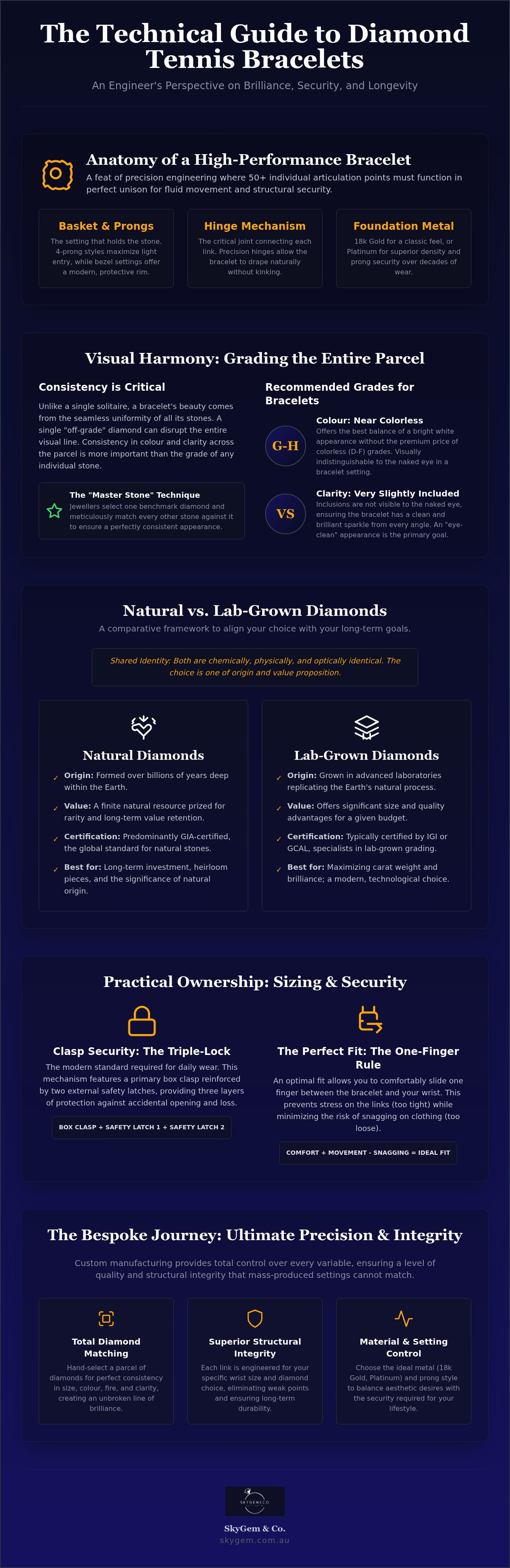
The diamond tennis bracelet is an architectural achievement in fine jewellery. While many perceive it as a simple row of stones, it is actually a complex series of articulated joints designed for both fluid movement and structural security. The origin of the tennis bracelet is famously traced back to the 1987 US Open. During a high-stakes match, professional player Chris Evert stopped play to recover her diamond bracelet after the clasp failed. This event didn't just give the piece its name; it fundamentally changed how manufacturers approach clasp security and link durability. Today, these bracelets are considered essential because they bridge the gap between high-investment luxury and functional, daily wear.
To understand the quality of diamond tennis bracelets, one must look at the individual link anatomy. Each unit consists of a basket to hold the stone, prongs to secure it, and a hinge mechanism that connects to the adjacent link. High-quality engineering ensures that these hinges allow the bracelet to drape naturally over the wrist without kinking or showing gaps in the metal. When these components are manufactured with precision, the result is a piece that feels like a second skin.
The Evolution of the In-Line Bracelet
Originally known as eternity bracelets or line bracelets, these pieces were once reserved for formal evening attire. Modern manufacturing has shifted this paradigm. Advances in CAD design and precision casting have allowed for thinner, more resilient links that offer greater flexibility than vintage counterparts. This evolution has transformed the piece into an elevated luxury staple. It's now common to see them paired with casual wear, providing a consistent sparkle that doesn't feel out of place in a professional environment.
Core Components of a High-Quality Piece
The choice of metal is the foundation of the bracelet's lifespan. While 18k gold offers a classic, premium feel, platinum provides superior density and prong security. This is vital for protecting a continuous line of stones over decades of wear. Setting styles also impact both aesthetics and safety. A four-prong setting offers maximum light entry for brilliance, while a bezel setting provides a modern, protective rim around each diamond.
Consistency is the final hallmark of quality. Every diamond must be matched for size, colour, and clarity to maintain the visual integrity of the line. For those seeking this level of precision, exploring natural white diamonds or lab-grown white diamonds ensures the parcel is curated for total uniformity. Without this technical matching, the bracelet will appear disjointed or uneven under professional lighting.
Technical Specifications: Diamond Grading and Setting Security
While the history of the tennis bracelet highlights its aesthetic appeal, the technical reality of diamond tennis bracelets lies in the rigorous grading of the entire parcel. Unlike a solitaire ring where a single stone is the focus, a bracelet requires a collective assessment of 50 or more diamonds. Total Carat Weight (TCW) represents the sum of these stones, but it's the individual stone weight that dictates the bracelet's profile and price. For example, a 10-carat natural diamond bracelet of fine jewellery quality, typically featuring VS clarity and G-H colour, carries a significantly different value proposition than a 3-carat piece due to the rarity of larger matched stones.
Structural integrity is measured by the fluidity of the link system. A well-engineered piece should drape without resistance. If the links are too tight, the metal will eventually fatigue and crack; if they're too loose, the bracelet risks catching on fine fabrics. For larger TCW pieces, GIA certification for the individual stones becomes a critical benchmark for verifying that the quality is consistent across the entire length of the asset. This level of verification prevents the inclusion of "off-grade" stones that are sometimes hidden in mass-produced lines.
Achieving Visual Harmony
Expert jewellers utilise the "master stone" technique to match a parcel for a seamless look. This involves selecting a single diamond that serves as the technical benchmark, with every other stone compared against it for colour and fire. G-H colour grades, often classified as near-colourless, provide the best value-to-aesthetic ratio because they appear perfectly white once set in precious metals. Maintaining consistent clarity across the entire parcel is essential because a single stone with a visible inclusion can create a "dead spot" that disrupts the continuous flow of light.
Setting Security and Prong Maintenance
The prong's primary engineering role is to protect the diamond's girdle from lateral impact while maintaining enough tension to prevent rotation. In mass-produced jewellery, prongs are often cast too thin to reduce metal volume, which increases the risk of stone loss during daily activity. Transitioning to a custom-made design approach ensures that each diamond is individually seated in a hand-finished basket. This bespoke precision ensures the prongs are correctly tensioned for long-term durability. Regular professional maintenance, specifically prong tightening and hinge inspection, is required to ensure the piece remains a permanent part of your collection.
Natural vs. Lab-Grown Diamonds: A Comparative Framework
Both natural and laboratory-grown diamonds share an identical chemical, physical, and optical composition. For the purpose of engineering diamond tennis bracelets, both materials offer the same Mohs hardness of 10 and the same refractive index. The primary distinction between the two isn't performance but origin and economic trajectory. While natural diamonds are formed over billions of years, lab-grown stones are cultivated in controlled environments that replicate these geological conditions. Both options are technically suitable for heirloom pieces because they possess the same resistance to scratching and thermal shock. Modern procurement processes for both types have become increasingly transparent, allowing clients to verify the provenance of their stones. This transparency ensures that ethical standards are maintained, whether you choose a stone from a mine or a laboratory.
The choice between the two often comes down to the intended use of the piece. If you're looking for a bracelet that acts as a portable asset, natural diamonds are the standard. If your goal is to maximise visual impact and achieve a specific carat weight on a set budget, lab-grown diamonds provide a clear path forward. Both materials will provide the same timeless brilliance, provided the stones are cut to professional standards.
The Case for Natural Diamonds
Natural stones are defined by their finite supply. This rarity ensures that natural GIA certified diamonds maintain a higher degree of market value retention over generations. For many, the traditional appeal of a mined stone is tied to its status as a unique geological asset. When you're selecting a bracelet for a significant milestone anniversary, the long-term investment profile of natural diamonds often outweighs the initial cost. They remain the preferred choice for those who view jewellery as a store of value that should hold its worth on the secondary market. The prestige of natural stones is also linked to the rigorous grading standards of the GIA, where every stone in a high-TCW natural bracelet represents a rare find.
The Case for Laboratory-Grown Diamonds
The rise of laboratory-grown diamonds has fundamentally changed the accessibility of high-TCW bracelets. Since 2020, wholesale prices for lab-grown diamonds have fallen by approximately 74%, allowing consumers to achieve a 5-carat or 7-carat look for a fraction of the natural diamond price. In 2026, lab-grown stones represent a significant and growing portion of the global fine jewellery market, reflecting a massive shift toward modern innovation. This option allows for superior clarity and colorless grades across the entire bracelet without the premium associated with natural rarity. It's the ideal solution for buyers who prioritise visual impact and the technical precision of a perfectly matched parcel. Because the growth environment is controlled, it's easier to source large quantities of E-F colour diamonds with VS1 clarity, resulting in a bracelet with unmatched fire.
Practical Ownership: Sizing, Security Features, and Maintenance
Practical ownership of diamond tennis bracelets requires a shift from viewing the piece as static jewellery to seeing it as a dynamic mechanical assembly. Unlike a ring, which remains stationary, a bracelet undergoes constant lateral and vertical stress throughout the day. Achieving the correct fit is the first line of defence against mechanical failure. Professionals recommend the "one-finger" rule; you should be able to slide one finger between the bracelet and your wrist without the metal feeling taut. This gap provides enough slack for natural wrist expansion and movement while ensuring the piece doesn't slide far enough down the hand to catch on external objects. While the standard length for these pieces is 7 inches, bespoke adjustments are often necessary to achieve this precise balance of comfort and security.
Maintaining the structural integrity of the links also involves proper storage. You should always store these pieces flat in a lined jewellery box. Hanging a tennis bracelet causes gravity to exert constant pressure on the internal hinge pins, which can lead to link stretching and eventual metal fatigue over several years. This simple habit preserves the original articulation and prevents the hinges from becoming loose or misaligned.
The Anatomy of a Secure Clasp
The security of the piece relies almost entirely on the clasp mechanism. A high-quality triple-lock system features a primary tongue and groove box clasp, reinforced by two figure-eight safety wings on either side. When engaging the clasp, an audible "click" is a vital indicator that the tongue has fully seated within the box. This sound confirms that the internal tension spring is functioning correctly. You can test the tension at home by closing the clasp and safety wings and then applying light, steady pressure to pull the links apart; any visible gap or unseating of the tongue indicates the metal requires professional retensioning.
Professional Restoration and Repair
Resizing these pieces is a complex technical process that involves more than just removing metal. Because each link is an independent unit, a jeweller must carefully deconstruct the hinge mechanism, remove the necessary sections, and then resolder and hand-finish the connection to ensure the drape remains uniform. Regular jewellery repair and maintenance is essential for high-wear items, as it allows for the early detection of worn prongs or thinning hinge pins. Professional ultrasonic cleaning also restores the fluidity of older bracelets by removing microscopic debris that can cause the links to feel stiff or unresponsive. If your piece requires a technical assessment or link adjustment, you can book a professional maintenance service to ensure its long-term viability.
The Bespoke Journey: Designing a Custom Diamond Tennis Bracelet
The transition from a standard acquisition to a bespoke commission is often driven by the need for technical precision that mass production cannot provide. While ready-to-wear options are designed for a statistical average, diamond tennis bracelets created through a bespoke process account for the unique ergonomics of your wrist. This approach eliminates the compromise of a piece that is either too restrictive or prone to excessive movement. By commissioning a custom piece, you gain total control over the diamond parcel, ensuring that every stone meets a specific benchmark for brilliance and fire. This level of curation prevents the subtle "stuttering" effect seen in lower-quality bracelets where stones vary in depth or table percentage.
The SkyGem & Co. process begins with a technical consultation to define the project's parameters, followed by advanced CAD design. This stage allows us to visualise the bracelet's volume and link articulation before a single grain of metal is cast. Whether you're matching the metal alloy to your existing engagement rings or designing a standalone statement piece, this phase ensures the final product integrates seamlessly with your current collection. Our master setters then individually seat each stone, ensuring the prong tension is calibrated for the specific dimensions of your selected diamonds.
Tailoring the Design to Your Lifestyle
Bespoke design allows for the adjustment of the profile height, which is a critical consideration for daily wear. A lower-clearance setting reduces the risk of the bracelet catching on knitwear or bumping against desk surfaces, extending the lifespan of the hinges. For those seeking a departure from the traditional monochromatic line, incorporating Australian sapphires or other precious gemstones adds a distinctive, personalised element. Selecting the correct metal purity is equally vital for structural longevity; you can find a detailed breakdown of alloy performance in The Definitive Guide to Gold Jewellery. This choice impacts not only the colour but also the long-term wear resistance of the link connections.
Creating a Future Heirloom
Working with a technical consultant rather than a traditional salesperson ensures that the focus remains on the engineering integrity of the piece. Our partnership approach prioritises the long-term viability of the asset, looking ahead to ongoing maintenance and environmental responsibility. Every custom piece undergoes a final quality control check that exceeds standard industry metrics, specifically testing for fluid link movement and stone security under magnification. This rigorous standard ensures that your bracelet isn't just a purchase, but a permanent and evolving asset designed to be worn with confidence for decades. By focusing on quality over hype, the bespoke journey results in a piece that truly defines the pinnacle of modern diamond tennis bracelets.
Securing a Legacy of Brilliance and Structural Integrity
Selecting diamond tennis bracelets is a decision that requires equal attention to gemological excellence and mechanical engineering. The longevity of these pieces depends on the precision of the link articulation and the security of triple-lock clasp systems. Whether you opt for the rarity of natural GIA-certified diamonds or the modern value of lab-grown alternatives, ensuring a consistent parcel and a hand-finished setting is the only way to guarantee a lifetime of wear. Mass-produced alternatives often lack the depth of seating and prong tension required for permanent security.
At SkyGem & Co., we act as your technical consultants throughout the design process. Our expert consultations guide you from initial CAD concepts to the final setting of each stone, ensuring your piece is tailored to your specific ergonomics. Beyond the initial creation, we provide specialised jewellery maintenance and restoration services to preserve the fluidity and safety of your investment. We invite you to Explore Bespoke Diamond Tennis Bracelets at SkyGem & Co. and discover a piece defined by technical precision and timeless brilliance. We look forward to partnering with you on a solution that meets your highest standards.
Frequently Asked Questions
What is a diamond tennis bracelet?
A diamond tennis bracelet is a continuous, symmetrical line of diamonds connected by a flexible precious metal chain. Originally known as an "eternity" or "line" bracelet, it earned its modern name after Chris Evert's bracelet fell off during a professional match. Technically, it consists of individual baskets and articulation points that allow the piece to drape fluidly while maintaining structural integrity. It remains a staple because it combines high-level brilliance with a versatile, low-profile design.
How many carats should a tennis bracelet be for everyday wear?
For everyday wear, a 3-carat total weight is considered the standard for a subtle, professional profile. This size offers enough brilliance to be noticeable without becoming cumbersome or prone to catching on clothing. If you prefer a more pronounced aesthetic, the 5-carat weight is currently the most popular statement size in 2026. This larger weight balances premium luxury with the functional durability required for regular use in various environments.
Is a lab-grown diamond tennis bracelet a good investment?
A lab-grown diamond tennis bracelet is an excellent investment in terms of aesthetic value and cost-efficiency. While natural diamonds hold better resale value on the secondary market, lab-grown stones allow you to achieve a higher clarity and carat weight for a lower initial outlay. Since wholesale prices for lab-grown diamonds have fallen by approximately 74% since 2020, they represent a high-performance choice for those prioritising immediate visual impact and modern innovation.
How should a tennis bracelet fit on my wrist?
The ideal fit follows the "one-finger" rule, where you can comfortably slide one finger between the bracelet and your wrist. This specific clearance prevents the piece from feeling too tight during natural wrist expansion while ensuring it doesn't slide down the hand. A correct fit reduces the mechanical stress on the hinge pins and prevents the links from stretching over time. This balance is vital for both comfort and the long-term viability of the metalwork.
Can I wear my diamond tennis bracelet every day?
Yes, diamond tennis bracelets are engineered for daily wear, provided they feature a high-quality setting and secure clasp. Diamonds have a Mohs hardness of 10, making them highly resistant to scratching. However, you should avoid wearing the piece during high-impact activities or while using harsh chemicals. Regular professional inspections of the prongs and hinges ensure the bracelet remains secure through years of continuous use, maintaining its structural integrity and brilliance.
What is the most secure clasp for a tennis bracelet?
The triple-lock system is the industry standard for maximum security. It consists of a primary tongue-and-groove box clasp reinforced by two figure-eight safety wings on the sides. This redundant safety mechanism ensures that even if the primary clasp is accidentally snagged, the safety wings will prevent the bracelet from falling off. You should always listen for a clear "click" when engaging the primary lock to confirm the internal tension spring is fully seated.
How do I clean a diamond tennis bracelet at home?
To clean your bracelet at home, soak it in warm water mixed with a mild, degreasing dish soap for 20 to 30 minutes. Use a very soft-bristled toothbrush to gently clean the underside of the baskets where oils accumulate. Rinse thoroughly under warm running water and pat dry with a lint-free cloth. Avoid using abrasive cleaners or ultrasonic machines at home, as these can loosen stones if the prongs have experienced any wear or thinning.
Can a diamond tennis bracelet be resized?
Yes, a professional jeweller can resize diamond tennis bracelets by removing or adding individual diamond links. This is a technical process that involves deconstructing the hinge mechanism and resoldering the connections to maintain the original drape. Because each link is an independent unit, resizing requires precision to ensure the metal finish and articulation remain seamless across the entire length. It's often easier to achieve a perfect fit through a bespoke design process from the outset.
Disclaimer
This article is for general informational purposes only and may include AI-assisted content. Pricing, specifications, and availability are subject to change. For accurate advice and current information, please contact SkyGem & Co. directly. Nothing in this content constitutes professional or financial advice.