
Cushion Cut Ruby Engagement Rings: The 2026 Connoisseur’s Guide

The cushion cut isn't just an aesthetic choice; it's a technical strategy to unlock the deepest possible red in a ruby while protecting your investment for a lifetime. Choosing a cushion cut ruby engagement ring requires a balance of gemological precision and design intuition. You probably recognize that rubies offer a bold alternative to traditional diamonds, yet the fear of purchasing an overly-treated stone or a fragile cut remains a valid concern for any serious collector.
Selecting a premium ruby involves understanding how light interacts with its internal crystal structure to maximize color saturation, which accounts for up to 80% of the stone's value. In this guide, you'll discover the technical artistry behind selecting unheated stones and how to navigate the 2026 GIA and SSEF certification standards. We'll examine the rise of blockchain traceability, the durability of Mozambique-sourced rubies, and how to design a bespoke setting that ensures your heirloom remains viable for generations.
Key Takeaways
- Gain technical certainty regarding the durability of Corundum, ensuring your selection withstands the rigours of daily wear as a permanent heirloom.
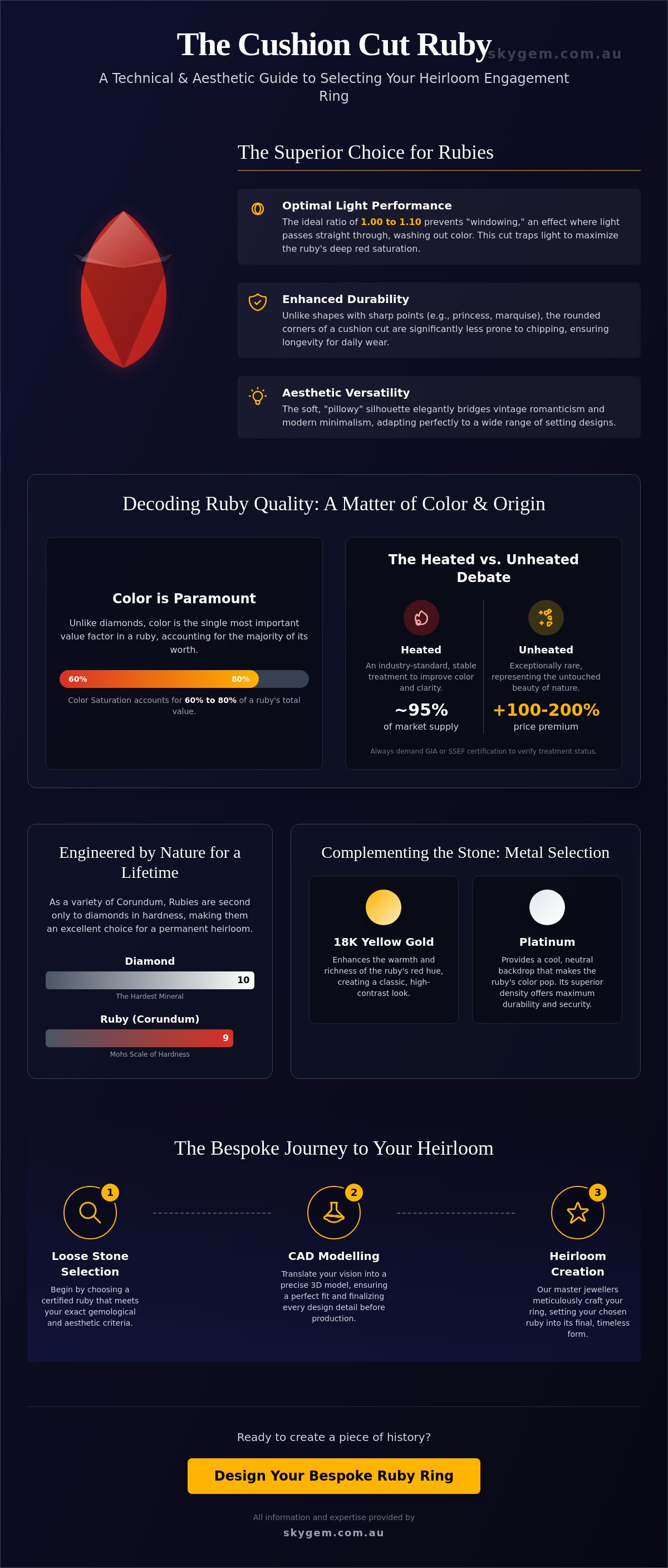
- Identify the critical geometry required for a cushion cut ruby engagement ring, specifically the 1.00 to 1.10 ratio that prevents "windowing" and maintains light saturation.
- Learn how to evaluate colour performance through the lens of pleochroism, ensuring the stone’s hue remains consistent and vibrant from every perspective.
- Compare the aesthetic and structural benefits of 18K yellow gold and platinum to determine which metal best complements the specific saturation of your chosen stone.
- Navigate the bespoke design process from loose stone selection to CAD modelling to achieve a precise fit for non-standard gemstone dimensions.
The Allure of the Cushion Cut Ruby Engagement Ring
The cushion cut represents a sophisticated hybrid of gemological history and modern optical engineering. By blending the high-intensity fire of a round brilliant with the soft, romantic perimeter of the antique "old mine cut," this geometry has become the preferred choice for connoisseurs. A cushion cut ruby engagement ring serves as more than a piece of jewellery; it's a technical solution for displaying the stone's inherent saturation while maintaining structural integrity. Unlike diamonds, where the goal is often to maximize white light return, rubies require a cut that allows light to dwell within the stone to intensify its natural hue.
Technical precision in the cutting process is vital because of the unique Ruby gemstone properties. As a variety of the mineral species corundum, rubies are pleochroic, meaning they exhibit different colours when viewed from different crystallographic directions. A master cutter uses the depth and facet arrangement of a cushion cut to manage these dichroic effects, often masking secondary orangey or purplish tints to prioritize the coveted "Pigeon's Blood" red. This vibrant, pure red with a subtle purplish undertone remains the industry benchmark for value and emotional impact.
Aesthetic Versatility: From Vintage to Modern
The "pillowy" silhouette of the cushion cut bridges the gap between Victorian-era romanticism and the clean lines of contemporary minimalism. It's a versatile geometry that adapts easily to various setting styles. For those seeking a natural ruby with significant presence, the cushion cut is often superior to ovals or pears. Its balanced proportions prevent "dead zones" or uneven colour distribution, ensuring the stone looks substantial on the finger. This shape is particularly effective for larger carat weights, where the soft corners provide a graceful look that doesn't feel overly aggressive or sharp.
Durability for Daily Wear
While diamonds sit at a 10 on the Mohs scale, rubies follow closely at a 9, making them exceptionally suitable for daily wear. However, hardness isn't the only factor in longevity. The physical shape of the gemstone plays a critical role in its survival over decades. The rounded corners of a cushion cut ruby engagement ring offer a distinct structural advantage over shapes with pointed tips, such as the marquise or princess cut. These rounded edges are far less prone to chipping or snagging on clothing. When paired with a secure setting, the cushion cut provides a level of protection that ensures your investment remains a viable heirloom for generations.
Gemological Quality: Colour, Clarity, and Heat Treatment
While the silhouette of a cushion cut ruby engagement ring provides a vintage appeal, its gemological performance is dictated by internal chemistry and light management. Colour isn't a single metric; it's a composite of hue, tone, and saturation. Connoisseurs look for a pure red hue with vivid saturation, avoiding stones that lean too heavily into secondary brown or orange tones. Pleochroism adds a layer of complexity. Because rubies are doubly refractive, they show different shades based on the viewing axis. A precision-cut cushion manages this by orienting the crystal to showcase the most vibrant red through the table, ensuring the stone doesn't appear "flat" from certain angles.
Internal characteristics, or inclusions, in rubies shouldn't be viewed through the same lens as diamonds. In fact, according to the GIA, ruby quality factors are heavily weighted toward how colour and clarity interact. Fine, needle-like rutile inclusions, known as "silk," are often desirable. They serve as a diagnostic feature of natural origin and can actually improve the gemstone's appearance by scattering light across facets, which softens the colour and reduces areas of extinction. Colour accounts for approximately 60% to 80% of a ruby's value, making the management of these internal features critical for the stone's final grade.
The Heated vs. Unheated Debate
Approximately 95% of rubies currently on the market have undergone heat treatment. This is a stable, industry-standard process used to dissolve silk and improve clarity or intensify the red hue. However, an unheated ruby of high quality is exceptionally rare. These stones command a significant price premium, often 100% to 200% higher than heated stones of similar appearance, as they represent the raw, untouched beauty of nature. Verification through a reputable laboratory like the GIA or SSEF is non-negotiable when confirming a stone's thermal history for investment purposes.
Colour Saturation and the Cushion Cut
The technical architecture of the cushion cut is uniquely suited to rubies. Its typically deeper pavilion acts as a light trap, forcing light to bounce internally through the rich red crystal before returning to the eye. This intensifies the saturation. When evaluating a stone, you must look for the balance between brilliance and extinction. Extinction refers to the dark areas where light doesn't return. While some extinction is inevitable in deeply coloured stones, a well-engineered cushion cut ruby engagement ring minimizes these zones to ensure the gem remains lively in all lighting conditions. For a deeper look at how these factors influence market value, you can consult our ruby price guide.
Designing the Setting: Metal Choices and Accent Stones
The engineering of a cushion cut ruby engagement ring requires a deliberate approach to metal selection and structural design. While the gemstone's internal characteristics are paramount, the surrounding architecture dictates how that colour is perceived by the eye. Technical specialists often recommend 18K yellow gold to amplify the warmth and richness of rubies with high saturation. This metal choice works in harmony with the stone's natural red tones, creating a cohesive and traditional aesthetic. In contrast, platinum or white gold creates a high-contrast environment that can make a vivid red ruby appear even more intense and modern. Consulting GIA's guide to ruby quality reveals how specific light environments and metal reflections can shift the perceived hue of the stone.
Securing a cushion cut stone involves more than just aesthetics. Due to the rounded corners and often deep pavilions of these gems, double prongs are a frequent technical recommendation. These provide eight points of contact rather than four, offering a redundancy that protects the stone against heavy impact. This setting style also mimics the vintage look of the Edwardian era, which aligns perfectly with the cushion shape's heritage. When selecting accent stones, the goal is to provide brilliance without distracting from the ruby's depth. Round brilliant diamonds offer maximum fire, while tapered baguettes provide a clean, architectural frame that highlights the ruby's "pillowy" silhouette.
Classic Halo vs. Minimalist Solitaire
A diamond halo is a strategic choice for those wanting to increase the visual footprint of their cushion cut ruby engagement ring. The surrounding diamonds act as a reflective border, drawing light into the centre stone and making it appear larger. For stones of exceptional clarity and saturation, a solitaire engagement ring is the superior option. It allows for unobstructed light entry from the sides, which is essential for showcasing the stone's pleochroism and internal "silk." Choosing between these styles often depends on whether you value a grand, brilliant display or a focused, technical showcase of the gem's quality.
Metal Purity and Longevity
18K gold is the professional standard for high-end ruby settings because it offers the ideal balance of purity and structural strength. While 24K gold is too soft for secure stone retention, 18K gold provides the necessary hardness to keep prongs aligned over decades of use. Platinum is another premium alternative, valued for its density and the fact that it doesn't thin over time. For a deeper understanding of how different alloys affect the longevity and investment value of your piece, read The Definitive Guide to Gold Jewellery. Selecting the right metal is a commitment to the ring's long-term viability as a permanent asset.
Practical Selection Guide: Proportions and Sourcing
Selecting a cushion cut ruby engagement ring requires a meticulous evaluation of proportions that go beyond surface-level aesthetics. The technical benchmark for a well-proportioned cushion is a length-to-width ratio between 1.00 and 1.10. This range ensures the stone maintains its classic "pillowed" silhouette without appearing overly elongated or distorted. When proportions deviate from this standard, the stone often suffers from "windowing," a phenomenon where light passes directly through the centre of the gem rather than reflecting back to the eye. For a pleochroic stone like a ruby, a window doesn't just result in a loss of brilliance; it dilutes the saturation of the red hue, compromising the stone’s primary value driver.
Technical certainty regarding a stone's origin and treatment is achieved through independent certification. As of 2026, verification against the latest GIA and SSEF standards is the industry requirement for any high-value natural ruby. These reports provide a definitive audit of the stone's thermal history and geographical origin. For those balancing aesthetic impact with sustainability, lab-grown rubies offer an identical chemical structure to natural stones at a more accessible price point. However, natural stones remain the gold standard for long-term value retention, particularly when sourced from regions with established ethical frameworks like Mozambique.
Evaluating the Cut Quality
A common pitfall in selecting a ruby is the "lumpy" cut, where excess weight is retained in the pavilion to increase carat weight without adding to the stone's visual face-up size. You should prioritise a stone with excellent symmetry in its facets and edges. This precision ensures that the dichroic colours, the various shades of red and purple inherent in the crystal, are blended harmoniously. In 2026, supply chain transparency is often supported by blockchain traceability, allowing you to verify the journey of your gemstone from the mine to the final setting. If you're ready to begin your selection, you can browse our certified gemstone collection to compare various cut qualities.
Budgeting for a Ruby Engagement Ring
The price of a ruby doesn't increase linearly with size; it grows exponentially. High-quality rubies over 3 carats are exceptionally rare, causing a significant jump in the price per carat. When managing a budget for a cushion cut ruby engagement ring, the professional consensus is to prioritise colour saturation over clarity. A slightly included stone with a vivid "Pigeon's Blood" hue is far more valuable and visually striking than a "clean" stone with a weak or pinkish tone. For a detailed breakdown of market trends and valuation metrics, refer to our Ruby Price Guide.
The Bespoke Journey: Creating Your Heirloom
The technical architecture of a cushion cut ruby engagement ring often necessitates a bespoke approach rather than a prefabricated setting. Because natural rubies are cut to maximise colour retention and weight, their dimensions rarely adhere to the calibrated standards found in mass-produced mounts. A bespoke design ensures that the unique pavilion depth and length-to-width ratio of your specific gemstone are accommodated with precision. Working with a boutique specialist allows for a partnership where technical specifications meet aesthetic goals, ensuring the final piece is both a structural success and a visual masterpiece.
The process begins with the selection of a loose gemstone, allowing you to inspect the stone's pleochroism and saturation without the interference of metal reflections. Once the ruby is selected, the custom-made engagement ring journey moves into the digital design phase. This stage is critical for addressing common engineering challenges, such as ensuring a wedding band can sit flush against the engagement ring. By customising the height of the gallery and the orientation of the prongs, we can create a seamless transition between the engagement ring and a future wedding band, preventing unnecessary wear from metal-on-metal friction.
From CAD Design to Final Polish
Modern jewellery engineering relies heavily on Computer-Aided Design (CAD) to provide a 3D rendering of the piece before any metal is cast. This allows you to visualise the proportions of the cushion cut ruby engagement ring from every angle, ensuring the balance between the centre stone and accent diamonds is correct. Following approval, the ring is cast and passed to an artisan for hand-setting. Rubies require a steady hand during this phase; despite their hardness, they can be sensitive to extreme pressure during the prong-folding process. Final quality control involves a rigorous inspection of the stone's security and a professional appraisal to document the gemstone's characteristics for your records.
Long-term Care and Maintenance
Maintaining a ruby heirloom requires a proactive approach to care. While rubies are durable, they can still accumulate oils and debris that dull their natural fluorescence. We recommend a professional cleaning and safety check every six to twelve months to ensure the prongs remain tight and the metal hasn't thinned. For insurance purposes, it's vital to maintain up-to-date documentation that reflects the current market value of your unheated or certified stone. If you're ready to translate your vision into a technical reality, explore our bespoke engagement rings to start your design journey.
Securing Your Gemological Legacy
Investing in a cushion cut ruby engagement ring is a decision that balances technical gemological insight with a commitment to long-term structural integrity. By prioritising the specific length-to-width ratios that prevent windowing and ensuring your stone’s thermal history is verified by GIA or GRS certification, you're selecting an asset that retains its value through the decades. The intersection of a ruby’s intense pleochroism and the cushion cut's light-trapping architecture creates a visual depth that other geometries simply cannot replicate.
Our role is to act as your technical consultant, providing expert guidance on unheated gemstones and bespoke designs tailored to your specific budget. We focus on precision engineering to ensure your setting is as durable as it is striking. Whether you're seeking a rare, unheated natural ruby or a precisely calibrated lab-grown alternative, our approach remains grounded in quality and performance over industry hype. Your journey toward a permanent heirloom starts with a professional partnership dedicated to excellence.
Create Your Bespoke Ruby Engagement Ring and experience the difference of expert craftsmanship.
Frequently Asked Questions
Is a ruby durable enough for an engagement ring?
Yes, rubies are exceptionally durable for an engagement ring, ranking 9 on the Mohs scale of mineral hardness. This makes them the second hardest natural gemstone, capable of withstanding the rigours of daily activities. While diamonds are harder, rubies don't have the same cleavage planes, meaning they're less likely to shatter upon impact. Their robust nature ensures they remain a viable heirloom for multiple generations.
What is the best metal for a cushion cut ruby ring?
18K yellow gold is the technical standard for rubies because its warmth complements the stone's red hue. If you prefer a contemporary aesthetic, platinum is the superior choice for its density and hypoallergenic properties. Platinum's naturally white lustre provides a crisp contrast that can make a vivid red stone appear more intense. Both metals offer the structural integrity required for a high-value gemstone setting.
How can I tell if a ruby is natural or lab-grown?
You can distinguish between natural and lab-grown rubies by examining their internal inclusions under magnification. Natural stones often contain "silk" or microscopic mineral crystals that indicate their deep-earth origin. Lab-grown stones are chemically identical but usually appear too "perfect" or show curved growth lines under a microscope. Relying on independent laboratory certification from the GIA is the most reliable method for verification.
What does "unheated" mean in a ruby engagement ring?
An unheated designation means the gemstone hasn't undergone thermal treatment to improve its clarity or colour saturation. Most rubies on the market are heated to dissolve inclusions, but unheated stones are prized for their natural purity. When selecting a cushion cut ruby engagement ring, an unheated stone acts as a rare investment-grade asset. Its value is significantly higher due to its scarcity in the global market.
Do rubies look better in a halo or solitaire setting?
Choosing between a halo and a solitaire depends on your preference for brilliance versus stone focus. A solitaire setting is the professional choice for showcasing a ruby's unique pleochroism and internal character without distraction. Conversely, a halo uses a border of diamonds to amplify the centre stone's perceived size and fire. Both styles are effective, but solitaires often highlight the technical quality of the gem more clearly.
How much should I spend on a high-quality ruby engagement ring?
Your expenditure should be dictated by the stone's colour quality rather than its size alone. It's better to invest in a smaller ruby with exceptional saturation and "Pigeon's Blood" certification than a larger stone with a weak tone. High-quality rubies are rare assets, and their price per carat increases dramatically as they cross the one-carat threshold. Focus on the stone's vividness to ensure long-term aesthetic satisfaction.
Can I use a cushion cut ruby with a diamond wedding band?
You can certainly pair a cushion cut ruby engagement ring with a diamond wedding band for a sophisticated, high-contrast aesthetic. The brilliance of white diamonds provides a neutral frame that allows the ruby's red hue to take centre stage. To ensure the rings sit flush, a bespoke setting is often required. This prevents the bands from rubbing against each other, which protects the metal and the stones over time.
What is the most desirable shade of red for a ruby?
The most desirable shade is "Pigeon's Blood" red, characterised by its vivid saturation and subtle purplish undertone. This specific colour profile is historically associated with the finest stones from Burma and remains the pinnacle of ruby grading. A stone with this hue maintains its vibrancy in both natural and artificial light. It represents the most sought-after and valuable colour in the gemstone market today.
Disclaimer
This article is for general informational purposes only and may include AI-assisted content. Pricing, specifications, and availability are subject to change. For accurate advice and current information, please contact SkyGem & Co. directly. Nothing in this content constitutes professional or financial advice.