
Choosing a Jeweller for a Custom Design: The 2026 Expert Guide

A stunning digital render does not guarantee a high-quality heirloom; in fact, the most critical aspects of a custom piece are often the ones you cannot see in a CAD drawing. When you are choosing a jeweller for a custom design in 2026, the distinction between a decorative accessory and a structurally sound investment relies on technical precision and transparent procurement. You likely feel the pressure to get every detail right, especially when navigating the complexities of gemstone authenticity and the nuances of hand-finished quality versus mass-produced components.
This expert guide establishes the professional benchmarks required to select a partner who can transform your vision into a durable, high-standard reality. We will provide a clear framework for evaluating a jeweller's technical portfolio and explain how to navigate the latest industry shifts, including the GIA’s expanded Country of Origin services and the RJC Code of Practices. You'll gain the confidence to secure ethically sourced stones and ensure your piece balances aesthetic beauty with the structural integrity demanded by modern international standards like the EN ISO 23345:2026 for precious metal fineness.
Key Takeaways
- Distinguish between true bespoke creation and simple modifications to ensure your piece is engineered for long-term structural integrity rather than just aesthetic appeal.
- Identify the value of a hybrid manufacturing process that combines CAD precision with expert hand-finishing to achieve a high-quality, heirloom-standard result.
- Establish a clear framework for choosing a jeweller for a custom design by prioritising transparent gemstone procurement and verified GIA certification.
- Recognise professional "green flags" during consultations, such as a focus on how your lifestyle impacts the technical design and durability of the mounting.
- Verify adherence to 2026 industry standards, including international fineness regulations and comprehensive ethical sourcing benchmarks beyond the Kimberley Process.
Understanding the Value of Bespoke Jewellery Design
True bespoke jewellery design is often conflated with "customisation", yet the two represent vastly different levels of technical execution. Customisation typically involves selecting a pre-existing mounting from a catalogue and pairing it with a stone. In contrast, bespoke design starts with a blank slate where every dimension is engineered to the specific proportions of the gemstone and the wearer's anatomy. When choosing a jeweller for a custom design, you're looking for a technical consultant who understands that a ring is a piece of high-performance machinery as much as a work of art.
The distinction between mass-produced settings and hand-finished bespoke pieces lies in the manufacturing process. Mass-produced items are often cast in large batches, which can lead to microscopic porosity and structural weaknesses. A bespoke piece, particularly one created through a bespoke engagement ring process, prioritises metal density and precision. This approach ensures the piece survives the rigours of daily wear while maintaining its aesthetic refinement. It's a collaborative partnership where the jeweller translates your lifestyle requirements into a functional, durable asset.
The Investment Value of Custom Craftsmanship
High-level custom design focuses on long-term viability. By controlling the metal density and prong security from the initial design phase, a jeweller prevents the common structural failures found in lighter, commercial-grade settings. For instance, the 2026 international standard EN ISO 23345:2026 provides a framework for non-destructive precious metal fineness confirmation, ensuring the material integrity of your piece is verified. A well-engineered mount doesn't just hold a diamond; it protects it. Balancing your aesthetic vision with the physical properties of metals like platinum or 18k gold requires a deep understanding of tensile strength and wear resistance. This technical foresight reduces future maintenance costs and prevents the loss of valuable gemstones.
Emotional vs. Technical Value
While the emotional significance of a custom piece is undeniable, its true value is found at the intersection of sentiment and technical precision. A seasoned expert will respect your budgetary parameters without compromising the structural standards of the build. They act as a bridge between your personal narrative and the engineering required to make that narrative permanent. Choosing a jeweller for a custom design means finding someone who values performance over hype and quality over quantity. Bespoke jewellery is a fusion of technical precision and personal narrative.
Technical Benchmarks: Evaluating Craftsmanship and Manufacturing
Selecting the right partner for your project requires looking past the showroom aesthetics and into the technicalities of their manufacturing methodology. Choosing a jeweller for a custom design involves a deep dive into how they bridge the gap between a digital concept and a physical heirloom. The most effective approach in 2026 is a hybrid model. This combines the mathematical precision of Computer-Aided Design (CAD) with the tactile expertise of traditional hand-finishing. Without this balance, a piece may look perfect on screen but lack the refinement and comfort expected of premium jewellery.
When you evaluate a jeweller's portfolio, look for consistency in their technical execution across different styles. High-quality work shows uniform prong dimensions, perfectly aligned stones, and a mirror-like polish even in hard-to-reach internal areas. It's vital to ask if the production happens in an internal workshop. Outsourcing production often leads to a dilution of quality control. An in-house team ensures that the lead designer and master jeweller oversee every stage of the build, from the initial casting to the final stone setting.
Metal choice is another critical technical benchmark that impacts long-term durability. Platinum is often favoured for its superior density and naturally white hue, which doesn't require the ongoing maintenance of rhodium plating. However, it's a demanding material that requires specialised tools and high-heat welding. 18K Gold offers excellent workability for intricate detailing and a classic warmth, though it requires a master's touch to ensure the alloy's structural integrity isn't compromised during casting. A technical expert will recommend the best metal based on the specific mechanical stresses your design will face.
The Role of CAD in Custom Design
3D renders allow you to verify every angle of your design before any metal is cast. This phase is essential for adjusting proportions and ensuring the gemstone sits at the optimal height for both light performance and safety. However, CAD has clear limitations. A computer cannot account for the subtle ways light interacts with hand-polished surfaces or how a ring's weight is distributed against the skin. Masterful bespoke engagement rings rely on the jeweller's eye to refine what the software generates, ensuring the final product feels substantial and ergonomic.
Hand-Finishing: The Mark of Quality
The mark of true quality is found in the final hand-finish. Hand-polishing removes the microscopic ridges left by the casting process, resulting in a superior, lasting lustre. Hand-setting stones ensures that each prong is tensioned specifically for that individual gem, providing significantly better security than pre-set commercial mounts. Evaluate the finish by checking for perfect symmetry and smooth, snag-free edges. If you're ready to see this level of precision in person, you might explore our range of engagement rings to understand the standard of a professional workshop.
Sourcing Excellence: How a Jeweller Procures Diamonds and Gemstones
The procurement phase represents the bridge between a technical design brief and the physical reality of the piece. When choosing a jeweller for a custom design, you're essentially hiring a procurement specialist who can navigate global markets to find stones that meet specific performance metrics. This process is distinct from selecting a pre-set diamond from a retail display. It involves a targeted search for stones that complement the structural and aesthetic requirements of your bespoke mount, ensuring that the gemstone's proportions align perfectly with the engineered setting.
Transparency in grading is the foundation of this process. As of January 1, 2026, the Gemological Institute of America (GIA) has implemented revolutionary grading standards that provide deeper insights into a stone's light performance and origin. A reputable jeweller will only present stones with these verified credentials. This ensures you aren't just paying for a certificate; you're investing in a stone that has been scientifically vetted for its unique properties. Whether you are seeking Australian Sapphires, Rubies, or Emeralds, the technical data provided during procurement should be exhaustive and verifiable.
The Educational Consultation
A technical consultant doesn't just show you stones; they explain how the 4Cs interact within your specific design. For example, a larger table facet might require a higher clarity grade to remain eye-clean in a solitaire setting. They'll also help you compare natural stones with lab-grown diamonds, which reached a functional price floor in late 2025. This allows for a budget-focused approach without sacrificing the optical brilliance of the piece. You can view examples of high-performance stones through our portal for loose diamonds online to understand the variety of inventory available for custom projects.
Ethical and Reputable Sourcing
Verification of origin is a non-negotiable standard in 2026. While the Kimberley Process remains the baseline for conflict-free stones, the Responsible Jewellery Council (RJC) Code of Practices is the comprehensive benchmark for ethical sourcing. This covers environmental impact and human rights across the entire supply chain. For those seeking rare coloured stones, origin significantly impacts value. For instance, an unheated Burmese ruby can command a price three times higher than a heated stone of similar visual quality. Similarly, the "No Oil" designation for emeralds can double the stone's value compared to one with "Minor Oil." A jeweller’s sourcing network is as vital as their bench skill. By leveraging the GIA Diamond Origin Report, your jeweller provides scientific confirmation of a gem's geographic journey, ensuring your investment aligns with both your aesthetic and ethical standards.
Red Flags and Green Flags: A Consultation Checklist
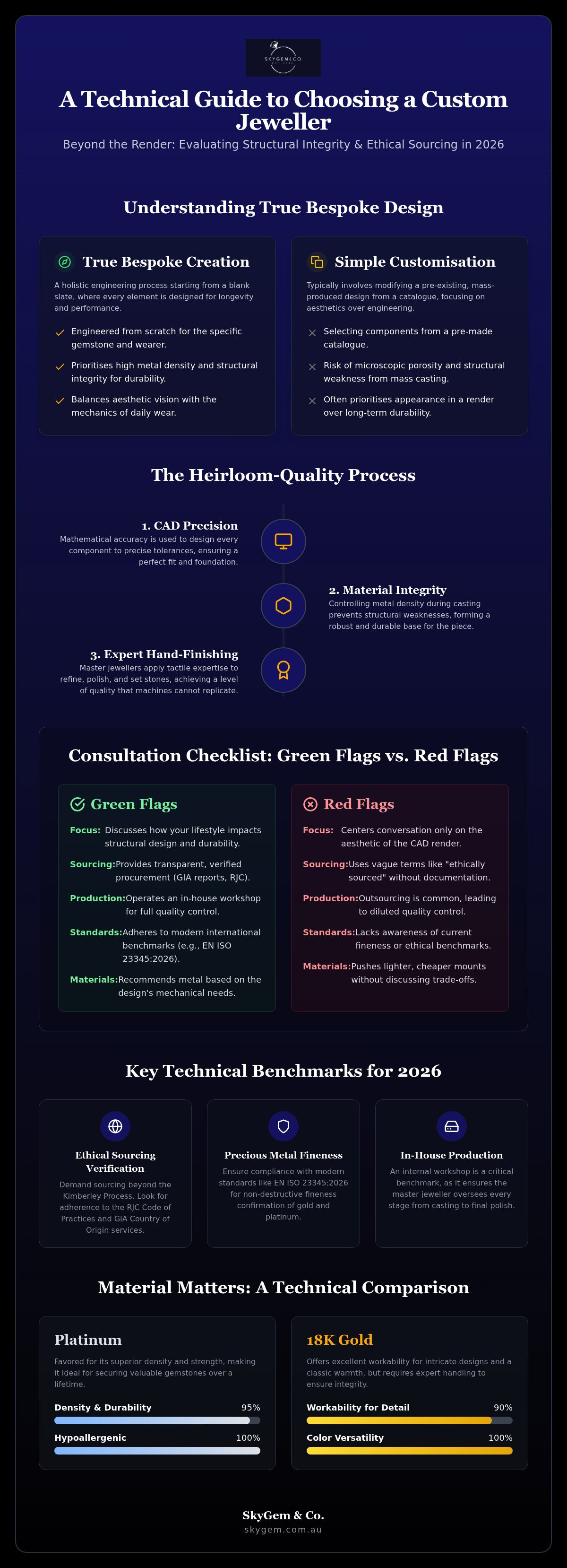
The consultation is the stage where the technical theory of a project meets its practical execution. When you are choosing a jeweller for a custom design, this meeting should feel less like a sales pitch and more like a high-level project briefing. A seasoned expert will prioritise the long-term viability of the piece over a quick transaction. They'll ask detailed questions about your lifestyle; for example, an active wearer might require a lower profile setting or a more durable metal like platinum to withstand daily impacts. This user-focused approach is a primary green flag, indicating the jeweller understands the intersection of aesthetic design and lived environments.
Conversely, a significant red flag is a lack of transparency regarding stone origins or grading reports. In 2026, scientific confirmation via the GIA Diamond Origin Report is an industry standard for diamonds, while the RJC Code of Practices serves as the benchmark for ethical gemstone sourcing. If a jeweller cannot provide these documents or seems dismissive of the new EN ISO 23345:2026 metal fineness standards, it suggests a lack of regulatory adherence. Another green flag is the provision of detailed CAD renders alongside multiple loose stone options. This allows you to compare performance metrics in person rather than relying on a single stock stone that may not suit your specific brief.
Avoid any jeweller who pressures you to exceed your budget without a clear technical justification. A professional consultant will instead offer solutions that balance your vision with your financial parameters, perhaps by suggesting a slightly different stone proportion or a more efficient manufacturing arc. Clear communication regarding timelines is also essential; a true bespoke piece requires a methodical manufacturing process that cannot be rushed without compromising structural integrity.
Evaluating the Portfolio
A jeweller's portfolio should showcase real-world examples of their craftsmanship. Look for high-resolution photos of finished pieces rather than generic stock renders. A diverse portfolio featuring Solitaire, Halo, and Trilogy rings demonstrates technical versatility. When examining Solitaire Engagement Rings, pay close attention to the symmetry of the prongs and the precision of the stone's alignment. These details reveal the jeweller’s commitment to quality over quantity and highlight their ability to manage the physical properties of precious metals.
The Communication Process
Trust is built through a methodical narrative flow during the design process. Your jeweller should act as a technical consultant, explaining the "why" behind every design choice. This partnership extends beyond the final delivery; robust after-care policies for resizing, professional cleaning, and ongoing maintenance are signatures of a jeweller who views your piece as a permanent asset. If you're ready to begin a collaborative design project, you can book a technical consultation with our team to explore your options.
Why Technical Specialisation Defines the Best Custom Jewellers
The successful execution of a bespoke project relies on the jeweller's ability to operate at the intersection of aesthetic design and mechanical engineering. Choosing a jeweller for a custom design is a process of identifying a partner who treats your vision as a complex technical project rather than a simple retail transaction. At SkyGem & Co., we act as technical consultants, ensuring that every design choice is backed by a logical justification for its structural integrity and long-term viability. As an independent, family-owned boutique, we maintain a steady, deliberate focus on quality over quantity, providing a level of personal oversight that guarantees your piece is a permanent asset.
Our methodology involves a seamless transition from high-level conceptual benefits to granular technical details. By managing the end-to-end creation of each piece within our specialized framework, we ensure that the finished product meets the rigorous standards of the regional professional landscape. This approach respects your time and investment, providing essential information in a sequence that reflects the decision-making process of a high-stakes project. We value performance over hype, focusing on the intersection of technical precision and aesthetic design to deliver a piece that is as durable as it is beautiful.
The SkyGem Standard
The SkyGem Standard is built on a foundation of education, transparency, and technical precision. We provide a curated selection of natural GIA-certified diamonds and premium lab-grown stones, ensuring every gem is vetted against modern light performance metrics. Our deep-rooted expertise in Australian Sapphires and other precious gemstones allows us to procure rare stones that match your specific design brief. By adhering to international fineness regulations and the RJC Code of Practices, we offer a solution-oriented approach that prioritises regulatory adherence and ethical responsibility. Every piece we create is designed for long-term viability, looking ahead to environmental responsibility and ongoing maintenance requirements.
Beginning Your Design Journey
Starting a custom project requires a methodical approach to inspiration and budgeting. We recommend gathering visual references that highlight specific structural elements you admire, such as prong styles or band profiles. Setting a realistic budget early in the process allows us to provide a framework for evaluating stone options and metal choices without compromising on quality. The manufacturing arc typically moves from initial concept to detailed CAD renders, followed by precision casting and expert hand-finishing. This timeline ensures that every stage is verified for accuracy before moving to the next. If you are ready to transform your vision into a high-quality, heirloom-standard piece, you can book a consultation for your custom jewellery design with our technical team today.
Securing the Future of Your Bespoke Investment
Choosing a jeweller for a custom design requires a shift from viewing jewellery as a mere accessory to seeing it as a precision-engineered asset. You now understand that the true value of a bespoke piece lies in its structural integrity, verified through modern benchmarks, and the absolute transparency of its gemstone procurement. A successful project is the result of a technical partnership where every prong placement and metal alloy choice is calculated for lifelong durability. This approach ensures your piece survives the rigours of daily wear while maintaining its aesthetic refinement.
At SkyGem & Co., we facilitate this process through expert consultations focused on education and transparency. As specialists in GIA-certified natural and lab-grown diamonds, we maintain a strict focus on heirloom-quality craftsmanship that ensures long-term viability. Our methodology bridges the gap between your creative vision and the rigorous engineering standards required for an enduring piece of jewellery. We're dedicated to providing the technical expertise necessary to protect your investment for generations.
Begin your bespoke design journey with a technical consultation
We look forward to engineering a piece that reflects your unique story with quiet confidence and uncompromising precision.
Frequently Asked Questions
How long does the custom jewellery design process usually take?
The custom jewellery design process typically takes between four and eight weeks from the initial consultation to final delivery. This timeline accounts for the methodical phases of gemstone procurement, CAD development, and precision hand-finishing. Complex designs involving rare stones or intricate gallery work may require additional time to ensure structural integrity. A transparent manufacturing arc allows for quality control checks at each stage, ensuring the final heirloom-standard piece meets all technical specifications.
Is a custom-designed ring more expensive than a ready-to-wear piece?
Custom-designed rings aren't inherently more expensive than ready-to-wear pieces of equivalent quality. While bespoke work involves dedicated design time and individual casting, it eliminates the retail overhead associated with mass-produced inventory. Choosing a jeweller for a custom design allows you to allocate your budget towards higher-grade materials, such as GIA-certified diamonds or unheated sapphires, rather than paying for a brand's marketing costs. This approach ensures you receive maximum technical value for your investment.
Can I provide my own gemstone for a custom design?
You can provide your own gemstone, though a technical consultant must first assess the stone's physical properties and structural condition. We evaluate the gem for any existing fractures or microscopic inclusions that might impact its stability during the setting process. If the stone meets safety standards, we can engineer a bespoke mounting that accommodates its specific dimensions. This ensures the final piece balances your personal narrative with the mechanical security required for long-term wear.
What is the difference between a CAD render and the final finished ring?
A CAD render serves as a mathematical blueprint, while the final ring possesses the tactile refinement of hand-finishing. The digital render allows you to verify proportions and stone placement with absolute precision. However, it cannot replicate the mirror-like polish or the ergonomic weight distribution achieved through traditional bench techniques. The finished piece will feel more substantial and exhibit a superior lustre that digital software simply cannot simulate, bridging the gap between engineering and art.
Do I need to have a clear design in mind before meeting a jeweller?
You don't need a finalized design before your initial consultation. A professional jeweller acts as a technical consultant to help you translate vague ideas or inspiration photos into a functional, aesthetically balanced piece. By discussing your lifestyle and aesthetic preferences, we can recommend specific mounting styles and metal choices that ensure structural integrity. This collaborative process is fundamental when choosing a jeweller for a custom design who values long-term viability over generic solutions.
How do I know the diamond in my custom ring is the one I paid for?
Verification is achieved through a combination of GIA certification and microscopic inspection of the diamond's laser inscription. Every natural or lab-grown diamond we source includes a unique identification number etched on the girdle, which matches the accompanying grading report. During your final viewing, you can verify this inscription under high magnification. This level of transparency ensures the stone's performance metrics and origin are exactly as documented, providing scientific confirmation of your investment's value.
Can a custom jeweller work within a specific budget?
Technical specialists can optimize a custom design to align with your specific financial parameters without compromising structural quality. By adjusting variables such as metal choice, stone proportions, or design complexity, we can focus resources where they provide the most visual and structural impact. For example, selecting a lab-grown diamond or a specific sapphire origin can significantly influence the project's total cost. A professional consultant provides the data necessary to make informed, budget-conscious decisions.
What happens if I don’t like the design after it is made?
The risk of a design mismatch is mitigated through the use of detailed CAD renders and physical checkpoints throughout the manufacturing process. You'll have multiple opportunities to review and approve the digital model before any metal is cast. This methodical approach ensures that the final physical piece is an exact technical execution of the approved design. Clear communication during the procurement and rendering phases guarantees that the finished heirloom meets your expectations for both beauty and performance.
Disclaimer
This article is for general informational purposes only and may include AI-assisted content. Pricing, specifications, and availability are subject to change. For accurate advice and current information, please contact SkyGem & Co. directly. Nothing in this content constitutes professional or financial advice.