
Best Diamond Shape for a Solitaire Ring: The 2026 Technical Guide to Sparkle

A high price tag on a diamond grading report is no guarantee that your stone won't look dull under the ambient light of an Australian evening. Selecting the best diamond shape for a solitaire ring requires looking beyond the simple silhouette to the underlying physics of light return. You've likely felt the pressure of choosing between technical specifications and visual impact, fearing that a significant investment might result in a stone that lacks life despite a high clarity or colour grade.
We understand that navigating the intersection of cut grades and light performance can feel like deciphering a complex engineering blueprint. This 2026 guide provides the technical clarity you need to move past the marketing hype. You'll discover the specific shapes that deliver the most intense scintillation and learn how to interpret a certificate to ensure your diamond performs as well in person as it does on paper. We've ranked the top shapes by their brilliance and provided a framework for balancing carat weight with optical efficiency to ensure your solitaire remains a permanent, high-performing asset.
Check Out: 2.20ct Total Natural Ruby Matching Pair
Key Takeaways
- Identify the technical components of sparkle-brilliance, fire, and scintillation-to evaluate how a diamond will perform under various Australian lighting conditions.
- Discover why the precision-engineered 57-facet Round Brilliant remains the best diamond shape for a solitaire ring, offering up to 99% light return.
- Compare the light performance of high-fire fancy shapes, such as the Oval and Radiant cuts, to achieve a balance of modern aesthetics and intense brilliance.
- Master the distinction between shape and cut grade to ensure you don't overpay for a stone that lacks the internal geometry required for maximum light reflection.
- Explore how bespoke setting choices and design features like the hidden halo can strategically enhance the visual impact and perceived size of your centre stone.
The Physics of Brilliance: Understanding Diamond Sparkle
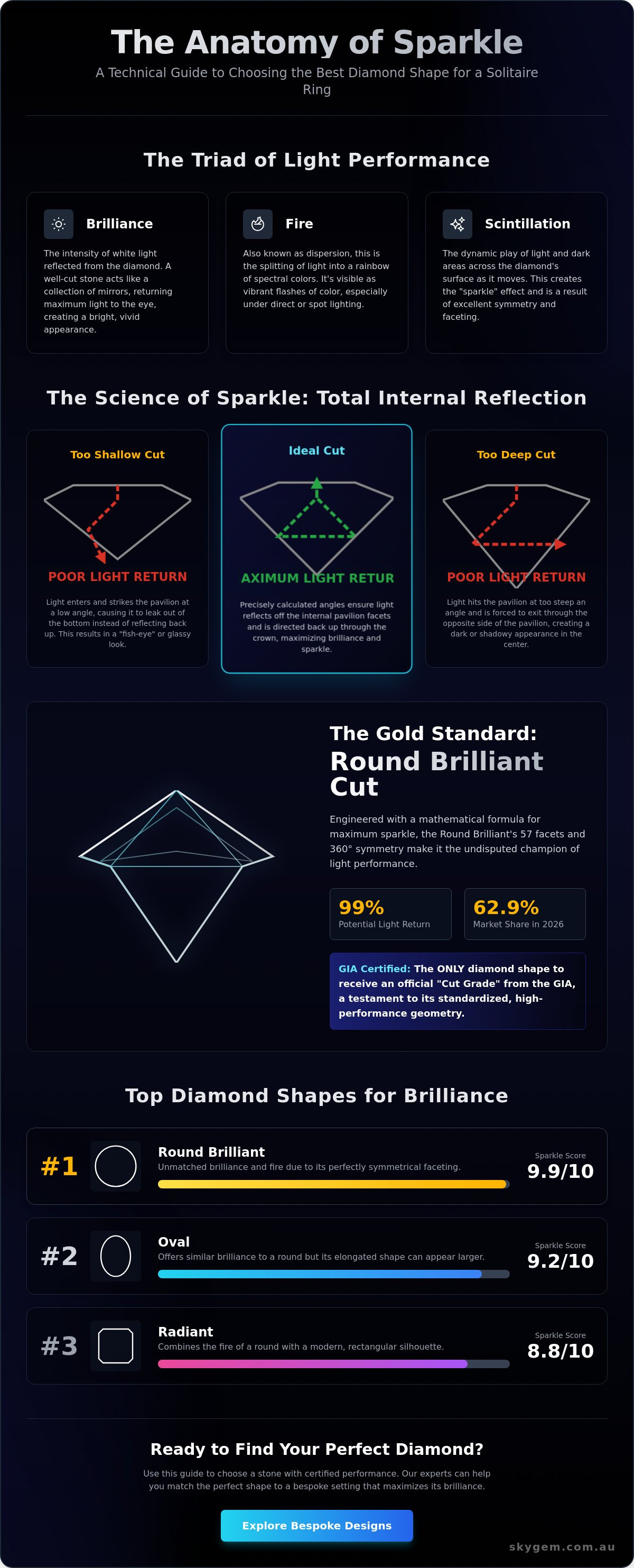
To identify the best diamond shape for a solitaire ring, one must first understand that "sparkle" is a quantifiable result of optical engineering. It isn't a singular trait but a complex interaction of light known as the triad of performance: brilliance, fire, and scintillation. Brilliance refers to the volume of white light reflected back to the viewer through the diamond’s crown. Fire, or dispersion, is the separation of that light into its spectral components, creating vivid flashes of rainbow colours. Scintillation represents the dynamic flashes of light and dark that occur when the stone, the observer, or the light source moves.
The primary objective of premium faceting is to achieve Total Internal Reflection. This occurs when light enters the diamond and strikes the pavilion facets at angles that allow it to bounce back up through the table rather than leaking out the bottom. When exploring the theory of diamond cutting, it becomes clear that the stone’s refractive index must be managed through precise geometric proportions. If the stone is cut too shallow or too deep, the light escapes. This results in a dull or "glassy" appearance that undermines the aesthetic of a solitaire setting.
Brilliance vs. Fire: What Drives Visual Impact?
The balance between brilliance and fire is largely dictated by the crown angle. Steeper crown angles typically promote greater dispersion, which produces more spectral fire. Conversely, shallower crown angles often prioritise raw brilliance. Your lighting environment also plays a critical role. Under the harsh Australian sun, fire is often more pronounced, while indoor office LEDs tend to highlight brilliance. Selecting the best diamond shape for a solitaire ring often involves deciding which of these optical traits you value most for your specific environment.
The Role of Scintillation in Dynamic Sparkle
Scintillation provides the "tempo" of a diamond's sparkle. A higher number of facets, as seen in certain modified brilliant cuts, creates smaller, more frequent flashes of light. However, the intensity of these flashes relies on optical symmetry and contrast. Dark areas within the stone, caused by the reflection of the observer or the environment, are necessary to make the bright flashes pop. Without this contrast, the diamond lacks depth and visual interest. A well-scintillated stone displays a balanced pattern that ensures the solitaire remains captivating from every viewing angle.
The Round Brilliant: Why It Remains the Gold Standard for Scintillation
While design trends evolve, the Round Brilliant continues to dominate the market, accounting for approximately 62.9% of diamond sales in 2026. This enduring popularity isn't merely a matter of tradition. It's rooted in a mathematical formula developed by Marcel Tolkowsky in 1919. His 57-facet design was specifically engineered to maximise the physics of light discussed in the previous section. By aligning facets to specific angles, the Round Brilliant achieves up to 99% light return, making it objectively the best diamond shape for a solitaire ring where the centre stone must stand alone without the support of accent gems.
The technical advantage of this shape lies in its 360-degree symmetry. Unlike elongated fancy shapes, a round stone allows light to enter and reflect consistently from any angle. This creates a uniform pattern of brilliance that older styles, such as the Old European Cut, cannot match. While those "chunky" heritage cuts offer a certain vintage charm, they often suffer from light leakage and a "dark hole" effect in the centre. A modern solitaire engagement ring serves as the ultimate showcase for this precision, allowing the stone's internal geometry to be the primary focus of the design.
Anatomy of a Round Brilliant Facet Pattern
The efficiency of a Round Brilliant depends on the interaction between its table, pavilion, and girdle. The table acts as the primary window for light, while the pavilion facets function as mirrors to redirect that light back to the observer. When these components are aligned with extreme precision, they produce a "Hearts and Arrows" pattern visible under specialised viewers. This alignment is so critical that the GIA only provides an official "Cut Grade" for round diamonds, as their performance is the only one standardised enough for such a rigorous metric.
Maximising Value in Round Brilliant Selections
To ensure your stone delivers the promised scintillation, prioritise a "Triple Excellent" rating, which denotes top-tier grades in Cut, Polish, and Symmetry. You should also look beyond the certificate by requesting an ASET or Idealscope image. These tools reveal light leakage that a standard report might miss. It's often better to select a slightly smaller stone with superior proportions than to sacrifice cut grade for a larger carat weight. If you're ready to explore these technical specifications in person, you can browse our collection of natural white diamonds to find a stone with optimal light performance.
Fancy Shapes and Fire: Comparing Sparkle Across Different Diamond Cuts
While the Round Brilliant remains the benchmark for scintillation, fancy shapes offer distinct optical profiles for those seeking an alternative best diamond shape for a solitaire ring. Shapes such as the Oval, Marquise, and Pear utilise modified brilliant faceting to emulate the light return of a round stone. The Radiant cut acts as a technical hybrid. It applies brilliant-style facets to a rectangular silhouette to achieve a level of sparkle that traditional step cuts cannot match. In contrast, the Princess cut provides a modern, square aesthetic, though its sharp corners require precise setting to prevent light leakage and protect the stone's integrity. For those who prefer architectural elegance over intense scintillation, step cuts like the Emerald and Asscher offer a "hall of mirrors" effect. You can experiment with these various silhouettes using our natural diamond ring builder to see how each interacts with a solitaire setting.
The Oval and Pear: Elongated Brilliance
Ovals and Pears are favoured for their ability to elongate the finger and their larger face-up appearance. An Oval diamond often appears significantly larger than a Round Brilliant of the same carat weight due to its elongated surface area. However, these shapes are susceptible to the "bow-tie effect," which is a dark shadow across the centre caused by misaligned facets. Selecting the best diamond shape for a solitaire ring in these categories requires a stone with specific depth and table percentages to ensure light remains trapped within the stone rather than passing through the centre.
Radiant vs. Cushion: The Battle of the Hybrids
The choice between a Radiant and a Cushion cut often depends on the desired "tempo" of the sparkle. Radiants are engineered for maximum white brilliance. This often results in a "crushed ice" appearance where hundreds of tiny light flashes occur simultaneously. Cushion cuts, particularly those with larger facets, are the preferred choice for those who value "Fire" or spectral rainbow flashes. Modern cushion designs can be cut for either a chunky, vintage feel or a modern, high-scintillation look, depending on the specific facet arrangement and symmetry.
Beyond the Shape: Technical Factors That Dictate Light Performance
Selecting the best diamond shape for a solitaire ring is only the first step in the technical procurement process. A common error among buyers is conflating the outline of the stone with its cut grade. A Round Brilliant with a "Good" cut grade often displays significant light leakage, making it visually inferior to an "Excellent" cut Pear or Oval. The cut grade is a measure of how well the stone's facets interact with light, and it remains the most critical determinant of sparkle regardless of the silhouette chosen.
In the high-UV environment of Australia, fluorescence requires careful consideration. While "Faint" or "Medium Blue" fluorescence can sometimes improve the perceived colour of stones in the J to L range, "Strong" or "Very Strong" fluorescence often introduces a milky or oily haze. This turbidity reduces the stone's transparency and dulls the scintillation. Similarly, the depth and table percentages must fall within specific ranges to ensure the stone doesn't look "dark" in the centre or "watery" around the edges. It is also vital to recognise that lab-grown diamonds are chemically and optically identical to their natural counterparts. They are graded by the same standards and achieve identical light performance when cut to the same rigorous proportions.
Reading the GIA Report for Light Performance
Beyond the basic 4Cs, the "Comments" section of a GIA report is a critical technical resource. It can reveal hidden inclusions, such as internal graining or "clouds not shown," that are not visible on the plot but significantly block internal light paths. Symmetry and polish serve as the final refinements of a high-sparkle stone. Even if the proportions are ideal, poor polish creates microscopic surface drag that scatters light, while poor symmetry leads to misaligned facets that disrupt the intended light pattern. By examining the proportions diagram, you can predict a diamond’s potential for fire by looking for crown angles between 34 and 35 degrees.
Material Purity and Transparency
Material purity is often the "missing link" in understanding light performance. Type IIa diamonds, which represent less than 2% of natural stones and include most high-quality lab-grown stones, lack measurable nitrogen impurities. This results in exceptional transparency. Light must travel through the stone unimpeded to create scintillation. If the diamond material itself is "hazy" due to sub-microscopic inclusions or internal graining, the most precise faceting cannot compensate for the lost brilliance. For those seeking the highest level of optical purity, you can filter for specific technical parameters using our lab-grown diamond ring builder.
Selecting Your Stone: How to Maximise Sparkle in Your Bespoke Design
The technical performance of even the best diamond shape for a solitaire ring can be compromised by an inferior setting. While the stone's internal geometry dictates its potential for brilliance, the physical housing determines how much light can actually reach the facets. Prong settings, particularly the classic four-prong or six-prong varieties, remain the preferred choice for maximising light entry from the sides and pavilion. In contrast, bezel settings provide a secure, modern aesthetic but can restrict light paths, potentially making the stone appear slightly less lively than it would in an open-mount design.
Current design trends in 2026 have introduced the "Hidden Halo" as a strategic technical solution. This involves placing a small row of diamonds just below the centre stone's girdle, adding a layer of scintillation visible from the side profile without distracting from the solitaire's primary silhouette. Choosing the right metal is equally critical for the final visual outcome. Platinum and 18K White Gold are highly recommended for colourless diamonds, as their neutral, mirror-like surfaces enhance the stone’s white brilliance. For those seeking a truly unique result, investing in bespoke engagement rings ensures that the setting is engineered specifically for the unique dimensions of your chosen diamond.
Bespoke Engineering for Maximum Light
Modern CAD (Computer-Aided Design) allows us to create low-profile settings that maintain structural integrity while minimising metal interference. This precision engineering ensures the setting doesn't cast internal shadows across the diamond’s pavilion. Hand-finishing the final piece is a vital step in this process. It allows a master jeweller to refine the prongs until they are as unobtrusive as possible, ensuring that the best diamond shape for a solitaire ring remains the undisputed focal point of the design. This balance of security and visibility is the hallmark of professional jewellery construction.
Consulting with a Specialist
Technical reports and certificates provide a baseline, but they cannot replace a side-by-side viewing under varied light sources. A diamond that performs well under the controlled lighting of a laboratory may behave differently in the natural sunlight of the Australian landscape. At SkyGem & Co., we prioritise optical performance over paper specifications, sourcing stones that exhibit superior transparency and light return. Our specialists act as technical consultants to help you navigate these nuances. To begin your journey toward a high-performance solitaire, you can book a bespoke consultation to find your perfect diamond and see the difference that precision engineering makes.
Engineering Your Ideal Solitaire for Long-Term Brilliance
Selecting the best diamond shape for a solitaire ring is a decision that balances geometric precision with personal aesthetic. While the Round Brilliant remains the benchmark for light return, the rise of elongated fancy shapes like Ovals and Pears offers a sophisticated alternative for those who prioritise a larger visual footprint. It's essential to remember that a stone's performance is ultimately dictated by its cut grade and material transparency rather than its silhouette alone. A high-performing stone requires the right internal proportions to ensure light is reflected rather than lost through the pavilion.
At SkyGem & Co., we act as your technical consultants to ensure your investment delivers maximum scintillation. We specialise in sourcing GIA Certified natural and lab-grown diamonds that meet the highest standards of optical performance. Whether you're interested in a classic solitaire or a complex bespoke design, our expertise in precision engineering ensures your stone is set to capture every possible light path. We focus on the intersection of technical data and visual impact to provide a solution that meets your specific requirements.
If you're ready to move beyond the grading report and see how a precision-cut diamond performs in person, we invite you to Book a Bespoke Consultation to Find Your Perfect Diamond. We look forward to partnering with you to create a piece that remains a permanent asset of beauty and light.
Frequently Asked Questions
Which diamond cut sparkles the most?
The Round Brilliant cut is objectively the highest-performing shape for light return. Its 57-facet pattern was mathematically engineered to maximise total internal reflection and scintillation. While fancy shapes like the Radiant or Oval offer high levels of brilliance, they cannot match the 360-degree symmetry and optical efficiency of a precision-cut Round Brilliant.
Does a bigger diamond always sparkle more?
Carat weight does not correlate with light performance; a larger diamond with poor proportions will appear duller than a smaller, well-cut stone. If a stone is cut too deep to retain weight, light leaks out the pavilion instead of reflecting through the table. Prioritising cut grade over size ensures the best diamond shape for a solitaire ring actually delivers visual impact.
Do lab-grown diamonds sparkle the same as natural diamonds?
Lab-grown diamonds exhibit identical sparkle to natural diamonds because they share the same physical, chemical, and optical properties. Both are graded using the same GIA standards for brilliance, fire, and scintillation. The light performance depends entirely on the precision of the faceting and the quality of the original crystal, not the origin of the stone.
What is the bow-tie effect in oval diamonds?
The bow-tie effect is a dark, butterfly-shaped shadow that appears across the centre of elongated shapes like Ovals, Pears, and Marquise cuts. It occurs when light passes through the stone without reflecting back to the observer due to specific facet angles. A well-proportioned stone minimises this effect, though a subtle bow-tie is often a natural characteristic of these silhouettes.
Can a setting make a diamond sparkle less?
A setting can significantly restrict light performance if it covers too much of the stone's surface area. Bezel settings block light from entering the sides of the diamond, which may reduce its overall brightness compared to an open prong setting. To achieve the best diamond shape for a solitaire ring, the mount must be engineered to allow maximum light exposure to the pavilion and crown.
Is a Princess cut or a Round Brilliant more sparkly?
The Round Brilliant is more sparkly than the Princess cut due to its superior ability to redirect light back to the eye. While the Princess cut is a "brilliant" style facet pattern, its square corners often trap light or cause leakage. The circular geometry of the Round Brilliant allows for more consistent light return and a higher frequency of scintillation flashes.
What are the 4 Cs and which one is most important for sparkle?
The 4 Cs are Cut, Colour, Clarity, and Carat weight, with "Cut" being the most critical factor for sparkle. While colour and clarity affect the stone's purity and aesthetic, the cut grade dictates how light interacts with the facets. A diamond with perfect colour and clarity will still look lifeless if its internal proportions and facet angles are poorly executed.
How can I tell if a diamond has a "Good" or "Excellent" cut?
You can verify a diamond's cut quality by examining the GIA or IGI grading report for specific proportion metrics. An "Excellent" grade indicates that the table percentage, crown angle, and pavilion depth fall within the ideal ranges for light return. For fancy shapes that lack an official GIA cut grade, viewing the stone under an ASET scope is the most reliable way to identify light leakage.
Disclaimer
This article is for general informational purposes only and may include AI-assisted content. Pricing, specifications, and availability are subject to change. For accurate advice and current information, please contact SkyGem & Co. directly. Nothing in this content constitutes professional or financial advice.