
Choosing Between a Plain or Diamond Wedding Band: The Definitive Guide

The most dazzling diamond band on the tray might be the wrong choice for your engagement ring. When choosing between a plain or diamond wedding band, many couples find themselves caught between the desire for maximum sparkle and the need for a cohesive, durable design. It's a significant decision that requires a balance of aesthetic preference and technical consideration. You likely want a piece that reflects your personal style while maintaining its structural integrity through years of active wear.
This guide will help you master the technical and aesthetic nuances of wedding band selection to find the perfect lifelong match for your engagement ring. We'll explore how different setting styles, such as channel or claw, impact the safety of your stones and how specific metal profiles affect whether your rings sit flush together. By the end of this analysis, you'll understand how to evaluate long-term value and daily functionality, ensuring your bridal stack remains a timeless asset that suits your lifestyle and professional environment.
Key Takeaways
- Identify the correct aesthetic hierarchy to ensure your wedding band enhances rather than competes with your engagement ring's centre stone.
- Assess the structural advantages of plain precious metal bands for high-activity lifestyles where durability and low maintenance are primary requirements.
- Understand the visual impact of choosing between a plain or diamond wedding band, specifically regarding how diamond-set pieces create a seamless "wall of light."
- Discover how bespoke CAD (Computer-Aided Design) services resolve the common "gap dilemma" by creating a technically perfect, flush fit between your rings.
- Utilise the "10-Year Test" to evaluate the long-term viability and maintenance needs of different setting styles before making your final investment.
The Foundation of the Bridal Stack: Plain vs. Diamond Wedding Bands
The wedding band serves as the functional and symbolic anchor of your bridal set, acting as the structural foundation upon which the engagement ring rests. While the engagement ring often receives the initial focus during a proposal, the wedding band is the piece that completes the architectural unit of the bridal stack. When choosing between a plain or diamond wedding band, you're essentially determining the aesthetic hierarchy of your set. You must decide whether the band should act as a quiet supporter or a secondary focal point that enhances the overall brilliance of the hand.
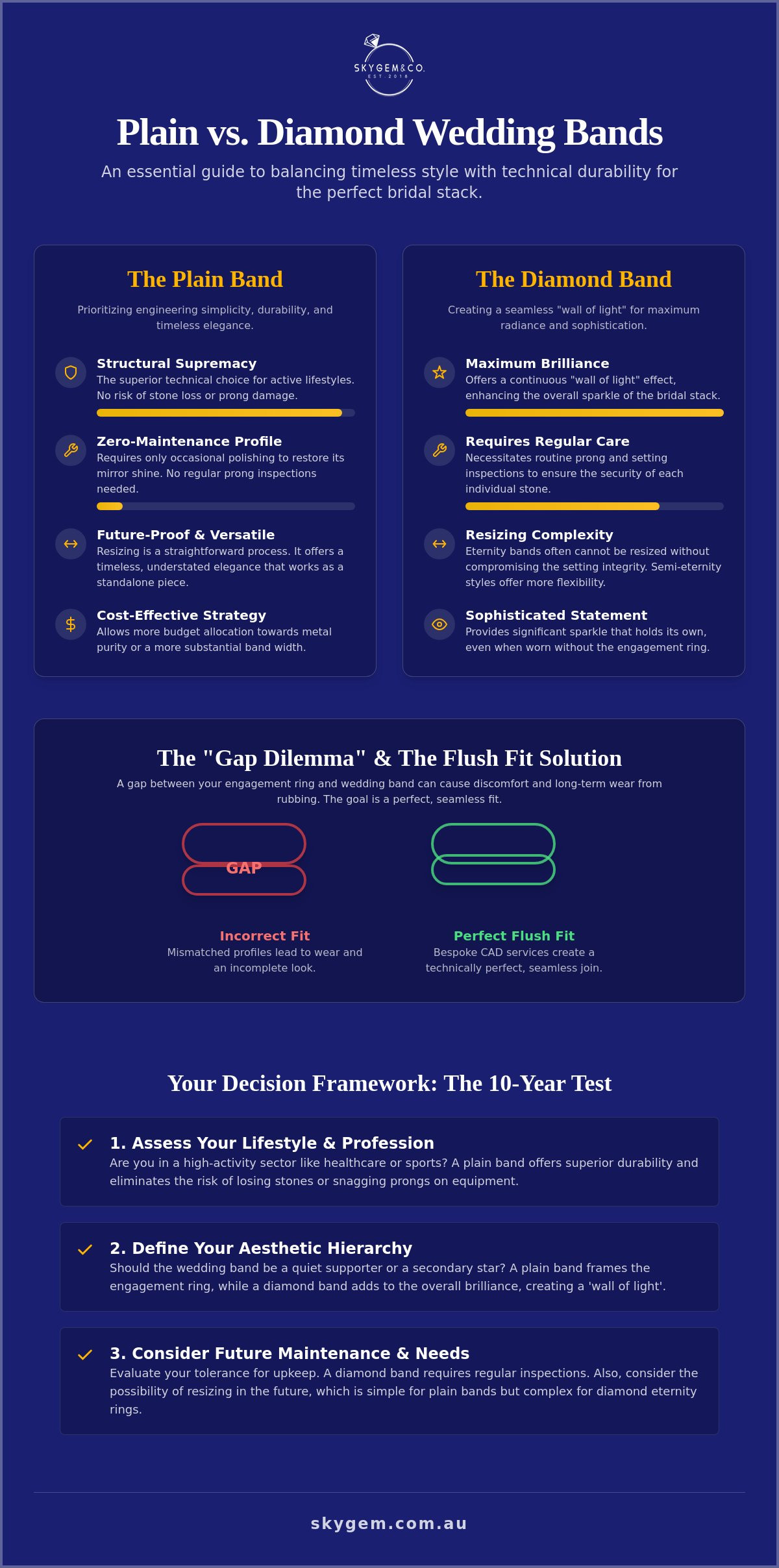
Historically, the history of wedding bands was rooted in the simplicity of solid precious metals, symbolising an unbroken circle without beginning or end. Modern design has seen a significant shift toward diamond-set eternity and semi-eternity styles, which offer a continuous "wall of light" on the finger. This evolution reflects a broader move toward customisation and high-impact design. However, this choice isn't purely visual; it establishes your jewellery maintenance schedule for the next several decades. A plain band requires only occasional polishing, whereas diamond-set bands necessitate regular prong inspections to ensure the security of every individual stone.
The Role of the Wedding Band
A well-chosen wedding band acts as a complementary frame for the engagement ring, either by matching its metal weight or by introducing a contrasting texture. It's vital to consider the symbolism alongside everyday practicality. While the band represents your commitment, it must also function as a standalone piece. Many individuals find that a band which can be worn comfortably on its own during travel or exercise provides the most long-term utility. Achieving this balance often requires a custom-made engagement ring approach where the band is engineered to sit perfectly flush against the existing setting.
Defining Your Personal Style
Your selection should reflect both your minimalist or glamorous preferences and the rigors of your professional environment. Those in high-activity sectors, such as healthcare or engineering, often lean toward the durability of a plain band to avoid the risk of losing stones. The "standalone test" is a practical way to evaluate your choice. Ask yourself how the band looks when worn without the engagement ring. A plain band offers a timeless, understated elegance, while a diamond band provides a sophisticated sparkle that holds its own even in the absence of a centre stone. This decision-making process ensures your bridal stack remains a cohesive and enduring asset.
The Case for a Plain Wedding Band: Durability and Timelessness
Choosing between a plain or diamond wedding band often involves a trade-off between immediate visual brilliance and long-term mechanical reliability. A solid metal band offers a "zero-maintenance" profile that appeals to those who value engineering simplicity and architectural purity. While diamond-set bands offer undeniable light performance, the uninterrupted lustre of polished gold or platinum provides a different kind of visual authority. It's a choice that prioritises the metal's natural properties, allowing the material's weight and finish to speak for themselves.
For individuals with high-activity lifestyles, such as healthcare professionals, athletes, or gardeners, a plain band is frequently the superior technical choice. These environments involve frequent hand-washing, exposure to abrasive surfaces, or physical impacts that can compromise delicate stone settings. A solid band eliminates the mechanical failure points associated with prongs and pavé. It's a practical decision that ensures your ring remains intact regardless of daily rigors. Additionally, opting for a plain band is a cost-effective strategy. It allows you to allocate more of your budget toward metal purity or a more substantial band width, ensuring the piece feels premium and substantial on the hand.
Structural Integrity and Longevity
From a technical standpoint, plain bands offer unmatched longevity. There's no risk of stone loss or prong damage over time, which significantly reduces the need for professional repairs. Resizing is also a straightforward process for plain bands, whereas diamond-set eternity rings often cannot be altered without compromising the setting. You can easily repolish or refinish a solid metal band to a mirror shine, effectively removing the microscopic scratches that accumulate through years of wear.
Versatility in Design
A plain band isn't synonymous with a lack of style. You can explore various geometric profiles to suit your hand shape, including the traditional Court, the rounded D-shape, the modern Flat, or the sharp Knife-edge. The choice of material is equally critical. While 18K white gold is a popular standard, many couples prefer the density and natural white hue of platinum for its superior durability. You might also consider exploring our range of 18K white gold wedding bands to find a weight that complements your existing jewellery. When researching how to choose a wedding band, consider how textured finishes like matte, hammered, or brushed effects can add a contemporary, artisanal edge to a traditional silhouette.
The Case for a Diamond Wedding Band: Radiance and Sophistication
While plain bands offer structural simplicity, diamond-set bands provide a sophisticated radiance that transforms the bridal stack into a high-impact visual statement. When choosing between a plain or diamond wedding band, many individuals prioritise the "wall of light" effect. This is achieved through precise setting techniques like pavé or claw settings, where diamonds are placed in close proximity to create an uninterrupted surface of brilliance. Beyond the visual impact, the "eternity" style, where stones circle the entire circumference, carries deep sentiment by representing a bond without end.
Technical precision is required when selecting diamond shapes for the band to ensure they complement the primary stone. While round brilliant diamonds are the standard for maximum light return, using fancy shapes like baguettes, marquise, or pear-cut diamonds can create a more architectural and bespoke look. Aligning the geometry of the band's diamonds with the engagement ring's centre stone, such as pairing a baguette band with a trilogy engagement ring, ensures a harmonious aesthetic that feels intentional and well-engineered.
Buy Now: sapphire price
Enhancing the Engagement Ring
A diamond band can provide necessary "visual weight" to a delicate solitaire setting. By introducing a secondary layer of light, you can create a pseudo-halo effect on the finger without altering the original ring's design. It's essential that the diamond quality aligns across both pieces to maintain a cohesive appearance. If your engagement diamond is a high-grade GIA-certified stone, pairing it with lower-quality band stones may cause the band to appear slightly warm or dull by comparison. We recommend matching the colour and clarity grades to ensure a seamless transition between the two rings.
Choosing Your Diamond Type
The choice of diamond origin is a key factor in the final design and budget allocation. Natural GIA-certified diamonds remain the gold standard for traditionalists who value rare, earth-mined assets. Conversely, lab-grown white diamonds have surged in popularity because they offer the same physical and chemical properties as natural stones. Research from February 2026 indicates that lab-grown diamonds can cost 40-60% less than natural alternatives, allowing you to achieve a higher total carat weight within your established budget. At SkyGem & Co., we maintain a transparent sourcing process for both categories, ensuring every stone meets our rigorous standards for hand-finished settings and generational durability.
Technical Compatibility: Achieving the Perfect Flush Fit
Achieving a seamless integration between two distinct pieces of jewellery requires a high level of technical precision. When choosing between a plain or diamond wedding band, the mechanical compatibility of the two rings is often overlooked in favour of aesthetics. The "Gap Dilemma" occurs when a standard straight band cannot sit flush against an engagement ring with a low-set basket or an elongated centre stone. This creates an unsightly void that can cause the rings to rotate independently, increasing friction and mechanical wear on the metal over time.
View More: cost of 3 carat diamond
Structural integrity also depends heavily on metal compatibility. You should never mix different metal types within a single stack. Platinum is significantly denser and harder than 18K gold. If a platinum band is worn alongside a gold engagement ring, the harder metal will slowly erode the softer one through constant contact. This mechanical abrasion can thin the prongs of your engagement ring, potentially leading to stone loss. To ensure generational durability, always match the metal alloy across your entire bridal set. To ensure your bridal stack is engineered for a lifetime of wear, book a bespoke design consultation with our technical specialists.
The Bespoke Advantage
Our use of Computer-Aided Design (CAD) allows for the creation of a "wed-fit" solution tailored to your specific jewellery. By taking precise measurements of your existing piece, we can engineer a custom-contoured band that follows the exact geometry of your setting. This bespoke approach is essential for bespoke engagement rings that feature non-traditional silhouettes. It ensures the height of the band matches the engagement ring shank perfectly, creating a unified architectural unit rather than two competing components.
Setting Styles and Security
The method used to secure stones in a diamond band significantly impacts its daily performance and maintenance requirements. We evaluate three primary styles for their technical merits:
- Claw Set: These allow maximum light entry into the diamonds for superior brilliance, but they present a higher snag risk on clothing and require more frequent professional inspections.
- Channel Set: This style offers superior protection by securing the stones between two parallel walls of metal. This protects the diamond girdles from side impacts, making it an ideal choice for active lifestyles.
- Pavé: Providing a delicate, vintage-inspired look, pavé relies on microscopic beads of metal to hold the stones. While beautiful, it is the most technically demanding style and requires regular prong checks to prevent stone loss.
Final Decision Framework: Lifestyle, Budget, and Future-Proofing
The "10-Year Test" serves as a technical projection for the lifecycle of your jewellery, helping you evaluate how a piece will perform after a decade of continuous wear. When choosing between a plain or diamond wedding band, you should consider how your daily environment and maintenance capacity might evolve. A plain band accumulates a unique patina of microscopic surface scratches that can be professionally refinished to a mirror shine at any time, restoring its original lustre. Conversely, a diamond-set band requires consistent technical oversight to ensure the mechanical integrity of the prongs remains intact, particularly if your lifestyle involves physical rigors that could compromise the setting.
See More: laboratory-grown diamond
Budget allocation often dictates the technical specifications of the final piece. Selecting a plain band allows you to prioritise metal density and purity, perhaps opting for a heavier platinum weight that provides a substantial, premium feel on the hand. If you choose a diamond band, your investment shifts toward the light performance and total carat weight of the stones. With lab-grown diamonds costing 40-60% less than natural counterparts as of early 2026, many couples find they can achieve a high-impact visual result without compromising the quality of the metal housing.
Maintenance and Care
Annual professional check-ups are essential for diamond-set bands to prevent the loss of stones due to everyday impacts. Our technical team provides specialised maintenance services, including ultrasonic cleaning and precise prong tightening, which are vital for hand-finished settings. At home, you can maintain the brilliance of your diamonds by using a mild degreasing solution to remove the build-up of skin oils and residues that interfere with the stone's refractive index. This proactive care ensures the band retains its radiance between professional servicing intervals, protecting your long-term investment.
The Future of Your Stack
A strategic approach to choosing between a plain or diamond wedding band involves planning for future additions to your bridal collection. You might consider the "Third Ring Strategy," where you leave physical space on the finger for a future eternity or anniversary band. This architectural arrangement often results in a symmetrical "sandwich" stack, placing the engagement ring between two complementary bands for a balanced and high-impact silhouette. If you intend to expand your stack later, a low-profile pavé band or a slender plain band may provide the most versatility for future nesting. For a deeper analysis of these technical considerations, consult our wedding rings buying guide to ensure your selection remains a permanent and evolving asset.
Engineering Your Perfect Bridal Match
Finalising your bridal stack requires a deliberate balance between your daily activity level and long-term aesthetic goals. Whether you've opted for the structural reliability of a solid metal band or the sophisticated light performance of a diamond-set piece, the technical success of your set depends on achieving a precise, flush fit. By considering future maintenance and how your rings will evolve over the next decade, you're making an informed decision that prioritises both form and function.
When choosing between a plain or diamond wedding band, remember that technical expertise can resolve even the most complex design challenges. At our Melbourne-based boutique, we specialise in bespoke manufacturing and use expert CAD design to ensure your band integrates seamlessly with your engagement ring. We provide full transparency in our sourcing, offering both GIA-certified natural and premium lab-grown diamonds to meet your specific standards. Explore our bespoke wedding band collections or book a consultation to begin the process of engineering your perfect match. We're here to help you create a piece that remains a reliable and beautiful asset for a lifetime.
Frequently Asked Questions
Will a diamond wedding band scratch my engagement ring?
Diamonds will scratch the metal of your engagement ring if they are allowed to rub against it. This mechanical abrasion occurs when the rings aren't sitting flush, causing the harder stones to wear down the softer metal shank. Utilizing bespoke CAD design ensures the two pieces function as a single unit, which minimises the friction that leads to surface damage.
Can a plain wedding band be engraved on the inside?
Solid metal bands offer the most versatile surface for internal engraving. Since there are no stone settings or azures to navigate, you have an uninterrupted area for laser or hand-engraved inscriptions. This allows for longer messages or more intricate symbols compared to diamond-set alternatives, which often have limited space due to the placement of the stones.
Is it harder to resize a diamond wedding band than a plain one?
It's technically more challenging to resize a diamond-set band than a plain one. Full eternity bands often cannot be resized without a complete remanufacture, while semi-eternity styles have a very limited range for adjustment. Plain bands are easily altered through standard goldsmithing techniques without risking the structural integrity of individual stone settings or prongs.
Should the metal of my wedding band match my engagement ring exactly?
We recommend matching your metal alloys exactly to prevent accelerated wear between the two rings. If you pair a platinum band with an 18K gold engagement ring, the denser platinum will gradually erode the softer gold through constant contact. When choosing between a plain or diamond wedding band, ensuring metal compatibility is a critical step toward generational durability.
How often do diamonds fall out of wedding bands?
Stone loss is rare if the piece receives annual professional maintenance and care. However, the risk is higher in pavé or claw settings where the metal prongs are fine and delicate. Regular inspections allow our technical team to identify and tighten loose prongs before a stone is lost during daily activity, ensuring the setting remains secure.
Are lab-grown diamonds a good choice for a wedding band?
Lab-grown diamonds are an excellent choice for wedding bands because they provide the same hardness and refractive index as natural stones. They allow you to achieve a larger, more radiant look within a fixed budget while maintaining identical physical properties. This transparency in sourcing ensures you receive a high-performance piece that meets your specific aesthetic requirements.
Which is more traditional: a plain or diamond wedding band?
Plain precious metal bands are the historically traditional choice, rooted in the symbolism of an eternal, unbroken bond. While diamond bands are a popular contemporary preference, choosing between a plain or diamond wedding band often comes down to whether you value traditional simplicity or modern brilliance. Both options serve as a permanent asset in a cohesive bridal stack.
What is the most secure setting for a diamond wedding band?
The channel setting is technically the most secure configuration for diamond-set bands. By securing the stones between two continuous parallel walls of metal, the diamond girdles are protected from lateral impacts. This design significantly reduces the risk of snagging on fabrics or losing stones while maintaining a sleek, architectural profile that suits a professional environment.
Disclaimer
This article is for general informational purposes only and may include AI-assisted content. Pricing, specifications, and availability are subject to change. For accurate advice and current information, please contact SkyGem & Co. directly. Nothing in this content constitutes professional or financial advice.