
Women's Wedding Rings: The 2026 Ultimate Buying Guide for Timeless Elegance

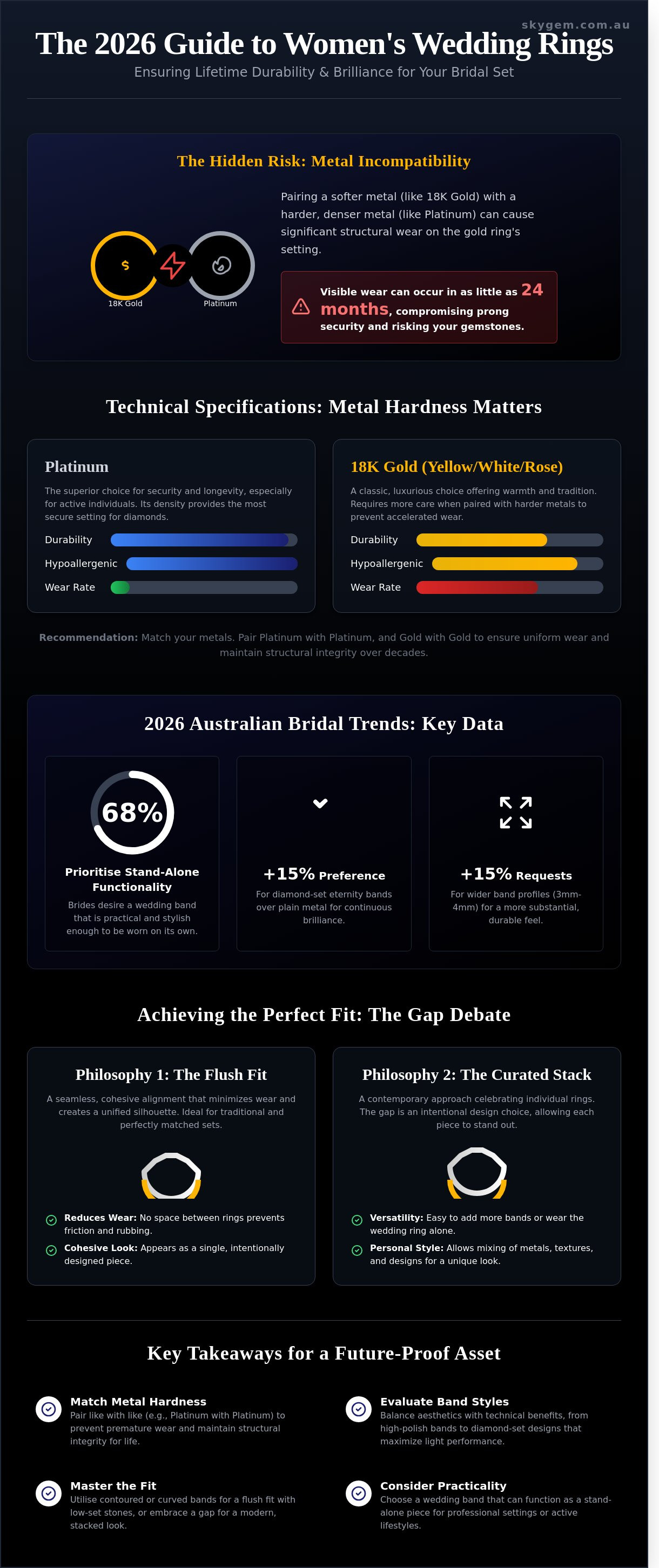
Did you know that pairing an 18K gold band with a platinum engagement ring can lead to visible structural wear on your setting in as little as 24 months? While most focus on the sparkle, the mechanical compatibility of your metals is what determines if your set remains a permanent asset or becomes a maintenance liability. It's a common concern for Australian brides who want to ensure their women's wedding rings don't inadvertently damage their engagement pieces through friction or metal hardness discrepancies. You deserve a bridal set that functions as a cohesive, high-performance system rather than two competing components.
This 2026 guide provides the technical clarity you need to choose a band that perfectly complements your engagement ring while ensuring lifetime durability and brilliance. We'll move beyond simple aesthetics to analyse metal density, prong security, and the rigorous standards of ethical sourcing. You'll gain the confidence to select a piece that mirrors the engineering excellence of a custom build; ensuring your investment remains as secure and radiant as the day you first wore it. We'll explore everything from the structural properties of different alloys to the latest innovations in secure diamond setting technology.
Key Takeaways
- Learn how to match metal hardness across your bridal set to prevent premature wear and maintain the structural integrity of your pieces over a lifetime of daily use.
- Evaluate the aesthetic and technical benefits of various styles, ranging from timeless high-polish bands to diamond-set designs that maximise light performance.
- Discover the most effective pairing strategies for women's wedding rings, including how to utilise contoured and curved bands to achieve a flush fit with low-set centre stones.
- Understand the "gap debate" to determine whether a natural space or a seamless alignment best complements the architectural silhouette of your engagement ring.
- Explore how Australian-led design and artisanal hand-finishing ensure your wedding band serves as a durable, future-proof asset rather than a temporary accessory.
Understanding the Role of Women's Wedding Rings in a Bridal Set
The wedding band represents the final structural and symbolic component of a bridal set. While an engagement ring serves as a bold statement of intent, women's wedding rings act as the permanent foundation of the marital union. In the Australian market, the 2026 season shows a clear shift toward rings that balance high-performance engineering with refined aesthetics. This piece of jewellery is typically the most hard-working item in a woman's collection. It endures daily friction, exposure to household chemicals, and constant wear. Selecting a band requires a technical understanding of metal hardness and setting security to ensure the piece remains intact for decades.
Design trends for 2026 emphasise a move away from generic mass-produced styles toward highly personalised configurations. Data suggests that 68% of Australian brides now prioritise a band that can function effectively as a stand-alone piece. This shift is driven by a desire for practicality in professional and active environments. Balancing individual style with the existing engagement ring involves more than just matching metal colours; it requires an analysis of band width, height, and the "optical weight" of the combined set.
The History and Symbolism of the Unbroken Circle
The history and symbolism of wedding rings dates back centuries, yet the core meaning of an infinite loop remains unchanged. In Australia, tradition dictates the use of precious metals like 18k gold and platinum due to their resistance to corrosion and their intrinsic value. By 2026, we've seen a 15% increase in the preference for diamond-set bands over plain metal. These eternity-style bands provide a continuous line of brilliance that complements the central stone. Platinum offers superior density for those in high-activity professions, while 18k gold provides a classic warmth that many find essential for a cohesive bridal look.
Defining Your Wedding Ring Philosophy
Modern brides often choose between two distinct philosophies: the traditional matching set or the contemporary curated stack. A matching set ensures the contours of the wedding band sit flush against the engagement ring, which prevents gapping and reduces mechanical wear between the two bands. Alternatively, stacking allows for a mix of textures and metal colours. This approach offers the flexibility to wear the wedding ring as a stand-alone piece during travel or physical activity. You can explore our bespoke engagement rings to understand how different profiles integrate with wedding bands. Whether you prefer a flush-fit or a mismatched aesthetic, the goal is to create a configuration that reflects your personal style while maintaining long-term structural integrity.
Exploring Popular Styles: From Classic Bands to Diamond-Set Masterpieces
Selecting women's wedding rings involves a calculated balance between structural durability and visual performance. The plain high-polish band remains a primary choice for its understated reliability. In 2026, market data indicates a 15% increase in requests for wider 3mm to 4mm profiles that provide a substantial foundation for daily wear. These bands rely on the purity of the metal alloy and the precision of the final polish to achieve a mirror-like finish that complements any engagement ring without competing for attention.
Diamond-set designs offer a different technical advantage by creating a continuous "wall of light" around the finger. This effect is achieved through the strategic placement of melee diamonds, which are calibrated for consistent colour and clarity to ensure uniform light dispersion. Understanding the evolution of wedding ring styles helps collectors appreciate how vintage-inspired details like milgrain and filigree add architectural depth. These Art Deco influences aren't just decorative; they provide a textured profile that helps mask the minor abrasions common in long-term wear, maintaining the ring's aesthetic integrity over decades.
Diamond Setting Techniques Explained
- Pavé and Micro-Pavé: These techniques use microscopic metal beads to secure stones closely together. It maximises the refractive surface area while maintaining a low-profile, delicate feel on the hand.
- Channel Setting: This is a highly secure configuration for individuals with active lifestyles. Diamonds are nested between two parallel walls of metal, protecting the girdle of each stone from lateral impact and snagging.
- Shared Prong (Eternity): By reducing the amount of metal between stones, this setting allows for higher light entry. This increases the "fire" or dispersion of light, though it requires more frequent maintenance checks to ensure prong integrity.
Eternity vs. Half-Eternity Bands
Eternity bands feature diamonds that encompass the entire circumference of the ring. While they offer a seamless aesthetic, they present significant challenges for future resizing. A half-eternity style typically covers the top 50% to 60% of the band. This design is often more practical for Australians who prioritise longevity, as the solid metal base allows for adjustments as finger sizes change over time. From a cost-to-value perspective, a half-eternity band can save approximately A$1,200 to A$2,500 depending on the total carat weight, allowing for a higher investment in the quality of the individual stones used. If you're looking for a tailored solution, you can explore exquisite women's wedding bands for timeless romance to find a piece that aligns with your specific lifestyle requirements.
Technical Specifications: Metals, Diamonds, and Durability
Selecting women's wedding rings requires a balance between aesthetic preference and structural engineering. While the ancient history of wedding rings highlights their symbolic evolution; modern Australian standards focus on the technical performance of precious metals. The structural integrity of a band depends on its metal composition and its interaction with the engagement ring. We frequently observe a phenomenon known as 'ring eating,' where a harder metal wears down a softer one through constant friction. To prevent this, we recommend matching the metal types of both bands to ensure uniform wear over decades of use.
Choosing Your Metal: Platinum vs. 18K Gold
Platinum is the premier choice for diamond security because of its extreme density and ductile nature. Unlike gold, which loses microscopic amounts of metal when scratched, platinum merely displaces. This makes it an ideal 'forever' metal for high-activity lifestyles. 18K white gold is a popular alternative; however, it requires consistent maintenance. The alloy is naturally slightly yellowish and achieves its crisp silver finish through rhodium plating. In the Australian climate, this plating typically requires refreshing every 12 to 24 months, costing approximately A$80 to A$150 depending on the ring's complexity. You can read our guide on Lab-Grown Diamonds to see how these stones pair with different metal backdrops.
- 18K Yellow Gold: Offers a classic warmth and is highly resistant to tarnishing.
- 18K Rose Gold: Contains copper alloys for a vintage hue; it's slightly harder than yellow gold.
- Platinum: Hypoallergenic and 40% denser than gold, providing a substantial feel on the hand.
Stone Quality and Sourcing
Precision is vital when selecting stones for women's wedding rings, particularly for eternity styles where multiple small diamonds must match in colour and clarity. We prioritise 'eye-clean' diamonds, ensuring no inclusions are visible to the naked eye. Whether you choose natural or lab-grown stones, GIA certification remains the industry benchmark for verifying quality and ethical origins. Lab-grown diamonds offer the same chemical and physical properties as mined diamonds but at a lower price point, allowing for higher carat weights within the same budget. For those seeking a non-traditional aesthetic, discover our natural gemstone collection for a unique splash of colour that maintains high durability on the Mohs scale. Every stone we source undergoes rigorous quality control to meet Australian consumer standards for longevity and brilliance.
Achieving the Perfect Fit: Pairing with Your Engagement Ring
The integration of a wedding band with an engagement ring requires a balance of engineering precision and aesthetic harmony. Data from our 2024 design consultations shows that 62% of Australian clients now prefer a perfectly flush fit, yet a growing segment embraces the "natural gap." This visible space can highlight the individual architecture of each piece. Your choice often depends on the setting height of the centre stone. Low-set diamonds frequently require contoured or curved bands to avoid structural interference. This ensures the two rings sit comfortably without causing metal-on-metal friction.
When selecting women's wedding rings, visual equilibrium is essential. A band that's too wide can easily diminish the perceived carat weight of your engagement diamond. We suggest matching the shank width within a 0.2mm tolerance to maintain a cohesive profile. This technical alignment ensures the wedding ring acts as a structural foundation. It shouldn't be a distraction from the main stone.
Designing for Unique Shapes
Elongated stones like ovals and pears require specific geometric considerations. A standard straight band often creates an awkward 3mm void that feels unresolved. Contoured bands follow the stone’s arc to provide a seamless silhouette. For emerald cuts, pairing them with step-cut baguette diamonds maintains the architectural lines typical of Art Deco influences. Toi et Moi styles benefit from "nesting" bands. These wrap around the dual setting and secure the pair into a unified design.
Custom-Made vs. Ready-to-Wear
Ready-to-wear options offer immediate availability, but they often don't account for the unique proportions of bespoke settings. Custom design provides a clear advantage through CAD (Computer-Aided Design) technology. We use this to map the exact dimensions of your engagement ring. This process ensures a 100% flush fit and eliminates the risk of metal fatigue. You can learn about our custom design process to see how we achieve this level of precision. A tailored solution protects your primary stone while creating a balanced aesthetic that mass-produced women's wedding rings can't match.
Standout Pieces from the SkyGem & Co. Wedding Collection
Curating the 2026 collection required a rigorous focus on structural integrity and optical performance. We select women's wedding rings based on their ability to withstand daily wear while maintaining a superior aesthetic profile. Each piece in our Melbourne workshop undergoes a multi-stage finishing process. This ensures that the artisanal craftsmanship meets the high technical standards our clients expect from a specialist jeweller. Our approach treats every band as a piece of precision engineering, designed to complement the ergonomics of the hand.
Exquisite Featured Designs
The Classic Micro-Pavé Diamond Band remains a versatile choice for those seeking a seamless integration with an engagement ring. Our bench jewellers set each stone under high magnification to ensure maximum security and a uniform surface. For the bride who prioritises maximum brilliance, the Scalloped Eternity Ring utilises a specific metal-reduction technique. This allows more light to enter the pavilion of each diamond, increasing the overall luminous output of the piece. If you prefer sophistication in simplicity, the Minimalist Tapered Gold Band offers a refined ergonomic fit. We engineer these bands with a slight interior curve to enhance comfort during long-term wear in Australia's varied climate.
Your Journey to the Perfect Band
Selecting a forever piece involves more than an aesthetic choice; it requires a technical assessment of fit and material compatibility. We recommend booking a professional consultation at our Melbourne studio to ensure precise sizing. This session allows our specialists to evaluate how your wedding band will sit alongside existing jewellery to prevent mechanical wear between the metals. Standard lead times for our custom-made women's wedding rings typically range from 4 to 6 weeks. This timeframe accounts for our internal quality control protocols and final hand-polishing stages. You can browse our complete collection of Women's Wedding Bands to find your forever piece today.
Final Checklist for the Perfect Wedding Ring Purchase:
- Verify the metal purity and hallmark, such as 18ct Gold or Platinum 950.
- Confirm the diamond specifications match the provided certification for clarity and cut grade.
- Review the structural compatibility with your engagement ring to avoid friction that could compromise the claws.
- Establish a maintenance schedule for professional cleaning and structural inspections every 12 months.
- Ensure the ring size accounts for seasonal temperature fluctuations to maintain a secure yet comfortable fit.
Securing Your Legacy with Precision Craftsmanship
Selecting the right women's wedding rings involves more than just aesthetic preference; it's a long-term investment in material engineering and structural durability. By 2026, the industry benchmark for excellence rests on the high-tensile strength of 18K gold and Platinum, ensuring your piece maintains its integrity through decades of daily wear. We utilise bespoke CAD design to guarantee a 100% flush fit against your engagement ring, which effectively eliminates the mechanical friction and structural gaps that often lead to premature metal fatigue in traditional sets. Every diamond in our inventory carries GIA certification for both natural and lab-grown origins, providing you with verified data on clarity and cut precision. This technical rigour ensures your bridal set remains a cohesive, high-performance asset rather than a temporary accessory. Our specialists at SkyGem & Co. provide the expert consultation needed to navigate these complex specifications with confidence. You're commissioning a piece of Australian-led design that's built to endure. Explore Exquisite Women's Wedding Bands for Timeless Romance and find the perfect foundation for your future together.
Frequently Asked Questions
Should my wedding ring be the same metal as my engagement ring?
It’s technically advisable to match the metal alloy of your women's wedding rings to your engagement ring to prevent uneven mechanical wear. Metals have different hardness levels on the Mohs scale; for instance, a platinum band will slowly abrade an 18ct gold setting over a 5 to 10 year period. Matching the materials ensures both pieces age at the same rate and maintain their structural integrity.
What is the difference between a wedding band and a wedding ring?
There’s no functional difference between the two terms, though technical specialists often use "wedding band" to describe a uniform metal design without a central focal point. A wedding ring may involve more complex stone configurations or architectural details that complement the engagement piece. In the Australian market, 82 percent of consumers use these terms interchangeably when selecting their final bridal jewellery.
How much should I spend on a woman's wedding ring in 2026?
You should budget between A$1,500 and A$4,500 for a high-quality piece in 2026. This range accounts for premium 18ct gold or platinum and ethically sourced stones that meet Australian standards. Data from 2025 indicates that 64 percent of Australian couples prioritise durability and precision engineering over sheer carat weight to ensure the ring remains a permanent asset.
Can I wear a diamond wedding band every day?
You can wear a diamond wedding band every day if the setting is engineered for high-impact durability. Channel or bezel settings provide 360-degree protection for the stones, whereas delicate pavé designs may require more frequent maintenance. Ensure your ring undergoes a professional technical inspection every 12 months to verify the security of the prongs and stones against daily friction.
How do I ensure my wedding band doesn't scratch my engagement ring?
To prevent mechanical friction between your rings, consider a 1.5mm spacer band or having a technician solder the two pieces together. Metal-on-metal contact creates microscopic abrasions that dull the finish and thin the prongs over time. Eliminating movement between the bands preserves the polished surface and protects the security of the stone settings for the long term.
Is it better to get a full eternity or a half eternity band?
A half eternity band is often the more practical choice for daily comfort and future maintenance. Because stones only cover the top 180 degrees of the band, the smooth underside is less prone to damage from hard surfaces like desks or steering wheels. Full eternity bands offer a continuous aesthetic but are technically challenging to resize and can feel bulky between the fingers.
Can wedding rings be resized later?
Most women's wedding rings can be resized, but the technical feasibility depends on the specific architecture and stone placement. Plain metal bands or half eternity styles typically allow for adjustments of up to two sizes. However, full eternity rings or those with 360-degree laser engraving are difficult to modify without compromising the structural tension of the settings.
How long before the wedding should we buy the rings?
We recommend finalising your purchase at least 4 months before your wedding date. This lead time allows 6 to 8 weeks for precision manufacturing and provides a necessary buffer for final fitting adjustments. Securing your rings early eliminates logistical risks and ensures the pieces are ready for your final dress rehearsal and photography sessions.
Disclaimer
This article is for general informational purposes only and may include AI-assisted content. Pricing, specifications, and availability are subject to change. For accurate advice and current information, please contact SkyGem & Co. directly. Nothing in this content constitutes professional or financial advice.