
Natural Alexandrite Engagement Rings: The 2026 Australian Selection Guide

The rarest gemstones don't just sit still; they transform. You've likely felt the frustration of searching for alexandrite engagement rings only to find yourself buried in lab-grown imitations or stones that lose their vibrancy the moment you step indoors. It's a common hurdle when seeking a gem that is rarer than diamond and far more complex to evaluate. Selecting a natural specimen requires more than an eye for beauty; it demands a technical understanding of how light interacts with specific chrysoberyl crystal structures.
This guide will empower you to master the technical specifications of natural, unheated specimens, ensuring you can identify the vivid colour-shift phenomenon that defines investment-grade quality. We'll examine the updated GIA certification standards for 2026, the structural requirements for protective bespoke settings, and how to verify origin provenance to secure a legacy piece. By the end of this selection guide, you'll have the expertise to navigate the Australian market with the confidence of a seasoned gemologist, focusing on long-term value over temporary trends.
Key Takeaways
- Identify the geological rarity of natural alexandrite, a chrysoberyl variety formed by a precise chromium infusion that creates its signature colour-changing properties.
- Master the technical metrics of the "Emerald by Day, Ruby by Night" effect to evaluate alexandrite engagement rings melbourne based on shift intensity, hue, and saturation.
- Prioritise unheated, natural specimens to ensure maximum long-term value and gemstone integrity, avoiding the common pitfalls of commercial treatments.
- Ensure investment security by insisting on GIA Coloured Stone Identification and Origin Reports to verify natural status and geographic provenance.
- Optimise the aesthetic performance of your stone by selecting a loose gem first and pairing it with specific metals like Platinum or 18K Yellow Gold to enhance its dual-colour profile.
The Rarity of Natural Alexandrite in the 2026 Jewellery Market
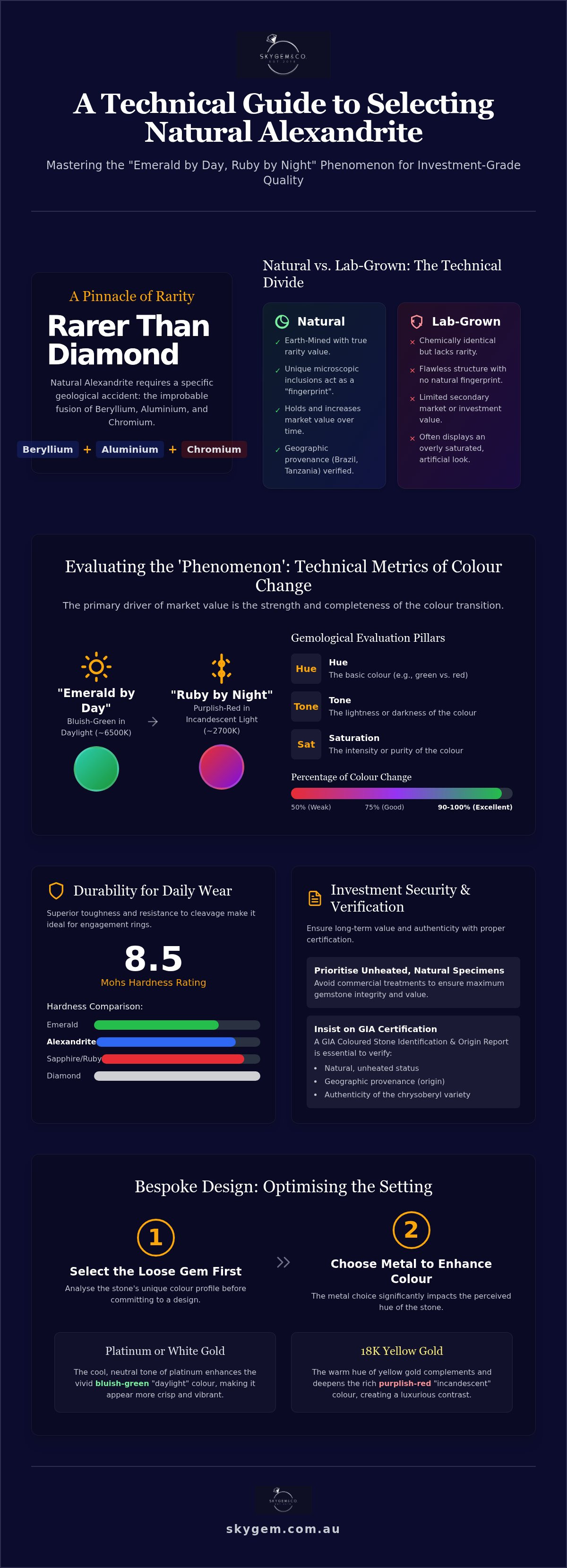
Alexandrite represents a pinnacle of mineralogical rarity that few other gemstones can match. It is defined as the colour-changing variety of chrysoberyl, and its formation requires a specific geological accident. For the stone to exhibit its famous shift, the element chromium must be present within the crystal lattice. This is statistically improbable because chromium is rarely found in the same geological environments as beryllium and aluminium. This scarcity makes high-quality natural specimens significantly harder to source than standard diamonds. For those researching alexandrite engagement rings melbourne, understanding Alexandrite mineral properties is the first step in appreciating why these stones are considered investment-grade assets.
Natural vs. Lab-Grown: The Technical Divide
The distinction between earth-mined and lab-grown stones is a technical one that directly affects long-term viability. Synthetic stones produced through flux-growth or the Czochralski process are chemically identical to natural chrysoberyl but lack the market value associated with rarity. These manufactured stones often display a colour change that feels overly saturated or artificial. In contrast, natural stones contain microscopic inclusions that act as a unique fingerprint of authenticity. In the 2026 market, provenance is paramount. Brazilian stones remain the gold standard for their vivid saturation, while African sources from Tanzania and Madagascar have become vital for those seeking larger, eye-clean specimens that retain a strong colour shift.
The Durability Factor for Daily Wear
Durability is a non-negotiable metric for any jewellery intended for daily wear. Alexandrite excels in this category with a Mohs hardness rating of 8.5, surpassed only by sapphire, ruby, and diamond. This physical property ensures the stone won't easily dull or scratch over decades of use. While emeralds are often fragile due to internal fractures, alexandrite's crystalline structure provides superior toughness and resistance to cleavage. This makes it an ideal candidate for bespoke engagement rings where the stone is exposed to the rigours of an active lifestyle. Maintaining this asset requires minimal but specific care; periodic professional cleaning helps preserve the internal paths that light must travel to trigger the colour-change phenomenon. Because the stone is so hard, it can be set in various styles, from traditional prongs to more protective bezel designs, without the high risk of breakage associated with softer gems.
Evaluating the 'Phenomenon': Technical Metrics of Colour Change
The colour change in alexandrite is a measurable optical phenomenon rather than a simple subjective preference. Often described by the industry shorthand "emerald by day, ruby by night," this shift occurs because of the way the stone absorbs and transmits specific wavelengths of light. According to GIA's guide to alexandrite quality, the strength and completeness of this transition are the primary drivers of market value. For those commissioning alexandrite engagement rings melbourne, the objective is usually to secure a stone with a 100% shift, where the transition between light sources is total and distinct.
Gemologists evaluate these specimens using three technical pillars: Hue, Tone, and Saturation. Hue identifies the basic colour, such as bluish-green or purplish-red. Tone describes the lightness or darkness of that colour, while Saturation measures its intensity. We also measure the percentage of colour change. A 50% shift might only result in a slight brownish tint under incandescent light, whereas a 90% to 100% shift provides a dramatic leap from a lush teal to a vivid raspberry. This performance is distinct from pleochroism, which is the stone's ability to show different colours from different viewing angles. Because alexandrite is trichroic, it can display three different colours across its three optical axes, requiring a master lapidary to orient the crystal for maximum face-up impact.
Mastering the Daylight vs. Incandescent Shift
The transition is triggered by the Kelvin scale of the light source. Natural daylight, which sits at approximately 6500K, is rich in blue and green wavelengths that the chromium in the stone allows to pass through. Incandescent light, at roughly 2700K, is heavy in red wavelengths. In the Australian climate, our high-intensity natural light makes the daylight green phase particularly striking. You should be wary of stones that exhibit "muddy" or overly grey secondary hues, as these indicate a less efficient light-filtering process within the crystal lattice.
The Importance of Colour Saturation
Saturation must be expertly balanced to avoid "extinction," a state where the stone is so dark that light cannot reflect back to the eye, making the gem appear black. Conversely, stones that are too light in tone often fail to show a convincing colour change. Medium-toned stones with "vivid" saturation typically provide the most dramatic results, as they have enough body colour to be impactful without sacrificing the transparency required for the shift. You may find it helpful to review our curated selection of unheated alexandrite gemstones to compare these saturation levels in person.
The Unheated Advantage and Gemstone Integrity
An unheated classification is the hallmark of a gemstone that remains untouched by thermal intervention. While the industry frequently treats rubies or sapphires to enhance their appearance, natural alexandrite is rarely subjected to heat because its chromium-based colour-change mechanism is stable. However, the 'unheated' or 'untreated' status on a laboratory report remains the gold standard for those investing in alexandrite engagement rings melbourne. It signifies a stone of such high natural quality that no artificial enhancement was required to achieve its vivid shift. While heat is uncommon, other treatments like fracture filling or oiling can occur, making a certified 'no indications of treatment' report essential for long-term value.
Investment Value of Untreated Specimens
Collectors and investors prioritise untreated specimens because they represent the pinnacle of geological rarity. Historical market data supports this preference; high-quality one-carat natural alexandrites have shown significant appreciation, with some records indicating a 300% increase in market value between 2014 and 2024. This growth far outpaces many traditional white diamonds. The scarcity factor becomes even more pronounced at higher carat weights. Finding a natural, unheated alexandrite that exceeds 1.00 carat is an exceptional event in the trade. Most earth-mined stones are recovered in sizes below 0.50 carats, meaning any specimen approaching or exceeding the one-carat mark is considered a significant find for a bespoke project.
Structural Integrity and Clarity Standards
The GIA classifies alexandrite as a Type II gemstone. This means that, unlike diamonds, most natural specimens will contain some degree of internal inclusions. The industry benchmark for a high-quality stone is 'eye-clean' clarity, where no flaws are visible to the naked eye at a distance of approximately 15 centimetres. When selecting stones for alexandrite engagement rings melbourne, we prioritise 'eye-clean' clarity to ensure the stone's beauty isn't compromised by distracting veils or crystals. We must also identify inclusions that could threaten the stone's stability. Flaws located near the girdle or surface-reaching fractures can compromise the gem during the setting process or through daily wear. A clean crystal lattice doesn't just ensure durability; it also facilitates the maximum brilliance of the colour shift, as light can travel through the stone without being deflected by internal obstructions. You can explore our current inventory of alexandrite gemstones to see how clarity affects the visual performance of these rare specimens.
Verification: Navigating GIA Certification and Lab Reports
Verification is the only definitive safeguard against the proliferation of high-quality synthetics in the Australian market. When sourcing alexandrite engagement rings melbourne, a verbal assurance of "natural" origin is insufficient for a gemstone of this magnitude. You require a document from an independent, third-party laboratory that uses advanced spectroscopic analysis to confirm the stone's chemical composition. The Gemological Institute of America (GIA) provides the industry standard for this verification, ensuring that the specimen is not a lab-grown simulant created via modern flux-growth or Czochralski processes.
A GIA 'Coloured Stone Identification and Origin Report' serves as a technical biography of the gem. The report must explicitly state the species as 'Natural Chrysoberyl' and the variety as 'Alexandrite'. This distinction is vital; without the variety designation, the stone is merely a chrysoberyl and lacks the essential chromium-induced colour-change properties that define its market value. The report also quantifies the degree of colour change, providing a neutral assessment of the shift from daylight to incandescent light.
Reading a GIA Alexandrite Report
The 'Comments' section is perhaps the most critical area of any laboratory report. For a premium specimen, this section should indicate 'no indications of heating' or other enhancements. While natural alexandrite is rarely subjected to thermal treatment, the formal absence of any intervention on a report preserves its long-term investment status. Additionally, the 'Origin' determination is a key value driver. In 2026, stones with a confirmed provenance from Brazil or the historic Ural Mountains command a significant premium due to their superior colour-shift performance. The report also provides precise millimetre measurements and carat weight to the second decimal point, allowing you to match the physical stone to its certificate with absolute certainty.
Tier-One Laboratories for Coloured Stones
While many retailers offer in-house grading, high-value precious gemstones should always be backed by internationally recognised authorities. Beyond the GIA, laboratories like SSEF and Gubelin in Switzerland are respected for their rigorous origin testing and treatment detection. Relying on minor or unrecognised labs introduces unnecessary risk, as they may lack the sophisticated instrumentation required to distinguish between natural inclusions and the subtle growth patterns found in high-end synthetics. To ensure your selection meets these international benchmarks, we invite you to view our collection of GIA-certified alexandrite gemstones to find a specimen with verified provenance.
Bespoke Design: Crafting the Perfect Alexandrite Setting
Designing for alexandrite requires a specialised approach that differs from standard diamond setting. The primary advantage of selecting a loose stone first is the ability to account for its unique optical axes. When crafting bespoke engagement rings, the setting must be engineered to facilitate maximum light entry. The colour-change phenomenon is entirely dependent on how light interacts with the chromium within the crystal lattice. If the setting is too enclosed, the stone won't receive enough ambient light to trigger its signature shift. For those commissioning alexandrite engagement rings melbourne, this technical consideration is the difference between a dull gem and a vibrant, shifting masterpiece.
Metal choice plays a decisive role in the stone's visual performance. Platinum or 18K White Gold offers a neutral, reflective backdrop that accentuates the crisp greens and teals of the daylight phase. Conversely, 18K Yellow Gold can provide a warm contrast that deepens the purplish-red hues under incandescent light, though it may subtly influence the daylight colour. A technical consultation helps determine which metal best aligns with the specific saturation and tone of your chosen gem.
Protecting the Centre Stone
While alexandrite is durable at 8.5 on the Mohs scale, its rarity necessitates a protective design. Bezel settings provide a continuous metal rim that shields the girdle from impact, while 'Halo' designs use a perimeter of diamonds to act as a buffer. For those who prefer a minimalist aesthetic, Solitaire Engagement Rings can be engineered with reinforced prongs to highlight the 'phenomenal' nature of the stone without compromising safety. Every design must allow for easy cleaning. Surface debris can block the light paths essential for the colour shift, so we ensure the underside of the stone remains accessible for maintenance.
The Technical Consultation Process
Our approach to custom engagement rings is built on a technical partnership. We guide national clients through a methodical process, starting with the procurement of a high-quality loose alexandrite gemstone. This transition from a raw asset to a finished heirloom involves precision CAD design and meticulous hand-finishing. It ensures the final piece is not only a work of art but a structurally sound housing for one of the world's most elusive minerals. We focus on education, ensuring your vision aligns with gemmological reality for a result that lasts a lifetime.
Securing an Heirloom of Optical Perfection
Selecting a natural alexandrite is a commitment to acquiring one of the most elusive minerals on earth. The true value of these specimens lies in the technical precision of their colour-change phenomenon and the integrity of their unheated state. By prioritising GIA-certified stones and specialised bespoke settings, you ensure that your investment is both visually striking and structurally sound for decades of daily wear. When searching for alexandrite engagement rings melbourne, it's essential to partner with experts who understand the nuances of chromium-induced shifts and origin provenance.
SkyGem & Co. acts as your technical consultant throughout this journey. We specialise in sourcing GIA-certified natural alexandrite and providing expert CAD design to create a housing that protects your stone while maximising its brilliance. We offer national Australian shipping and detailed technical consultations to ensure every detail meets our rigorous standards. View our collection of rare, natural alexandrite gemstones to begin your bespoke project. We're ready to help you secure a gemstone that truly transforms with the light.
Frequently Asked Questions
What is the difference between natural and synthetic alexandrite?
Natural alexandrite is an earth-mined mineral characterized by unique inclusions, while synthetic alexandrite is a factory-produced crystal. Lab-grown stones are chemically identical but lack the geological rarity and investment value of natural specimens. While synthetics often show a "perfect" but artificial colour shift, natural stones offer a sophisticated, organic transition. This rarity makes natural alexandrite engagement rings melbourne a premier choice for those seeking an asset that maintains its long-term market position.
Is alexandrite durable enough for an engagement ring?
Alexandrite is exceptionally durable, ranking 8.5 on the Mohs scale of mineral hardness. This rating makes it one of the hardest gemstones available, sitting just below sapphire and ruby. It possesses excellent toughness and lacks the cleavage planes that make stones like emerald prone to chipping. This physical resilience ensures the gem can withstand the rigours of daily wear while maintaining its polish and structural integrity over several decades.
Why does alexandrite change colour?
The colour-change phenomenon, known as the alexandrite effect, occurs due to the presence of chromium ions within the crystal lattice. These ions absorb specific wavelengths of light in the yellow and blue regions of the spectrum. Under daylight, which is rich in green light, the stone appears teal or emerald. Under incandescent light, which is rich in red wavelengths, the stone reflects the red portion of the spectrum, appearing purplish-red.
What is the most valuable colour of alexandrite?
The most valuable specimens exhibit a 100% colour shift from a vivid bluish-green in daylight to a saturated purplish-red under incandescent light. Market value is dictated by the completeness of this shift and the absence of brown or grey secondary hues. Stones with a "vivid" saturation and medium tone are preferred by collectors. They allow the most dramatic visual transition without becoming so dark that the stone's internal brilliance is lost to extinction.
How can I tell if my alexandrite is real?
Identifying a natural alexandrite requires sophisticated spectroscopic analysis that only a tier-one laboratory can provide. You can't reliably distinguish between a natural stone and a high-quality synthetic with the naked eye. Always insist on a GIA report that confirms the variety as "Alexandrite" and the species as "Natural Chrysoberyl". This document is the only definitive way to verify that your stone was formed in the earth rather than a laboratory.
Does the origin of alexandrite affect its price?
Geographic origin significantly influences the valuation of natural alexandrite due to the distinct colour profiles associated with specific mines. Brazilian specimens are highly prized for their intense saturation and dramatic shift. Russian stones from the Ural Mountains command the highest premiums because of their historical significance and superior green-to-red transition. While African and Sri Lankan sources provide larger, eye-clean stones, the "Origin" section on a lab report remains a primary price driver.
Should I choose platinum or gold for an alexandrite ring?
Platinum and 18K White Gold are the preferred choices for accentuating the cool bluish-green hues of the daylight phase. These metals provide a neutral, reflective surface that won't interfere with the stone's primary colour. 18K Yellow Gold is an excellent alternative if you wish to enhance the warmth of the incandescent red phase. Your choice should depend on which side of the colour-change phenomenon you find most compelling for your bespoke design.
What should I look for on a GIA alexandrite certificate?
A GIA report for alexandrite must verify several technical metrics to ensure the stone's value and authenticity. You should look for the following specific designations:
- The variety must be listed as "Alexandrite" rather than just chrysoberyl.
- The "Comments" section should indicate no indications of thermal treatment.
- The geographic origin should be identified to confirm market provenance.
Verifying these details ensures your alexandrite engagement rings melbourne are backed by the highest international standards for gemstone identification.
Disclaimer
This article is for general informational purposes only and may include AI-assisted content. Pricing, specifications, and availability are subject to change. For accurate advice and current information, please contact SkyGem & Co. directly. Nothing in this content constitutes professional or financial advice.