
What to Look for in a Quality Ruby: The 2026 Collector’s Guide

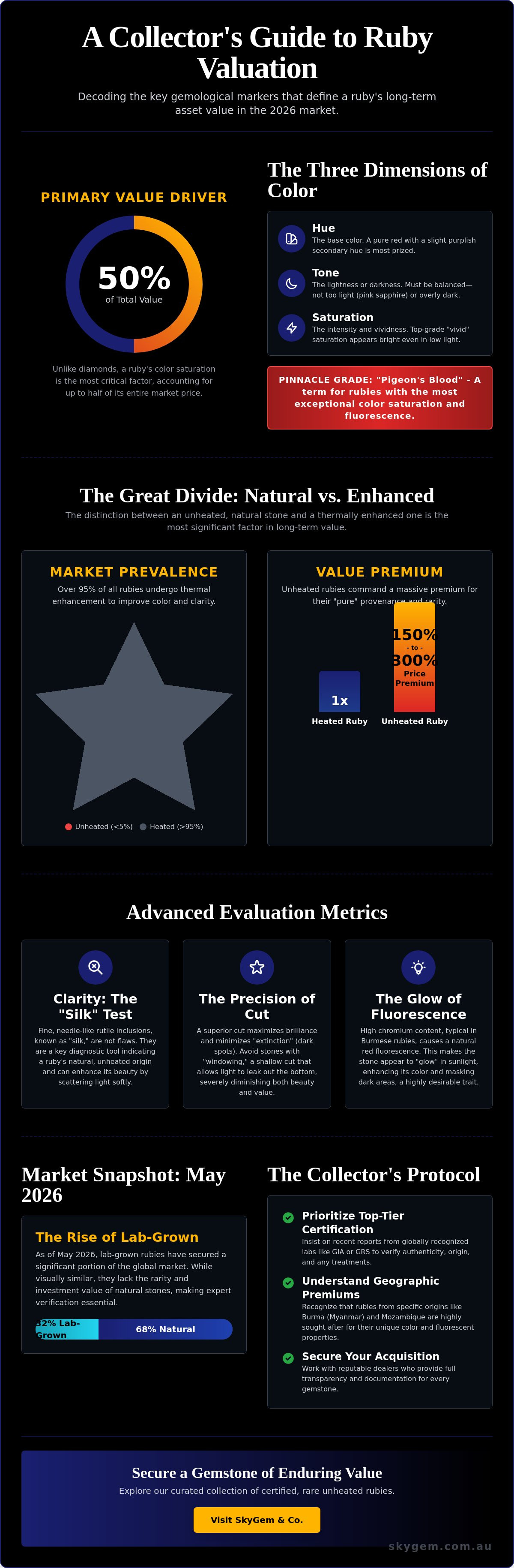
Did you know that as of May 2026, lab-grown rubies have secured a 32% share of the global market, often presenting a visual profile that mimics natural stones with startling accuracy? For the serious collector, this reality creates a landscape where technical due diligence is the only safeguard against significant financial missteps. It's common to feel a sense of hesitation when faced with the nuanced differences between a heated commercial stone and a rare, unheated specimen. Understanding exactly what to look for in a quality ruby is no longer just about aesthetic preference; it's about identifying the specific gemological markers that define long-term asset value.
This guide provides the technical precision you need to master ruby selection, from decoding the "Pigeon's Blood" colour grade to evaluating the impact of thermal management on a stone's price. You'll learn why an unheated ruby can command a 150% to 300% premium over its treated counterparts and how to interpret the latest 2026 GIA identification and origin reports. We'll provide a structured breakdown of how to balance the 4Cs within the current market context, ensuring you can secure a gemstone that offers both architectural beauty and enduring investment potential.
Key Takeaways
- Understand why colour saturation accounts for up to 50% of a ruby's total valuation and how to identify the most desirable hues within the corundum family.
- Gain technical clarity on what to look for in a quality ruby by distinguishing between rare, unheated specimens and the 95% of stones that undergo thermal enhancement.
- Learn to identify "silk" inclusions as a diagnostic tool for natural origin and authenticity rather than viewing them as a clarity defect.
- Evaluate how cutting techniques impact a stone's brilliance and why avoiding "windowing" is essential for maintaining both aesthetic and financial value.
- Establish a protocol for secure acquisition by prioritising GIA or GRS certification and understanding the premium associated with specific geographic origins like Mozambique and Burma.
The Hierarchy of Ruby Quality: Why Colour Reigns Supreme
Ruby is scientifically classified as the red variety of the mineral corundum. While other colours of corundum are categorised as sapphires, the presence of chromium transforms this mineral into the most valuable coloured gemstone in the world. When evaluating Ruby quality factors, colour remains the primary driver of value, typically accounting for up to 50% of a stone's total market price. Unlike diamond grading, which relies on a strict, linear scale of transparency and lack of colour, ruby assessment is a nuanced study of light and chemistry.
The industry's pinnacle is the "Pigeon's Blood" designation. This term describes a ruby with exceptional saturation and a specific level of fluorescence that creates a vibrant, glowing red. For collectors determining what to look for in a quality ruby, achieving this balance between deep saturation and internal brilliance is the ultimate goal. You'll find that natural rubies with this certification command the highest premiums in the 2026 market because they represent the rarest intersection of geological conditions.
The Three Dimensions of Ruby Colour
Hue refers to the basic colour of the stone. While a pure red is rarest, most rubies exhibit secondary overtones of purple, orange, or pink. A slight purplish tint is generally preferred as it enhances the richness of the red. Tone describes the lightness or darkness of the stone; if a stone is too light, it's technically a pink sapphire. Saturation is perhaps most critical, representing the vividness of the hue. A "vivid" saturation grade indicates a stone that appears bright even in low-light environments, avoiding the dullness of "flat" stones.
The Role of Fluorescence in Quality
Chromium isn't just a colouring agent; it also triggers fluorescence. This physical property allows a ruby to emit its own light when exposed to ultraviolet radiation, including natural sunlight. High fluorescence can effectively mask "extinction" areas, which are the dark, non-reflective patches within a gem. This is why Burmese rubies, which typically possess high chromium and low iron content, often appear more "alive" than Thai rubies. Thai specimens often contain higher iron levels, which quenches fluorescence and results in a darker, more brownish-red appearance that lacks the same visual energy.
Natural vs. Enhanced: Navigating Ruby Treatments
Over 95% of rubies entering the global market in 2026 have undergone some form of thermal enhancement. While this is a widely accepted practice, it creates a significant divide in the valuation hierarchy that every collector must understand. When assessing what to look for in a quality ruby, the distinction between a stone that has been optimised by human intervention and one that reached its peak aesthetic naturally is critical for determining long-term value. A quality ruby is defined as much by what hasn't happened to it as by its visual appearance.
Standard Heat Treatment (Thermal Enhancement)
Thermal enhancement typically involves heating the gemstone to temperatures between 800 and 1,800 degrees Celsius. This process dissolves rutile inclusions, which improves the stone's transparency and clarifies its primary red hue. According to GIA's ruby quality factors, this treatment is permanent and does not compromise the stone's structural integrity. It isn't a deceptive process; it simply completes a natural geological event that didn't finish within the earth's crust. However, because heat-treated stones are more abundant, they lack the extreme rarity of unenhanced specimens.
The Rarity of Unheated Rubies
An unheated ruby is a geological miracle. These stones possess exceptional colour and clarity without any external assistance, making them significantly rarer than treated specimens. In the current market, an unheated ruby can command a 150% to 300% price premium over a heated stone of the same visual grade. Collectors value these for their "pure" provenance and superior asset stability. If you're searching for an heirloom piece of enduring value, you can explore our collection of rare unheated rubies to see the difference in vibrancy first-hand.
You must remain vigilant against unstable treatments such as lead-glass filling or flux healing. These methods involve injecting foreign substances into surface-reaching fractures to mask significant flaws. Unlike standard heat, these treatments are considered non-permanent and can be damaged by common jewellery cleaning solutions or the heat used during ring resizing. A premium ruby should never rely on synthetic fillers for its visual appeal. If a stone's price seems disproportionately low for its size and colour, it often indicates these invasive enhancements. You can review our ruby price guide to ensure you're paying for genuine rarity rather than a temporary aesthetic fix.
Internal Characteristics: Clarity, 'Silk', and Authenticity
While diamond collectors demand a "loupe-clean" standard, the criteria for precious gemstones like ruby are more practical. In the gemological world, rubies are classified as Type II gemstones, meaning they almost always contain natural inclusions. When determining what to look for in a quality ruby, the industry standard is "eye-clean," which refers to the absence of inclusions visible to the naked eye at a distance of approximately 15 to 20 centimetres. A stone that appears clear to the eye while retaining its natural internal markers is often more desirable than a suspiciously perfect specimen.
Internal characteristics serve as a reliable map of a stone's history. These inclusions don't just prove a stone is natural; they can often pinpoint its geographic origin. For example, specific crystal shapes or "fingerprint" inclusions are characteristic of certain mining regions. Rather than viewing these as defects, experienced collectors see them as certificates of authenticity that distinguish a natural ruby from a lab-grown alternative.
The 'Silk' Signature
Fine, needle-like inclusions of rutile, known as "silk," are a hallmark of natural corundum. These microscopic structures scatter light, creating a soft, velvety glow that enhances the stone's internal colour and masks minor extinction areas. When these needles are densely packed and properly oriented, they produce the rare phenomenon of asterism, or the "star" effect seen in star rubies. The total absence of any inclusions in a large ruby is a primary red flag for synthetic origin. These natural growth markers are essential for verifying that a gem was formed over millions of years rather than weeks in a controlled laboratory environment.
Clarity Grading for Coloured Gems
Assessing clarity requires a balance between aesthetic appeal and structural stability. You should differentiate between "character" inclusions and "deal-breaker" flaws. Surface-reaching cracks are a significant concern as they compromise the stone's durability during the setting process or daily wear. Large black crystals or opaque clusters located directly under the table, the top flat facet, are also detrimental to value because they disrupt light return. In contrast, small inclusions tucked away near the girdle often have a negligible impact on the stone's market performance. Understanding these nuances helps you identify a quality ruby that maintains its structural integrity without sacrificing its visual brilliance.
The Precision of the Cut: Maximising Brilliance and Weight
Ruby cutting is an exercise in compromise that differs fundamentally from the standardised approach used for diamonds. While diamonds are processed to achieve a mathematical ideal for light return, rubies are cut to balance colour saturation, clarity, and carat weight retention. When determining what to look for in a quality ruby, you'll find that symmetry often takes a back seat to colour preservation. A master cutter's primary goal is to align the stone's table facet with the crystal axis that displays the most vibrant red, a property known as pleochroism.
Pleochroism means the ruby displays different colours depending on the angle of observation, typically a purplish red from one direction and an orangey red from another. By precisely orienting the cut, a specialist can ensure the face-up colour is the most desirable hue. This technical decision is what separates a premium investment stone from a commercial specimen. If the cut is too shallow, the stone may suffer from "windowing," where light leaks through the back and creates a pale, lifeless centre. Conversely, a cut that is too deep might make the stone appear smaller than its carat weight suggests, though it can also intensify the saturation of a lighter-coloured crystal.
Common Ruby Shapes and Their Performance
Ovals and cushions are the most prevalent shapes in the high-end market because they mirror the natural "rolled pebble" shape of raw ruby crystals. This allows for maximum weight yield while maintaining excellent light return. Round brilliants are significantly rarer in weights exceeding 1.0 carat. The cutting process for a round stone requires removing a large percentage of the raw material, which results in a substantial price premium. Step cuts, such as the emerald cut, are reserved for stones with exceptional clarity, as their large, open facets provide a clear view into the stone's internal structure.
Proportions and Light Return
The visual impact of a ruby is defined by its brilliance and scintillation. Brilliance refers to the flashes of internal light, while scintillation is the sparkle produced when the stone moves. A poor cut often results in "extinction," which are dark or black patches where no light is reflected. While we previously established silk as an authentication marker, its interaction with the cut is vital. A precise cut uses these rutile needles to diffuse light throughout the pavilion, effectively softening extinction areas and creating a more uniform glow. To judge this accurately, you should always evaluate a stone in natural daylight; jewellery store lighting is often engineered to hide these technical deficiencies. If you are seeking a stone that balances technical precision with natural beauty, you can view our range of expertly cut natural rubies to observe these optical properties in person.
Sourcing and Certification: The Final Step in Selection
The final phase of acquisition involves securing technical documentation and ensuring ethical provenance. When you've mastered the visual indicators of what to look for in a quality ruby, you must then validate those observations through rigorous third-party certification. A premium gemstone functions as a long-term asset, and its market value is inextricably linked to its documented history and geographic origin. Without a reputable laboratory report, even the most visually stunning stone carries a high level of financial risk.
Ethical sourcing has become a primary pillar of quality in the 2026 market. Millennial and Gen Z buyers now represent 68% of the ruby market, driving a demand for "Clean Rubies" with verifiable supply chains. Ensuring your stone is conflict-free isn't just a moral choice; it's a future-proofing strategy that protects the stone's resale appeal in an increasingly transparent global economy.
The Power of Provenance
Historically, the Mogok valley in Burma set the benchmark for the "Pigeon's Blood" legacy. However, political instability in Myanmar has restricted new supply throughout early 2026, making existing Burmese rubies exceptionally rare and costly. Mozambique has effectively emerged as the modern standard for exceptional clarity and size. These African rubies often display fewer inclusions than their Burmese counterparts and are frequently supported by blockchain-backed traceability. For a detailed breakdown of how geographic origin impacts your investment, you can consult our Ruby Price Guide for current market valuations.
Verifying Your Investment
A report from a top-tier laboratory like the GIA (Gemological Institute of America) or GRS (GemResearch Swisslab) is non-negotiable for any high-value purchase. These documents provide an unbiased analysis of the stone's origin, treatment status, and colour grade. As of the April 2026 fee update, a GIA Identification and Origin Report for a ruby between 2.00 and 3.99 carats costs $120. This report serves as your technical guarantee. Before finalising a purchase, you should perform a final checklist:
- Verify that the certificate's measurements and weight match the physical stone exactly.
- Check for laser inscriptions on the girdle that correspond to the report number.
- View the stone in at least three lighting environments: natural daylight, incandescent light, and office LED.
Once you've secured a high-quality loose ruby, the focus shifts to architectural integration. Transitioning from a loose stone to a bespoke engagement ring design allows you to engineer a setting that specifically accommodates the stone's pleochroic axis and depth. This technical partnership ensures the mounting protects the ruby's structural integrity while maximising its unique light return. A custom-built solution transforms a rare mineral specimen into a permanent and functional piece of art.
Securing Your Legacy in Red Corundum
Identifying the perfect gemstone requires a technical eye for light return and a deep understanding of geological rarity. We've explored how the "Pigeon's Blood" saturation remains the market's gold standard and why unheated rubies continue to command a 150% to 300% price premium over treated counterparts. Mastering what to look for in a quality ruby ensures your selection aligns with both aesthetic excellence and long-term asset stability. Every inclusion and every facet tells a story of millions of years of pressure, and your choice should reflect that enduring history.
Our team specialise in the procurement of GIA-certified natural rubies and rare, unheated specimens. We combine this technical expertise with bespoke Australian craftsmanship to create permanent assets that reflect your personal standards. Begin your journey to a bespoke ruby engagement ring with a private consultation at SkyGem & Co. and allow us to partner with you in securing a gemstone of enduring value. We're ready to help you navigate the complexities of selection with quiet confidence and technical precision. Your search for the perfect ruby is a significant undertaking, and we're honoured to be your technical consultants in this process.
Frequently Asked Questions
Is a ruby more expensive than a diamond?
High-quality rubies frequently exceed the per-carat price of colourless diamonds. For instance, an exceptional 2-carat unheated ruby with a "Pigeon's Blood" certificate can command over $100,000 per carat in the 2026 market, which is significantly higher than a standard D-colour, internally flawless diamond of the same weight. Rarity is the primary driver of this valuation gap.
What does 'Pigeon's Blood' red actually mean?
This term represents a specific gemological grade for the pinnacle of colour saturation and fluorescence. It describes a vivid red hue that possesses a soft, internal glow, which effectively masks dark areas of extinction within the stone. A "Pigeon Blood" certification from a top-tier laboratory like GRS can increase a stone's market value by approximately 40%.
Can I wear a ruby engagement ring every day?
Rubies are exceptionally suitable for daily wear due to their mineral hardness. Scoring a 9 on the Mohs scale, rubies are second only to diamonds in their resistance to scratching and abrasion. This structural durability makes them a practical and reliable choice for engagement rings that must withstand the rigours of a lifetime of use.
How can I tell if a ruby is real or synthetic at home?
It's virtually impossible to distinguish a high-quality synthetic from a natural stone without professional laboratory equipment. While some suggest visual tests, these are unreliable for modern lab-grown rubies, which now account for 32% of the market. When researching what to look for in a quality ruby, you'll find that only a GIA or GRS report provides definitive proof of natural origin.
Why does the origin of a ruby affect its price so much?
Origin serves as a technical proxy for rarity and specific geological signatures. Burmese rubies carry a historical prestige and a high-chromium, low-iron chemical profile that produces superior fluorescence. This heritage creates a pricing hierarchy where stones from legendary mines like Mogok command a premium due to their diminishing supply in 2026 compared to more abundant sources.
What is the difference between a pink sapphire and a light ruby?
The distinction is based entirely on technical saturation and tone thresholds. Both gems are varieties of the mineral corundum; however, if the chromium content is low enough that the primary colour is pink rather than red, it's classified as a sapphire. Gemological laboratories use master stones to determine this boundary, which has a significant impact on the stone's nomenclature and market value.
Does heat treatment decrease the value of a ruby?
Heat treatment doesn't decrease the value, but it establishes a lower price ceiling compared to rare unheated specimens. Since over 95% of rubies are thermally enhanced to improve clarity, it's the industry standard for commercial stones. An unheated stone is considered a geological miracle, which is why it commands a 150% to 300% price premium over a treated counterpart of identical appearance.
What is the best setting for a high-quality ruby ring?
The ideal setting balances physical protection with maximum light exposure. High-quality rubies require settings that allow light to enter the pavilion facets to activate their internal silk and fluorescence. When determining what to look for in a quality ruby setting, consider platinum or 18k gold prongs, as these materials provide the necessary structural integrity to secure the gem for decades without compromising its aesthetic brilliance.
Disclaimer
This article is for general informational purposes only and may include AI-assisted content. Pricing, specifications, and availability are subject to change. For accurate advice and current information, please contact SkyGem & Co. directly. Nothing in this content constitutes professional or financial advice.