
VVS vs VS Diamond Clarity: The Expert Guide for Your Engagement Ring in 2026

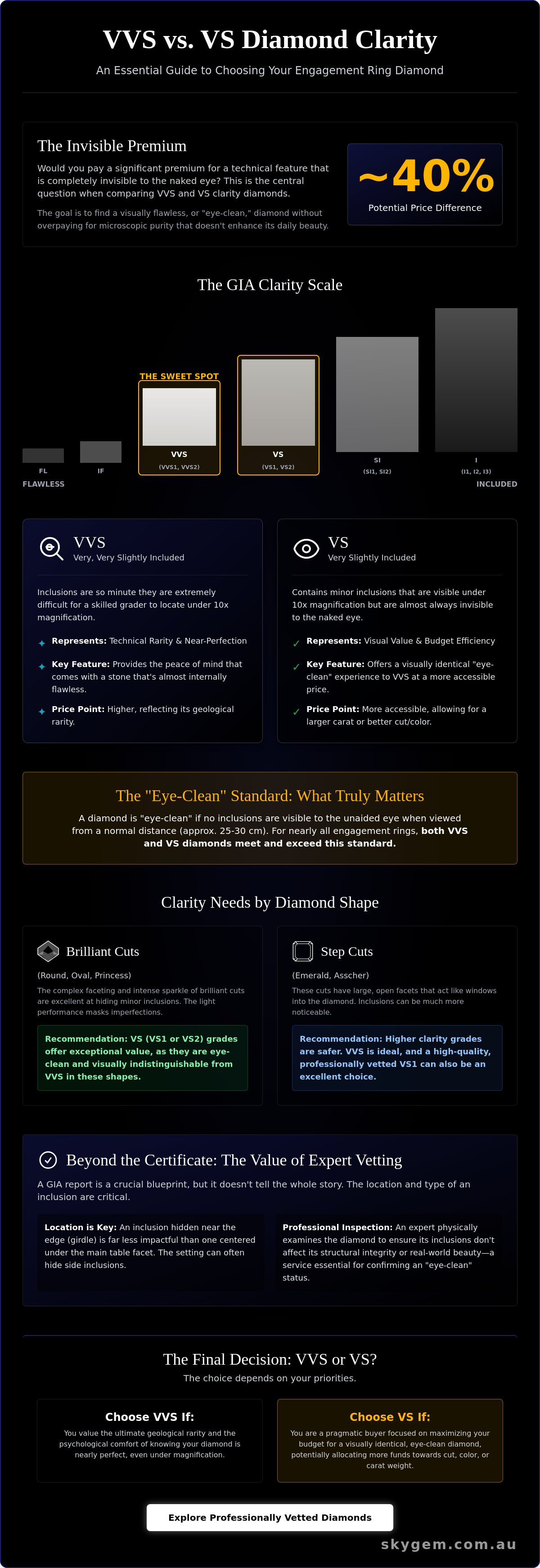
Would you intentionally pay a 40% premium for a technical feature that is invisible to the human eye? This is the central question facing many couples when evaluating VVS vs VS diamond clarity for an engagement ring. While a grading report provides a scientific breakdown of a stone's internal characteristics, the practical difference between Very, Very Slightly Included and Very Slightly Included often disappears once the diamond is set in a bespoke mounting. We understand that you want a stone that remains flawless to the eye without overpaying for microscopic specifications that don't enhance the ring's daily beauty.
You likely feel the pressure to choose a perfect diamond, yet the price gap between these two clarity grades can be substantial. In this guide, we provide the technical expertise to help you identify truly eye-clean stones and explain how specific diamond shapes require different clarity standards. You'll learn how to balance clarity with cut and colour to maximize your 2026 budget. This analysis moves from high-level grading definitions to granular advice on stone selection, giving you the confidence to secure a high-performance diamond that meets both your aesthetic requirements and your financial goals.
Key Takeaways
- Identify why VVS and VS grades represent the optimal balance of rarity and visual purity for a high-performance engagement ring.
- Understand the "eye-clean" standard to determine if the price premium for VVS vs VS diamond clarity for an engagement ring offers a tangible visual benefit for your specific mounting.
- Learn how diamond geometry influences clarity needs, particularly why step-cuts require higher technical grades than brilliant-cut counterparts.
- Discover why a grading report is only a baseline and how professional physical inspection ensures the long-term viability and aesthetic precision of your stone.
Understanding Diamond Clarity: Why the VVS vs VS Debate Matters
Clarity serves as a technical assessment of a diamond's internal purity and surface integrity, measured under standardised 10x magnification. While many factors contribute to a stone's allure, clarity is the primary metric for rarity. When you evaluate VVS vs VS diamond clarity for an engagement ring, you're essentially deciding between two tiers of high-performance luxury. These categories represent the "sweet spot" where technical excellence meets practical beauty, ensuring that your investment remains visually stunning for decades.
The choice between these grades often involves a trade-off between psychological satisfaction and budget efficiency. A VVS stone offers the peace of mind that comes with near-perfection, while a VS stone often provides an identical visual experience at a more accessible price point. This decision must be made in the context of the other 4Cs. A diamond's clarity grade does not exist in isolation; it interacts directly with the cut quality to determine how light is reflected and whether internal characteristics are obscured or highlighted. As natural diamond prices show signs of stabilisation in early 2026 after the fluctuations of 2025, understanding these nuances is essential for making a strategic purchase.
The GIA Clarity Grading Scale
The industry standard, established by the GIA, utilises an 11-grade scale ranging from Flawless (FL) to Included (I3). For those seeking a custom made engagement ring in Melbourne, the VVS and VS categories are the most sought-after due to their consistent performance. This scale provides a universal language for professionals to communicate the size, number, and position of inclusions. Referencing the established standards for Diamond Clarity ensures that your selection is backed by rigorous laboratory testing rather than subjective opinion. A GIA report acts as a technical blueprint, verifying that the stone meets the strict criteria required for these premium classifications.
Defining VVS and VS in 2026
The technical distinctions between these grades are precise. VVS (Very, Very Slightly Included) diamonds contain inclusions so minute that they are difficult for even experienced graders to locate under magnification. These are divided into VVS1 and VVS2, with the former being closer to internally flawless. VS (Very Slightly Included) diamonds contain minor inclusions, such as small crystals or clouds. While these are visible under 10x magnification, they remain invisible to the naked eye in almost all instances. The "V" in VVS makes a significant difference in market pricing because of the geological rarity of stones with such high purity. In the current 2026 market, selecting VVS vs VS diamond clarity for an engagement ring allows you to decide whether your priority is technical rarity or visual value.
Technical Distinctions: Microscopic Differences Between VVS and VS Grades
The distinction between VVS and VS grades is defined strictly by what remains visible under 10x magnification. While a customer might see a clear, sparkling stone, a master jeweller identifies a landscape of microscopic features. These features include pinpoints, which are tiny crystals; clouds, which are clusters of pinpoints; and needles, which are long, thin crystals. The primary technical differentiator in VVS vs VS diamond clarity for an engagement ring is the ease with which these characteristics are located by a trained professional. In a VVS stone, these features are so minute that they are difficult to find even under laboratory conditions.
Location is the most critical variable in determining a grade. An inclusion positioned directly under the table, the large top facet, is more likely to impact the grade than one tucked near the girdle or hidden under a bezel facet. Inclusions near the table are more visible because they aren't obscured by the diamond's brilliance. Conversely, characteristics near the girdle can often be hidden by the ring's setting. This spatial factor explains why two diamonds with the same number of inclusions can have different clarity rankings. It's a matter of structural positioning and light interference.
VVS1 vs VVS2: The Elite Tiers
VVS1 diamonds represent the pinnacle of clarity, often indistinguishable from Internally Flawless stones. Technically, VVS1 inclusions are only visible when viewed through the pavilion, the bottom of the stone, under 10x magnification. VVS2 inclusions might be visible from the crown but remain exceptionally difficult to pinpoint. This tier is favoured by perfectionists who value technical rarity. According to the GIA Diamond Clarity Scale, these stones are extremely rare in nature. This rarity contributes to their higher market value and long-term investment potential compared to lower grades.
VS1 vs VS2: Finding the Visual Threshold
The VS category is where strategic buyers often find the best value. VS1 diamonds contain minor inclusions that are difficult to see under 10x magnification. VS2 stones have slightly larger or more numerous characteristics. However, the colour of the inclusion matters as much as the size. A white twinning wisp or a faint cloud is far less noticeable than a dark carbon spot. Many VS2 diamonds are completely eye-clean. If you are looking for high-quality natural GIA certified diamonds, an expert physical inspection is the only way to confirm if a VS2 stone meets your visual standards. This technical vetting ensures that your budget is allocated toward brilliance rather than invisible grading metrics.
The Eye-Clean Standard: Visual Performance in Real-World Settings
While technical grading reports provide a necessary baseline for quality, the true test of a diamond occurs outside the laboratory. For most buyers, the ultimate goal is to secure a stone that appears flawless under normal conditions. This brings us to the concept of the "eye-clean" standard. When evaluating VVS vs VS diamond clarity for an engagement ring, it's essential to recognise that a VS1 stone is almost always visually identical to a VVS1 stone to the naked eye. The premium paid for VVS often covers technical rarity that remains invisible during daily wear.
Professional assessment involves a specific viewing distance rule. To determine if a stone is eye-clean, experts evaluate the diamond at a range of 15 to 25 centimetres under balanced lighting. If no inclusions are detected at this range, the diamond meets the standard for a high-quality engagement ring. However, carat weight acts as a magnifying glass for clarity. A 1-carat VS2 diamond is likely to be eye-clean, but as you move toward a 2-carat stone, the facets become larger and the internal characteristics more apparent. In larger stones, the choice of VVS clarity becomes a more practical safeguard against visible inclusions.
Magnification vs The Naked Eye
The decision-making process often involves a choice between "mind-clean" and "eye-clean" stones. A mind-clean diamond, typically in the VVS range, provides the psychological assurance of near-perfection. In contrast, an eye-clean diamond focuses on visual performance in daily environments rather than laboratory conditions. An eye-clean diamond is defined as a stone with no inclusions visible to a person with 20/20 vision at a normal viewing distance. Because daily wear involves movement and varied light sources, minor VS inclusions that are visible under a 10x loupe often disappear entirely in the sparkle of the stone.
Clarity and Brilliance: The Hidden Connection
Clarity impacts more than just the presence of spots; it influences how light travels through the stone. While minor VS inclusions won't affect sparkle, very heavy inclusions can cause light leakage, which reduces the overall fire of the diamond. This is why the cut quality is paramount. A GIA "Triple Excellent" cut grade is arguably more important than achieving VVS clarity. A superior cut maximizes light return, using brilliance to effectively mask minor internal characteristics. By prioritising cut over technical clarity, you ensure the diamond delivers maximum visual impact. This strategic approach allows you to maximise your budget while maintaining the high standards expected of natural GIA certified diamonds.
Strategic Selection: Matching Clarity to Diamond Shape and Metal
The physical architecture of a diamond dictates how light interacts with its internal characteristics. When you evaluate VVS vs VS diamond clarity for an engagement ring, the specific shape you select should be your primary guide. Brilliant-cut diamonds, including the Round, Oval, and Pear, are engineered with a complex facet arrangement that produces intense scintillation. This light performance serves a practical purpose by effectively masking minor VS inclusions. In these shapes, the visual difference between a VVS stone and an eye-clean VS2 stone is virtually non-existent under standard conditions.
The interplay of light between the metal and the stone is a frequently overlooked factor when comparing VVS vs VS diamond clarity for an engagement ring. Platinum and white gold offer a neutral, high-lustre background that complements the icy purity of a VVS stone. In contrast, 18K yellow gold can be more forgiving of slight colour tints, yet its rich hue can highlight dark carbon inclusions in a VS2 diamond. Strategic stone placement, such as positioning a prong over a peripheral inclusion, can further optimise the final aesthetic. By aligning your clarity choice with the diamond's geometry and the ring's material, you ensure a balanced investment that prioritises visible beauty over invisible technical grades.
The Step-Cut Challenge: Why Clarity is Paramount
Emerald and Asscher cuts are defined by their transparency. Unlike the fragmented light of a round brilliant, these shapes feature long, rectangular facets that act as a window. This is known as the "hall of mirrors" effect, where any internal feature is easily reflected and magnified throughout the stone. We typically recommend VVS or high-specification VS1 grades for these designs. In a step-cut, even a minor pinpoint can create a "salt and pepper" effect that detracts from the diamond's clean, architectural lines. This is particularly noticeable in minimalist solitaire designs where the stone is the sole focus of the piece.
Metal Choices and Setting Strategies
Beyond the choice of metal, the setting style provides a final layer of tactical optimisation. A halo setting surrounds the centre stone with a perimeter of smaller diamonds, creating a wall of brilliance that can draw the eye away from minor internal characteristics. Prongs can also be positioned with precision to conceal a feather or a crystal located near the girdle. By consulting with a specialist on bespoke engagement ring design, you can ensure that the stone placement and setting style are engineered to mask any technical imperfections. You can explore our available natural GIA certified diamonds to see how different grades perform across various shapes and settings.
Beyond the Certificate: SkyGem & Co.’s Professional Selection Process
A grading certificate provides a scientific snapshot, but it cannot capture the unique personality of a stone. When selecting VVS vs VS diamond clarity for an engagement ring, relying solely on a report can be a mistake because two diamonds with identical GIA grades are never truly the same. One VS2 might have a faint white cloud near the edge, while another has a dark crystal directly under the table. Our role is to act as your technical consultant, performing a rigorous physical inspection to ensure that every stone we offer meets a premium visual standard regardless of its technical classification.
Integrating clarity into a balanced budget is particularly vital for a Solitaire Engagement Ring. In these minimalist designs, the stone is fully exposed to light from all angles, making internal purity more critical than in a complex halo setting. We prioritise sourcing "eye-clean" VS1 and VS2 stones that offer the same visual impact as VVS diamonds, allowing you to reallocate funds toward a larger carat weight or a superior cut grade. This methodical approach ensures that your investment is directed toward features that contribute to the ring's daily performance and beauty.
The Bespoke Consultation Advantage
Our selection process involves more than just a transaction; it's a collaborative technical review. During a boutique consultation, we utilise high-resolution video and 10x loupe sessions to examine natural GIA certified diamonds side-by-side. This allows you to see exactly how light interacts with specific inclusions. We tailor our recommendations to your lifestyle and ring design, ensuring the stone you choose is robust enough for daily wear while maintaining its aesthetic precision. This level of partnership ensures the long-term success of your bespoke project.
Natural vs Lab-Grown Clarity
The technical rules for clarity remain consistent across both natural and lab-created stones. However, the market dynamics differ significantly. Because the growth process of lab-grown diamond selection is controlled, VVS clarity is far more accessible and common than in the natural market. This accessibility allows buyers to secure a technically near-flawless stone at a price floor that was previously impossible. When choosing VVS vs VS diamond clarity for an engagement ring in the lab-grown sector, the price gap is often narrow enough that opting for the higher VVS grade becomes a practical and affordable luxury that guarantees absolute purity.
Securing Your Investment with Technical Precision
Selecting the ideal stone involves more than just reading a grading report. The decision between VVS vs VS diamond clarity for an engagement ring should be guided by the diamond's shape, the setting style, and your personal standard for visual purity. While VVS offers technical rarity, a carefully selected VS stone often provides identical beauty. This allows you to optimise your 2026 budget for cut quality and carat weight. Relying on a physical inspection by a professional ensures that your diamond is truly eye-clean and structurally sound for a lifetime of wear.
At SkyGem & Co., our expert GIA-trained consultants act as your technical partners throughout the design process. We're specialists in crafting bespoke solitaire engagement rings that highlight the unique properties of every stone. Whether you're in Melbourne or require national Australian shipping and support, we provide the granular detail needed to make an informed choice. Book a bespoke consultation at SkyGem & Co. to find your perfect diamond and take the next step in creating a permanent asset of exceptional quality. We look forward to helping you secure a piece that perfectly reflects your standards.
Frequently Asked Questions
Is VVS better than VS for an engagement ring?
VVS is technically superior in terms of geological rarity, but it isn't necessarily better for the final appearance of your ring. When comparing VVS vs VS diamond clarity for an engagement ring, most people find that a VS stone looks identical to the naked eye. VVS offers the psychological benefit of near-perfection, while VS provides a more efficient use of your budget without compromising visual beauty.
Can you see VS1 inclusions with the naked eye?
No, VS1 inclusions are completely invisible to the naked eye and can only be detected under 10x magnification by a trained professional. These internal characteristics are minor and don't interfere with the stone's transparency or brilliance. This makes VS1 one of the most popular choices for those seeking a balance between technical quality and real-world performance.
Why is there such a big price jump between VS1 and VVS2?
The price increase is a direct reflection of scarcity in the natural diamond market. As you move up the clarity scale, the number of diamonds available in nature drops significantly, which drives the market value higher. While the visual difference between these two grades is often indistinguishable, the VVS2 diamond is a rarer asset, which commands a premium price for its technical purity.
Does diamond shape affect which clarity grade I should choose?
Yes, the diamond's architecture plays a vital role in how inclusions are perceived. Brilliant cuts like round or oval stones have many facets that reflect light in complex patterns, which helps hide minor internal features. However, step-cuts like Emerald or Asscher diamonds have large, open facets that act like windows. For these shapes, we recommend a higher clarity grade to ensure the stone remains eye-clean.
Is it worth buying a VVS diamond if it's lab-grown?
Opting for VVS clarity is often a strategic choice for lab-grown diamonds because the price premium is much smaller than in natural stones. Since lab-grown diamonds are produced in controlled environments, high-clarity stones are more accessible. This allows you to secure a technically perfect stone for your engagement ring without the significant financial trade-offs required in the natural diamond market.
What is the best clarity grade for a round brilliant solitaire?
VS2 is typically the optimal clarity grade for a round brilliant solitaire. The intense sparkle and scintillation of the round brilliant cut are exceptionally good at masking small inclusions. When evaluating VVS vs VS diamond clarity for an engagement ring in this shape, a VS2 stone usually offers the best visual value, allowing you to focus more of your budget on a superior cut grade.
Can a jeweller hide a VS2 inclusion under a prong?
A master jeweller can often conceal an inclusion by strategically positioning a prong or a part of the setting over the characteristic. This is most effective for inclusions located near the girdle or the outer edges of the diamond. During our technical design process, we evaluate the stone's internal map to determine if the setting can be engineered to hide specific features and enhance the final aesthetic.
Should I prioritise clarity over colour or cut?
You should always prioritise the cut of the diamond above all other factors. The cut is responsible for the stone's brilliance and fire, which has the most significant impact on its overall beauty. A perfectly cut diamond can hide minor clarity features through its intense light return. Once you've secured a high-quality cut, you can then balance colour and clarity to fit your specific design requirements.
Disclaimer
This article is for general informational purposes only and may include AI-assisted content. Pricing, specifications, and availability are subject to change. For accurate advice and current information, please contact SkyGem & Co. directly. Nothing in this content constitutes professional or financial advice.