
Natural Gemstones Origin : The Complete Scientific Guide

A decorative certificate of authenticity is not scientific proof of where a crystal formed. True provenance isn't established across a retail sales counter; it's determined inside an accredited gemological laboratory through rigorous analytical chemistry. When verifying the origin of a natural gemstone, relying on unsubstantiated verbal claims leaves you exposed to synthetic substitutes, undisclosed thermal treatments, and distorted valuations.
You shouldn't have to wonder whether an unheated sapphire, ruby, or emerald genuinely hails from an elite historic deposit or an ambiguous secondary source. The distinction between baseline species identification and an independent geographic origin report dictates tangible market confidence, yet conventional retail settings frequently blur the two.
Discover the precise laboratory methodologies specialists use to decode crystal chemistry and verify geological sources, empowering you to commission bespoke fine jewellery with absolute certainty. We'll explore the inclusion microscopy, trace-element fingerprinting, and report evaluation standards that transform subjective claims into empirical fact.
Key Takeaways
- Understand the critical distinction between baseline species identification and comprehensive geographic origin reports rooted in empirical geological data.
- Discover the diagnostic role of high-magnification immersion microscopy and LA-ICP-MS trace-element profiling when verifying the origin of a natural gemstone.
- Learn how accredited independent gemological laboratories evaluate trace chemistry against curated reference databases to issue definitive scientific opinions.
- Recognise how overlapping geological formations from ancient continental shifts can complicate chemical signatures, and why unheated status preserves vital diagnostic markers.
- Acquire a systematic verification protocol to safely evaluate physical stone characteristics against independent laboratory documentation before commissioning bespoke jewellery.
What Does Verifying the Origin of a Natural Gemstone Actually Mean?
Verifying the geographic origin of a mineral specimen connects that physical crystal to a definitive subterranean deposit. In commercial jewellery spaces, retail documents often label a stone as "genuine" without establishing where it formed. True geographic provenance requires comparative geochemical testing rather than sales declarations.
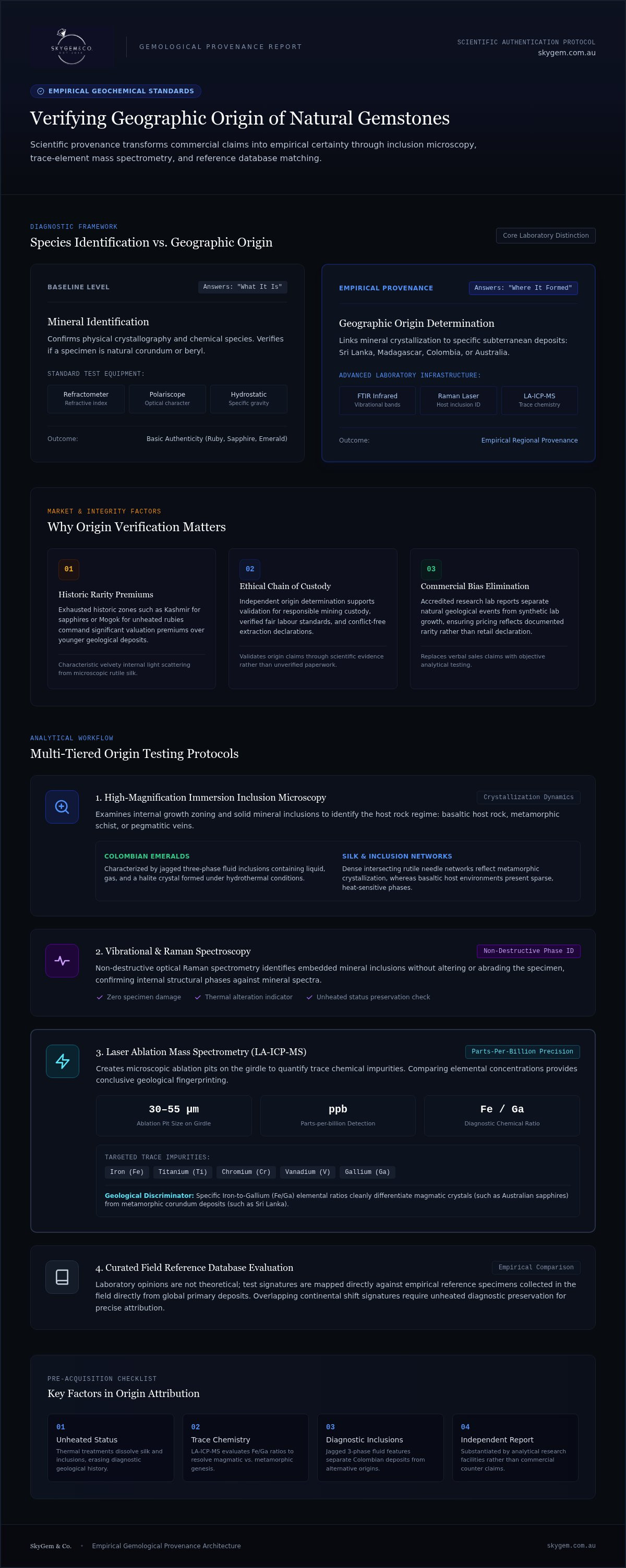
The process of verifying the origin of a natural gemstone evaluates microscopic internal characteristics and elemental impurities against empirical reference samples. Independent research laboratories examine whether a crystal crystallized within basaltic host rock, metamorphic schist, or pegmatitic veins. This empirical link establishes clear provenance, directly separating natural geological events from synthetic laboratory growth.
Gemstone Identification vs. Geographic Origin Determination
Basic gemstone identification answers what a stone is, whereas geographic origin determination answers where it formed:
- Mineral Identification: Confirms physical properties and chemical family, identifying whether a specimen is natural corundum (sapphire/ruby) or beryl (emerald). Standard refractometers, polariscopes, and hydrostatic balances easily resolve this baseline.
- Geographic Origin Determination: Establishes the exact regional mining site, such as Sri Lanka, Madagascar, Colombia, or Australia. Conclusive attribution demands advanced infrared spectroscopy, Raman spectrometry, and trace-element mass spectrometry.
Standard testing confirms authenticity, but origin testing requires advanced scientific infrastructure.
Why Origin Verification Dictates Valuation and Ethical Sourcing
Geographic origin dramatically influences market valuation across untreated coloured stones. Historical extraction zones with exhausted reserves, such as Kashmir for sapphires or Mogok for unheated rubies, command exponential valuation premiums over geologically younger deposits. These historical premiums reflect distinctive visual traits, such as the velvety internal light scattering caused by microscopic rutile silk in Kashmir material.
Geographic provenance provides structural accountability. Ethical sourcing standards rely on definitive origin verification to validate responsible mining custody, fair labour practices, and conflict-free origin claims. Discerning collectors can review laboratory-tested specimens within our precious gemstones collection to understand how validated provenance underpins quality.
Independent laboratory reports remove commercial bias from transactions. When an independent gemological report confirms origin, the valuation reflects documented rarity rather than subjective appraisal.
The Scientific Methods Used to Verify Gemstone Geographic Origin
Gemologists don't rely on isolated visual checks. Conclusively verifying the origin of a natural gemstone demands a multi-tiered analytical protocol combining optical crystallography, trace geochemistry, and advanced vibrational spectroscopy. Laboratories compare empirical test results against verified reference libraries curated directly from field-collected mining deposits.
Microscopic Inclusion Fingerprinting
Under high-magnification immersion microscopy, internal growth structures reveal formation dynamics. Jagged three-phase fluid inclusions containing liquid, gas, and a halite crystal traditionally characterize hydrothermal formation in Colombian emeralds. Growth zoning and mineral silk also distinguish formation regimes. Dense, intersecting rutile needle networks reflect metamorphic crystallization, whereas basaltic host environments present sparse, heat-sensitive mineral phases. Gemologists employ non-destructive Raman spectroscopy to identify these embedded mineral inclusions without altering the stone.
Chemical Trace Element Profiling
Trace chemistry delivers definitive geological fingerprinting. Laser Ablation Inductively Coupled Plasma Mass Spectrometry (LA-ICP-MS) assesses micro-impurities down to parts-per-billion, creating microscopic ablation pits measuring roughly 30 to 55 micrometres on the girdle. Evaluating trace concentrations of iron, titanium, chromium, vanadium, and gallium establishes clear discriminators. Diagnostic iron-to-gallium (Fe/Ga) ratios clearly differentiate magmatic gems, such as Australian sapphires, from metamorphic corundum sourced from Sri Lanka. Reviewing verified provenance within natural sapphires ensures buyers select gems with documented geochemical profiles.
Spectroscopic and Optical Analysis
Spectroscopic instrumentation assesses crystal lattice physics to ensure full authenticity:
- UV-Vis-NIR Spectroscopy: Measures absorption bands across ultraviolet and visible spectra, mapping chromophore mechanisms that determine colour origin.
- FTIR Spectroscopy: Identifies structural hydroxyl groups and diagnostic bonding patterns to distinguish natural formation from thermal enhancement.
- Photoluminescence Mapping: Examines defect centers within the crystal lattice, detecting subtle lattice diffusion and artificial irradiation treatments.
When verifying the origin of a natural gemstone for an heirloom setting, combining technical science with bespoke design provides total peace of mind. To review verified laboratory documentation alongside tailored mounting options, you can book a private gemstone consultation.
Comparing Independent Gemological Reports for Natural Gemstones
A standard retail appraisal is not a scientific origin report. Store valuations estimate local replacement figures for retail insurance schedules, frequently relying on unverified vendor paperwork. Rigorously verifying the origin of a natural gemstone requires documentation from an independent research facility with zero commercial jewellery sales interests.
Global gemological authorities operate strictly as non-transactional testing laboratories. According to the Laboratory Manual Harmonisation Committee (LMHC), an origin conclusion represents an expert gemological opinion based on comparative analysis against curated reference databases, rather than a legal guarantee. High-tier auction houses and bespoke jewellers rely on these objective determinations to confirm historical provenance and preserve international liquidity.
Recognised Global Laboratories for Coloured Gemstone Origin
Several accredited facilities represent the benchmark for coloured gemstone provenance:
- GIA (Gemological Institute of America): Assesses species, treatment status, and geographic origin across rubies, sapphires, emeralds, and alexandrite using extensive empirical databases.
- SSEF (Swiss Gemmological Institute) & Gübelin Gem Lab: Premier Swiss facilities renowned for high-value colored stones, tracing geological sources through field-collected reference samples.
- GRS (GemResearch Swisslab): Specialises in origin and treatment grading for major Asian and African deposit profiles.
For investment-grade specimens exceeding substantial values, trade standards often demand dual independent origin reports to confirm matching provenance.
Decoding Laboratory Wording and Origin Opinions
Reviewing independent reports requires careful attention to specific gemological phrasing. A laboratory report will explicitly state "inconclusive" when analytical markers cross regional boundaries, refusing to assign speculative localities. This technical restraint protects collectors from inflated provenance claims.
Buyers must distinguish between geographic origin determinations and trade colour descriptors. Terms like "Royal Blue" or "Pigeon Blood" describe visual colour grades. They do not confirm that a stone originated in Burma or Kashmir. Real provenance is stated separately under a dedicated "Geographic Origin" section.
Critically, origin verification must accompany complete treatment disclosures. High-temperature thermal treatments can alter internal inclusion networks and complicate testing. When assessing certified specimens among our untreated natural rubies, verify that the report states "no indications of heating", ensuring that both the geological source and the crystal's natural state remain fully substantiated.
Key Challenges and Complexities in Gemstone Origin Determination
Geological processes do not respect modern international borders. While high-precision instrumentation enables origin profiling, natural anomalies frequently challenge laboratory analysts. When verifying the origin of a natural gemstone, laboratories occasionally encounter physical and chemical ambiguities that prevent conclusive provenance attribution.
Mineral crystallization occurs across vast subterranean systems over millions of years. Secondary alluvial deposits present an initial hurdle, as weathering and river transport mix minerals from multiple host formations across extensive catchment basins. When a stone also exhibits exceptional clarity, the complete absence of diagnostic mineral inclusions or fluid cavities deprives analysts of vital visual baseline data.
Overlapping Geological Fingerprints and Inconclusive Findings
Continental drift explains why geographically distant mines can yield virtually identical crystals. Before the breakup of the Gondwana supercontinent, landmasses comprising modern-day Madagascar, East Africa, Sri Lanka, and Southern India formed a contiguous geological belt. Corundum deposits within these zones crystallized under matching thermal and baric conditions, resulting in overlapping trace-element profiles.
When mass spectrometry reveals overlapping iron-to-gallium or vanadium-to-chromium ratios across these historic belts, an accredited laboratory will issue an inconclusive finding rather than guessing. An inconclusive origin conclusion does not diminish the stone's authenticity; it validates the laboratory's scientific integrity by confirming natural origin while acknowledging the limits of current reference data.
The Impact of Thermal and Clarity Enhancements
Artificial modifications introduce another layer of complexity to origin analysis:
- Thermal Enhancement: Sustained high-temperature heating dissolves fine rutile silk and causes fluid inclusion discoids to burst, erasing the primary micro-structures needed for locality matching.
- Lattice Diffusion: Introducing elements such as beryllium or titanium under extreme heat alters the outer chemical shell, confusing trace-element spectrometers.
- Fracture Clarity Treatments: Polymer or oil substances used in fissure filling mask native host fluids within emeralds, impeding reliable spectroscopic profiling.
Unenhanced specimens retain pristine internal architecture, allowing full analytical scrutiny. Reviewing certified, unenhanced options within our natural emeralds collection highlights how undisturbed inclusions preserve crystal origin markers for definitive verification.
How to Safely Purchase an Origin-Verified Natural Gemstone
Acquiring fine jewellery centered on a rare coloured stone requires a methodical verification workflow. Because verifying the origin of a natural gemstone establishes both its scientific narrative and tangible market value, buyers must confirm that physical characteristics align precisely with the supporting analytical report before final payment.
Securing genuine provenance begins by separating sales assertions from verifiable laboratory documentation. Rather than accepting verbal promises, ensure that each candidate stone carries independent certification from a globally recognised research institution. The report must be accessible online via the issuing laboratory's database to prevent counterfeit or altered paperwork.
Essential Questions to Ask Before Buying a Precious Gemstone
When consulting with a jeweller or gemstone specialist, structure your technical inquiries around empirical documentation:
- Laboratory Independence: Is the accompanying dossier from an accredited, independent research facility (such as GIA, SSEF, or Gübelin) with zero financial interest in the retail transaction?
- Definitive vs. Trade Attribution: Does the document confirm a geographic origin opinion based on analytical testing, or does it merely quote a trade colour descriptor like "Pigeon Blood"?
- Complete Treatment Status: Does the documentation explicitly verify an unheated profile ("no indications of heating"), confirming that structural inclusions and native trace elements remain unaltered?
- Physical Metric Alignment: Do the measured dimensions, carat weight down to the hundredth, and inclusion plot match the physical stone under inspection?
Selecting Origin-Verified Stones for Bespoke Fine Jewellery
Commissioning custom pieces allows you to evaluate loose crystals prior to mounting. Settings can obscure inclusions, girdle laser inscriptions, and facet edges, making loose stone verification the gold standard. Examine candidate stones under balanced 5500K daylight equivalent lighting and 10x magnification to evaluate pleochroism, saturation, and natural crystallization markers in real time.
Collaborating with master jewellers ensures that bespoke mountings, such as custom solitaires or trilogy rings, protect delicate mineral structures while accentuating natural colour zoning. You can inspect unmounted gems and begin designing an enduring setting by scheduling an appointment.
Rigorous due diligence transforms gemstone acquisition into an informed investment. By confirming that independent analytical data supports every visual attribute, verifying the origin of a natural gemstone guarantees lasting authenticity across generations.
Securing Authentic Provenance for Your Bespoke Jewellery
Verifying the origin of a natural gemstone requires moving past subjective sales descriptions into empirical science. By combining diagnostic inclusion microscopy with trace-element mass spectrometry, accredited research laboratories establish verified geochemical links to historic deposits. Independent documentation protects your fine jewellery acquisition against undisclosed treatments, ensuring that market value reflects genuine geological rarity.
We specialise in ethically sourced, independent laboratory-certified natural sapphires, rubies, and emeralds. Our transparent consultations provide complete scientific origin disclosures for clients nationwide, pairing master craftsmanship with unheated stones to create custom engagement rings built to endure.
Frequently Asked Questions
Can a gemologist always determine the exact country of origin for a natural gemstone?
Laboratories can't always determine a conclusive country of origin. When verifying the origin of a natural gemstone, analysts sometimes encounter overlapping trace-element profiles caused by ancient geological formations across regions like Madagascar and Sri Lanka. Furthermore, stones with flawless clarity lack diagnostic mineral inclusions, depriving gemologists of vital visual evidence. In such ambiguous scenarios, responsible testing facilities issue an inconclusive origin finding rather than speculating.
Is geographic origin verification included automatically in every standard diamond or gemstone certificate?
Geographic origin verification isn't included automatically in standard gemological reports. Baseline identification certificates focus solely on mineral species classification, optical properties, and whether a stone is natural or synthetic. Geographic origin determination is a specialised, multi-instrument service requested specifically for major coloured stones like sapphires, rubies, and emeralds. For natural diamonds, uniform mantle growth conditions make geographic origin profiling chemically impossible.
How much does geographic origin really impact the market price of a natural sapphire or ruby?
Geographic origin exerts a massive influence on market valuation. Untreated corundum from historically depleted localities commands significant premiums based on prestige and visual uniqueness. Fine Burmese rubies routinely trade at premiums ranging from 100% to over 300% compared to equivalent Mozambique material. Kashmir sapphires can command premiums between three and ten times the price of visually comparable untreated gems from Ceylon or Madagascar.
What is the scientific difference between a certificate of authenticity and a laboratory origin report?
A certificate of authenticity is usually a subjective retail appraisal issued by a seller without analytical testing. In contrast, an independent laboratory origin report represents rigorous scientific research. When verifying the origin of a natural gemstone, accredited facilities deploy trace-element mass spectrometry and immersion microscopy, comparing empirical data against curated reference databases to issue an objective, non-commercial gemological opinion.
Can heat treatment permanently prevent a laboratory from verifying a gemstone's geographic origin?
High-temperature heat treatment can permanently erase the microscopic evidence required for origin identification. Extreme heating melts delicate rutile silk networks and ruptures fluid inclusions, destroying the native internal architecture gemologists use to determine host formation conditions. Once these diagnostic structures dissolve and internal diffusion occurs, laboratories frequently find the analytical evidence compromised and classify the origin as inconclusive.
What happens if two independent gemological laboratories provide conflicting origin opinions for the same stone?
Conflicting laboratory results occur because geographic origin determinations represent expert scientific opinions rather than absolute legal certainties. Discrepancies arise when facilities rely on different internal reference libraries or varying statistical algorithms. When premier laboratories disagree on provenance, the international market generally prices the stone according to the more conservative origin call until secondary testing establishes clear consensus.