
Interest-Free Jewellery Financing Traps: What to Check Before You Commit

What if an “interest-free” jewellery offer costs more because you miss a condition? Understanding interest-free jewellery financing traps starts with looking beyond the promotional wording. The repayment schedule, fees, consequences of a missed payment and treatment of any balance left at the deadline can all affect what you repay.
It’s reasonable to expect a payment plan labelled interest-free to make the total cost clear. But details can be difficult to compare at checkout, and a repayment that looks manageable may not fit your budget throughout the full term.
This guide explains which terms to check before accepting an offer, how to compare its total repayment obligation with other ways to pay, and what to consider if a payment is late or the promotional period ends with a balance remaining. You’ll also learn how to assess whether instalments suit your budget before choosing a piece.
Key Takeaways
- When understanding interest-free jewellery financing traps, examine the agreement’s conditions rather than relying on the promotional headline.
- Compare offers using the same measures: total repayments, fees, repayment duration and missed-payment terms.
- Check whether the repayment schedule clears the balance within the promotional period. Investigate deferred interest only if the contract includes it.
- Set a jewellery budget first, then test repayments against essential expenses and possible changes in cash flow.
- Assess the jewellery and payment method separately, comparing design, stone and material options with your budget before deciding how to pay.
Interest-Free Jewellery Financing: What the Offer Actually Means
Interest-free jewellery financing is a payment arrangement where interest isn’t charged under the conditions set out in the finance provider’s agreement. The phrase describes the interest condition, not necessarily every cost, repayment obligation or consequence attached to the arrangement. Check the written terms to understand what you’ll pay and when.
This distinction is central to understanding interest-free jewellery financing traps. A promotional message may highlight an interest-free period, while the contract sets out the rules that determine whether the offer applies to your purchase and what happens if you don’t meet its conditions. The agreement, rather than the headline alone, is the basis for comparing options.
What does “interest-free” mean in a jewellery offer?
It means the provider’s terms specify that interest won’t be charged in the circumstances described. It doesn’t automatically mean there are no account charges, fees or other obligations. Offer periods, eligibility conditions and repayment rules can vary, so read the relevant agreement before deciding.
For example, an offer might promote interest-free repayments for a defined period, while the agreement sets out a required payment schedule and conditions for keeping that benefit. If a contract instead uses deferred interest, check what happens if the balance isn’t cleared by the stated deadline. The treatment depends on the specific wording. For general background on how unpaid interest can affect a balance, see this explanation of deferred interest.
Who provides the finance, and what does the retailer do?
Identify the lender or finance provider named in the agreement, then distinguish its payment terms from the retailer’s sale of the jewellery. The retailer supplies the item and sets out the purchase details. The provider’s agreement governs the credit or payment arrangement. Check which organisation to contact about each part, as their terms and responsibilities may differ.
Before accepting, confirm that the agreement relates to the intended purchase and review who administers payments. Don’t assume the retailer’s promotional description contains every condition or that the retailer is the lender. The named provider and written agreement give you the details needed to assess the arrangement.
Start with the complete commitment: the amount payable, payment schedule, applicable charges and conditions for late payments or a balance remaining at the end of the promotional period. If any term is unclear, ask the provider to explain it before you commit.
How Interest-Free Jewellery Finance Works: Terms That Shape Repayment
Your repayment obligation depends on the purchase amount, payment schedule and promotional period. A schedule may require regular payments, but the timing and amount don’t necessarily show whether the balance will be cleared before the promotional terms end. Check how the agreement treats any balance left at that point.
The contract, not the headline, defines the repayment obligation. Use the provider’s documents to work out the total scheduled repayments, then add any disclosed charges that apply. This helps you see whether the advertised interest condition reflects the full cost of the arrangement.
Which repayment and fee details should you find first?
Locate the required payment amount, frequency, first payment date and final date. Then check the agreement and any account documents for establishment, account, administration or late-payment fees, where applicable. Don’t assume a charge applies, or that it doesn’t, until you’ve checked the specific terms.
Compare the scheduled repayments with the purchase amount and all disclosed charges. If there’s a promotional period, check whether the schedule is designed to clear the balance by its end and what the agreement says if it doesn’t.
- Payment timing: Confirm when repayments start and how often they’re due.
- Total payable: Add scheduled repayments and applicable disclosed charges.
- Promotional conditions: Check the rules for the offer’s end date and any balance remaining.
What can happen if a repayment is late or missed?
Consequences depend on the agreement. Check whether it describes a late fee, a change to the interest terms or another outcome if a payment is missed. Don’t assume every provider treats a late payment the same way. Contact the provider for clarification if the wording isn’t clear.
Credit reporting or collection outcomes can depend on the provider and applicable rules. For questions about your circumstances or Australian requirements, consult current guidance from official Australian sources such as ASIC or Moneysmart, rather than relying on a retailer’s promotional summary.
If the agreement refers to deferred interest, read how that term works in the specific offer. Experian’s explanation of deferred interest versus a 0% introductory APR provides background on the distinction, but it doesn’t replace the provider’s contract or Australian guidance.
Once the payment commitment is clear, set your jewellery budget independently of the finance offer. A SkyGem & Co. consultation can help you discuss design and material choices within a stated budget. It isn’t an assessment of credit or a recommendation about a payment plan.
Interest-Free Jewellery Financing Traps: Compare the Conditions, Not the Headline
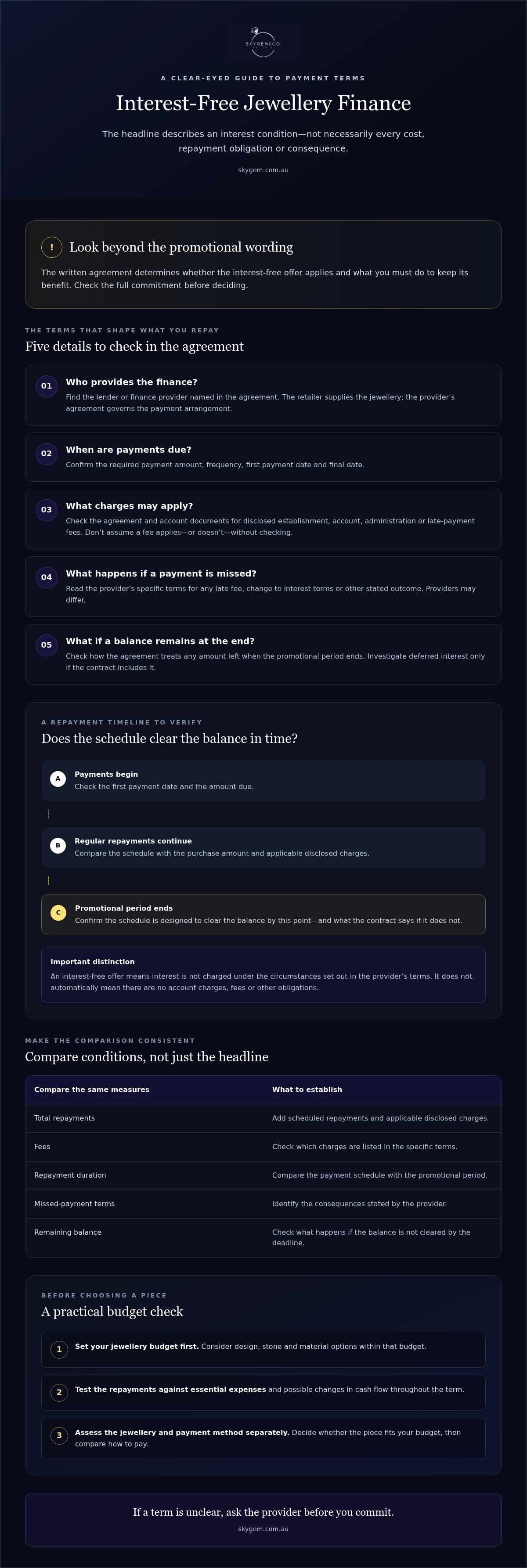
To compare offers fairly, use the same checklist for each one: total repayments, applicable fees, repayment duration and the stated consequences of a missed payment. This makes differences visible even when the promotional wording sounds similar. When understanding interest-free jewellery financing traps, focus on the conditions that determine what you’ll repay, not just the phrase used to advertise the offer.
| What to check | Where to find it |
|---|---|
| Total repayments and applicable charges | Repayment schedule, fee details and account terms |
| Offer duration and repayment dates | Promotional conditions and payment schedule |
| Late or missed-payment consequences | Default, late-payment or account terms |
| Eligibility and conditions for the offer | Offer terms and provider agreement |
| How any remaining balance is treated | Promotional-period and interest clauses |
How is interest-free different from deferred interest?
“Interest-free” generally describes an offer under which interest isn’t charged if the agreement’s stated conditions are met. Deferred interest may mean interest is postponed during a promotional period but could become payable later if specified conditions aren’t satisfied. Providers may use different wording, so don’t rely on a label alone or assume every jewellery finance offer works this way.
Check the contract to see whether interest can apply after the promotional period, what triggers it and how any remaining balance is treated. Compare those terms with an offer that states interest won’t be charged under its conditions. The practical distinction depends on the specific agreement.
Which red flags deserve a closer read?
A headline that omits fees, payment dates, eligibility requirements or missed-payment consequences leaves important questions unanswered. That doesn’t prove the offer is unsuitable, but you should locate the details in the written terms before deciding. A prompt to accept quickly is another reason to pause and review rather than commit under pressure.
Ask the finance provider to explain unclear terms in writing, then check that the explanation matches the agreement. In particular, clarify whether a missed payment changes the offer, whether charges apply and what happens at the end of the promotional period. Keep the response with your documents so you can compare the same conditions across options.
Once you’ve set out each offer against the same checklist, compare the full repayment commitment and decide whether its timing suits your budget. If a key condition remains unclear, wait until you understand it before accepting.
A Practical Checklist Before You Finance a Jewellery Purchase
A clear process helps separate the jewellery decision from the finance decision. Before comparing offers, set a maximum budget based on available funds and regular commitments. Credit approval only indicates that a provider may offer credit. It doesn’t establish that repayments will be comfortable for your household budget.
If you’re considering an engagement ring, explore design and material options within your predetermined limit using the engagement rings page. Keep that budget in view when reviewing any payment option.
- Set your budget. Decide what you can spend without relying on a promotional offer to make a higher amount feel manageable.
- Obtain the agreement. Read the provider’s written terms, not only a checkout summary or advertisement.
- Check the conditions. Find the total payable, repayment dates, applicable charges, promotional end date and terms for late, missed or early payments.
- Compare payment choices. Assess the offer alongside other available ways to pay, using the same total-cost and timing measures.
- Decide without pressure. Proceed only if the jewellery and payment commitment both fit your circumstances.
How can you check whether repayments fit your budget?
Compare each scheduled repayment with your ordinary expenses, regular commitments and a realistic buffer for unexpected costs. Consider likely changes to cash flow, such as a change in income or an upcoming large expense. If making the payments depends on everything going exactly to plan, the arrangement may be too fragile. You could delay the purchase or consider a lower-cost design instead.
What should you ask before accepting an offer?
Ask the provider to confirm in writing the total amount payable, every applicable fee and the complete repayment schedule. Clarify how the agreement treats late, missed and early repayments, and whether those actions affect promotional conditions. If an explanation is unclear or differs from the contract, request clarification before accepting. For general Australian finance information, check current Moneysmart or ASIC guidance that applies to the specific type of agreement. It may not address every offer.
Use the checklist to test the arrangement against your real budget, not just the amount a provider is willing to approve. This helps you assess both affordability and the contract’s conditions before committing.
Choose Jewellery on Your Budget, Then Decide How to Pay
A piece’s value to you and the suitability of a finance agreement are separate questions. First decide what you’re comfortable spending, then assess payment options against that limit. Credit approval doesn’t mean repayments are manageable, and an attractive offer shouldn’t determine how much jewellery you choose.
For a bespoke engagement ring, design choices can reflect your priorities and budget. Stone type and size, setting and metal are all details to discuss as part of the design brief. Exploring bespoke engagement ring design can help you consider which features matter most before making a payment decision.
How can design choices support a defined budget?
Start by identifying the features you value most, then discuss how design and material choices may align with your budget. An expert consultation can help you consider those choices and communicate your budget boundaries. This is a conversation about jewellery design, not finance advice or an assessment of whether credit is appropriate for you.
What is a sensible next step if you are still comparing?
Keep the two discussions distinct. Review finance terms directly with the named provider, and consider jewellery design separately from questions about credit. If you have individual credit or legal concerns, seek guidance from a qualified adviser or an appropriate official Australian source.
Understanding interest-free jewellery financing traps means looking carefully at the agreement, while also considering what you want from the piece and what fits your budget. If you’re still weighing up options, take time to compare design priorities without feeling obliged to accept a payment offer. SkyGem & Co.’s expert consultations can help you discuss jewellery choices within a stated budget.
Make Your Jewellery Choice With Confidence
Understanding interest-free jewellery financing traps comes down to checking the full agreement rather than relying on its headline. Compare total repayments, applicable fees, repayment period and missed-payment conditions before accepting an offer. Then assess whether the scheduled payments fit your budget, including room for ordinary expenses and changes in cash flow.
Keep the jewellery decision separate from the payment decision. A clear budget can help you weigh design, stone and material choices without letting a promotion or credit approval set your spending limit. SkyGem & Co. specialises in bespoke engagement rings and fine jewellery, with expert consultations to help customers explore tailored pieces within their budgets. A consultation is about jewellery choices, not finance advice.
Take the time you need to review the terms and choose a piece that fits both your priorities and your finances.
Frequently Asked Questions
Is interest-free jewellery financing really free?
Not necessarily. “Interest-free” describes an interest condition in the provider’s agreement, but it doesn’t confirm that every associated cost is zero. Check for applicable account, establishment, administration or late-payment fees, and review what happens if you miss a repayment or don’t clear the balance by the promotional deadline. The total commitment depends on the specific offer, so use the written terms rather than the advertisement to assess the cost.
What happens if I miss a repayment on an interest-free jewellery plan?
The outcome depends on the agreement. It may specify a fee, a change to the interest terms or another consequence, but don’t assume every provider applies the same conditions. Check the missed-payment clause and contact the provider promptly if you think you may not meet a due date. Ask what options apply to your account, and keep any response with your agreement so you can refer to the provider’s exact terms.
Can interest-free jewellery finance affect my credit report in Australia?
It can depend on the provider, the type of finance and its credit-check and reporting practices. Before applying, ask whether the application involves a credit enquiry and whether account or repayment information may be reported. Read the provider’s privacy and credit information carefully. Consult current guidance from the Office of the Australian Information Commissioner or ASIC if you need to understand credit reporting or have a concern about your own report.
How do I compare interest-free jewellery finance offers?
Compare each agreement using the same measures: total scheduled repayments, applicable fees, repayment frequency and duration, and the consequences of late or missed payments. Check what happens to any balance remaining at the end of a promotional period and whether the offer has eligibility conditions. A side-by-side comparison helps reveal differences that promotional headlines may obscure. If a condition is unclear, ask the named provider for an explanation in writing before accepting.
What fees should I check before using jewellery finance?
Review the agreement for any establishment, account, administration or late-payment fees, as well as other charges that may apply to your specific offer. Check when each charge could be incurred and whether it changes the total amount you’ll repay. Don’t assume a fee applies because it’s common in another agreement, or that no fee applies because the promotion emphasises interest-free payments. Confirm the full cost in the provider’s written terms.
Is deferred interest the same as interest-free finance?
No, the terms can describe different arrangements. An interest-free offer may state that interest won’t be charged if its conditions are met. Deferred interest may mean interest is postponed and could become payable later under conditions set out in the agreement. Providers may use different wording, so check whether interest can apply after the promotional period, what triggers it and how a remaining balance is treated. Don’t assume every jewellery finance offer uses deferred interest.
Can I return jewellery bought using a finance plan?
Whether you can return an item depends on the reason for return, the retailer’s stated policy and any consumer rights that apply to your circumstances. A return may also require follow-up with the finance provider because the purchase and credit agreement involve separate terms. Before buying, ask the retailer about its return process and ask the provider how a refund would affect your account. For rights questions, check current Australian guidance from the ACCC.
Disclaimer
This article is for general informational purposes only and may include AI-assisted content. Pricing, specifications, and availability are subject to change. For accurate advice and current information, please contact SkyGem & Co. directly. Nothing in this content constitutes professional or financial advice.