
Ultimate Diamond Buying Guide: Expert Quality & Value Tips

Did you know that lab-grown diamonds now account for approximately 61% of centre stones in engagement rings? This rapid shift in the global market has created a complex landscape where traditional assumptions about value and rarity no longer apply. Selecting a high-performance diamond for a bespoke piece of jewellery is a significant technical undertaking that requires more than a surface-level understanding of marketing terms. It's common to feel a sense of hesitation when faced with the granular data of a grading report or the ethical considerations of modern sourcing.
We believe that a diamond's value is a fusion of geological rarity, optical physics, and technical certification. This guide will help you master the technical and aesthetic nuances of diamonds to select the perfect stone for your bespoke jewellery with total confidence. We'll provide a structured framework for evaluating performance metrics, decoding the latest GIA and IGI certificate standards, and navigating the choice between natural and lab-grown origins. By the end of this article, you'll have the technical insight required to ensure your investment serves as a permanent and high-performing asset.
Key Takeaways
- Understand how the "Cut" grade serves as the primary driver of light performance, directly impacting the visual brilliance of your selected diamond.
- Gain clarity on the identical chemical and physical properties shared by natural and lab-grown stones to make an informed choice based on your technical priorities.
- Learn the essential steps for verifying third-party certifications from GIA or IGI to guarantee the authenticity and ethical origin of your stone.
- Establish a practical framework for matching specific shapes and colour grades to precious metals for a cohesive bespoke design.
- Master the technical language of the 4Cs to transition from a confused consumer to a confident stakeholder in your jewellery project.
Understanding the Diamond: Composition, Resilience, and Rarity
A diamond is fundamentally a solid form of the element carbon, organised in a highly specific crystal structure. Unlike graphite, which is also pure carbon, the atoms here are arranged in a face-centered cubic lattice. This formation occurs under staggering conditions, typically at depths of 150 kilometres beneath the Earth’s surface where pressures exceed 4.5 gigapascals and temperatures reach over 1,000 degrees Celsius. These extreme environments forge the stone's legendary resilience, making it the hardest known natural material. On the Mohs scale of mineral hardness, it holds the definitive rank of 10. For a piece of jewellery intended for daily wear, this rating ensures that the surface resists scratching from almost any other substance, maintaining its polish over decades.
Beyond physical toughness, the stone's value is defined by its interaction with light. High-quality stones exhibit a high refractive index of 2.417 and significant dispersion. This dispersion, often called "fire," is the stone's ability to split white light into its constituent spectral colours. When you examine a well-cut stone, you aren't just seeing a reflection; you're witnessing the result of precise geological and technical alignment. To understand the full scope of Diamond Composition, Resilience, and Rarity, one must look at both the atomic level and the broader market context.
The Molecular Structure of Carbon Allotropes
The strength of the stone comes from its strong covalent bonding. In this arrangement, each carbon atom shares electrons with four adjacent atoms, creating a rigid three-dimensional framework that resists structural deformation. This structure is unique among gemstones, providing a level of stability that prevents the material from degrading over time. However, the chemical profile isn't always perfectly uniform. Trace elements, such as nitrogen, can enter the crystal lattice during formation. While pure carbon results in a colourless stone, nitrogen atoms often introduce the subtle yellow tints found in many natural white diamonds.
Diamond Rarity in the Modern Market
It's a common misconception that all gem-quality stones are abundant. In reality, the vast majority of rough material recovered globally is industrial grade, used for cutting and grinding tools due to its extreme hardness. Gem-quality specimens represent only a fraction of total production. This geological rarity is what underpins the long-term value of natural stones. Because they are chemically inert and incredibly stable, they don't succumb to environmental wear or chemical erosion. This permanence is a direct function of their molecular stability, ensuring that a high-quality stone remains a permanent and evolving asset rather than a temporary purchase.
Decoding Diamond Quality: The Technical Framework of the 4Cs
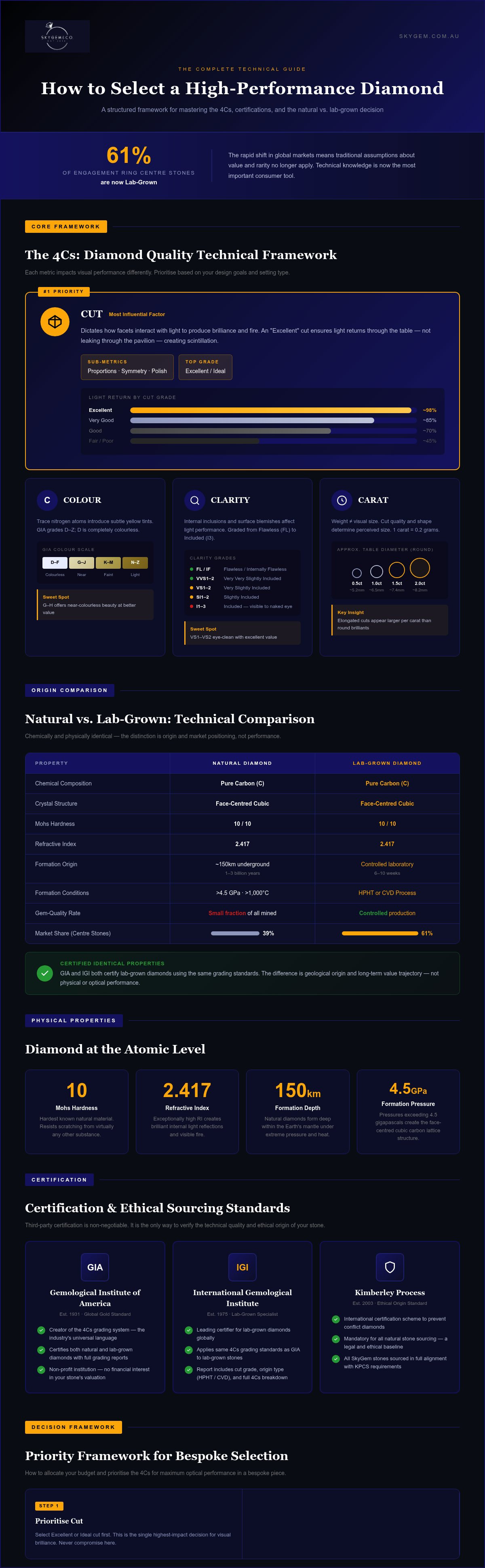
The 4Cs—Cut, Colour, Clarity, and Carat—act as the universal language for assessing stone value and performance. This framework isn't merely a retail tool; it's a rigorous technical standard that allows specialists to communicate the specific physical properties of a stone. While each metric influences the final grade, their impact on the visual outcome varies significantly. When we act as technical consultants for a project, we prioritise these metrics based on how they interact with the intended setting and the user's aesthetic goals. Understanding this hierarchy is essential for anyone looking to secure a high-quality asset.
Beyond aesthetic metrics, technical integrity is reinforced by global regulatory standards. We ensure all stones are sourced in alignment with the Kimberley Process Certification Scheme, providing a foundation of reliability for every project. This ensures that the technical excellence of a stone is matched by its ethical standing.
Cut Precision and Light Performance
Cut is widely regarded as the most influential factor in a stone's appearance. It dictates how well a diamond's facets interact with light to produce brilliance and fire. Technical sub-metrics such as proportions, symmetry, and polish determine the efficiency of light return. An "Excellent" cut ensures that light entering the stone is reflected back through the table rather than leaking through the pavilion. This precision creates scintillation, the play of light and dark that defines a high-performing stone. If you're starting a new project, our team can guide you through the bespoke design process to ensure your stone choice matches your design requirements.
Carat Weight vs. Visual Dimensions
Carat is a measure of weight, not physical dimensions. It's a common error to assume that a higher carat weight always results in a larger-looking stone. A poorly cut diamond might "hide" significant weight in a deep pavilion, resulting in a smaller surface diameter than a lighter, better-proportioned stone. This is why two stones of the identical weight can look remarkably different when placed in a solitaire engagement ring. We focus on the millimetre dimensions to ensure the visual impact meets the technical specifications of the design.
Colour and clarity provide the final layers of the quality framework. The colour scale runs from D (colourless) to Z (light yellow), with the D-F range being the standard for premium white settings. Clarity assesses the presence of internal inclusions. For most bespoke rings, we target the "eye-clean" standard. This means that while inclusions may be visible under 10x magnification, they don't interfere with the stone's beauty or structural integrity when viewed by the naked eye. Balancing these four factors requires a methodical approach to ensure value is maximised without compromising on performance.
Natural vs. Lab-Grown Diamonds: A Technical Comparison
A fundamental technical reality often overlooked in the jewellery industry is that lab-grown diamonds are chemically, physically, and optically identical to their natural counterparts. Both are composed of pure carbon arranged in a cubic crystal lattice. From a performance perspective, they exhibit the same refractive index, dispersion, and 10/10 hardness on the Mohs scale. While their origins differ, the resulting material is the same. For many projects, the choice between the two depends on whether the client prioritises geological rarity or the ability to secure a larger, higher-specification stone within a specific budget. To understand the broader industrial context of these materials, one can examine U.S. Geological Survey data on industrial diamonds, which details the long-standing use of synthetic material in technical applications.
The Growth Process: HPHT and CVD Explained
Modern technology allows us to create gem-quality material through two primary methods. The High-Pressure High-Temperature (HPHT) process utilises large presses to mimic the extreme conditions found in the Earth's mantle, using a molten metal catalyst to dissolve carbon and deposit it onto a seed. Conversely, the Chemical Vapour Deposition (CVD) method operates at lower pressures. CVD is a process where carbon atoms are deposited onto a seed diamond in a vacuum chamber. This method is often preferred for producing high-clarity stones as it allows for precise control over the chemical environment, minimising the introduction of impurities like nitrogen.
Long-term Value and Market Perception
The primary distinction between these two origins lies in their market dynamics and rarity. Natural stones are finite assets with a value underpinned by geological scarcity. In contrast, lab-grown stones are scalable, which has led to a significant price spread. As of mid-2026, the price difference between a one-carat natural and lab-grown stone of similar quality is approximately 78%. This makes lab-grown diamonds an excellent choice for modern, bespoke designs where the focus is on achieving maximum visual impact.
When selecting a stone for a permanent piece of jewellery, it's essential to consider your long-term goals. Natural stones tend to retain a higher percentage of their initial value due to their limited supply. However, lab-grown stones offer a level of transparency and environmental efficiency that appeals to many contemporary stakeholders. Both options are valid; the correct choice is the one that aligns with your technical requirements and personal values. We provide data-driven consultations to help you weigh these factors against the specific needs of your bespoke setting.
Certification and Ethical Sourcing: The Industry Standard
Certification from the Gemological Institute of America (GIA) or the International Gemological Institute (IGI) is a mandatory requirement for any high-value diamond purchase. These documents provide an impartial, third-party assessment of the stone's technical specifications. You shouldn't rely solely on a retailer's internal grading. As of 2026, the GIA remains the gold standard for natural stones, while the IGI has become the primary authority for full 4Cs grading of lab-grown specimens. Every certified stone features a microscopic laser inscription on its girdle that matches the unique identification number on the grading report. Verifying this inscription under a jeweller's loupe is a standard procedure we perform with every client to ensure absolute transparency.
Ethical integrity is a core component of a stone's value. We exclusively source natural diamonds that are certified through the Kimberley Process Certification Scheme. In 2026, this scheme expanded its mandate to include protections against human rights abuses, ensuring that your investment supports legitimate, conflict-free trade. This commitment to transparency ensures that the geological rarity of your stone isn't compromised by unethical practices or illicit trade chains.
Reading a GIA Diamond Grading Report
The GIA report includes a "Diamond Plot," which functions as a structural map of the stone. This diagram shows the exact location and type of internal inclusions or surface blemishes using specific symbols for crystals, needles, or feathers. Understanding this plot helps you identify your specific stone and ensures it meets the "eye-clean" standard discussed earlier. The proportions diagram is equally vital; it lists the table percentage, crown angle, and pavilion depth in precise percentages. These metrics are the hard data points that determine the "Excellent" cut grade. We also evaluate fluorescence, a technical detail where the stone reacts to UV light. While often misunderstood, fluorescence requires expert interpretation to ensure it doesn't cause a "milky" or "hazy" appearance in specific natural lighting environments.
Transparency in the Global Supply Chain
Maintaining a clean supply chain requires a partnership with reputable suppliers who adhere to the Responsible Jewellery Council (RJC) standards. These benchmarks go beyond simple conflict-free claims to include environmental and social governance criteria. For a deeper look at how these standards apply to local projects, you can explore our guide on Engagement Rings Australia. Our role as your technical consultant is to vet every stone for both its physical performance and its supply chain history.
Ready to view certified stones for your project? Browse our GIA-certified diamond inventory online to find a stone that meets your technical requirements.
Selecting Your Diamond for Bespoke Jewellery Design
The transition from a loose stone to a finished piece of jewellery is where technical specifications meet aesthetic design. Selecting a diamond is only half the process; the setting must protect the stone while enhancing its specific optical properties. We approach this as a technical partnership, ensuring the stone's dimensions and light performance align with the structural requirements of the ring. Every choice, from the metal alloy to the prong style, impacts the longevity and visual success of the project.
Finger aesthetics play a critical role in shape selection. A Round Brilliant offers the highest light return, while an Oval or Pear shape can create a visual lengthening effect on the finger. When matching a stone to its metal, we consider the colour grade carefully. A D or E grade stone is best suited for the cool tones of Platinum or White Gold. Conversely, a stone with a slightly lower colour grade in the G to I range can appear perfectly white when set in 18K Yellow Gold, as the metal's warmth masks the stone's subtle tint. This strategic pairing allows for a more efficient allocation of your budget without compromising the final aesthetic.
Shape and Setting Synergy
Step-cut shapes, such as the Emerald cut, feature large, open tables that act as windows into the stone. These require higher clarity grades than brilliant cuts because inclusions are more easily detected by the naked eye. If the goal is to maximise visual impact, a halo engagement ring uses a perimeter of smaller stones to enhance the perceived size of the centre diamond. Each shape has specific technical requirements for security. For example, V-prongs are essential to protect the vulnerable tips of a Pear or Marquise cut, ensuring the stone remains a permanent and secure asset.
The Expert Consultation Experience
Moving from loose stone selection to bespoke ring design requires a methodical consultation process. Unlike automated online tools, a professional consultation provides a technical audit of how your chosen stone will perform in a physical environment. We use CAD (Computer-Aided Design) to create a precise digital model of the setting, allowing for granular adjustments before any metal is cast. This precision ensures that the finished masterpiece is not only aesthetically perfect but also structurally sound for daily wear. From the initial stone procurement to the final setting, the process is designed to respect the technical complexity of high-end jewellery design.
Securing Technical Excellence for Your Bespoke Project
Mastering the technical nuances of the 4Cs and understanding the structural integrity of your chosen stone ensures that your investment remains a high-performing asset. Whether you prioritise the geological rarity of a natural stone or the scalable value of a lab-grown alternative, the foundation of a successful project lies in rigorous certification and expert interpretation of data. A diamond isn't merely a purchase; it's a permanent component of a bespoke design that requires precise engineering and aesthetic alignment.
By integrating GIA or IGI certified stones with professional CAD design services, you bridge the gap between technical specifications and a finished masterpiece. Our role is to act as your technical consultant, providing the expert guidance needed to navigate market shifts and sourcing standards with total clarity. This structured approach respects both your professional time and the long-term viability of the final design.
Take the next step in your design journey by securing professional insight tailored to your specific requirements. We invite you to Book an Expert Diamond Consultation with SkyGem & Co. to begin the process of creating a piece that reflects both technical precision and personal significance. Your path to a perfectly executed bespoke ring starts with a single, informed decision.
Frequently Asked Questions
What is the most important of the 4Cs when buying a diamond?
Cut is the most critical of the 4Cs because it directly determines the stone's light performance and brilliance. While colour and clarity are important, a poor cut will make even the highest quality material look dull. An "Excellent" cut grade ensures that light is reflected efficiently through the table, maximising the visual impact of your stone.
Are lab-grown diamonds considered 'real' diamonds?
Lab-grown diamonds are authentic diamonds, sharing the exact chemical, physical, and optical properties of natural stones. They are composed of pure carbon in a cubic crystal structure, just like those formed in the Earth's mantle. The only difference is the point of origin, which is why they are classified as a "real" diamond by gemological bodies like the GIA.
Why is GIA certification preferred over other grading labs?
GIA certification is preferred because the Gemological Institute of America maintains the industry's most rigorous and consistent grading standards. As a non-profit research institution, their assessments are impartial and internationally recognised. This consistency provides a level of technical security that other labs often struggle to match, ensuring the grade on the certificate accurately reflects the stone's properties.
How do I know if a diamond is ethically sourced?
Ethical sourcing is verified through the Kimberley Process Certification Scheme and adherence to the Responsible Jewellery Council's Code of Practices. These frameworks ensure that stones are conflict-free and sourced under fair labour conditions. In 2026, many high-quality stones also come with a GIA Diamond Origin Report, which uses scientific analysis to track the stone's journey from the mine.
What is the difference between Moissanite and a lab-grown diamond?
The primary difference is their chemical composition; Moissanite is silicon carbide, while a lab-grown stone is pure carbon. Moissanite also has a different refractive index, which creates a "disco ball" effect with more colourful fire than a traditional stone. While Moissanite is a durable alternative, it doesn't share the same physical or optical profile as a lab-grown diamond.
Can you tell the difference between a natural and lab diamond with the naked eye?
It is impossible to distinguish between a natural and a lab-grown stone with the naked eye. Even experienced gemologists require specialised spectroscopic equipment to identify the minute growth patterns or trace elements that reveal a stone's origin. For the user, the visual performance, brilliance, and fire will be identical regardless of whether the stone was mined or grown in a laboratory.
How much should I spend on a diamond engagement ring in 2026?
In 2026, the amount spent on an engagement ring should be dictated by your personal financial strategy and technical requirements rather than outdated social rules. We recommend focusing on the specific 4C parameters that matter most to you, such as prioritising cut and an eye-clean clarity grade. This technical approach allows you to maximise the stone's performance within your established budget.
What does 'eye-clean' mean in diamond grading?
"Eye-clean" refers to a stone that has no internal inclusions or external blemishes visible to the unaided eye when viewed from a distance of about 15 to 25 centimetres. While a stone might have microscopic characteristics visible under 10x magnification, an eye-clean rating ensures these don't detract from its beauty. This is a practical standard for bespoke rings, as it offers better value than paying for higher clarity grades.
Disclaimer
This article is for general informational purposes only and may include AI-assisted content. Pricing, specifications, and availability are subject to change. For accurate advice and current information, please contact SkyGem & Co. directly. Nothing in this content constitutes professional or financial advice.