
Trapiche Emerald vs Colombian Emerald: How They Differ

The defining difference between a trapiche emerald and a conventional Colombian emerald is its pattern, not necessarily its origin. A trapiche emerald has a distinctive fixed, six-rayed arrangement of dark spokes separating green areas; “Colombian” describes where an emerald comes from. The two terms therefore describe different features, and an emerald can be both trapiche and Colombian.
That distinction matters when you’re assessing a stone’s appearance and deciding which qualities matter most. A trapiche pattern is unusual and graphic, while conventional Colombian emeralds are valued for their green colour without the characteristic spoke-like structure.
This guide explains what makes an emerald trapiche, how its pattern forms as the crystal grows, and how it compares with conventional Colombian emeralds in appearance and physical properties. You’ll also learn why origin alone doesn’t identify a trapiche stone and what to consider when choosing an emerald for jewellery.
Key Takeaways
- Understand how a trapiche pattern develops within a single emerald crystal, rather than through twinning.
- Learn why growth sectors and contrasting boundaries create the stone’s distinctive radial design.
- See how cutting orientation can preserve the pattern and affect how it appears in a finished gem.
- Compare the shared physical properties of trapiche and conventional emeralds with the visual features that distinguish them.
- Recognise which gemological observations can help identify a trapiche emerald and assess its natural characteristics.
What Is a Trapiche Emerald?
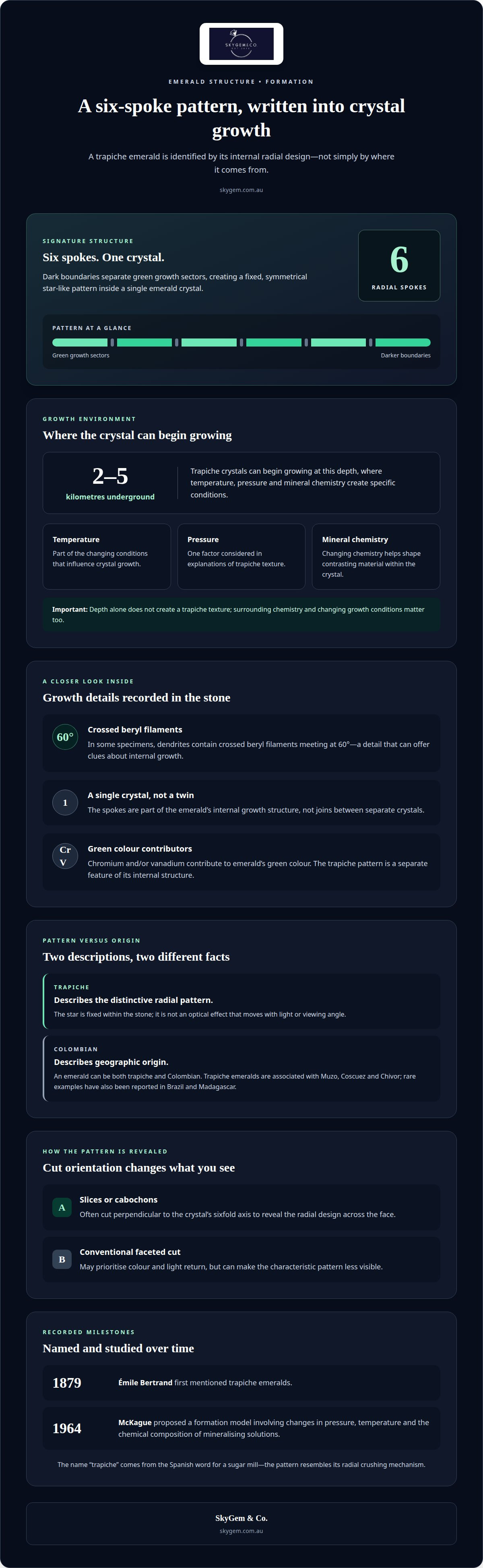
A trapiche emerald is a variety of beryl with a distinctive radial pattern: typically, six dark spokes divide green areas like a fixed star. The spokes are usually black, and the six arms align symmetrically with the crystal’s growth structure. “Trapiche” describes this pattern, not a separate mineral or a Colombian origin.
In Colombian examples, the pattern consists of six transparent, prismatic growth sectors separated by darker, non-transparent boundaries. Together, they create a star-like design within a single crystal. Trapiche emeralds are associated with Colombia’s Muzo, Coscuez and Chivor mining areas; rare examples have also been reported in Brazil and Madagascar.
The pattern forms as an emerald crystal grows under specific conditions involving temperature, pressure and mineralising chemicals. Differences in growth create the green sectors and contrasting material between them. A trapiche emerald is a single crystal, not a twin, so its spokes are part of its internal growth structure, not joins between separate crystals.
A trapiche star is fixed within the stone. By contrast, asterism describes a star effect that appears to move as light or the viewing angle changes. The difference helps enthusiasts distinguish a true trapiche pattern from a reflected or optical star effect.
Cutting orientation affects how clearly the pattern appears in jewellery. Trapiche emeralds are often cut as slices or cabochons perpendicular to the crystal’s sixfold axis, revealing the radial design across the face. A conventional faceted cut may prioritise colour and light return, but can make the characteristic pattern less visible.
In Australia, a trapiche emerald’s price depends on factors such as colour, clarity, carat weight, cut, pattern definition, treatment and provenance. The pattern’s symmetry and contrast can affect its appeal, while documentation can help establish origin and treatment history.
Assessment may consider the emerald’s visible characteristics and the definition of its pattern. For care, clean the stone gently with warm water, mild soap and a soft brush, then dry it with a soft cloth.
The name “trapiche” comes from the Spanish word for a sugar mill, which the pattern resembles. Six hexagonal arms are arranged symmetrically along the {110} crystallographic directions.
Trapiche emerald meaning and formation
A trapiche emerald’s internal structure records its growth history. Examining its geological setting and formation theories helps explain why this texture appears in only certain crystals.
Formation Conditions and Depth
Trapiche emerald crystals can begin growing about 2 to 5 kilometres underground, where temperature, pressure and mineral chemistry create specific conditions. Emerald is a beryl variety; chromium and/or vanadium contribute to its green colour. These conditions matter because a crystal’s growth environment influences its composition and internal features, helping explain why two emeralds from Colombia can have markedly different appearances.
Colombian emerald formation is associated with mineralising fluids moving through geological settings, including the country’s eastern and western emerald belts. Depth alone doesn’t create a trapiche texture: the surrounding chemistry and changing growth conditions matter too. This distinction separates an emerald’s geological origin from the particular structure recorded inside an individual crystal.
Development of Trapiche Texture
Trapiche texture develops as a crystal grows amid changing chemical conditions, which can leave contrasting material within its structure. Rather than representing a second crystal joined to the emerald, the texture records differences formed during growth. In some trapiche specimens, dendrites contain crossed beryl filaments meeting at 60°. Such details give gemologists evidence of internal growth processes beyond the visible surface pattern.
Inclusions also form part of an emerald’s internal record. Their type and arrangement can help distinguish growth features from material introduced later. Chromium and vanadium contribute to green colour, while other minerals or organic matter may occur as inclusions in Colombian emeralds. Examining the interior can help explain how a particular crystal developed.
Theories of Formation
Formation theories explain how changing geological conditions may produce the distinctive internal texture. In 1964, McKague proposed a model incorporating changes in pressure, temperature and the chemical composition of mineralising solutions. The model matters because it treats the pattern as a product of interacting conditions, not simply a visual feature imposed after the crystal formed.
These factors provide a framework for understanding why trapiche structures are uncommon and why individual examples can differ. A gem’s visible pattern is one part of a more complex growth record involving beryl, mineralising fluids and changing conditions underground. For a closer discussion of how emerald structure informs jewellery design, arrange a design discussion.
Meaning and origin of the term Trapiche
The name “trapiche” comes from the Spanish word for a sugar mill. The pattern resembles the radial structure of a mill’s crushing mechanism, so the gemstone’s name describes its appearance. The term refers to the emerald’s internal design, not its colour, mineral species or country of origin. That distinction matters: “Colombian” identifies geographic origin, while “trapiche” describes a visible growth pattern.
Émile Bertrand first mentioned trapiche emeralds in 1879. His reference marks an early recorded use of the term, not the beginning of the geological process itself. The crystals formed underground before people named or studied their pattern. In gem descriptions, the historical name helps connect a modern stone with a recognised category of emerald structure.
The mill comparison is useful because the pattern has a central area and radiating divisions. In a typical example, six arms extend outward, separating green regions with darker boundaries. This pattern is fixed inside the crystal rather than appearing to move like a star effect. The name is a practical visual description, not a claim that the emerald contains a literal mill-shaped object.
“Trapiche” and “Colombian” answer different questions about a stone. The first describes its internal pattern; the second names its geographic source. A Colombian emerald may show the distinctive structure, but Colombian origin alone doesn’t make every emerald trapiche. In a description, the pattern term and origin term provide separate information.
The name also distinguishes trapiche emeralds from conventional emeralds in jewellery discussions. A seller or gem description using “trapiche” refers to the characteristic radial structure, while “emerald” identifies the gemstone variety. The term alone doesn’t establish colour quality, clarity, treatment or overall value. Those characteristics need separate assessment for each stone.
That separation is useful for Australian buyers comparing emerald descriptions. A defined trapiche pattern is uncommon: fewer than 2% of emeralds mined in Colombia display one. Its distinct appearance may make the gemstone valuable to collectors who prize unusual natural patterns, but the name alone cannot determine a stone’s value. Colour, pattern definition, clarity, cut and provenance remain relevant considerations.
Trapiche versus conventional emerald properties
Trapiche and conventional emeralds share beryl composition and a Mohs hardness of 7.5-8. Their key visible difference is the radial pattern; rarity alone doesn’t establish which stone is more valuable.
Color, Clarity, and Inclusions
Chromium and/or vanadium contribute to an emerald’s green colour, whether or not the stone displays a trapiche pattern. In a trapiche, dark spokes contrast with green sectors to create a graphic appearance not found in conventional emeralds. Clarity varies between individual stones; the pattern itself doesn’t establish clarity or colour quality.
Inclusions provide another point of comparison. In the 1930s, Bernauer identified quartz, muscovite, albite, pyrite and organic matter in Muzo emerald samples. These examples show the range of materials that may occur within Colombian emeralds, rather than a fixed inclusion profile for every trapiche or conventional stone.
Rarity and Relative Value
A defined trapiche pattern is uncommon among Colombian emeralds, but its presence doesn’t automatically make a stone more valuable than a conventional Colombian emerald. Value depends on the individual gem’s colour, clarity, cut, carat weight, pattern definition and provenance. Rarity is one consideration, not a substitute for assessing the whole stone.
The distinction also separates a gem’s visual interest from its physical properties. Both forms are emeralds, so the pattern doesn’t create a different mineral or change their shared hardness range. A conventional emerald can stand out for its colour, while a trapiche may appeal through its contrasting radial design.
Individual crystals can show optical characteristics that inform examination. In one studied Colombian trapiche emerald, the stone appeared blue-green when viewed parallel to its c-axis and yellow-green perpendicular to it. This pleochroism describes that specimen; it isn’t a defining colour rule for every Colombian emerald.
Cut also affects how internal features are presented. A slice oriented across the crystal can make the radial structure easier to see, while faceting may prioritise the stone’s colour and overall form. Comparing the two types means considering both what the emerald is and how its natural features appear in a finished cut.
Authenticity and identification
Identifying a trapiche emerald means assessing both its emerald characteristics and its internal pattern. A radial design alone doesn’t establish geographic origin or treatment history.
Identifying Authentic Emeralds
Examination looks for emerald’s characteristic green colour and inclusions, as well as a structured pattern within the crystal in trapiche stones. Assess the six-arm design as part of the stone, rather than assuming it from a surface marking or sales description. This helps distinguish a genuine growth feature from an appearance that merely resembles one.
Origin requires separate consideration. Muzo, Coscuez and Chivor are Colombian mining areas associated with trapiche emeralds, but a place name alone doesn’t establish a particular stone’s provenance. Records describing a stone’s source can support its history, while examining the crystal reveals its gem features. Neither detail substitutes for the other.
Internal features can add context. In the 1930s, Bernauer identified quartz, muscovite, albite, pyrite and organic matter in Muzo emerald samples. These minerals and materials are examples, not a checklist that every authentic emerald must match. The pattern, inclusions, colour and documented origin should be considered together when assessing a stone.
Treatments and Disclosure
Treatment information helps distinguish a stone’s natural characteristics from changes made after mining. Emeralds with minimal treatments are sometimes marketed as natural, so “natural” alone doesn’t tell a buyer what treatment the stone received. A clear description should state any known treatment separately from the stone’s natural origin and trapiche pattern.
For trapiche and conventional Colombian emeralds, don’t infer treatment from the six-arm design or country name. Those features describe pattern and origin, not treatment. A disclosure should state the treatment information available for the individual stone, using direct terms rather than implying that natural means untreated. This gives buyers a clearer basis for comparison.
For a considered comparison of natural emeralds, review natural emeralds alongside their pattern and treatment descriptions.
Frequency is another point to keep distinct from identification: fewer than 1 in 1,000 Colombian emeralds show the trapiche pattern. That figure describes how uncommon the pattern is, not whether a particular stone has been authenticated. In the examined Colombian trapiche emerald, the view through two prism faces was rotated by 30° from the view perpendicular to a prism. This observation describes the viewing geometry of that examined stone; it should not be treated as a universal test for every emerald. Individual assessment remains important.
SkyGem & Co.
SkyGem & Co. is a next step once you understand the difference between an emerald’s origin and its internal pattern and are considering jewellery. That distinction can clarify what you value in a gemstone. Choosing an engagement ring also involves deciding how its centre stone and setting should work together.
A trapiche pattern is a feature of a natural emerald, not an engagement-ring style. Keep the gemstone’s radial design separate from decisions about the ring’s overall form. If you’re considering a diamond-centred ring instead, focus on the diamond and the setting you prefer.
SkyGem & Co. offers Solitaire, Halo and Trilogy Engagement Rings, along with Lab-Grown Diamonds. These options suit different design preferences. A solitaire centres attention on one principal stone, a halo frames the centre with surrounding detail, and a trilogy design makes three principal stones its visual focus.
Turn to SkyGem & Co. when you’re ready to move from gemstone terminology to considering an engagement ring or diamond. If an emerald’s colour, inclusions, treatment or provenance remain central to your choice, keep those characteristics in view as you compare designs. When weighing ring styles, consider which visual emphasis you want.
Lab-Grown Diamonds offer another option for a diamond-centred design. A natural emerald and a diamond aren’t a direct comparison of origin terms: emerald describes a gemstone, while lab-grown describes how a diamond is produced. Keeping the distinction clear can help you choose a centre stone and style that suit your preferences.
A distinctive pattern needn’t be the only factor in a jewellery decision. Consider the look you want, the role of the centre stone and whether a Solitaire, Halo or Trilogy design aligns with your preferences. SkyGem & Co. can help you consider these options.
Make Your Next Choice With Clarity
As you move from research to a personal jewellery decision, focus on the qualities you want the finished piece to express. A distinctive gemstone can set the direction, while the setting and overall design shape how the choice works in everyday wear. Defining your priorities makes the next conversation more useful.
Knowing how a trapiche emerald differs from a Colombian emerald can help you describe what draws you to a stone, but your preferences should guide the design. Consider which visual details feel meaningful, how the piece will be worn and what information you want before settling on a direction. There’s no need to base your decision on one feature alone.
When you’re ready to discuss emeralds and the design possibilities that interest you, SkyGem & Co. can help you consider the next step.
Let your choice reflect what matters to you, and take the next step with confidence.
Frequently Asked Questions
Where Are They Found?
Colombian emeralds are associated with mining areas such as Muzo, Coscuez and Chivor. These localities are within Colombia’s emerald-producing regions, where emerald-bearing geological formations occur. A stone’s origin describes where it was mined, not necessarily its internal appearance. A Colombian emerald without a radial pattern remains Colombian; the trapiche designation describes a distinct crystal feature.
What is a trapiche emerald and how does its radial pattern form?
A trapiche emerald is an emerald with a radial arrangement of contrasting sectors and boundaries inside its crystal. The structure develops as the crystal grows under changing conditions, rather than being added as a surface design. In one examined crystal, the observed pattern changed with a 60° rotation along the c-axis. That observation illustrates how viewing orientation can affect what appears across a specimen.
Where are trapiche emeralds found, and are they always Colombian?
Almost all trapiche emeralds come from Colombia, particularly areas including Muzo, Coscuez and Chivor. They aren’t exclusively Colombian: rare examples have also been reported in Brazil and Madagascar. A trapiche pattern therefore doesn’t prove Colombian origin by itself. A stone’s description should distinguish its visible structure from its geographic provenance, as these terms communicate different characteristics.
What is the difference between a trapiche emerald and a regular Colombian emerald?
“Trapiche” describes an emerald’s internal pattern, while “Colombian” describes its geographic origin. A Colombian emerald may display a trapiche pattern, but the origin label alone doesn’t mean it does. Both remain emeralds, with the same mineral identity and shared physical properties. A Colombian stone without radial divisions, for example, is a conventional emerald from Colombia, not a trapiche emerald.
How can you tell a genuine trapiche emerald from an imitation or treated stone?
Identification relies on examining the stone’s internal structure, not simply its label or surface appearance. A gemological assessment can consider whether the pattern belongs to the crystal and examine inclusions and optical characteristics. Treatment is a separate question: a natural emerald may still have been treated. Ask for a written description distinguishing natural origin, any stated treatment and the basis for identifying the stone as trapiche.
What should Australian buyers check before purchasing a trapiche emerald?
Ask for clear information about the stone’s origin, treatment, colour, clarity, cut and pattern definition. Check that the description separates Colombian provenance from the trapiche pattern, rather than treating one term as proof of the other. For a significant purchase, consider an independent gemological assessment and keep the written description with your purchase records. These details help you compare stones on their individual characteristics.