
Toi et Moi Ring Meaning: Gemstone Symbolism and Uses

A solitaire places one gemstone at the centre; a toi et moi ring makes a pair of stones part of its meaning. The French phrase means “you and me,” and the design sets two gemstones close together to represent two people joined while retaining their individual qualities. The meaning and symbolism of a toi et moi ring begins with this balance between unity and individuality.
That symbolism can make the style feel personal, but a two-stone setting also looks and wears differently from a traditional solitaire. The choice is not only about what the gemstones represent: proportion, comfort and suitability for everyday wear matter too.
This article explores how gemstone pairings can express a relationship, how the style compares with solitaire and traditional rings, and when it may suit an engagement or another milestone. It also covers practical considerations for choosing stones and a setting, helping you decide whether this distinctive design reflects the meaning you want to carry.
Key Takeaways
- Two gemstones set close together can represent a couple’s unity while preserving each person’s individuality.
- Pairing stones with different colours or meanings can make the ring’s symbolism more personal.
- For an engagement ring, consider proportion, comfort and how securely the stones are set, as well as their meaning.
- A two-stone design offers a more expressive alternative to a solitaire, while a solitaire keeps the focus on one central gemstone.
- The style can mark an engagement, anniversary or personal milestone, depending on the meaning you want the pairing to carry.
Are toi et moi rings good for engagement?
Yes. A toi et moi ring can be a considered engagement choice when its paired stones suit the wearer’s taste and routine. The meaning and symbolism of a toi et moi ring can express a connection between two people while giving each gemstone its own character. With two focal points, the design also makes a more expressive statement than a single-stone setting.
The Two-Stone Design and Its Meaning
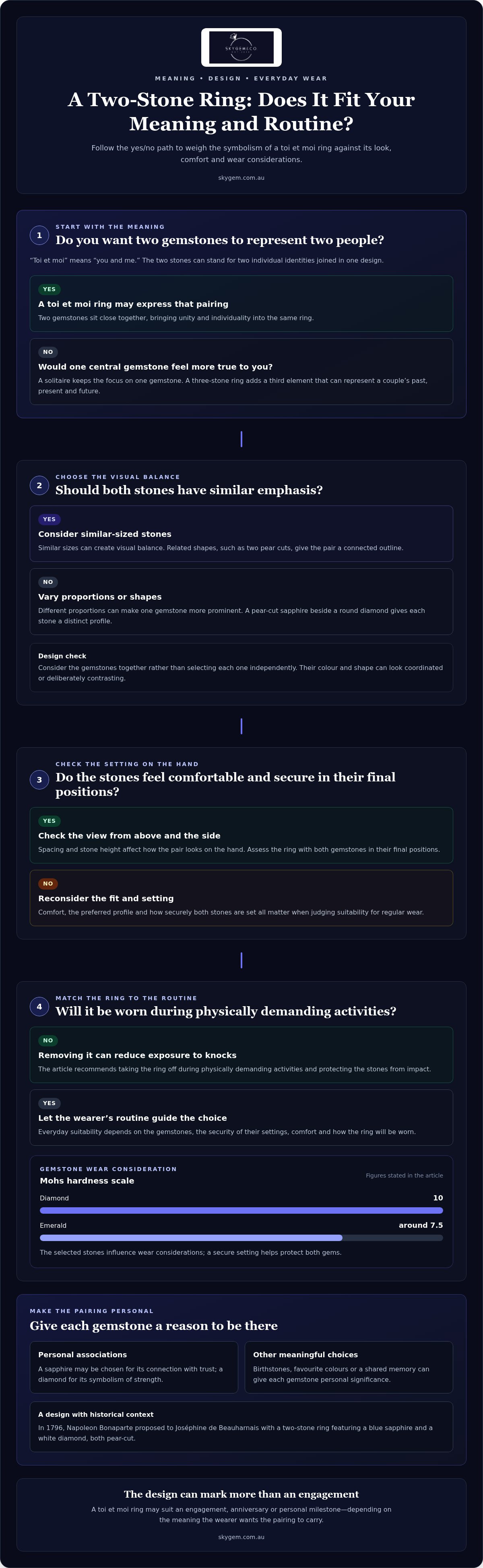
A toi et moi setting places two gemstones close together, bringing two distinct elements into one ring. Couples may choose similar-sized stones for balanced emphasis or vary their proportions to make one gem more prominent. For an engagement, the arrangement can represent two individual identities within a shared commitment. View the ring from above and from the side: spacing and stone height affect how the pair looks on the hand.
The design also has a historical connection: Napoleon Bonaparte proposed to Joséphine de Beauharnais with a two-stone ring in 1796. It featured a blue sapphire and a white diamond, both pear-cut. That example shows how a couple can combine distinct colours and shapes within one composition. A modern pair might choose different gems or cuts to reflect its own preferences rather than reproduce the historic ring.
Meaningful Stones and Personalisation
Personalising the stones means choosing them for associations that matter to the wearer. One partner might choose a sapphire for its connection with trust, while the other prefers a diamond for its symbolism of strength. The meaning and symbolism of a toi et moi ring can also come from birthstones, favourite colours or a shared memory. A meaningful pairing gives each gem a personal reason for being there, beyond visual contrast.
Shape and colour determine whether the pair looks coordinated or deliberately contrasting. Two pear cuts create a related outline, while a pear-cut sapphire beside a round diamond gives each stone a distinct profile. Similar sizes can create visual balance; a difference in size can establish a clear focal point. Consider the gemstones together rather than selecting each one independently.
Comparisons With Other Ring Styles
A solitaire engagement ring centres on one gemstone, keeping the design focused on a single feature. A toi et moi ring puts two stones in the foreground, while a three-stone ring adds a third element that can represent a couple’s past, present and future. Comparing these layouts can help you decide whether one focal point, a pair or a trio best expresses the commitment you have in mind.
Everyday suitability depends on the gemstones and the security of their settings. Diamonds rank 10 on the Mohs hardness scale, while emeralds rank around 7.5, so the selected stones influence wear considerations. A secure setting helps protect both gems, and removing the ring during physically demanding activities can reduce exposure to knocks. The wearer’s routine, comfort and preferred profile all matter in deciding whether it works as a daily engagement ring.
For a comfortable, secure fit, assess the ring with both gemstones in their final positions. For care, avoid wearing it during physically demanding activities and protect the stones from impact. These practical points can help you judge whether the design suits regular wear as well as carrying personal meaning.
The French meaning of toi et moi
In French, “toi et moi” translates directly as “you and me.” The phrase has three words: “toi” addresses one person, “et” joins the terms, and “moi” identifies the speaker. French uses familiar singular forms here, giving the wording a direct, personal quality. On a ring, the phrase names a relationship through two points of view rather than describing a gemstone or setting. Its literal translation is the starting point for its symbolism.
The wording places “you” before “me,” so it can sound like one person addressing another. But it does not establish which partner comes first or matters more. The wearer can read the phrase from either perspective. Maya might see it as a message to her partner, while Leo could understand the same words as describing their shared connection. The order expresses togetherness, not a ranking between two people.
As a jewellery term, toi et moi turns an everyday French phrase into a design idea. The words describe a relationship, while the ring gives it a visible form. A diamond beside an emerald, for example, makes the paired wording tangible through two distinct gemstones. Their arrangement can suggest coming together, while their differences allow each stone to reflect a separate person or quality. The phrase thus links language, material and personal interpretation.
The translation also explains why the style’s name feels intimate without prescribing a particular story. “You and me” can describe romantic partners, but the phrase itself does not identify a specific couple, milestone or promise. A wearer might connect it with a proposal, a lasting partnership or another meaningful bond. The French wording provides a compact theme; the people who choose the ring give it context.
The contrast with a solitaire helps clarify the phrase’s role. “Solitaire” describes a ring centred on one gemstone, while “toi et moi” names a relationship between two people. This distinction concerns the design’s underlying idea, not a fixed rule about what either ring must mean. For example, a wearer may choose a paired design because its French name expresses connection, then select gemstones and shapes that reflect their own story. Understanding the translation makes that choice more deliberate.
Contrasting gemstones and their symbolism
Contrasting stones let a toi et moi ring express both connection and difference. A diamond beside a coloured gemstone, for example, creates a visual distinction that can represent two individual personalities. The pairing might suggest strength alongside elegance, tradition alongside modernity, or a shared past alongside future plans. This contrast gives couples room to choose symbolism that feels romantic and personally relevant, rather than relying on colour alone.
Each gemstone carries familiar associations. Diamonds can symbolise enduring love, purity and strength; sapphires can represent loyalty, sincerity and trust. Rubies are associated with passion and vitality, while emeralds can suggest hope, growth and renewal. Aquamarine is linked with clarity and harmony, and amethyst with peace and tranquillity. Napoleon Bonaparte and Joséphine offer a well-known historical example of a diamond paired with a sapphire.
Modern pairings can begin with a shared story rather than a traditional meaning. A couple might choose a sapphire for one partner’s favourite colour and a diamond for the other’s preference for a clear, bright stone. An emerald beside a ruby could reflect growth and passion, while two differently coloured sapphires could represent distinct tastes within one relationship. These interpretations belong to the people wearing the ring; the stones offer a framework, not a fixed message.
Shape also affects how a gemstone pair looks. Two pear cuts can create a coordinated outline, while an oval beside a round cut introduces a visible difference. Similar-sized stones often create a more even balance, whereas a larger gemstone can become the dominant feature. Compare the stones from above and from the side, considering whether their outlines, colour contrast and proportions support the story you want the ring to express.
The metal adds another design layer. Yellow gold gives a ring warmth and vintage appeal, while white gold and platinum create a sleeker, contemporary finish. For example, yellow gold can complement a deep ruby’s rich colour, while white metal can emphasise the contrast between a blue sapphire and a diamond. The metal can visually connect the stones, helping two different gemstones read as one considered design.
To refine a pairing, decide what each stone should represent, then consider colour, cut and metal together. A sapphire and emerald might reflect loyalty and growth; an oval and pear cut would add another layer of contrast. The goal is balance, not identical stones: each gemstone should remain visually distinct while contributing to the ring’s overall appearance. This makes the symbolism deliberate and the combination personal to its wearer.
Engagements, anniversaries and personal milestones
A toi et moi ring can serve as an engagement ring because its paired design gives commitment a visible form. The two gemstones can represent people choosing a future together, while their distinct shapes or colours preserve each stone’s individuality. This style is commonly worn on the left-hand ring finger as an engagement ring. Its meaning, however, comes from the couple’s choice, not a required wearing rule.
Famous engagement rings show how differently the paired format can be interpreted. Jacqueline Kennedy’s toi et moi engagement ring featured an emerald and a diamond totalling more than 5 carats. The combination brought together two contrasting gemstones in a single design. Her ring offers an example for couples drawn to a noticeable contrast, rather than a matching pair, when selecting a style that feels personal and enduring.
Emily Ratajkowski’s engagement ring paired a 3-carat pear-cut diamond with a 2-carat princess-cut diamond. The different cuts and sizes gave each stone a distinct profile, while both remained part of one ring. This example shows how engagement rings can use contrast in more than colour: shape and proportion also influence the overall design. Couples can consider whether they prefer two similarly sized stones or one more prominent centre.
Ariana Grande’s toi et moi engagement ring placed an oval-cut diamond beside a pearl, while Kylie Jenner wears a two-stone ring with pear-cut and radiant-cut diamonds. These well-known examples show the range of styles associated with the format, from different gemstone types to contrasting diamond cuts. They can inspire ideas, but a ring’s significance need not depend on celebrity influence or copy a famous design.
For an anniversary, the pairing can mark both a shared history and the relationship’s next chapter. One stone might reflect a milestone already celebrated; the second could represent a promise or aspiration for the years ahead. For example, partners celebrating an important change together could choose two stones with different colours or cuts. The design becomes a record of their own story, rather than a replica of another couple’s ring.
A personal milestone can make this style meaningful beyond an engagement. A wearer might choose a pair to celebrate a new beginning, a close relationship or an achievement shared with someone important. The key is deciding what each stone represents and how the two work together visually. This clarity distinguishes an engagement ring’s commitment from an anniversary or personal gift, while keeping the design individual.
Toi et moi rings compared with solitaires and traditional rings
A solitaire gives one gemstone the visual focus; a toi et moi ring divides attention between two. For example, a round diamond solitaire presents one clear centre, while a diamond beside a sapphire creates two focal points. That difference shapes both appearance and symbolism. A classic single-stone design may suit someone who prefers simplicity, while two stones offer room to express distinct identities.
The two-stone layout also changes how shape and proportion work together. A pear-cut diamond beside a round sapphire creates contrast in colour and outline; two similar-sized stones can feel more balanced. A solitaire relies on its central stone and setting to define the design. When comparing styles, consider whether you prefer one dominant feature or a pair that shares attention.
“Traditional ring” can describe several designs, so compare specific formats rather than treating it as one fixed style. A solitaire uses one principal gemstone; a trilogy ring uses three. A toi et moi engagement ring has two stones, which can represent a partnership while keeping each gem visually distinct. The number of stones is a useful starting point, but shape, spacing and setting also affect the finished look.
Practical fit matters as much as appearance. A two-stone setting places both gems across the top of the ring, so its profile and spacing affect how it sits on the hand. If you plan to wear the ring with a wedding band, a contoured band can sit flush against a toi et moi setting. A solitaire may have a different profile, depending on its setting and the band chosen.
Symbolically, one stone can stand for a central commitment, while two can reflect two people coming together. Three stones offer another interpretation, often associated with a couple’s past, present and future. These meanings are not exclusive rules. For example, a wearer may choose a solitaire for a personal milestone or two stones because their contrast reflects a particular relationship.
Start by deciding what matters most: a single focal gemstone, a paired design or a three-stone arrangement. Then compare rings from above and from the side, noting visual balance, setting profile and band fit. Napoleon’s historic two-stone ring helped make the paired form famous, but a modern choice can tell a different story. The strongest match is the style whose appearance and meaning work together for its wearer.
SkyGem &: Solitaire Engagement Rings
SkyGem & Co. can help you compare engagement ring styles when you’re deciding whether one central gemstone better reflects your preferences than a paired design. Its Solitaire Engagement Rings focus on one gemstone, while Halo Engagement Rings add a surrounding frame and Trilogy Engagement Rings feature three stones. Comparing these compositions can help you decide which look and symbolism feel right for your commitment.
Gemstone choice also shapes a ring’s design. SkyGem & Co. offers Lab-Grown Diamonds, another option to consider as you weigh the qualities that matter to you. Focus on the setting, stone arrangement and how each style suits your intended meaning and daily wear.
Visit skygem.com.au to explore SkyGem & Co.’s engagement ring options.
Choose a ring that reflects your next chapter
The meaning and symbolism of a toi et moi ring becomes most personal when its design connects with the people who will wear it. Before choosing, decide what you want the two stones to express, then consider how their shape, colour and setting work together. That intention can help you distinguish between a ring chosen for its appearance and one that also carries a lasting personal association.
If you’re still weighing up styles, SkyGem & Co.’s solitaire, halo and trilogy engagement rings offer different design references to help you compare how each composition suits your preferences. Choose the direction that feels coherent with your commitment, practical needs and sense of style.
Take the time to choose with purpose, and let the finished ring mark a beginning that feels unmistakably yours.
Frequently Asked Questions
What Is a Toi Et Moi Ring?
A toi et moi ring is a design featuring two gemstones in one setting. The stones may match or differ in colour, shape and size, creating a paired focal point rather than one central gem. For example, two oval stones can give a coordinated look, while an oval beside a pear cut creates more contrast. The setting’s layout affects how the pair appears on the hand.
What does toi et moi mean?
“Toi et moi” is French for “you and me.” The phrase gives this jewellery style its relationship-centred name, but it does not dictate a particular story or occasion. A wearer might connect it with a partner, a close family bond or a personal commitment. The wording can guide the ring’s meaning, while the wearer’s choice of stones and design provides the individual interpretation.
What is toi et moi jewellery?
Toi et moi jewellery refers to pieces built around a paired motif, most commonly rings with two gemstones. The idea can also appear in pendants, bracelets and earrings, where two stones or design elements sit together. For instance, a pendant may place two coloured gems side by side. The shared motif carries across jewellery types, although each piece has different proportions and wearing considerations.
Why are two stones more meaningful than one?
Two stones are not inherently more meaningful than one; their significance depends on the wearer’s associations. Someone might choose a pair to mark a relationship between two people or to represent contrasting qualities within one person. A single gemstone can carry equally personal meaning through its colour, origin or connection to an event. The useful question is which arrangement best expresses the story the wearer wants to keep close.
What does a toi et moi ring symbolize?
A toi et moi ring commonly symbolises a connection between two people, while allowing each gemstone to remain distinct. Its meaning might relate to romantic commitment, partnership or another bond important to the wearer. For example, a couple might associate the pair with a shared decision or a new chapter. The design offers a visual prompt for that meaning, not a fixed message that applies to every ring.
What do the two stones in a toi et moi ring represent?
The stones can represent each partner, two parts of a relationship or separate moments in a shared story. Their meanings may come from personal associations, such as a favourite colour, a significant event or a quality the wearer values. One person might select a stone connected to a memory, then choose the second for a future goal. This makes the pairing personal without requiring both gemstones to have traditional symbolism.
What gemstones and shapes are common in toi et moi rings?
Diamonds, sapphires, rubies and emeralds are gemstone options used in paired-ring designs. Pear, oval and round cuts can create distinct combinations, such as an oval gemstone beside a pear-shaped one. Before choosing, consider how each cut’s outline looks beside the other and whether the colours complement or contrast. The setting should support both stones securely and keep the overall arrangement visually coherent.
What is the difference between a toi et moi ring and a traditional solitaire ring?
A solitaire ring centres on one principal gemstone, while a toi et moi ring features two. This changes the composition: a solitaire concentrates attention on one focal point, whereas a paired design distributes it across two. Someone who prefers a clear, singular centre may favour a solitaire. A wearer who wants two distinct stones to carry personal associations may prefer the paired format.