
Toi et Moi Engagement Rings: The 2026 Comprehensive Buying Guide

Can two entirely different gemstones achieve a perfect technical and aesthetic equilibrium, or is a design featuring two centres destined to feel unbalanced? While Toi et Moi engagement rings are the most searched style for 2026, many buyers hesitate because they fear the stones will look mismatched or the setting will catch on every sleeve. You want a ring that tells a personal story through bespoke design, yet you need the assurance that the structural engineering supports a lifetime of wear.
We understand that selecting two distinct stones requires a level of precision beyond a traditional solitaire. It's a complex exercise in managing proportions, light performance, and budget allocation. This comprehensive guide will provide you with the technical framework needed to master the selection process. You'll learn how to pair shapes like the trending pear and oval cuts, how to balance lab-grown or natural diamonds with coloured gemstones, and how to ensure the final piece meets rigorous durability standards. By focusing on intentional tension and structural harmony, we'll help you move from initial concept to a high-quality, certified piece of fine jewellery.
Key Takeaways
- Understand the symbolic "You and Me" origin and historical context to ensure your design reflects a meaningful and personal narrative.
- Apply the "Golden Rule" of visual weight to create balanced pairings for Toi et Moi engagement rings by focusing on complementary stone ratios rather than identical carat sizes.
- Assess the structural requirements of bypass versus parallel settings to guarantee the long-term security of your gemstones and the ring's circular integrity.
- Optimise your investment by understanding how to mix natural diamonds, lab-grown options, or Australian sapphires while maintaining high standards of light performance.
- Streamline the bespoke design process by utilizing technical consultations and CAD precision to transition from a conceptual sketch to a finished piece of fine jewellery.
What is a Toi et Moi Engagement Ring? Meaning and Mechanics
A Toi et Moi ring, translated from French as "You and Me," is defined by its dual-stone architecture. Unlike a standard solitaire that focuses on a single focal point, Toi et Moi engagement rings utilize two distinct gemstones set side-by-side or in a bypass arrangement. This configuration creates a visual dialogue between the stones, symbolizing the union of two separate personalities into one partnership. Historically, this style gained prominence in 1796 when Napoleon Bonaparte presented a sapphire and diamond bypass ring to Joséphine de Beauharnais. While the history of engagement rings often highlights the evolution of the diamond solitaire, the Toi et Moi remains the most technically expressive choice for those seeking a bespoke narrative.
The core appeal of this design lies in its capacity for total customisation. Because there are two centre stones, you aren't limited to a single shape, colour, or gemstone type. This allows for a design that is as unique as the relationship it represents. It's a sophisticated way to incorporate birthstones, heirloom gems, or contrasting diamond cuts into a single, cohesive piece of fine jewellery.
The Evolution of the Two-Stone Design
Traditional iterations of this design typically featured two stones of identical shape and size to maintain strict symmetry. However, 2026 market trends show a clear shift toward intentional asymmetry. Modern Toi et Moi engagement rings often pair contrasting geometries, such as a sharp emerald cut alongside a soft pear shape. This evolution reflects a move away from "matching" toward "complementing." We're also seeing this style adopted for significant anniversaries. A second stone is often added to an existing setting to mark a decade of growth. The total customisation available makes it a versatile platform for both new engagements and legacy pieces.
Why Technical Precision Matters
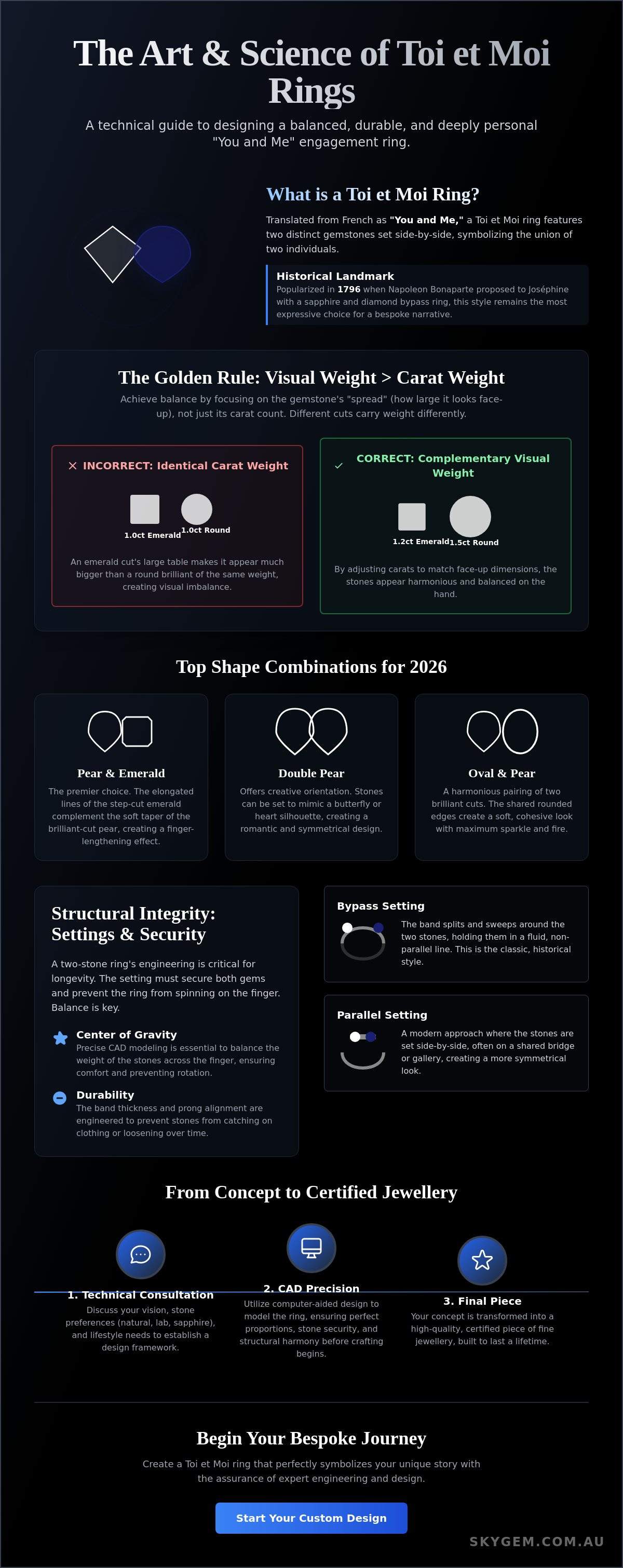
From an engineering perspective, a two-stone setting presents unique challenges that a standard ring does not. The primary concern is the centre of gravity. If the stones aren't balanced correctly across the finger, the ring will inevitably spin. This causes discomfort and potential damage to the setting. Achieving this balance requires precise CAD modelling to ensure the "bridge" between the stones is structurally sound. At SkyGem & Co., we focus on the mechanical alignment of the prongs and the thickness of the band to prevent the stones from catching on clothing or loosening over time. Technical precision isn't just about aesthetics. It's about the long-term viability of the piece.
Choosing the Perfect Pair: A Guide to Stone Shapes and Ratios
Selecting stones for Toi et Moi engagement rings is an exercise in geometric alignment rather than a simple tally of carats. The "Golden Rule" of this design dictates that you must prioritize complementary visual weight over identical carat weight. Because different cuts carry their mass differently, two stones with the same carat count can look significantly mismatched on the hand. For instance, a one-carat round diamond has a vastly different footprint than a one-carat emerald cut. Your goal is to achieve a balanced "spread" where neither stone dwarfs the other.
Faceting patterns also play a critical role in the final aesthetic. Mixing a step-cut, such as an emerald or asscher, with a brilliant-cut stone like a pear or oval creates what we call "intentional tension." The hall-of-mirrors effect of the step-cut provides a sophisticated contrast to the high-frequency sparkle of the brilliant-cut. While Napoleon and Joséphine's iconic ring featured a pear-shaped sapphire and diamond, today's designs often designate one stone as the "lead" and the other as the "accent" through subtle variations in size or colour saturation.
Top Recommended Shape Combinations
The Pear and Emerald duo remains a premier choice for 2026. The elongated lines of the emerald cut complement the tapered point of the pear, creating a flattering, finger-lengthening effect. Alternatively, a Double Pear configuration allows for creative orientation, where the stones can be set to mimic a butterfly or heart silhouette. For those seeking a modern edge, pairing an Oval with a Radiant cut balances soft, organic curves with sharp, pressurized brilliance. You can explore these combinations through our bespoke design process to see how different ratios interact.
The Importance of Surface Area
Technical precision requires looking beyond the certificate to the actual millimetre dimensions. A stone with a shallow cut may have a larger surface area, or "spread," making it appear larger than a deeper stone of the same weight. When designing Toi et Moi engagement rings, we use CAD renders to verify that the table heights of both stones align. If one stone sits significantly higher than the other, it increases the risk of the ring catching on fabrics. Ensuring the stones have a similar depth profile is essential for both the structural integrity and the visual harmony of the piece.
To begin curating your own balanced pairing, you can browse our extensive inventory of certified natural and lab-grown diamonds to compare dimensions and light performance across various shapes.
Structural Integrity: Settings and Security for Two Stones
While the visual balance of Toi et Moi engagement rings is a primary focus for many, the mechanical performance of the piece depends entirely on its underlying architecture. A two-stone ring faces unique torque challenges that a standard solitaire does not. You'll generally choose between a parallel setting, where the stones sit side-by-side on a straight band, or a bypass setting, where the metal curves around each stone in an "S" shape. Parallel designs provide a traditional circular foundation that distributes pressure evenly. In contrast, bypass designs require careful reinforcement to ensure the "tails" of the metal don't deform over time.
The bridge acts as the structural spine of the ring, maintaining its circular shape under the mechanical stress of daily wear. In high-end bespoke jewellery, this bridge prevents the band from "ovalising," which is a common failure point when two large focal points are placed on a delicate shank. We often recommend Platinum for these structural components. Because Platinum is a dense, malleable metal, it provides a superior grip on gemstones and is less likely to snap under stress than gold. This material choice is particularly important for the intricate prong work required to secure two independent centres. Our custom engineering process prioritises these metallurgical properties to ensure your ring remains a permanent asset.
The Bypass Setting Challenge
Open-ended bypass designs are popular for their fluid, modern appearance, but they present a specific catching risk. Without a secured gallery, "floating" stones can catch on fabrics, creating leverage that may pull the setting out of alignment or bend the shank. To mitigate this, we use reinforcement techniques such as a hidden rail beneath the stones. This creates a "closed loop" of metal that maintains the bypass aesthetic while providing the security of a traditional setting. You can explore these reinforced structures in our 18K white gold and platinum collections.
Securing Different Gemstone Species
Pairing different gemstones requires an understanding of their varying physical properties. If you're setting a hard diamond next to a softer stone like an emerald, the stones must never touch, as the diamond's edge will eventually abrade the emerald. Additionally, shapes with vulnerable points, such as pears or marquises, require V-prongs to protect the tips from impact. We also have to account for different girdle thicknesses to ensure both stones sit at a uniform table height. The history of the Toi et Moi ring demonstrates that longevity is always a result of technical precision in the setting process. Shared prongs must be avoided in Toi et Moi designs to ensure each stone remains independently secure and to prevent a single loose prong from compromising both centres.
Customising Your Ring: Metals, Gemstones, and Origin
Customising Toi et Moi engagement rings involves a strategic allocation of resources across two focal points. You must decide whether to distribute your budget equally between two high-quality stones or to prioritise a "hero" stone paired with a smaller accent. For 2026, 18K Yellow Gold has seen a resurgence as the preferred metal for these designs. It provides a warm contrast that enhances the saturation of coloured gemstones, whereas White Gold or Platinum remains the standard for maintaining the crisp, colourless profile of high-grade diamonds. Selecting the right metal isn't just about aesthetics; it's about how the material interacts with the light performance of your specific stone combination.
One technical nuance often overlooked is the reflection interaction between the two centres. When a highly saturated gemstone is set adjacent to a colourless diamond, the diamond can act as a prism, catching and reflecting the hue of its neighbour. This "colour-bleed" effect can be mitigated through precise prong positioning and by selecting diamonds with specific fluorescence profiles. We act as technical consultants during this phase to ensure your chosen pairing maintains its intended visual separation.
Diamond vs. Coloured Gemstone Pairings
The pairing of a diamond with a blue sapphire is a classic choice that nods to royal heritage, yet modern buyers are increasingly looking toward Australian Sapphires for a unique, locally sourced aesthetic. These stones offer a spectrum of teal and deep forest greens that provide a sophisticated alternative to traditional blues. When pairing different species, you must consider the Mohs scale of mineral hardness. A diamond, rated at 10, can easily scratch a sapphire, rated at 9, if the stones are set too closely. Our designs ensure a physical gap or a protective metal barrier exists between the stones to prevent long-term abrasion.
Lab-Grown vs. Natural Diamonds
The choice of origin significantly impacts the scale of your design. Choosing lab-grown diamonds allows for larger stone sizes, often making 3 to 5-carat combinations accessible within a standard budget. These stones possess the same physical and chemical properties as their mined counterparts, providing identical brilliance. Conversely, many clients prefer the long-term value retention and rarity of natural GIA certified diamonds. When viewing two stones side-by-side, it's vital to identify "eye-clean" options where inclusions aren't visible to the naked eye, as any flaws in one stone may be highlighted by the perfection of the other.
If you're ready to explore these technical pairings in person, you can book a bespoke consultation to view our curated selection of natural and lab-grown centres side-by-side.
Selecting Your Toi et Moi Engagement Ring from SkyGem & Co.
Choosing to commission one of our Toi et Moi engagement rings is a decision that moves beyond simple retail selection. It's a partnership in technical design. As we've detailed throughout this guide, the complexity of balancing two distinct focal points requires a level of engineering that standard manufacturing processes can't provide. Our focus on custom-made engagement rings ensures that every component, from the depth of the bridge to the placement of the prongs, is calculated specifically for your chosen stones. This bespoke approach is essential for preventing the common structural failures associated with mass-produced two-stone settings.
The journey begins with a meticulous consultation where we evaluate your stone pairings for light performance and physical compatibility. We then transition into the CAD design phase. This allows you to visualise the ring's proportions and verify the stone alignment before any metal is cast. This methodical approach eliminates the risk of the ring spinning or catching, issues that frequently plague lower-quality designs. Once the structure is finalised, our master jewellers hand-set each stone, ensuring the independent security of both centres while maintaining a sleek, premium profile.
The SkyGem & Co. Bespoke Advantage
Our commitment to structural longevity means we don't compromise on metal density or prong thickness. You gain access to a curated global inventory of precious gemstones and GIA-certified diamonds. This allows you to source rare Australian sapphires or high-carat lab-grown centres that meet our rigorous "eye-clean" standards. We act as your technical consultants, providing a transparent breakdown of how different combinations affect the ring's centre of gravity and long-term maintenance requirements. Every piece is backed by our dedication to quality, offering you the security of a boutique jewellery experience that prioritises performance over hype.
Ready to Start Your Story?
While we specialise in bespoke engineering, we also maintain a curated selection of ready-to-wear engagement rings for those who prefer an immediate acquisition. These pieces serve as a testament to our design philosophy, showcasing the same technical precision found in our custom commissions. Whether you're looking for a classic diamond pairing or a modern mismatched aesthetic, our process is designed to respect both your budget and your vision for a lifelong piece of fine jewellery. You don't have to settle for a design that feels unbalanced or fragile.
Explore the Toi et Moi Collection and book an expert consultation today to begin the design process for your unique piece.
Engineering Your Personal Legacy
Achieving a successful two-stone design requires a deliberate intersection of technical precision and aesthetic vision. By understanding the "Golden Rule" of visual weight and the mechanical necessity of reinforced settings, you ensure your ring remains both a visual masterpiece and a durable asset. This guide has detailed how technical precision in stone pairing and metal selection creates a piece that's as structurally sound as it is symbolic. The complexity of Toi et Moi engagement rings demands a bespoke approach that prioritises structural integrity alongside the selection of high-quality, GIA-certified diamonds and ethically sourced gemstones.
Since 2018, SkyGem & Co. has functioned as a technical consultant for clients seeking fine jewellery that withstands the rigours of daily life. Our reliance on expert CAD design provides the stability needed for these intricate, two-stone configurations. Whether you're drawn to the sharp contrast of a pear and emerald cut or the regional heritage of an Australian sapphire, our team is dedicated to the long-term viability of your design. We invite you to begin your bespoke journey with a partner who values performance over hype and precision over trend.
Discover our curated Toi et Moi Collection
We look forward to helping you translate your personal story into a permanent asset that offers both exceptional beauty and lifelong reliability.
Frequently Asked Questions
Are Toi et Moi engagement rings more expensive than solitaires?
Toi et Moi engagement rings often carry a higher price point than standard solitaires because they require the acquisition of two independent centre stones and a more complex setting process. However, the total investment is highly variable depending on whether you select natural GIA certified diamonds, lab-grown alternatives, or coloured gemstones like Australian sapphires. Budgeting for two stones allows for strategic allocation, such as pairing a high-clarity diamond with a vibrant teal sapphire to manage costs without compromising on visual impact.
Can I use two different types of gemstones in a Toi et Moi ring?
You can certainly mix different gemstone species, which is a hallmark of the bespoke Toi et Moi style. Popular pairings often include a colourless diamond alongside a ruby, emerald, or sapphire to represent individual personalities or birthstones. It's essential to consider the physical properties of each stone during the design phase to ensure they don't abrade each other. Our technical consultants help you select compatible species that maintain their brilliance and structural integrity over time.
Is the Toi et Moi style a passing trend or a classic choice?
This style is a historical classic that has remained relevant since the late 18th century. While it's currently the most searched engagement ring style for 2026, its origins with Napoleon Bonaparte establish it as a design with enduring longevity rather than a fleeting trend. Its capacity for total customisation ensures that it remains a sophisticated choice for those who value personal storytelling and technical elegance in their fine jewellery.
How do I choose the right metal for a two-stone engagement ring?
Metal selection should be dictated by the optical properties of your chosen gemstones and the desired structural requirements. 18K Yellow Gold is excellent for enhancing the saturation of peach or teal sapphires, while Platinum or White Gold is preferred for maintaining the crispness of colourless diamonds. For complex bypass settings, we often recommend Platinum due to its superior durability and malleability, which provides a more secure grip on two separate centres.
Are Toi et Moi rings less secure than other settings?
Toi et Moi rings aren't inherently less secure, provided they're engineered with proper structural reinforcement. Issues like stones catching or settings bending usually occur in mass-produced pieces rather than bespoke designs. By using expert CAD modelling and ensuring each stone has its own dedicated prongs rather than shared settings, we maintain a high level of security. Choosing a reinforced bridge or a closed-loop bypass design further ensures the ring's long-term stability.
What is the best stone shape combination for a Toi et Moi ring?
There's no single "best" combination, but the most successful designs prioritise complementary visual weight. Trending pairings for 2026 include the sharp lines of an emerald cut set against the soft taper of a pear shape, or an oval diamond paired with a radiant cut. The key is to ensure the surface area of both stones is balanced so that neither appears significantly smaller on the hand, regardless of their individual carat weights.
Can I resize a Toi et Moi engagement ring?
Resizing is possible for most Toi et Moi designs, though the process is more technically demanding for open-bypass settings. Because the band doesn't always form a continuous circle, adjusting the size requires careful recalibration to ensure the stone alignment and gap remain proportional. It's best to work with a specialist jeweller who understands the specific torque and tension of two-stone architectures to avoid compromising the security of the settings during the resizing process.
Disclaimer
This article is for general informational purposes only and may include AI-assisted content. Pricing, specifications, and availability are subject to change. For accurate advice and current information, please contact SkyGem & Co. directly. Nothing in this content constitutes professional or financial advice.