
The Ultimate Guide to Sapphires: Understanding Rarity, Colour, and Value in 2026

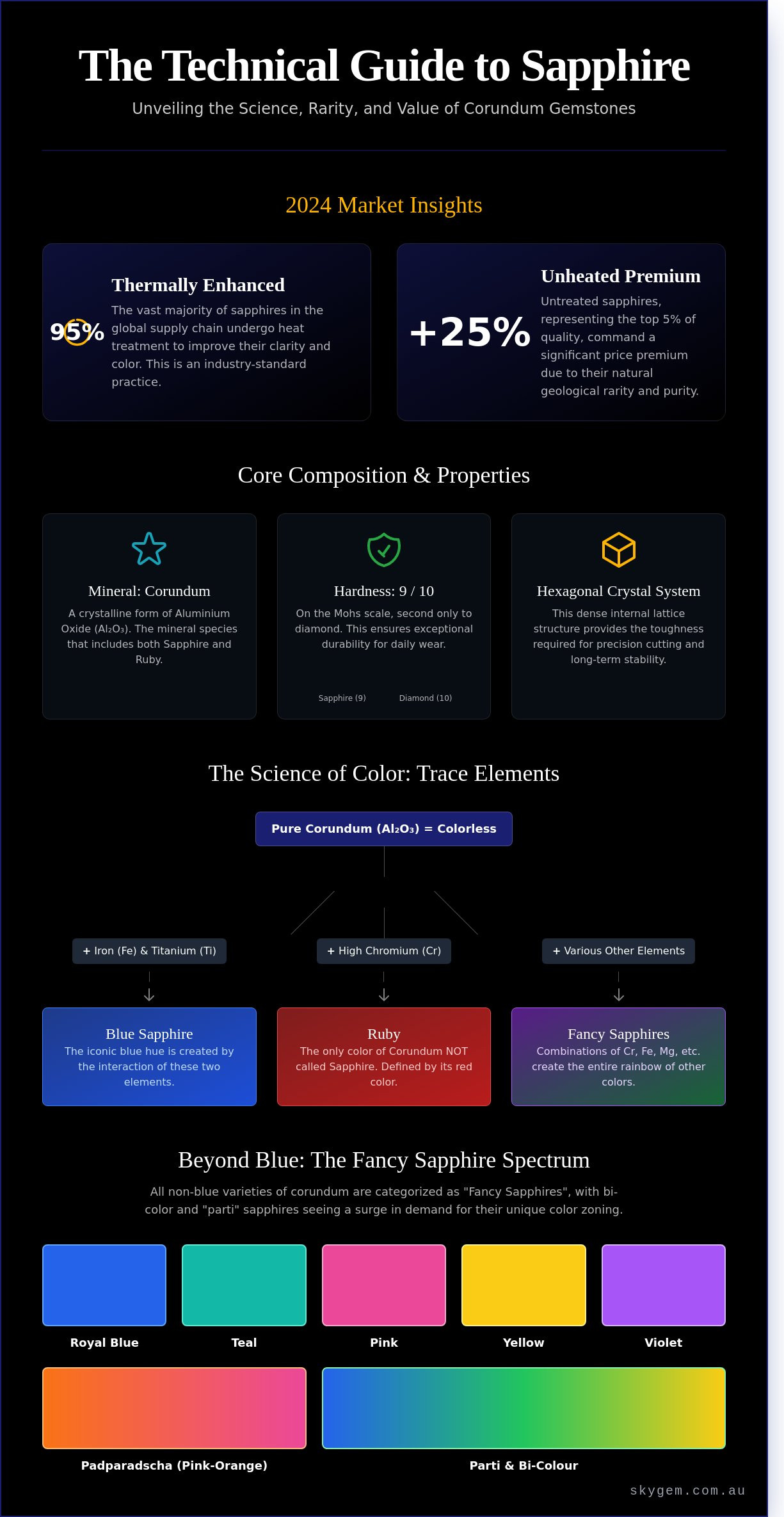
Did you know that a 2024 market analysis revealed that nearly 95% of the sapphires currently in the global supply chain have undergone thermal enhancement to artificially improve their clarity? While these treatments are industry standard, the 25% price premium typically commanded by unheated stones creates a complex landscape for even the most seasoned collector. You likely recognise that the true value of a sapphire lies in its unique chemical composition and light-return properties, yet the technical data behind that vibrancy often remains obscured by vague marketing terms.
We understand the frustration of seeing a A$10,000 price difference between two seemingly identical stones without a clear technical explanation. Our objective is to provide the technical framework you need to master the nuances of these gemstones, ensuring you can select a piece that balances geological rarity with high-performance aesthetics. We'll examine the specific grading metrics for 2026, evaluate the investment potential of Australian-mined stones, and provide the professional expertise required to identify authentic quality. By the end of this guide, you'll have the confidence to distinguish between a commercial-grade gem and a true investment-grade asset.
Key Takeaways
- Understand the technical composition of corundum and how specific trace elements dictate the rare colour profiles found within the fancy gemstone spectrum.
- Master the specialised grading criteria for a high-quality sapphire, prioritising colour saturation and tonal depth over standard diamond-centric metrics to ensure value.
- Assess the commercial significance of geographic origin and industry-standard heat treatments to secure a gemstone that meets Australian market expectations for authenticity.
- Identify the optimal pairing of gemstone hues with precious metals and high-performance settings to guarantee both aesthetic excellence and long-term durability.
What is a Sapphire? The Science and History of Corundum
A sapphire is a precious variety of the mineral corundum, which consists of aluminium oxide. While pure corundum is naturally colourless, the introduction of trace elements during the crystal's formation over millions of years creates the vibrant palette we observe in fine jewellery. Iron and titanium are responsible for the iconic blue hues, while chromium, iron, and magnesium produce yellows, greens, and violets. These chemical variations allow the sapphire to exist in almost every colour of the rainbow.
From a technical perspective, the physical properties of this gemstone are exceptional. It holds a rating of 9 on the Mohs scale of mineral hardness, making it the second hardest natural substance on Earth. Only a diamond, rated at 10, possesses greater scratch resistance. This high rating is a critical metric for durability; it ensures the stone can withstand the rigours of daily contact without losing its polish or sustaining surface damage. Detailed records of Sapphire mineralogy and history show that this combination of chemical stability and physical hardness has made it a prized asset for both industrial applications and high-end archival jewellery.
Beyond the laboratory, these stones carry a weight of historical authority. Ancient Greeks wore them for guidance when consulting oracles, while Buddhists believed they brought spiritual enlightenment. This legacy of wisdom and protection transitioned into European royalty, where the gem became a staple of crown jewels and ecclesiastical rings. In the Australian market, the stone is viewed as a symbol of reliability and sophisticated taste, often chosen by those who value heritage alongside technical performance.
The Mineral Composition of Corundum
The durability of the gemstone is rooted in its hexagonal crystal system. This internal lattice structure is exceptionally dense, providing the structural integrity required for precision cutting and faceting. It's a common point of confusion, but the distinction between a ruby and a sapphire is purely based on the presence of chromium. When chromium levels are high enough to produce a red hue, the stone is a ruby; every other colour of corundum is classified as a sapphire. This shared mineral heritage means that loose sapphires offer the same industrial-grade toughness as rubies, making them the ideal technical solution for engagement rings intended for lifetime wear.
A Legacy of Significance
Sapphires have long been the centrepiece of sovereign regalia, most notably the 104-carat Stuart Sapphire currently set in the British Imperial State Crown. This association with power and longevity reached a peak in 1981 with the engagement of Princess Diana, whose 12-carat blue sapphire sparked a global shift in bridal trends. Today, it remains the premier alternative to diamonds for Australian engagement rings, offering a unique intersection of architectural beauty and investment value. Corundum is a mineral species that includes both sapphire and ruby.
The Vibrant Spectrum: Exploring Sapphire Colours and Varieties
The common perception that a sapphire must be blue is a narrow view of a chemically complex gemstone. In reality, the corundum family produces a spectrum that rivals almost any other mineral group. Gemologists categorise all non-blue varieties as "Fancy Sapphires," a group that has seen a 30% increase in market demand across Australia since 2023. This shift is driven by a growing desire for individuality, particularly with bi-colour and "parti" sapphires. These stones display distinct colour zoning, often showing green, gold, and blue within a single crystal. You can view these unique optical characteristics and their technical variations on the SkyGem gemstones page.
For those seeking technical benchmarks on how these colours form, GIA's guide to sapphire quality details how trace elements like iron, titanium, and chromium dictate these diverse hues. Understanding these chemical compositions helps collectors appreciate why certain varieties command such high premiums in the current market.
Iconic Blue and Teal Varieties
Cornflower blue remains a classic industry benchmark, prized for its soft, velvety appearance and medium-light tone. Royal Blue sits at the higher end of the saturation scale, offering a deep, vivid intensity that has historically defined the luxury sector. However, teal sapphires have emerged as the primary choice for modern bespoke designs in Melbourne and Sydney. They exhibit a sophisticated green-blue shift that changes depending on the light source, whether it's natural daylight or warm interior lighting. This versatility makes teal sapphire engagement rings a practical yet distinctive alternative to traditional options, offering a unique aesthetic that complements both white and yellow gold settings.
Peach, Pink, and Padparadscha
The Padparadscha is the rarest variety in the corundum family. It requires a precise, delicate balance of pink and orange, often compared to the hue of a lotus blossom. High-quality Padparadscha specimens can command prices upwards of A$20,000 per carat in the 2026 Australian market. For a similar romantic aesthetic at a more accessible price point, peach and champagne tones are gaining significant traction in contemporary jewellery. These shades offer a neutral, sophisticated palette that pairs well with modern minimalist designs. Additionally, yellow and green sapphires provide high brilliance and exceptional durability, scoring a 9 on the Mohs scale. They represent a high-performance choice for clients who value technical excellence and longevity without the extreme rarity premium of a Padparadscha or a top-tier Royal Blue stone.
Evaluating Quality: The Four Cs of Sapphire Grading
Professional grading for a sapphire differs significantly from the rigid protocols used for diamonds. While diamond valuation focuses on a clinical absence of colour and inclusions, coloured gemstones are judged on the richness and character of these very traits. You can't apply a standard D-to-Z scale here because a sapphire's value is driven by its chromatic intensity and light-handling properties. In the Australian market, we prioritise a stone's visual impact and its structural durability over the pursuit of microscopic perfection.
Colour: Hue, Tone, and Saturation
Colour drives up to 70% of a stone's market value. We evaluate this through three technical lenses: Hue (the base colour), Tone (the level of lightness or darkness), and Saturation (the vividness of the hue). The most valuable specimens feature vivid saturation with a medium-dark tone, usually between 60% and 75%. It's vital to avoid "inky" stones that appear black in low-light environments. According to the Gemological Institute of America (GIA), the ideal specimen maintains a pure, vibrant blue that doesn't shift toward grey or brown under different light sources.
Clarity and Inclusions
The technical benchmark for a sapphire is "eye-clean" quality. This means the stone appears clear to the naked eye from a distance of 15 centimetres. Unlike diamonds, internal "silk" or fine rutile needles are often welcomed. This silk proves the stone's natural origin and can diffuse light to create a softer, more velvety appearance. While certain dense inclusions create the rare "star" effect known as asterism, you should ensure no fractures reach the surface, as these can compromise the stone's long-term integrity.
The cut of the gem functions as its optical engine. A well-proportioned cut ensures maximum light return, preventing "windowing" where light leaks through the back of the stone, making it look transparent and lifeless. When you evaluate a stone's brilliance, the precision of the facets determines how much "life" it exhibits. A poorly cut stone will have dark patches, known as extinction, which reduces its overall vibrancy.
Lighting conditions play a decisive role in how these technical factors manifest. A stone that looks exceptional under high-intensity showroom LEDs might appear dull in a standard office setting. You should always inspect a sapphire in natural Australian daylight or under a 5500K daylight-balanced lamp. This ensures the hue you see at the point of purchase remains consistent across different environments. Investing in a stone with high optical performance ensures it remains a brilliant asset for decades.
Origin and Treatment: Ensuring Authenticity and Value
The geographic provenance of a sapphire serves as a primary driver for its market valuation and long-term investment potential. While stones from Madagascar and Sri Lanka (Ceylon) frequently dominate the high-end trade, the specific geological conditions of each region dictate the chemical composition and visual characteristics of the gem. Buyers should recognize that a laboratory-verified origin can influence the price per carat by 20% to 35% depending on the prestige of the source. To understand these nuances in a practical context, you can browse loose sapphires to compare how different origins manifest in diverse saturation levels and price points.
The Prestige of Australian Sapphires
Australian deposits, primarily located in the New England region of New South Wales and Central Queensland, are unique for their basaltic-type geological formation. This environment produces stones with high iron content, resulting in deep blues and the iconic "parti" sapphire. These stones display distinct yellow, green, and blue colour zoning within a single crystal, a feature highly prized for bespoke jewellery. From a technical perspective, Australian mining operates under strict environmental and ethical frameworks. This provides a transparent supply chain that many international sources lack. These stones are renowned for their structural integrity and density, ensuring they remain a durable choice for daily wear in the Australian climate.
Understanding Heat Treatments
Heat treatment is a standard industry practice. Approximately 92% of all sapphires undergo thermal enhancement to dissolve rutile inclusions and improve colour saturation. This process is stable and permanent, mirroring the natural volcanic heat that forms these stones. However, professional buyers must distinguish between standard heat and invasive procedures:
- Standard Heat: Uses controlled temperatures to improve clarity and colour without adding external chemicals.
- Beryllium Diffusion: Introduces foreign elements to artificially change the stone's colour, significantly lowering its market value.
- Lead-Glass Filling: Fills surface-reaching cracks with glass to improve transparency; these stones are fragile and should be avoided for high-quality collections.
The rarity of natural, untouched beauty cannot be overstated. High-quality unheated sapphires often command a price premium of 50% to 100% over their heat-treated counterparts. For a 2-carat specimen of exceptional clarity, this distinction can represent a price difference exceeding A$6,000 in the current market. Ensuring you have a reputable laboratory certificate is the only way to verify these treatments and protect your investment.
Ready to select a stone with a verified pedigree? Explore our collection of certified sapphires today.
Designing with Sapphires: Selecting the Perfect Stone
Selecting a sapphire involves balancing structural integrity with visual impact. Unlike diamonds, these stones often feature unique dimensions and asymmetrical depths that require a precise mounting strategy. Choosing between a bezel and a prong setting is the first technical decision. A bezel setting provides a 360-degree protective metal rim, which is ideal for Australians with active lifestyles who want to secure the gemstone against accidental impact. Conversely, prong settings maximize light entry through the pavilion and crown, which heightens the brilliance and fire of the stone.
Creating a custom engagement ring offers the most reliable way to house a specific stone. Standard commercial mounts often fail to account for the specific height or girdle thickness of high-quality stones. A bespoke approach allows for a tailored seat that prevents movement and long-term wear. This engineering precision ensures the stone remains secure for decades, avoiding the common issue of stones becoming loose in mass-produced settings.
Metal Pairings and Aesthetics
The choice of precious metal significantly influences the perceived colour of the gemstone. Professional designers typically follow these pairing guidelines to ensure the stone's natural beauty is the focal point:
- 18K White Gold or Platinum: These are the preferred choices for blue, teal, and green stones. Cool-toned metals reflect a neutral light that preserves the crisp saturation of the stone without introducing yellow tints.
- 18K Yellow Gold: This is ideal for yellow or bi-colour stones. The metal enhances the natural warmth and golden flashes within the crystal, making the colour appear more vivid.
- 18K Rose Gold: This metal complements peach, padparadscha, and pink varieties. It brings out the soft copper and salmon undertones that are highly sought after in the Australian market.
The "Toi et Moi" style remains a dominant trend in 2026. This design features a sapphire paired with a diamond, symbolising the union of two individuals. This configuration requires careful calibration. A jeweller must ensure the heights of both stones align perfectly within the setting to create a flush, high-end finish that doesn't snag on clothing.
Longevity and Care
These stones rate a 9 on the Mohs scale, making them exceptionally durable for daily wear. However, maintaining their lustre requires a consistent cleaning routine. Use warm water mixed with a mild detergent and a soft-bristled brush to remove oils and debris every fortnight. This prevents the "cloudy" appearance that occurs when lotions or soaps build up behind the stone facets.
Professional maintenance checks are essential every 12 months. A qualified jeweller will inspect the setting for thinning prongs or structural fatigue. For those seeking deeper design insights, consulting a technical guide on bespoke jewellery can help clarify the requirements of complex builds. Taking these steps ensures your investment remains a permanent asset.
Explore our full engagement ring collection to find a piece that combines engineering precision with the timeless beauty of a sapphire.
Securing Your Investment in Fine Gemstones for 2026
Selecting a high-quality investment requires a technical understanding of trace elements and GIA grading standards. As the 2026 market shifts toward untreated stones, verifying a gem's origin and heat-treatment status remains the most critical factor for long-term value retention. You've now gained the baseline knowledge to evaluate colour saturation and clarity with professional precision; these technical benchmarks ensure your acquisition serves as a stable asset. Our team applies 30 years of industry experience to help you navigate these complexities with confidence.
Skygem provides a technical partnership that extends beyond a simple transaction. We specialise in bespoke Australian designs and provide GIA certified expertise to guarantee the authenticity of every piece. We've built our reputation on expertly sourced natural and unheated gemstones that meet the rigorous demands of the Australian market. Whether you're an investor or a collector, you'll find that our commitment to transparency and local compliance sets a new standard for quality.
Explore Our Curated Collection of Natural Sapphires
Your journey into the world of premium gemstones is just beginning, and we're here to ensure every choice you make is backed by engineering-grade data and aesthetic excellence.
Frequently Asked Questions
Are sapphires more expensive than diamonds?
Generally, sapphires are more affordable than diamonds, though exceptional specimens command premium prices. While a high-quality one-carat diamond often retails for approximately A$10,000 in the 2026 Australian market, a comparable blue sapphire typically ranges between A$3,000 and A$5,500. Rare varieties like the Padparadscha can exceed A$30,000 per carat, surpassing the cost of many white diamonds due to their extreme scarcity and collector demand.
What is the rarest colour of sapphire?
The Padparadscha is the rarest colour of sapphire, distinguished by its unique salmon-toned blend of pink and orange. These gems account for less than 1% of all gem-quality corundum found globally. Authenticated Padparadschas from Sri Lanka are the most prized, with high-quality stones often fetching prices 40% higher than traditional cornflower blue varieties. Their value is strictly tied to the precise balance of hues as verified by laboratory analysis.
Can I wear a sapphire engagement ring every day?
You can wear a sapphire engagement ring every day because it's one of the most durable gemstones available. It ranks 9 on the Mohs scale of mineral hardness, sitting just below the diamond's 10. This structural integrity ensures the stone resists scratching and chipping during daily activities. For long-term maintenance, we recommend a professional inspection every 12 months to check the security of the setting and ensure the stone remains protected.
What is a "Parti" sapphire and why are they popular in Australia?
A Parti sapphire displays two or three distinct colours within a single crystal, typically combinations of yellow, green, and blue. These stones are popular in Australia because our local mines in Central Queensland and New South Wales produce approximately 70% of the world's supply. Their popularity has surged by 25% since 2023 as modern couples seek unique, non-traditional stones that offer a distinct architectural aesthetic compared to uniform, single-colour gems.
How do I know if my sapphire is natural or lab-grown?
You can distinguish between natural and lab-grown stones by examining their internal inclusions under 10x magnification. Natural stones often contain "fingerprint" inclusions or straight growth lines, whereas lab-grown versions typically show curved striae or tiny gas bubbles. Since synthetic stones are chemically identical to natural ones, professional verification through a laboratory like the GAA (Gemmological Association of Australia) is essential to confirm a stone’s geological origin and market value.
Does a sapphire need a GIA certificate?
A sapphire should have an independent certificate if its value exceeds A$2,000 to ensure investment security. While the GIA is a global standard, many Australian buyers also rely on the Gemmological Association of Australia for local certification. These reports provide technical data on heat treatment, origin, and carat weight. Relying on a third-party certificate mitigates the risk of purchasing treated or synthetic stones at natural price points.
What is the difference between a Ceylon sapphire and an Australian sapphire?
The primary difference lies in the trace element composition, which dictates the stone's final colour and saturation. Ceylon stones from Sri Lanka are famous for their vibrant, "cornflower" blue and high clarity. In contrast, Australian sapphires often contain higher iron content, resulting in deeper, inky blues or unique teal and green-blue hues. While Ceylon stones historically commanded higher prices, the demand for Australian teal varieties has grown by 15% annually since 2024.
Why do some sapphires change colour in different lighting?
Some sapphires change colour due to how their chemical structure absorbs specific wavelengths of light. This phenomenon, often caused by trace amounts of vanadium or chromium, makes a stone appear blue in daylight and violet under incandescent lighting. True colour-change sapphires are rare, with those exhibiting a 100% colour shift being the most valuable. This technical characteristic is a key metric in determining the stone's rarity and overall performance in varied environments.
Disclaimer
This article is for general informational purposes only and may include AI-assisted content. Pricing, specifications, and availability are subject to change. For accurate advice and current information, please contact SkyGem & Co. directly. Nothing in this content constitutes professional or financial advice.