
The Ultimate Guide to Ruby and Diamond Trilogy Rings: Symbolism, Quality, and Design

Did you know that approximately 95% of rubies entering the Australian market have undergone thermal enhancement to reach their final hue? While this process is standard in the jewellery industry, it creates a complex landscape for buyers seeking a genuine ruby and diamond trilogy ring that holds long term value. You're likely looking for a piece that captures a specific emotional milestone without compromising on technical gemstone quality or structural integrity. It's common to feel concerned about how heat treatments affect market price or how to ensure a setting is robust enough for daily wear.
This guide provides the technical clarity you need to select a premium ruby and diamond trilogy ring that balances breathtaking aesthetics with rigorous gemstone standards. We'll explore the critical distinctions between various ruby origins, the physics of light performance between coloured stones and diamonds, and the engineering required for a bespoke setting. You'll gain the expertise to secure an investment grade piece that reflects your unique design vision while meeting high quality benchmarks. We'll move from high level conceptual benefits to the granular technical details of gemstone selection and durability.
Key Takeaways
- Understand the symbolic "Past, Present, and Future" narrative of the three-stone setting and how it serves as a sophisticated choice for significant Australian anniversaries.
- Gain technical insight into the 4Cs of ruby selection, specifically identifying the "Pigeon’s Blood" standard to ensure your investment meets premium aesthetic and value benchmarks.
- Evaluate how specific metal selections, from 18k yellow gold to platinum, influence the ruby’s perceived colour and the overall structural integrity of the mount.
- Learn to apply the "Golden Ratio" to your ruby and diamond trilogy ring to achieve a mathematically balanced proportion between the centre gemstone and its flanking diamonds.
- Discover the precision of the CAD design process, which offers a bespoke engineering solution superior to mass-produced retail alternatives for a lifetime of durability.
The Symbolism and Allure of the Ruby Trilogy Design
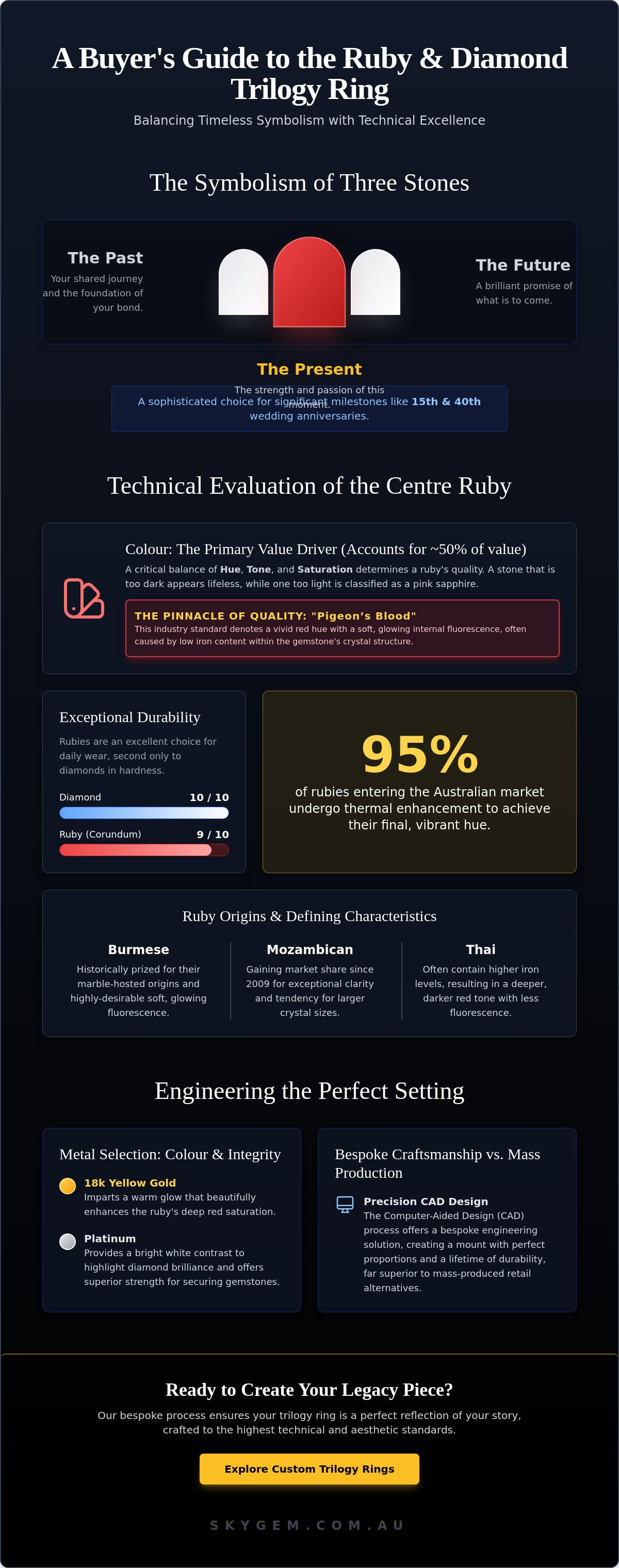
The ruby and diamond trilogy ring serves as a technical masterclass in balanced jewellery design. By utilising a three-stone configuration, this style creates a cohesive narrative that extends beyond simple aesthetics. Traditionally, the Trilogy ring symbolism defines the layout as a chronological representation of a couple’s past, present, and future. This depth of meaning is why the design remains a staple for significant milestones in Australia, particularly for 15th and 40th wedding anniversaries.
Beyond the emotional weight, the trilogy format offers practical benefits for the wearer. A three-stone setting provides superior finger coverage compared to a standard solitaire, creating a visual span that occupies the width of the finger more effectively. This horizontal orientation balances the proportions of the hand; meanwhile, the combination of diverse gemstone shapes allows for a high degree of customisation. Rubies, historically referred to as the "King of Gemstones," bring a level of prestige to this layout. Their deep red saturation has been associated with vitality and passion for centuries, providing a striking contrast to the white brilliance of surrounding diamonds.
The Narrative of Three Stones
The layout of a trilogy ring follows a logical, linear progression. In this design, the centre ruby acts as the "Present" anchor, usually featuring the largest carat weight and the most intense colour saturation. It represents the current strength of a relationship. Flanking the centre stone are two diamonds that represent the "Past" and the "Future." These side stones aren't merely decorative; they serve a technical purpose by reflecting light back into the central ruby, enhancing its natural glow and ensuring the ring maintains high optical performance from every viewing angle.
Ruby as an Alternative Engagement Stone
There is a growing shift in the Australian market toward coloured gemstone engagement rings. While diamonds remain the traditional standard, the ruby and diamond trilogy ring offers a distinct, non-traditional aesthetic for those seeking a bespoke look. From a technical standpoint, rubies are an excellent choice for daily wear. They sit at a 9 on the Mohs scale of mineral hardness, second only to diamonds at 10. This high level of durability ensures the stone resists scratching and chipping over decades of constant use. Choosing a ruby allows for a bold pop of colour that reflects personal style while maintaining the structural integrity required for a lifelong piece of jewellery. For those interested in exploring specific stone options, we provide a curated selection of loose rubies to suit various design requirements.
Technical Evaluation: Selecting the Perfect Centre Ruby
Selecting the primary gemstone for a ruby and diamond trilogy ring requires a methodical approach to optical performance. While diamonds are graded on a rigid scale, rubies demand a more nuanced technical evaluation. Colour remains the most significant driver of value, accounting for approximately 50% of the stone's total assessment. Professionals look for a balance of hue, tone, and saturation. A ruby that is too dark will lose its brilliance in low-light environments, while one that is too light may be classified as a pink sapphire by international laboratories.
The "Pigeon's Blood" designation represents the pinnacle of ruby quality. This industry standard describes a vivid red hue with a soft, glowing fluorescence. This effect is often caused by low iron content, which allows the stone to emit a secondary red glow when exposed to ultraviolet light. Beyond colour, the internal "life" of the stone is determined by its transparency. While inclusions are expected in natural corundum, they shouldn't obstruct light paths. Precise GIA ruby quality factors dictate that the cut must maximize light return, ensuring the ruby doesn't appear "flat" when placed next to high-brilliance diamonds.
Origin plays a critical role in the stone's internal architecture. Burmese rubies are historically prized for their marble-hosted origins and high fluorescence. In contrast, Mozambican rubies have gained significant market share since 2009 due to their exceptional clarity and larger crystal sizes. Thai rubies often contain higher iron levels, resulting in a deeper, more garnet-like red that requires expert faceting to brighten the stone's appearance.
Heat Treatment vs. Unheated Rubies
Approximately 95% of rubies in the global market undergo standard heat treatment. This stable, industry-accepted process dissolves rutile inclusions and improves colour saturation. However, unheated rubies that possess natural "top" colour are exceptionally rare. These stones represent a significant investment opportunity; a certified unheated ruby can command a price premium of 50% to 100% over a treated stone of similar appearance. When reviewing a GIA or GRS report, look for the "Treatment" section. A "No indications of heating" comment is the gold standard for collectors. You can Explore our collection of natural unheated rubies to see the difference in character and value.
Colour Saturation and Pleochroism
Rubies are pleochroic, meaning they display different colours when viewed from different crystallographic directions. A master cutter will orient the stone to show the purest red through the table facet. If the orientation is off, the stone might display a distracting purplish or orangey secondary hue. The "sweet spot" in saturation is a stone that maintains its vivid red identity without becoming "over-saturated" or opaque. Identifying this balance ensures your ruby and diamond trilogy ring maintains a vibrant contrast between the deep red centre and the colourless brilliance of the side diamonds. If you're ready to begin your search, you might consider how a bespoke gemstone selection can elevate the final design of your piece.
Engineering the Setting: Metal Selection and Security
Engineering a ruby and diamond trilogy ring requires a precise understanding of how light interacts with different metallic surfaces. The choice of metal isn't merely a stylistic decision; it's a technical specification that dictates the visual performance of the gemstones. Professional jewellers focus on the interplay between the metal's reflective properties and the ruby's secondary undertones. For instance, a high-purity metal can either cool down a stone's appearance or amplify its inherent warmth. When evaluating these factors, GIA's guide to ruby quality highlights that colour saturation is paramount. A setting must support this saturation without introducing unwanted tints.
The structural requirements for a trilogy setting are more complex than a standard solitaire. You're balancing three substantial gemstones in a single row, which increases the physical footprint on the band. This layout demands a robust architecture to prevent the stones from shifting or the prongs from snagging. We prioritise "galleries"—the side profiles of the setting—that use open-work designs. This engineering choice allows maximum light entry into the pavilion of each stone. Without these light ports, even the highest quality ruby can appear dark or "extinguished" once set in the metal.
- 18k White Gold: Composed of 75% gold mixed with white alloys like palladium. It offers excellent workability for intricate gallery details.
- Platinum: With a density of approximately 21.45g/cm³, it's the most secure option for protecting the prongs of three stones.
- 18k Yellow Gold: Provides a traditional aesthetic and can mask slight yellow tints in lower-grade side diamonds.
The Case for Platinum and White Gold
White metals provide a neutral, high-contrast backdrop that makes the red of a ruby appear more vivid. This "pop" occurs because the metal doesn't bleed any warmth into the stone's facets. Platinum is particularly favoured for its durability; it doesn't wear away over time like gold alloys do. It's a "forever" metal that ensures the structural integrity of your ruby and diamond trilogy ring for decades. To explore these high-performance settings, you can Browse 18K White Gold Trilogy Designs from our local collection.
Yellow and Rose Gold for Warmth
Yellow gold is a strategic choice for rubies with a warmer, slightly orange secondary hue. The metal's richness complements the stone's natural glow. Rose gold offers a vintage aesthetic that's become increasingly popular in the Australian market. For the best of both worlds, we often recommend "mixed metal" settings. By using white gold or platinum claws on a yellow gold band, we ensure the diamonds remain bright and white while the band provides a warm, traditional feel. This hybrid approach guarantees both aesthetic beauty and technical security.
Designing the Trilogy: Stone Shapes and Proportions
Achieving the perfect aesthetic balance in a ruby and diamond trilogy ring requires a technical understanding of proportion and light performance. The central ruby acts as the primary focal point, while the flanking diamonds serve to enhance its saturation and brilliance. In high-end jewellery design, we often apply a variation of the "Golden Ratio" to ensure the side stones don't overwhelm the primary gem. A standard benchmark involves selecting side diamonds that are approximately 30% to 35% of the centre stone's carat weight. For instance, a 1.50-carat ruby pairs optimally with two 0.50-carat diamonds. This specific ratio maintains a clear visual hierarchy and prevents the side stones from crowding the finger.
Light management is equally vital. Rubies have a refractive index of 1.762 to 1.770, which is lower than a diamond's 2.417. Because rubies possess a deeper, more "velvety" light return, the cut of the side stones must be carefully calibrated. If the side diamonds are too large or feature an overly aggressive "crushed ice" sparkle, they can visually "wash out" the deep red hues of the ruby. To prevent this, we focus on the following technical considerations:
- Depth Matching: Ensuring the pavilion depth of all three stones is aligned to prevent the ring from sitting too high or unevenly on the finger.
- Colour Grading: Selecting diamonds in the F-G colour range to provide a crisp, white contrast that makes the ruby's red "pop" without appearing yellow.
- Symmetry: Using identical dimensions for the two side stones to ensure the trilogy's architectural stability.
The Classic Oval Ruby with Round Side Diamonds
The oval cut remains the industry standard for high-quality rubies because it preserves the maximum amount of rough material during the cutting process. While a round cut might lose 60% of the original stone, an oval often retains 70% or more of the weight. Pairing an oval centre with round brilliant side stones creates a cohesive, fluid silhouette. The round diamonds act as high-intensity light reflectors, providing a "halo-like" shimmer that draws the eye inward toward the ruby's rich colour saturation.
Modern Geometric Combinations
For a more architectural aesthetic, modern designs often incorporate geometric step-cuts. A cushion-cut ruby paired with Cadillac or Trapezoid side diamonds offers a structured, contemporary profile that suits the Australian preference for clean lines. Step-cuts, such as emerald or baguette shapes, produce a "hall of mirrors" effect. This linear flash of light contrasts sharply with the internal "silk" and depth of a fine ruby. These combinations are particularly effective for clients seeking a bespoke look that departs from traditional Victorian styles.
Bespoke Craftsmanship: Creating Your Custom Trilogy
Choosing a bespoke path for a ruby and diamond trilogy ring offers a level of technical precision that standard retail pieces can't match. Mass-produced rings are typically cast from generic moulds designed for calibrated, uniform stones. This often results in "gapping" or insecure seating when working with high-value natural gemstones that possess unique dimensions. A custom-engineered setting ensures the metal architecture is built specifically around the physical properties of your stones, rather than forcing the stones to fit a pre-existing frame.
The process begins with Computer-Aided Design (CAD), which acts as the structural blueprint for the piece. CAD technology allows our designers to calculate exact tolerances, ensuring the ruby and diamonds are positioned to maximise light entry and internal reflection. This digital phase is critical for "future-proofing" the ring; it allows us to simulate stress points and reinforce the bridge or gallery before the metal is even cast. We use these renders to provide a 360-degree view of the proportions, ensuring the side stones complement the central ruby without overshadowing its saturation.
Once the 18K gold or platinum frame is cast, the role of the master jeweller becomes paramount. While technology provides the accuracy, hand-finishing provides the soul and comfort of the piece. Our jewellers spend hours refining the internal shank for a "comfort fit" profile and hand-pulling the wire for the prongs. This human intervention ensures that every surface is polished to a mirror finish, even in areas the eye can't easily see, preventing moisture buildup and skin irritation.
The SkyGem Bespoke Process
Our methodology focuses on the technical synergy between the three stones. Because rubies are naturally denser and often cut deeper than diamonds, matching their crown heights is a complex task. We source side diamonds with specific table percentages and depth ratios to ensure a flush, continuous surface across the top of the ring. This meticulous selection process prevents one stone from sitting higher than the others, which would otherwise create a snagging hazard. You can start your custom ring journey by consulting with our specialists to view our current inventory of ethically sourced stones.
Ensuring Long-Term Durability
A trilogy ring features more "exposed" stone edges than a solitaire, making structural integrity a primary concern. We recommend professional prong inspections every 12 months to check for metal fatigue or accidental displacement. In the Australian climate, sunscreen and salt water can accumulate behind the settings, dulling the ruby's lustre. To maintain the piece, use a soft-bristled brush and mild detergent in warm water. Avoid ultrasonic cleaners for rubies that have undergone traditional heat treatments, as the vibrations can occasionally stress natural inclusions. Regular maintenance ensures the settings remain tight and the stones stay secure for decades of daily wear.
Securing Your Investment in Fine Jewellery Engineering
Selecting a ruby and diamond trilogy ring involves more than aesthetic preference; it's a technical exercise in material science and architectural balance. You've seen how the integration of GIA-certified diamonds and rare, unheated rubies creates a foundation of value that stands up to professional scrutiny. Each bespoke piece relies on precise stone proportions and secure metal settings to ensure long-term durability. By focusing on high-end natural gemstone procurement, you avoid the common pitfalls of treated stones and secure a piece with lasting market relevance.
SkyGem & Co. provides direct access to a global network of ethically sourced stones, ensuring every component meets rigorous Australian quality standards. Our specialist boutique consultation process functions as a technical partnership, guiding you through the complexities of gemstone selection and structural design. This methodical approach ensures your custom trilogy isn't just a purchase, but a permanent asset engineered for the future.
Design your bespoke ruby and diamond trilogy ring with SkyGem & Co. to experience the intersection of high-end craftsmanship and technical excellence. We're ready to help you build a legacy of quality and precision.
Frequently Asked Questions
What is the meaning of a ruby and diamond trilogy ring?
A ruby and diamond trilogy ring traditionally represents a couple's past, present, and future journey together. The inclusion of a ruby, which ranks 9 on the Mohs scale, introduces a layer of symbolism representing passion, vitality, and protection. This specific design has remained a staple in Australian jewellery since the Victorian era, specifically gaining prominence in the late 19th century as a meaningful alternative to standard solitaire settings.
Is a ruby durable enough for an engagement ring?
Rubies are exceptionally durable and perfectly suited for the daily wear required of an engagement ring. As a variety of the mineral corundum, a ruby has a Mohs hardness rating of 9.0, which is surpassed only by a diamond. This physical property ensures the stone resists scratching and surface abrasion, meeting the rigorous demands of the Australian lifestyle and long-term structural integrity.
How much should a high-quality ruby trilogy ring cost?
The investment for a high-quality ruby and diamond trilogy ring depends on the ruby's origin and the technical specifications of the side stones. According to 2023 GemGuide pricing benchmarks, premium unheated rubies command a 30% to 50% premium over heat-treated equivalents. In the Australian market, a bespoke piece featuring a certified 1-carat natural ruby with high-grade diamond accents requires a technical consultation to determine precise market-linked pricing based on current trade data.
Can I use lab-grown diamonds as side stones for a natural ruby?
You can certainly integrate lab-grown diamonds as side stones for a natural ruby centrepiece. This configuration is a practical solution for those seeking maximum brilliance and clarity at a lower price point than mined alternatives. Lab-grown diamonds possess the same chemical and physical properties as mined stones, offering a sustainable option that aligns with modern ethical standards while maintaining the high-performance aesthetics of the ring.
Which metal is best for a ruby and diamond ring?
18ct yellow gold and platinum are the superior choices for this specific gemstone combination. Yellow gold naturally complements the warm, rich tones of the ruby, while platinum provides a secure, high-strength setting for the diamonds. For Australian consumers, 18ct gold offers a precise balance of 75% purity and necessary structural durability, ensuring the trilogy setting remains stable and secure over decades of use.
How do I know if a ruby has been heat-treated?
Identifying heat treatment requires a laboratory report from a recognised body such as the GIA or GRS. Approximately 95% of rubies on the global market undergo thermal enhancement to improve colour and clarity. A technical analysis under 40x magnification by a qualified gemmologist can identify the presence of "silk" inclusions; these often dissolve or change shape when a stone is subjected to temperatures exceeding 1,200 degrees Celsius.
Should the side diamonds be the same quality as the centre stone?
The side diamonds should ideally match or slightly exceed the centre ruby in terms of visual performance. To ensure a cohesive aesthetic, we recommend side stones with a G or H colour grade and VS clarity. This prevents the diamonds from appearing yellow against the vibrant red of the ruby. Selecting side stones that are within 15% of the ruby's depth ensures the trilogy proportions remain balanced and architecturally sound.
What is the most popular ruby shape for a trilogy ring?
The oval cut is currently the most popular shape for a ruby and diamond trilogy ring because it maximises the stone's surface area and colour depth. Data from 2023 Australian bridal trends indicates that 40% of custom trilogy designs feature an oval centre stone flanked by pear or round brilliant diamonds. This combination offers a sophisticated silhouette that elongates the finger while providing excellent light return through the precision-cut side facets.
Disclaimer
This article is for general informational purposes only and may include AI-assisted content. Pricing, specifications, and availability are subject to change. For accurate advice and current information, please contact SkyGem & Co. directly. Nothing in this content constitutes professional or financial advice.