
The Ultimate Guide to Precious Gemstones: Sourcing, Quality, and Bespoke Design

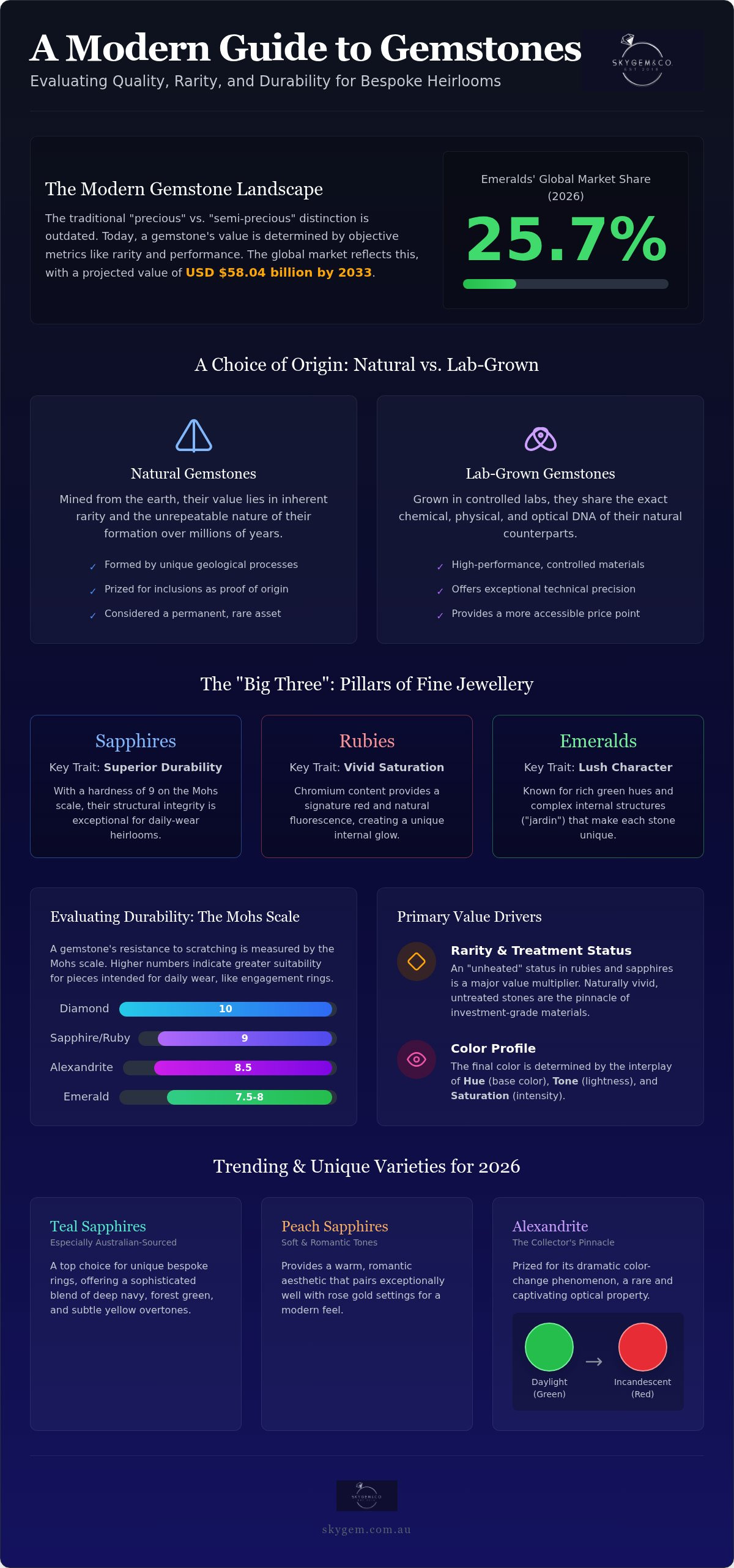
While diamonds often lead the conversation, emeralds now account for over 25% of the global gemstone market share as of 2026. You likely understand that selecting gemstones for a bespoke heirloom involves more than just picking a favourite colour. It's a high-stakes decision where technical durability must align with your aesthetic vision to ensure a piece stands the test of time. Many clients feel a justified hesitation when weighing the "Big Three" against semi-precious alternatives or deciding between natural and lab-grown origins.
We'll provide a rigorous framework for evaluating quality and provenance so you can invest with absolute confidence. This guide examines the critical distinctions in mineral hardness, the impact of the 2026 GIA reporting updates on origin determination, and how to select materials that suit your specific lifestyle. Whether you're considering the deep saturation of an unheated ruby or the modern performance of lab-grown diamonds, you'll gain the expert knowledge required to commission a truly enduring piece. We'll move from high-level sourcing ethics to the granular details of physical properties, ensuring your next acquisition is both a personal statement and a stable asset.
Key Takeaways
- Understand why the traditional distinction between "precious" and "semi-precious" is being replaced by objective metrics of rarity and mineral performance.
- Master the technical criteria for evaluating gemstones, specifically how the interplay of hue, tone, and saturation dictates the final colour profile.
- Learn to select stones that withstand daily wear by identifying the difference between mineral hardness on the Mohs scale and overall structural toughness.
- Understand the logistical steps of the bespoke process, from initial consultation to comparing loose centre stones under specific lighting conditions.
- Explore the unique performance characteristics of the "Big Three" and rising varieties like Australian Teal and Peach sapphires for bespoke jewellery designs.
Understanding Gemstones: Origins, Rarity, and Modern Classification
Gemstones are mineral crystals or organic materials selected for their rarity, durability, and optical beauty. Traditionally, the trade divided these into "precious" and "semi-precious" categories, a binary that has become increasingly irrelevant. In the Modern Classification of Gemstones, value is determined by objective performance metrics and geological scarcity. A top-tier Australian teal sapphire or a vibrant tsavorite garnet often holds more value and rarity than a commercial-grade emerald. Modern collectors focus on the specific physical properties that make these materials suitable for heirloom jewellery.
Natural vs. Lab-Grown: A Choice of Origin
Lab-grown stones share the exact chemical and optical DNA as those mined from the earth. They aren't "fakes"; they're high-performance materials grown in controlled environments that replicate geological processes. While lab-grown options offer technical precision and a lower entry point, natural stones remain the primary choice for those seeking a permanent asset with inherent rarity. The 2026 GIA reporting updates have expanded country-of-origin services for stones like opal and demantoid garnet. This reflects a market demand for transparency. Choosing between them often comes down to whether you value the technological achievement of a lab-grown stone or the unrepeatable nature of a mineral formed over millions of years.
The Role of Rarity in Gemstone Value
True rarity is defined by the unique geological conditions required to produce a stone. For instance, the "unheated" status of a ruby or sapphire is a major value driver. Most precious gemstones are thermally treated to enhance their appearance. Locating a stone with natural, vivid saturation that hasn't undergone heat treatment is a rare find. These unheated specimens represent the pinnacle of investment-grade materials. Beyond colour, clarity plays a role, though natural inclusions are frequently prized as proof of a stone's ancient origin. As the global market grows toward a projected USD 58.04 billion by 2033, understanding these technical nuances helps you secure gemstones that function as both personal heirlooms and stable assets.
The 'Big Three' and Trending Varieties for 2026
The "Big Three"—rubies, sapphires, and emeralds—continue to dominate the global market for gemstones in 2026. These stones remain the structural pillars of fine jewellery due to their historical stability and vivid optical performance. Current data indicates that emeralds alone account for approximately 25.7% of the market share this year. While these classics are permanent fixtures, the 2026 trend shifts toward bold, saturated colours and unique bicolour varieties. You can find technical specifications for these minerals in GIA's guide to gemstone quality, which establishes the baseline for evaluating professional-grade materials.
The "Big Three" possess distinct technical profiles that dictate their use in design:
- Sapphires: Superior hardness (9 Mohs) and high refractive index, offering exceptional durability.
- Rubies: Chromium-driven saturation and natural fluorescence that creates a signature internal glow.
- Emeralds: Complex internal structures, known as "jardin," and rich chromium or vanadium greens.
Alexandrite remains the pinnacle for many collectors due to its dramatic colour-change phenomenon. This variety of chrysoberyl shifts from a crisp green in daylight to a soft red under incandescent light. This rare optical property ensures its status as a permanent, evolving asset in any high-level collection.
The Rise of Australian and Teal Sapphires
Teal sapphires have emerged as a primary choice for unique bespoke engagement ring designs. These stones offer a sophisticated blend of blue and green, often featuring subtle yellow overtones. Australian-sourced stones are particularly valued for their deep navy to forest green profiles and structural integrity. For those seeking softer tones, peach sapphires provide a romantic aesthetic that pairs exceptionally well with rose gold settings. If you are beginning your search, exploring a curated selection of gemstones can help you identify the specific colour profile that aligns with your vision.
Emeralds and Rubies: Timeless Investment Stones
Natural emeralds and rubies hold their value because of their "unrepeatable" nature. When evaluating emeralds, understand that minor oiling is an industry-standard practice. This fills surface-reaching fissures to enhance transparency without altering the stone's fundamental structure. In contrast, the search for unheated rubies focuses on locating stones with naturally high colour depth and no thermal enhancement. These unheated specimens are rare and represent a significant investment in geological history. Because of their chromium content, natural rubies often display a fluorescence that makes the colour appear more vivid in natural sunlight, a trait that remains highly sought after by technical specialists.
Evaluating Gemstone Quality: The Four Cs and Beyond
Evaluating the quality of gemstones requires a departure from the standardised grading used for diamonds. While the Four Cs provide a foundation, coloured stones demand a more nuanced technical analysis of optical performance. Colour remains the primary driver of value, yet it's often misunderstood as a single metric. Professionals break this down into three components: hue, which is the basic colour; tone, representing the lightness or darkness; and saturation, which measures the intensity or vividness of the hue. A stone with high saturation and a medium-dark tone is typically the most prized.
Clarity in coloured gemstones is rarely about achieving a "flawless" state. Most natural minerals contain inclusions that serve as geological fingerprints. The industry standard is "eye-clean," meaning no inclusions are visible to the naked eye at a standard viewing distance. For certain stones like emeralds, internal characteristics are expected and even celebrated, provided they don't compromise the structural integrity of the piece.
The cut of a gemstone determines its brilliance and life. Unlike diamonds, which are cut to strict mathematical proportions, coloured stones are faceted to maximise their unique colour profile. A poorly cut stone may exhibit "windowing," where the centre appears pale and transparent because light leaks through the back. Conversely, "extinction" occurs when areas of the stone appear black because the facets don't reflect light back to the eye. Precision faceting ensures the stone performs consistently under various lighting conditions.
The Nuance of Coloured Stone Grading
Specific optical properties like pleochroism add complexity to the grading process. This phenomenon causes a stone to display different colours when viewed from different angles. A skilled lapidary must align the crystal axis during cutting to highlight the most desirable hue. Understanding these technicalities is vital when commissioning a piece, as the density of different minerals also affects their physical size. For example, a one-carat sapphire is denser than a diamond, meaning it will appear physically smaller than a diamond of the same weight.
Transparency and Certification
Independent verification is the only way to confirm a stone's origin and treatment status. While natural white diamonds follow a highly standardised grading system, coloured gems require specialised reports from laboratories like the GIA or IGI. These documents are essential for identifying "unheated" claims, which significantly impact market value. According to USGS gemstone sourcing data, the global trade of these materials is subject to complex supply chain variables, making transparent certification a non-negotiable requirement for any serious acquisition.
Durability and Selection for Daily Wear
Selecting gemstones for daily wear requires a technical understanding of mineralogical performance. Hardness alone doesn't guarantee longevity. We evaluate a stone based on three specific criteria: hardness, toughness, and stability. Hardness, measured by the Mohs scale, dictates a stone's resistance to scratching. For any piece intended for daily wear, such as a ring, we recommend stones with a Mohs rating of 7 or higher.
It's a common misconception that a hard stone can't break. Diamonds are the hardest known material at Mohs 10, yet they possess perfect cleavage. This means a sharp impact along a specific crystal plane can cause a chip. Toughness measures this resistance to fracturing. Stability refers to how well a stone resists chemical exposure, light, and heat. Understanding these distinctions ensures you select a material that functions as a permanent asset rather than a fragile ornament.
Top-Tier Durability: Sapphires and Rubies
Corundum, the mineral family of sapphires and rubies, remains the gold standard for daily-wear jewellery. Rated at Mohs 9, these stones are exceptionally scratch-resistant and lack the cleavage planes that make other minerals prone to splitting. Alexandrite and aquamarine also offer high resilience, making them suitable for long-term wear. When considering the structural foundation of a ring, lab-grown diamonds provide the same Mohs 10 hardness as natural diamonds, ensuring identical performance in high-impact environments.
Caring for Delicate Gemstones
Emeralds require a more cautious approach. While they rank 7.5 to 8 on the Mohs scale, their internal structures can create structural vulnerabilities. They're sensitive to pressure and harsh detergents, which can strip away standard oil treatments. Setting styles play a vital role here. A protective halo or bezel setting can shield the edges of a stone from accidental knocks. Regular professional maintenance, including prong tightening and inspections, preserves the stone's security. If you're ready to select a stone that matches your lifestyle requirements, you can view our range of durable gemstones to find the perfect balance of beauty and resilience.
The Journey from Loose Gemstone to Bespoke Heirloom
The transition from a raw mineral specimen to a finished piece of fine jewellery is a methodical process that requires a balance of technical expertise and aesthetic vision. This journey begins with a detailed consultation where your preferences are mapped against structural feasibility and budget. Unlike standard retail environments, a bespoke approach treats the centre stone as the architectural foundation of the entire project. Comparing loose gemstones side-by-side is a critical step, as it allows you to observe how different specimens perform under varying light sources, such as natural daylight and incandescent office lighting.
Once you select a stone, the design phase utilises Computer-Aided Design (CAD) to create a digital blueprint. This ensures the metalwork precisely accommodates the unique physical dimensions, including the girdle thickness and pavilion depth, of your specific gem. This technical precision prevents the structural issues often found in mass-produced settings where stones are forced into pre-made mounts. The final setting phase is the most delicate, requiring a master setter to secure the stone with enough pressure to ensure long-term stability without compromising the integrity of the material.
Setting Styles for Gemstone Rings
The choice of setting dictates how the light interacts with the stone's facets. We focus on three primary configurations for bespoke projects:
- Solitaire Engagement Rings: A minimalist approach that allows the natural colour and saturation of a premium sapphire or ruby to take centre stage without distraction.
- Halo Engagement Rings: A border of smaller diamonds surrounds the centre stone, which serves to enhance the perceived size and brilliance of coloured gemstones.
- Trilogy Engagement Rings: This configuration uses three stones to represent a narrative of past, present, and future, often pairing a coloured centre stone with diamond side accents.
The Value of Expert Guidance
Partnering with a specialist boutique provides a level of quality control that e-commerce platforms cannot replicate. Expert guidance is particularly vital when dealing with unique stone shapes or rare varieties like Alexandrite, where the setting must be engineered to protect the stone's edges. Choosing a custom-made engagement ring ensures that the final piece is not just a purchase, but a permanent asset that reflects your personal heritage and lifestyle. This collaborative process transforms a loose mineral into a finished heirloom, built to withstand daily wear while maintaining its optical performance for generations.
Securing Your Legacy through Technical Precision
Investing in high-performance gemstones requires a sophisticated balance of geological knowledge and architectural design. We've explored how mineral hardness, GIA-certified provenance, and precise faceting dictate the long-term viability of a bespoke heirloom. Whether you're selecting a rare unheated ruby or a modern lab-grown diamond, the priority remains the intersection of technical durability and optical beauty. This methodical approach ensures your acquisition is both a personal statement and a stable asset.
Our methodology centres on transparency and expert partnership. We utilise GIA certified diamonds and premium coloured stones to ensure every selection is backed by rigorous independent verification. Through detailed bespoke design consultations and expert craftsmanship in every setting, we transform these raw materials into permanent, wearable assets. This engineering-focused process ensures your piece isn't just aesthetically striking; it's structurally sound for decades of daily wear. We're here to provide the technical expertise required to navigate these complex variables with absolute confidence.
Explore our curated collection of precious gemstones and begin your bespoke journey today.
We look forward to acting as your technical consultant in creating a piece that serves as a lasting legacy for generations.
Frequently Asked Questions
What is the most durable gemstone for an engagement ring?
Diamonds are the most durable gemstones for daily wear, ranking 10 on the Mohs scale. Following diamonds, the corundum family, which includes sapphires and rubies, offers a hardness of 9. These minerals are highly resistant to scratching and lack the cleavage planes that make other stones prone to fracturing. For an engagement ring subjected to daily activity, these materials provide the highest level of structural security and long-term performance.
Are lab-grown gemstones real gemstones?
Lab-grown gemstones are chemically, physically, and optically identical to their natural counterparts. They aren't imitations; they're created in controlled environments that replicate the high-pressure, high-temperature conditions found within the earth. Because they share the same mineral DNA, they offer the same level of brilliance and durability. The primary difference lies in their origin and the technological precision used to produce stones without the environmental impact of traditional mining.
What is the difference between a natural and an unheated sapphire?
While most natural sapphires undergo thermal enhancement to improve colour and clarity, unheated sapphires remain in their original state. An "unheated" designation indicates that the stone's vivid saturation was achieved through geological processes alone. These specimens are significantly rarer and hold a higher market value than heat-treated stones. Verification through an independent laboratory report is essential to confirm that no artificial treatments were applied to the mineral.
Why are emeralds more expensive than some other gemstones?
Emeralds command high prices due to the extreme rarity of high-quality chromium-rich beryl. Unlike other gemstones, emeralds naturally contain internal inclusions known as "jardin," and finding a specimen with both vivid colour and high transparency is exceptionally difficult. Their value is also influenced by the risk involved in cutting and setting these stones, as their complex internal structures require a high degree of technical precision to avoid breakage.
Can I use an aquamarine for my engagement ring?
Aquamarine is suitable for engagement rings, provided the wearer understands its maintenance requirements. With a Mohs hardness of 7.5 to 8, it's durable enough for regular wear but is more susceptible to scratching than diamond or sapphire. To ensure its longevity, we recommend protective setting styles and avoiding exposure to harsh chemicals or abrasive surfaces. It's an excellent choice for those seeking a soft blue aesthetic with reliable mineral performance.
How do I know if my gemstone is ethically sourced?
Verifying ethical sourcing requires a combination of independent certification and supply chain transparency. Look for GIA origin reports that confirm the country of extraction, especially for gemstones like Australian sapphires. Professional boutiques should provide documentation regarding their procurement standards and adherence to international trade regulations. This level of transparency ensures that your stone was sourced through legitimate channels that respect both environmental standards and labour rights.
What is the 'Big Three' in the gemstone world?
The "Big Three" refers to rubies, sapphires, and emeralds, which have historically dominated the fine jewellery market. These stones are grouped together because of their enduring value, historical significance, and superior optical properties. While modern trends have introduced varieties like teal sapphires or alexandrite, the Big Three remain the primary benchmarks for investment-grade coloured stones. Their established market stability makes them a preferred choice for creating permanent heirloom assets.
How often should I have my gemstone jewellery professionally cleaned?
We recommend having your fine jewellery professionally inspected and cleaned every six to twelve months. During these sessions, a specialist checks the integrity of the prongs and the security of the setting to prevent stone loss. Professional ultrasonic cleaning removes accumulated oils and debris that standard home care cannot reach, restoring the stone's original brilliance. This proactive maintenance schedule is a vital part of preserving the long-term viability of your bespoke piece.
Disclaimer
This article is for general informational purposes only and may include AI-assisted content. Pricing, specifications, and availability are subject to change. For accurate advice and current information, please contact SkyGem & Co. directly. Nothing in this content constitutes professional or financial advice.