
The Ultimate Guide to Choosing a 1 Carat Diamond Ring in 2026

In 2026, 61% of engagement rings feature lab-grown center stones, marking a significant shift in how we value and acquire luxury. You likely understand that a 1 carat diamond ring represents a major milestone, yet you might fear that a lack of technical knowledge will lead to a stone that lacks presence or brilliance. It is a common frustration to face the complexity of the 4Cs, especially with the GIA transitioning to broader "Premium" and "Standard" descriptors for lab-grown stones as of February 23, 2026.
We'll show you how to maximise the brilliance, value, and visual impact of your selection through expert technical insights and bespoke design principles. This guide details the specific benchmarks for light performance, the stability of current market pricing, and the engineering behind settings that enhance a diamond's perceived size. You will gain the confidence to choose a durable, high-quality ring that aligns with both your aesthetic goals and your commitment to ethical sourcing. We'll move from high-level value comparisons to the granular details of certification and local Australian compliance.
Key Takeaways
- Distinguish between mass and millimetre measurements to ensure your selection offers the maximum face-up visual impact for its specific weight.
- Prioritise Cut quality as the primary driver of brilliance, as this technical specification determines how effectively a 1 carat diamond ring handles light.
- Evaluate the stable 2026 pricing structures for both natural and lab-grown options to align your investment with your long-term value requirements.
- Apply architectural design strategies, including specific prong configurations and halo settings, to amplify the perceived scale of the centre stone.
- Master the bespoke design journey from CAD modelling to final hand-finish to guarantee a durable, high-performance piece that meets Australian compliance standards.
Understanding the 1 Carat Diamond: Weight vs. Visual Dimension
Carat weight is often misunderstood as a measure of physical dimensions, but it technically refers to a diamond's mass. One carat equals exactly 0.2 grams. While this metric provides a baseline for pricing, it doesn't guarantee the visual presence of a 1 carat diamond ring. In the Australian market, the 1.00ct mark remains a significant psychological milestone, deeply rooted in the history of diamond engagement rings where a full carat symbolises a global standard of luxury and commitment.
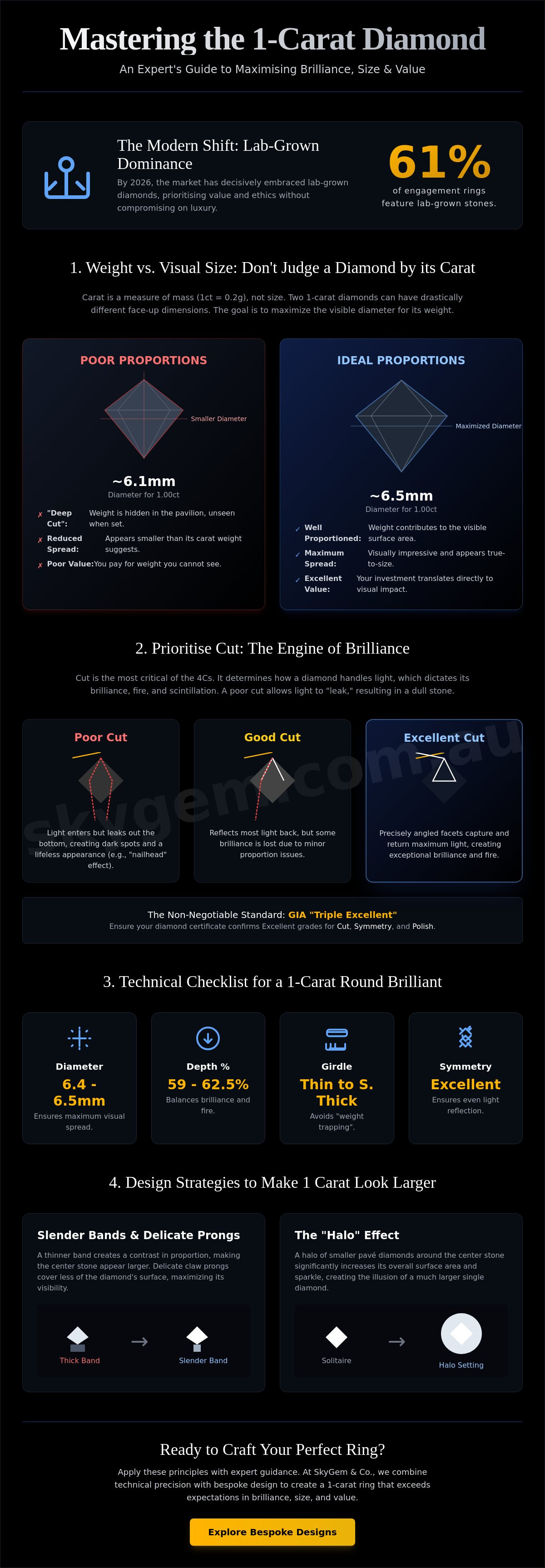
The true value of a stone lies in its "face-up" appearance. Two diamonds with identical weights can appear vastly different in size due to their cut proportions. A "deep-cut" stone carries excessive weight in its pavilion, effectively hiding its mass where it cannot be seen once set. This results in a smaller diameter and reduced light performance. Conversely, a well-proportioned stone maximises its surface area, ensuring you perceive the full benefit of the 1.00ct investment.
The Geometry of Perceived Size
Perception is heavily influenced by the stone's shape and girdle thickness. An oval cut diamond typically has a larger surface area than a round brilliant of the same weight, often appearing 10% to 15% larger to the eye. Additionally, a thick girdle acts as a weight trap, adding mass without increasing the stone's diameter. Savvy buyers often look for "under-size" stones, such as a 0.95ct diamond. Because diamond prices jump significantly at the full 1.00ct mark, a 0.95ct stone with a superior spread can offer the same visual impact as a 1 carat diamond ring while providing better value.
Anatomy of a 1 Carat Stone
To evaluate a stone's physical dimensions, you must look beyond the certificate's weight. The table percentage, which is the width of the top facet relative to the stone's diameter, should ideally fall between 52% and 62% for maximum light return. Diamonds described as "spready" have a larger diameter for their weight, but they must be balanced carefully; if a stone is too shallow, it will lose its fire and brilliance. For those seeking precision in these technical specifications, exploring diamonds online in Melbourne allows for a detailed comparison of these critical metrics before committing to a final design.
A technical checklist for a 1ct round brilliant includes:
- Diameter: Aim for approximately 6.4mm to 6.5mm.
- Depth Percentage: Keep this between 59% and 62.5% for optimal balance.
- Girdle: Thin to Slightly Thick is ideal to avoid hidden weight.
- Symmetry: Excellent symmetry ensures light is reflected consistently across the stone's surface.
The 4Cs of a 1 Carat Diamond: Prioritising Cut for Maximum Brilliance
While carat weight provides the physical foundation, the technical execution of the cut determines the stone’s ultimate performance. For a 1 carat diamond ring, the cut is the most critical variable because it dictates how light interacts with the internal facets. The The 4Cs of Diamond Quality framework, established by the GIA, remains the definitive technical guide for evaluating this interaction. In a stone of this size, even minor deviations in facet alignment can lead to a significant loss in luminous efficacy.
Light performance is measured through three distinct components: brilliance, fire, and scintillation. Brilliance refers to the total white light reflected back to the viewer. Fire describes the dispersion of light into spectral colours, while scintillation is the pattern of light and dark areas visible as the stone moves. A high-performance 1ct stone requires a "Triple Excellent" grade from the GIA, which confirms that the cut, symmetry, and polish all meet the highest engineering standards for light return. This certification is a non-negotiable benchmark for ensuring the diamond doesn't appear dull or undersized.
The Impact of Cut Grade on Light Leakage
Poor proportions result in light leakage, a phenomenon where light rays exit through the pavilion rather than reflecting back through the table. In poorly cut 1ct stones, you may observe a "fisheye" effect, where the girdle reflects in the table, or a "nailhead," where the centre of the stone appears dark. An Excellent cut ensures that the diamond's diameter is maximised, often making a 1.00ct stone appear visually larger than a 1.10ct stone with a "Very Good" grade. This precision in cut geometry is what separates a premium asset from a standard retail stone.
Colour and Clarity Sweet Spots
Achieving a high-performance 1 carat diamond ring doesn't require "D" colour or "Internally Flawless" clarity. For stones set in white metal, G or H colour grades provide a clean, white appearance without the premium cost of the colourless range. Regarding clarity, VS2 or SI1 grades are typically "eye-clean" at the 1ct mark, meaning inclusions aren't visible to the naked eye. Blue fluorescence can be a technical advantage in H or I colour stones, as it can make them appear whiter under UV light. If you're ready to explore these technical specifications in person, you can view our range of 18K white gold engagement rings to see how cut quality impacts visual performance.
As of February 23, 2026, it is vital to note that the GIA has transitioned its grading for lab-grown diamonds to "Premium" and "Standard" descriptors. This shift reinforces the importance of understanding the underlying technical data rather than relying solely on traditional letter grades when evaluating 2026 market offerings.
Natural vs. Lab-Grown: Choosing the Right 1 Carat Stone for Your Budget
Distinguishing between natural and laboratory-grown stones is no longer a matter of chemical composition but of origin and economic strategy. Both varieties are isomorphous, sharing the same cubic carbon structure and physical properties. This means a lab-grown 1 carat diamond ring will exhibit the same thermal conductivity and refractive index as its mined counterpart. As of 2026, 61% of engagement rings feature lab-grown centre stones, a shift driven by the functional price floor reached in late 2025 and a growing demand for transparent supply chains.
Price transparency remains a primary differentiator. A natural 1-carat diamond ring in a standard 14K gold setting typically costs between $6,000 and $12,000. In contrast, a lab-grown equivalent ranges from $2,500 to $4,500. This price delta allows buyers to reallocate funds toward a more complex setting or a higher technical grade within the 4Cs of Diamond Quality. The decision must account for long-term asset performance; lab-grown diamonds currently return only 10% to 30% of their original purchase price in the resale market, whereas natural stones maintain a higher percentage of their value due to geological rarity.
The Case for Natural 1 Carat Diamonds
Natural diamonds offer a tangible connection to geological history, having formed under extreme pressure over billions of years. For many Australian buyers, this rarity is the core driver of value. When evaluating a natural stone, GIA certification is the gold standard for verifying origin and ensuring the stone isn't a synthetic substitute. You can explore our curated selection through our natural white diamond ring builder to compare certified stones that meet these rigorous standards for authenticity and ethical sourcing.
The Advantages of Lab-Grown 1 Carat Diamonds
The primary technical advantage of lab-grown technology is the ability to produce high-clarity, high-colour stones at a fraction of the cost. Under the GIA grading system updated on February 23, 2026, a "Premium" lab-grown diamond must achieve D colour and VVS clarity. This allows consumers to secure a visually perfect 1 carat diamond ring that fits within a more accessible budget. The controlled production environment offers a reduced environmental footprint, making it a preferred choice for modern, sustainable luxury. To see these high-performance stones in detail, consider using our lab-grown white diamond ring builder to customise your selection based on real-time inventory and technical specifications.
Design Strategies: How to Make a 1 Carat Diamond Look Larger
The architectural presentation of a 1 carat diamond ring is just as critical as the stone's internal technical specifications. While the previous chapters focused on light performance and origin, the setting acts as a structural frame that can either amplify or diminish the stone's visual presence. By applying specific engineering principles to the ring's design, you can ensure the centre stone remains the primary focal point. This creates a presence that often rivals larger carat weights through the clever use of visual contrast and geometric alignment.
Scale is perceived through the relationship between the diamond and the metal that surrounds it. For example, selecting a band width of 1.8mm creates a significant visual pop for a 1ct stone, whereas a standard 2.5mm band can make the same diamond appear smaller by comparison. Additionally, the choice of metal plays a functional role in light return. Using 18K white gold or platinum provides a monochromatic backdrop, allowing the prongs to blend seamlessly into the diamond’s facets. This reduces visual clutter around the stone's perimeter and ensures the eye focuses entirely on the diamond's diameter.
Architectural Settings and Prong Styles
Prong configuration significantly alters the diamond's silhouette and light intake. A four-prong setting is the preferred choice for those wanting to maximise visibility, as it exposes more of the diamond's profile to light. Conversely, a six-prong setting provides superior structural integrity and can make a round stone appear more circular. For a modern aesthetic, the Compass setting, where prongs are placed at the North, South, East, and West positions, offers a unique frame that draws the eye outward. This configuration increases the perceived spread of a 1 carat diamond ring. Tapered bands, which narrow as they approach the centre stone, further use geometry to direct attention toward the diamond's table.
Alternative Shapes for Maximum Spread
If visual footprint is your primary objective, certain fancy shapes offer a larger surface area per carat than the traditional round brilliant. Shapes like the Oval, Pear, and Marquise are elongated, covering more of the finger's width and creating the illusion of a more substantial stone. An Oval cut can appear up to 15% larger than a round brilliant of the same weight due to its elongated length-to-width ratio. An Emerald cut, while offering a smaller face-up area, provides a sophisticated hall-of-mirrors effect that highlights the diamond’s clarity and structural precision. Balancing these shapes with your specific finger type ensures the most flattering and impactful aesthetic. To begin designing a piece that perfectly balances these technical and aesthetic factors, you can explore our custom made engagement rings in Melbourne for a tailored consultation.
The Halo effect remains a dominant strategy for those seeking maximum amplification. By surrounding the 1ct centre stone with a perimeter of micro-pavé diamonds, you can increase the overall diameter of the setting by several millimetres. This technical choice doesn't just add sparkle; it creates a unified field of light that makes the entire head of the ring appear as one large, brilliant asset. This design strategy is particularly effective for those who want the visual impact of a 2-carat stone while maintaining the budget of a 1-carat selection.
Crafting Your 1 Carat Engagement Ring with SkyGem & Co.
The final phase of acquiring a 1 carat diamond ring involves translating granular photometric data into a physical asset engineered for longevity. At SkyGem & Co., we operate as technical consultants, ensuring that every design choice prioritises the intersection of engineering excellence and architectural aesthetics. Our bespoke journey begins with high-fidelity CAD design. This allows us to simulate the ring’s structural performance and light return before any metal is cast. This methodical process ensures that the strategies discussed in previous chapters, such as the use of tapered bands to enhance the centre stone’s presence, are executed with mathematical precision.
Transparency in sourcing is a recurring signature of our reliability. We maintain a strict commitment to GIA-certified stones, adhering to the refined February 2026 grading standards that differentiate between "Premium" and "Standard" lab-grown origins. By providing comprehensive technical data for every stone, we empower you to make a decision based on performance rather than hype. Our role is to navigate the complexities of the 4Cs within your specific budget, providing a turnkey solution that balances cost-effectiveness with high-level visual impact.
The SkyGem & Co. Quality Standard
Engineering a ring for multi-generational durability requires a deep understanding of metallurgy. We exclusively utilise premium 18K gold and platinum alloys, selected for their superior hardness and resistance to deformation. This focus on structural integrity protects the centre stone from the rigours of the Australian lifestyle. Like any high-performance system, regular maintenance is essential to preserve luminous efficacy. We provide professional cleaning and prong inspections to ensure the setting remains a permanent and evolving asset. You can explore our bespoke engagement ring process to understand how we bridge the gap between technical data and architectural beauty.
Your Next Steps
Selecting a diamond is a sensory experience that complements the hard data of a grading report. We invite you to book a private consultation at our Melbourne studio to view a curated selection of loose diamonds under professional lighting conditions. This allows you to evaluate fire and scintillation firsthand, ensuring the stone meets your requirements for brilliance. For those who prefer a digital-first approach, our online configuration tools provide real-time access to our certified inventory. You can browse our GIA certified natural diamonds to begin filtering by the specific cut and clarity benchmarks established in this guide. Our team is dedicated to ensuring your investment represents a sophisticated, high-performance solution.
Secure Your Technical Milestone with Precision
Selecting a 1 carat diamond ring is a technical undertaking that requires a balance of engineering data and aesthetic vision. You now understand that maximizing brilliance depends on the "Triple Excellent" cut standard and that strategic architectural settings can significantly amplify a stone's perceived scale. Whether you opt for a natural stone with billion-year geological history or a "Premium" lab-grown diamond under the February 2026 GIA guidelines, the focus must remain on light performance and structural integrity.
Our team acts as your technical consultant, providing expert consultations to help you navigate these specifications within your specific budget. We offer a curated selection of GIA certified natural and lab diamonds, all housed in bespoke craftsmanship using 18K gold and platinum alloys. This approach ensures your investment is both a brilliant visual asset and a durable piece of Australian-led design. We're ready to help you translate these technical insights into a permanent reality. Start Designing Your Bespoke 1 Carat Ring today and experience the confidence of expert guidance.
Frequently Asked Questions
Is a 1 carat diamond ring considered big?
A 1 carat diamond ring is a substantial and prestigious choice, though market averages have shifted significantly. In 2026, the average carat size for an engagement ring has increased to 1.9 carats, largely due to the popularity of lab-grown stones. However, for natural diamonds, the average remains 1.16 carats, making a 1.00ct stone a significant and timeless benchmark for luxury. Its visual impact depends heavily on the cut quality and the architectural design of the setting.
How much should I spend on a 1 carat diamond ring in 2026?
Budgeting for a 1 carat diamond ring depends on the diamond's origin and technical specifications. A natural stone in a standard 14K gold setting typically costs between $6,000 and $12,000, while lab-grown options range from $2,500 to $4,500. Currently, 66% of couples spend less than $6,000 on an engagement ring. This reflects a strategic shift toward high-performance lab-grown stones that offer superior colour and clarity grades within a more accessible price range.
What is the best diamond shape for a 1 carat weight?
The ideal shape depends on whether you prioritise light performance or visual spread. A round brilliant is engineered for maximum brilliance and fire, providing the most traditional sparkle through its 57 or 58 facets. If you want to maximise the footprint on the finger, elongated shapes like the Oval or Marquise offer a larger surface area per carat. These shapes can appear 15% larger than a round stone of identical weight due to their elongated geometry.
Does a lab-grown 1 carat diamond look different from a natural one?
There is no visual difference between a lab-grown and a natural diamond because they share an identical cubic carbon structure. Both exhibit the same refractive index and thermal conductivity, ensuring they handle light in the same way. As of February 23, 2026, the GIA uses descriptors like "Premium" for high-quality lab stones to acknowledge their identical physical properties. Specialized laboratory equipment is required to identify their growth origin; they are indistinguishable to the naked eye.
Which 4C is most important when buying a 1 carat diamond?
Cut is the most critical "C" for ensuring your diamond doesn't appear dull or undersized. While colour and clarity are important, the cut determines the stone's luminous efficacy and how light is handled by internal facets. A Triple Excellent grade ensures maximum light return, preventing the light leakage that can make a stone look dark. Prioritising cut allows you to secure a stone with superior brilliance, even if you compromise slightly on the colour grade.
What band width is best for a 1 carat solitaire ring?
A band width of 1.8mm is the ideal architectural choice for a solitaire setting. This narrow width creates a sharp visual contrast that makes the centre stone appear larger and more prominent. Bands wider than 2.5mm can overwhelm a 1ct diamond, reducing its perceived scale on the finger. Using 18K white gold or platinum further enhances this effect by allowing the metal prongs to blend seamlessly with the diamond's brilliance.
Can I tell the difference between a 0.90ct and a 1.00ct diamond?
Distinguishing between a 0.90ct and a 1.00ct stone is nearly impossible to the naked eye if their millimetre measurements are similar. A well-cut 0.90ct diamond with a large "spread" can have a diameter of 6.3mm, which is nearly identical to a standard 1.00ct stone. Because prices jump significantly at the full carat mark, choosing a high-quality 0.90ct stone is a cost-effective strategy for achieving the same visual impact for a lower investment.
Why do some 1 carat diamonds sparkle more than others?
Sparkle is a direct result of precise facet alignment and light handling. Diamonds with poor proportions suffer from light leakage, where light exits through the bottom of the stone instead of reflecting back to the viewer. This reduces fire and scintillation. Stones that sparkle more have been engineered with ideal table and depth percentages, ensuring that every ray of light is returned with maximum intensity. This technical precision is what defines a high-performance diamond.
Disclaimer
This article is for general informational purposes only and may include AI-assisted content. Pricing, specifications, and availability are subject to change. For accurate advice and current information, please contact SkyGem & Co. directly. Nothing in this content constitutes professional or financial advice.