
The Ultimate Australian Ring Size Chart: A Professional Guide to Precision Fit

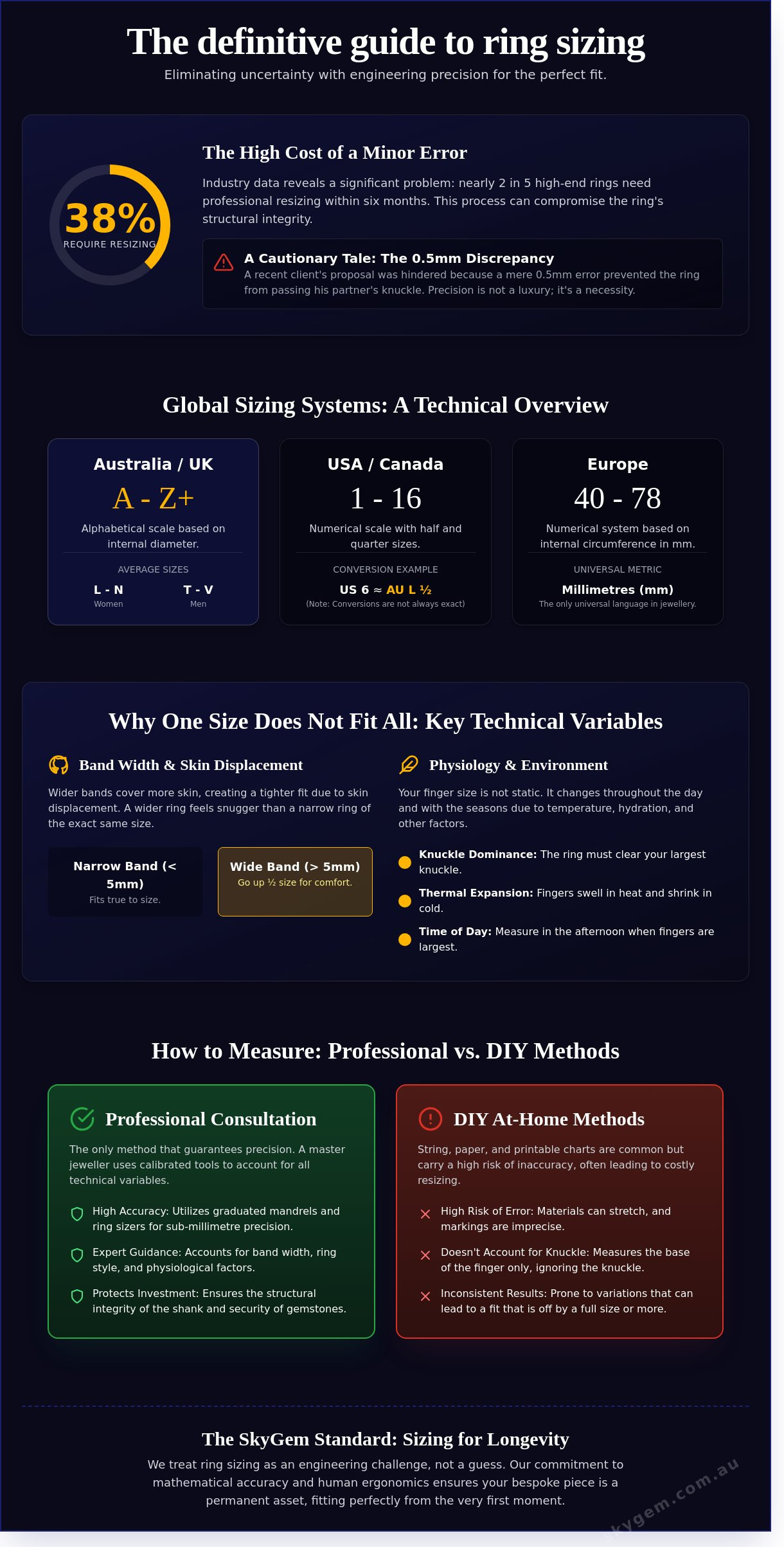
Last October, a Sydney-based client discovered that a 0.5mm discrepancy in measurement meant his bespoke engagement ring couldn't slide past his partner's knuckle during the critical moment of his proposal. It's a frustrating scenario that highlights the absolute necessity of precision in fine jewellery, where a minor miscalculation leads to significant logistical hurdles. You likely understand that selecting the correct dimensions is as much about engineering as it is about aesthetics, yet the technical variance between international standards often makes using a standard ring size chart feel like a calculated risk. Industry data from 2023 indicates that approximately 38% of high-end rings require professional resizing within six months, a process that can occasionally compromise the structural integrity of a refined band.
We're here to eliminate that uncertainty by providing the technical expertise required to master the Australian alphabetical sizing system with total confidence. You'll gain the professional measurement techniques needed to account for physiological factors like thermal expansion, ensuring your investment fits perfectly from the first moment. This guide delivers a definitive conversion matrix and establishes a clear framework for when to move from home measurements to a professional consultation with a master jeweller.
Key Takeaways
- Understand the Australian alphabetical sizing system and its technical distinction from international numerical standards to ensure seamless communication with your jeweller.
- Evaluate how band width and internal profile engineering alter the perceived fit, ensuring your design remains comfortable without sacrificing aesthetic proportions.
- Access a professional ring size chart and learn to distinguish between high-accuracy measurement tools and common DIY techniques that risk inaccurate results.
- Account for environmental variables and physiological changes, such as knuckle dominance, to guarantee a fit that remains secure through seasonal transitions.
- Recognize the importance of precision sizing in protecting the structural integrity of the shank and the long-term security of your loose gemstones.
Understanding the Australian Ring Sizing System
Australia utilizes an alphabetical scale ranging from A to Z, with additional sizes denoted as Z+1 or Z+2 for larger requirements. This system, shared with the United Kingdom, relies on specific increments where each letter represents a distinct measurement of the inner diameter. While the US uses a numerical scale and Europe often utilizes the internal circumference in millimetres, the Australian ring size standards provide a structured framework for local jewellers to ensure a secure fit. For context, a standard woman's size M has an internal diameter of 16.71mm. In the Australian market, the average size for women typically falls between L and N, while men usually require sizes between T and V.
The Anatomy of a Ring Size
Achieving a precision fit requires understanding the difference between internal diameter and external circumference. Internal diameter is the straight-line distance across the centre of the ring's opening; this is the primary metric used to populate a professional ring size chart. For high-end engagement rings, even a 0.2mm discrepancy can lead to discomfort or the risk of the piece sliding off. Professional jewellers use a graduated mandrel to measure size. It's vital to distinguish between a "leading edge" reading, where the ring first touches the mandrel, and a "centre" reading, which aligns with the middle of the band's width. Quarter and half-sizes are essential for ensuring the band clears the knuckle without rotating excessively at the base of the finger.
AU vs International Sizing Conversion
Ordering jewellery from international suppliers often introduces technical risks due to varying conversion scales. A US size 6, for instance, translates approximately to an Australian L 1/2. However, these conversions aren't always exact. Small variations in manufacturing tolerances mean that a "size 7" from one region might feel different from another. Millimetre precision remains the only universal language in jewellery manufacturing. At Skygem, we focus on exact measurements to avoid the common pitfalls of international scaling. Relying on a standardized ring size chart calibrated to Australian metrics ensures that your investment meets local compliance and comfort standards. This technical approach eliminates the guesswork often associated with retail purchases.
Precision is the cornerstone of our design philosophy. We treat ring sizing as an engineering challenge rather than a simple measurement. By focusing on the intersection of mathematical accuracy and human ergonomics, we ensure that every piece functions as a permanent asset. This methodology reflects our commitment to long-term performance and architectural aesthetics in every project we undertake.
The Technical Variables: Why One Size Does Not Fit All
Achieving a precise fit involves more than matching a finger circumference to a standard ring size chart. The geometry of the band itself plays a critical role in how the piece interacts with the wearer's anatomy. When selecting a design, you must consider the surface area of the metal in contact with the skin. Technical variables such as band width, internal profile engineering, and the weight distribution of gemstones can alter the required size by as much as a full millimetre in diameter.
Band Width and Displacement
Band width is a primary determinant of comfort. As the width of a ring increases, it covers more surface area, which leads to greater skin displacement. A 2mm band allows the skin to move freely around the edges; however, a 6mm band traps more tissue, creating a tighter sensation. A professional rule of thumb dictates that for bands exceeding 5mm in width, a half-size increase is often required to maintain the same level of comfort as a thinner ring. Metal density also influences this perception. Platinum, being roughly 60% denser than 14K gold, feels more substantial on the finger, which can make a slightly loose fit feel more secure. For those seeking technical precision, consulting Professional Ring Sizing Techniques ensures these physical variables are accounted for during the design phase.
Jewellery Architecture and Balance
The structural distribution of weight impacts stability. Rings featuring high-set natural diamonds often experience "spinning" if the sizing isn't exact. This occurs because the centre of gravity is elevated, causing the stone to pull the band to the side. To mitigate this, bespoke designs often incorporate counter-balancing elements or a slightly wider base to increase friction against the finger. Internal profiles also matter. A "Standard Fit" is flat on the inside, while a "Comfort Fit" features a domed interior. This curvature reduces the contact area between the metal and the finger, which usually requires the wearer to drop down by a quarter or half size compared to a flat band.
Structural integrity also limits how much a ring can be adjusted post-production. While a plain gold band can typically be resized by two or three sizes, full eternity bands are often impossible to resize without a complete rebuild. If you are planning a surprise and aren't certain of the measurement, it's safer to choose a custom-made engagement ring where the shank is designed with a small sizing bar at the base. This foresight ensures that the final piece can be adjusted to match the ring size chart perfectly without compromising the stone settings.
How to Measure Ring Size: Professional vs. DIY Methods
Achieving a precise fit requires a shift from domestic shortcuts to technical measurement. The common "string and paper" approach relies on materials that stretch or compress, often leading to errors of one to two full sizes. A standard piece of string can expand by 3% when tensioned, rendering it useless for a high-value investment. Instead, a physical multi-sizer tool provides a stable circumference that doesn't distort under pressure. While a printable ring size chart offers a baseline, it can't account for the three-dimensional volume of a finger or the way skin displaces around a metal band. For a definitive result, the professional jeweller’s mandrel remains the gold standard. This tapered steel tool is calibrated to national standards, ensuring the internal diameter aligns perfectly with Australian sizing metrics.
The Existing Ring Method
Precision starts with a digital caliper. Measuring the internal diameter to two decimal places is essential for accuracy. A reading of 16.51mm correlates to an Australian size L, while 16.92mm moves the measurement to an M. You must inspect the band for "out of round" distortions before measuring. Daily wear often flattens the base of a ring by 0.2mm or more, which creates an inaccurate diameter reading. Always measure the finger on the specific hand intended for the piece. Data from ergonomic studies indicates the dominant hand is typically 0.5mm to 1.0mm larger due to increased muscle density and blood flow. If the ring is for a custom made engagement ring in Melbourne, using a ring that is currently worn on the correct finger is the only way to ensure a reliable data point.
Professional Sizing Tools
A plastic multi-sizer acts like a miniature belt, but users often over-tighten it. The goal is a comfortable resistance when passing over the knuckle. Professional kits differ from DIY tools by offering varied widths. This is a critical technical distinction.
- Thin Sizing Rings: These are used for bands 2mm or narrower to minimize skin displacement.
- Wide Sizing Gauges: These are used for bands 6mm or wider, as broader metal surfaces create more friction and require a slightly larger size for comfort.
Consulting a Trusted Specialist for a formal assessment removes the variables of temperature and humidity, which can cause finger fluctuations of up to half a size. Specialists use a combination of physical gauges and a ring size chart to cross-reference measurements against the specific profile of the chosen setting. This methodical approach ensures the final piece functions as a permanent, comfortable asset rather than a logistical challenge.
Expert Tips: Accounting for Physiology and Environment
Achieving a precision fit requires more than a simple reference to a ring size chart. Human physiology is dynamic. Finger volume can fluctuate by up to 0.5mm in diameter within a single 24 hour cycle. When you measure a finger, you aren't just measuring bone and skin; you're measuring fluid retention and blood flow. While a ring size chart provides the essential baseline, these physiological adjustments ensure long-term comfort.
Environmental factors play a critical role. Cold temperatures cause blood vessels to constrict, which often results in a measurement that's too small. If you measure on a 10 degree morning, the ring will likely feel uncomfortably tight during a 38 degree Australian summer. We recommend measuring at least three times at different intervals to find a reliable average. This approach mitigates the risk of an outlier reading caused by temporary conditions.
For individuals with knuckle dominance, where the joint is significantly wider than the base of the finger, the ring must be sized to clear the knuckle with moderate resistance. If the ring spins excessively once seated, we often recommend sizing beads. These are two small gold or platinum spheres soldered into the interior of the shank. They provide the necessary grip to keep the ring upright without requiring a full resize that might make the piece impossible to slide over the joint.
Circadian and Seasonal Fluctuations
Body chemistry directly impacts fit. High salt intake, intense exercise, or a 14 hour long-haul flight can cause temporary swelling. Afternoon measurements are typically the most accurate because the body has reached a stable equilibrium after daily activity. In the Australian climate, we must account for the summer fit. A ring that feels perfect in July might become restrictive in January. We advise aiming for a fit that is snug enough to stay in place but allows for the natural expansion that occurs in humid conditions.
The Secret Measurement Strategy
Securing a size for a surprise proposal requires a tactical approach. One effective method involves tracing the inside of a ring your partner currently wears on their ring finger. Ensure you use a fine-point pen to maintain accuracy. You can also briefly borrow a ring and press it into a piece of softened wax to create a physical impression, though this carries a 10% margin of error if the ring is distorted.
Consulting friends or checking existing fine jewellery collections can provide useful data points. Keep in mind that the dominant hand is usually half a size larger than the non-dominant hand. If you're between sizes, always opt for the larger option. It's technically simpler to downsize a ring than to stretch or add metal to a shank during a resize.
Browse our selection of ready to ship engagement rings to find a piece that combines technical precision with timeless design.
Sizing for Bespoke Longevity: The SkyGem Standard
Precision sizing serves as the fundamental safeguard for your investment. While a standard ring size chart provides a baseline, achieving a professional fit is critical for the long-term security of loose gemstones. When a ring doesn't fit correctly, the resulting centrifugal force during hand movement causes the head of the ring to rotate. This leads to accidental impact against hard surfaces, which can loosen claws or chip the girdle of a stone. At SkyGem, we treat sizing as a technical specification rather than an afterthought. Integrating exact measurements into the custom-made engagement ring process ensures that the structural integrity remains uncompromised from the day of manufacture. We view every piece as a permanent asset, requiring a fit that accommodates daily wear while protecting the delicate geometry of the setting.
Resizing and Metal Memory
Every time a ring undergoes resizing, the metal is subjected to thermal or mechanical stress. Stretching a band to increase its diameter thins the shank, often reducing its thickness by up to 15 percent in extreme cases. Conversely, cutting and soldering introduces a join that, while professional, can create a microscopic weak point. Certain sapphire settings, particularly those with side-stone accents or intricate pavé work, shouldn't be adjusted beyond two sizes. Exceeding this limit risks the alignment of the stones and can warp the "shoulders" of the ring. Maintaining the original metal memory of 18k gold or 950 platinum is essential to protect the internal hallmarks and the overall durability of the piece.
The Final Fitting Experience
A professional consultation removes the guesswork inherent in a static ring size chart. During the final fitting, we apply the "Resistance Test" to ensure a secure fit. A correctly sized ring should slide over the knuckle with a firm push but provide noticeable resistance when being removed. This ensures the ring stays secure during the 0.5-size fluctuations caused by Australian temperature shifts. Finalising your design, whether it features a natural ruby or a high-carat diamond, requires this level of technical certainty. Our commitment to lifetime maintenance ensures that your ring continues to meet these rigorous standards as your lifestyle evolves.
- Structural Integrity: Maintaining a minimum 1.8mm shank thickness for durability.
- Gemstone Security: Reducing rotational impact to protect claw tension.
- Professional Calibration: Using physical sizers to account for finger shape and knuckle width.
- Future-Proofing: Designing with enough metal volume to allow for minor adjustments over decades.
Securing Your Legacy with Technical Precision
Achieving a perfect fit requires moving beyond a basic ring size chart to account for the complex variables of human physiology and band architecture. Professional sizing is essential because even a 0.2 millimeter discrepancy can compromise the security of GIA certified diamonds or rare gemstones over time. Our data shows that environmental factors and daily activity levels significantly impact finger volume, making expert calibration a vital step in the bespoke design process. SkyGem & Co. focuses on the intersection of technical engineering and long-term comfort, ensuring your piece remains a permanent asset. We don't just provide a measurement; we offer a technical roadmap for a ring that's built to last a lifetime. Our specialists leverage decades of industry experience to guide you through the nuances of Australian sizing standards. This precision ensures your investment remains as comfortable on its fiftieth anniversary as it is on the first day. You're invited to Book a Professional Sizing Consultation with SkyGem & Co. to experience our commitment to excellence. We'll help you finalize your design with the peace of mind that comes from lifetime professional cleaning and maintenance. It's time to transform your vision into a perfectly fitted reality.
Frequently Asked Questions
Is it better for a ring to be slightly too big or too small?
It's better for a ring to be slightly too large rather than too small for safety and comfort. A ring that's too tight restricts blood flow and can be difficult to remove in an emergency. If a ring is slightly loose, a professional jeweller can install two sizing beads or a metal spacer to achieve a secure fit. This approach maintains the structural integrity of the band while providing a reliable user experience.
How much does it cost to resize a ring in Australia?
Professional resizing in the Australian market typically starts from $80 for simple sterling silver adjustments and reaches $250 or more for complex platinum work, according to 2024 retail benchmarks. These costs vary based on the metal type and the number of sizes changed. A standard resize involves cutting the band and adding or removing metal, which requires precise thermal management to protect the gemstones during the soldering process.
Can all rings be resized, or are some styles fixed?
Not all rings can be resized; certain materials and designs are technically fixed and cannot be altered. Eternity bands with stones set around the entire 360 degree circumference and industrial metals like tungsten or titanium cannot undergo traditional resizing. When selecting a piece, consult a technical specialist to ensure the design allows for future-proofing and adjustments. This ensures your investment remains a permanent asset as your requirements change.
What is the most common ring size for a woman in Australia?
The most common ring size for women in Australia is size O, which corresponds to an internal diameter of 17.5 millimetres. Size N is also a frequent standard found in 65% of local retail inventory. While these averages provide a baseline for production, using a precise ring size chart is essential to ensure compliance with individual anatomical requirements. Accurate measurement prevents the need for costly post-purchase modifications.
How many millimetres is a size M in the Australian system?
An Australian size M has an internal diameter of exactly 16.7 millimetres and a circumference of 52.5 millimetres. This measurement is a critical specification when cross-referencing a ring size chart for international conversions. Precision at this granular level ensures that the ring sits correctly on the finger without excessive rotation. Proper alignment is vital for maintaining the aesthetic balance of the central setting and the comfort of the wearer.
Will my ring size change if I lose or gain weight?
Your ring size will change with weight fluctuations because the fingers store adipose tissue similarly to other body parts. A weight change of 5 to 10 kilograms often results in a full size difference in finger circumference. Environmental factors like thermal conditions and hydration levels also impact daily fit. It's best to measure your size during a period of physical stability to ensure the most accurate and long-term fit.
What happens if I order the wrong size for a custom engagement ring?
If a custom engagement ring is ordered in the incorrect size, the resolution depends on the specific architecture of the piece. Most bespoke designs allow for a one-size adjustment, but complex pavé settings may require a complete rebuild to maintain structural stability. This process involves additional labour and material costs. Verifying measurements against a professional standard before production is a critical step in the procurement process to avoid these issues.
How do I measure my ring size if I have large knuckles?
To accommodate larger knuckles, you must measure both the base of the finger and the joint to find a functional midpoint. The ring needs to be tight enough not to rotate at the base but large enough to pass over the knuckle with minimal resistance. Professional jewellers recommend using a 3mm or 6mm sizing gauge that mimics the width of the intended band. This ensures the ring remains secure during daily activity.
Disclaimer
This article is for general informational purposes only and may include AI-assisted content. Pricing, specifications, and availability are subject to change. For accurate advice and current information, please contact SkyGem & Co. directly. Nothing in this content constitutes professional or financial advice.