
The Technical Risks of Buying Uncertified Rubies: A Professional Buyer’s Guide

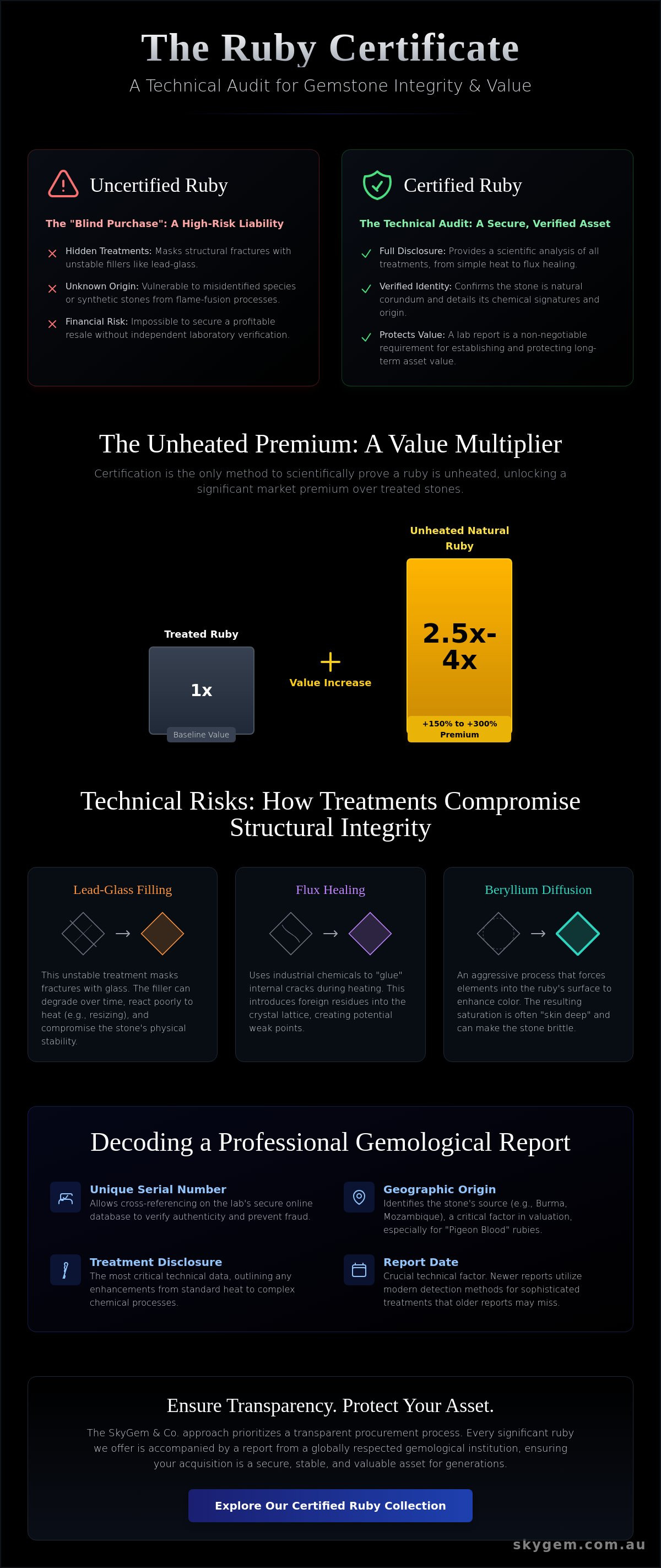
A ruby certificate isn't an optional luxury; it's a technical audit of structural integrity and chemical history. You've likely felt the tension between the allure of a vivid red stone and the uncertainty of its true origin or treatment status. The risks of buying uncertified rubies are often invisible to the naked eye, yet they can compromise both the physical stability and the financial future of your asset. In a market where unheated rubies now command a premium of 150% to 300% over treated counterparts, the absence of a laboratory report is a significant technical liability.
We understand that your goal is to acquire a stone that meets rigorous gemological standards without the anxiety of hidden treatments. This guide provides a clear framework for identifying structural red flags and understanding the technical data that distinguishes a natural ruby from a synthetic or lead-glass filled alternative. You'll learn how to evaluate the 2026 market landscape, the impact of Pigeon Blood certifications on valuation, and which international laboratories offer the most reliable performance metrics for your investment.
Key Takeaways
- Identify how unstable treatments like lead-glass filling mask fractures and compromise the stone's physical stability over time.
- Evaluate the financial risks of buying uncertified rubies, particularly the difficulty of securing a profitable resale without independent laboratory verification.
- Learn the technical difference between a standard jeweller's appraisal and a third-party gemological report from globally respected institutions.
- Gain a clear framework for verifying certificate serial numbers through secure online databases to ensure the documentation's authenticity.
- Explore why a transparent sourcing process is critical for maintaining the long-term asset value and integrity of natural ruby rings.
What Is a Certified Ruby? Beyond the Paperwork
In professional gemological circles, a ruby certificate is viewed as a third-party technical audit rather than a simple piece of paperwork. It represents an independent laboratory's objective analysis of a stone's chemical and physical characteristics. When you bypass this verification, you're engaging in what trade professionals call a "blind purchase." The primary risks of buying uncertified rubies stem from the fact that you're relying solely on the seller's claims without scientific backing. While a jeweller's appraisal might provide a dollar value for insurance purposes, it doesn't offer the granular technical data found in an independent gemological report. Understanding what is a gemstone involves looking at the specific mineral species, in this case, corundum, and identifying the trace elements that determine its origin and authenticity.
The role of corundum chemistry is vital for long-term value. For a stone to be classified as a natural ruby, it must possess specific internal inclusions and chemical signatures that match its stated origin. Uncertified stones often lack this chemical roadmap, leaving the buyer vulnerable to undisclosed treatments or misidentified species. In the trade, "blind purchases" aren't just about the stone's appearance; they're about the unknown history of the material. A professional buyer views the certificate as a safeguard against the volatility of the uncertified market.
The Anatomy of a Professional Gemological Report
A reputable report from a lab like GIA or AGL contains specific security features, including holograms and unique serial numbers. These numbers allow you to cross-reference the data on the lab's secure online database. You must distinguish between an "Identification" report, which confirms the stone is a ruby, and a "Grading" report, which evaluates its quality and origin. Also, the date of the report is a critical technical factor. As detection methods for sophisticated treatments improve, older reports may not account for modern enhancement techniques like beryllium diffusion or certain polymers.
Natural vs. Synthetic: The First Line of Defence
Uncertified stones frequently mask sophisticated lab-grown processes like flame-fusion or the Czochralski method. These synthetic rubies share the same chemical properties as natural corundum but lack the rarity and value of earth-mined gems. High-end laboratory equipment is required to detect the subtle chemical markers and growth patterns that distinguish them. In the market for gemstones, an "eye-clean" ruby offered without certification is a significant red flag. Natural rubies almost always contain microscopic inclusions; a stone that appears too perfect without documentation is often a synthetic product created in a controlled environment.
Technical Risks: How Treatments Compromise Structural Integrity
The physical durability of a gemstone depends on its internal crystal structure. When a ruby undergoes extreme treatments, that structure is fundamentally compromised. While traditional heat treatment is a stable process used for centuries to clarify corundum, modern "extreme" enhancements involve chemical additives that alter the stone's engineering. The risks of buying uncertified rubies are most acute when these treatments go undisclosed. Without a technical audit, you cannot distinguish between a stone that has been lightly heated and one that has been flux-healed. Flux healing uses industrial chemicals to "glue" internal cracks during the heating process. While this improves clarity, it introduces foreign residues that can react poorly to heat during routine maintenance or resizing. These technical nuances are why the FTC guidelines on gemstone disclosures are so critical; they establish the baseline for what must be revealed to a professional buyer.
Beyond flux healing, beryllium diffusion represents a more aggressive chemical intervention. This process forces chemical elements into the surface of the ruby to enhance its colour. This isn't a natural state, and the resulting saturation is often only "skin deep." The primary risks of buying uncertified rubies involve the introduction of these foreign substances into the crystal lattice, which can make the stone brittle or reactive to environmental factors. For those seeking the highest level of stability, selecting an unheated ruby ensures the stone's appearance is a result of natural geological processes rather than surface-level chemistry.
The Danger of Lead-Glass Filled Rubies
Lead-glass filled stones are notoriously unstable. Because the glass has a different thermal expansion coefficient than the ruby, the stone can shatter if exposed to rapid temperature changes. Common household cleaners, particularly those containing mild acids or ammonia, can cause the glass filling to cloud or dissolve entirely. This leaves the stone looking dull and pitted. Because these are technically composite materials, their resale value is negligible. Professional dealers often refuse to handle them because they cannot guarantee the stone's longevity over time.
Surface Diffusion and Chemical Alterations
Beryllium diffusion renders a stone "treated" for life. If the stone ever sustains a scratch and requires repolishing, you risk removing the treated layer and exposing a paler or differently coloured core. This permanent alteration significantly impacts the stone's market value. A gemological report is the only reliable way to verify if the colour saturation is consistent throughout the crystal lattice. Without this verification, you're investing in a surface-level aesthetic that lacks the technical integrity required for a high-value asset.
Financial and Ethical Risks of Uncertified Gemstone Purchases
The financial implications of bypassing independent verification are often immediate and severe. In the professional trade, the "Value Gap" represents a significant overpayment where a buyer might pay 50% to 80% more than the stone's actual market worth. This occurs because uncertified stones are priced based on the seller's optimistic claims rather than verified technical data. For instance, while unheated rubies command a premium of 150% to 300% over heated stones in the 2026 market, an uncertified stone claiming to be unheated will almost always be valued as a treated stone by professional appraisers. The primary risks of buying uncertified rubies involve this lack of pricing transparency, which can turn a supposed investment into a significant financial loss.
Liquidity is another critical factor for any high-value asset. Professional dealers and auction houses operate on a foundation of risk mitigation; they typically refuse to acquire or trade rubies that lack a report from a globally respected laboratory. Without a verifiable history, your gemstone remains a "frozen" asset that's difficult to resell. This lack of a provenance trail also intersects with ethical concerns. Modern investors, particularly the 68% of Millennial and Gen Z buyers who demand ethically sourced stones, require proof of origin to ensure their purchase doesn't fund conflict. By choosing verified natural rubies, you secure a stone with a documented journey that protects both your conscience and your portfolio's long-term viability.
Insurance and Appraisal Hurdles
In the Australian regulatory landscape, securing comprehensive coverage for high-value jewellery requires precise documentation. Most specialized insurers mandate a GIA or equivalent report for stones valued above certain thresholds to establish a baseline for replacement. If an uncertified stone is later identified as synthetic or heavily treated, you face the risk of a "total loss" where the insurance claim is denied based on misrepresentation. A certificate from a lab that identifies common ruby treatments provides the legal and technical certainty required to simplify the claims process and protect your investment.
The Hidden Cost of "Bargain" Rubies
A "bargain" ruby often carries deferred expenses that negate any initial savings. If you decide to certify the stone post-purchase, you'll encounter laboratory fees that are often higher for private individuals than for trade entities. As of April 1, 2026, GIA fees for a ruby identification and origin report for stones between 2.00 and 3.99 carats are set at ¥20,724. Beyond these direct costs, the psychological burden of uncertainty can be taxing, especially when the stone is intended for a bespoke engagement ring. Consulting a professional ruby price guide reveals that the most stable returns are always found in stones with a clean technical pedigree.
How to Evaluate a Gemological Report Before You Buy
Evaluating a gemological report requires a methodical approach that prioritizes technical data over marketing narratives. While a certificate serves as a safeguard, its utility depends entirely on the laboratory's independence and the buyer's ability to interpret specific codes. The risks of buying uncertified rubies are compounded when a buyer accepts a report without verifying its origin or cross-referencing its data against a secure database. A professional audit involves five critical steps: verifying the lab's reputation, checking the serial number online, scrutinizing the comments for treatment codes, matching physical dimensions, and evaluating the origin opinion. Each step acts as a layer of technical security for your investment.
A mandatory first step is the verification of the report's serial number through the issuing laboratory's official online portal. Reputable institutions maintain digital archives where you can confirm that the carat weight, measurements, and treatment status on the paper match the lab's permanent record. If the physical stone deviates from the reported weight by even 0.01 carats, it's a significant red flag that the certificate may not belong to that specific stone. This level of precision is essential when dealing with precious gemstones, where minor technical discrepancies can translate to thousands of dollars in value difference.
Which Gemological Labs Can You Trust?
The Gemological Institute of America (GIA) remains the global benchmark for identification, particularly for establishing a baseline of authenticity. For high-end coloured stones, Swiss laboratories such as SSEF and Gübelin are often preferred due to their advanced spectroscopic equipment and extensive databases of regional mineral signatures. You should exercise extreme caution with "In-House" certificates issued by the seller. These documents represent a fundamental conflict of interest and lack the objective technical rigour required for a professional-grade asset.
Decoding the "Comments" Section
The "Comments" section is where the most critical technical data is often condensed into shorthand. Understanding these terms is vital to avoiding the hidden risks of buying uncertified rubies or poorly documented stones. "No indications of heating" is the most desirable statement, confirming the stone's colour is entirely natural. Conversely, terms like "H(a)" or "H(b)" indicate heat treatment with varying levels of residual substances. Clarity enhancements are typically graded from F1 (minor) to F3 (significant). A blank comments section isn't necessarily a sign of a perfect stone; in some cases, it may indicate a basic report that didn't test for advanced treatments like beryllium diffusion.
To ensure the technical integrity of your next acquisition, explore our curated selection of natural ruby rings, each accompanied by independent laboratory verification.
The SkyGem & Co. Approach to Ruby Procurement
SkyGem & Co. operates as a technical consultant for clients who value precision and long-term asset security. We eliminate the risks of buying uncertified rubies by adhering to a strict procurement protocol that mandates independent laboratory verification for every stone in our inventory. Our commitment to 100% transparency ensures that you're never making a "blind purchase." Instead, you're provided with a comprehensive technical audit that confirms the stone's chemical history, treatment status, and origin. This methodical approach allows us to focus on the intersection of aesthetic brilliance and structural integrity, ensuring that each natural ruby we source meets the highest gemological standards.
Educating our clients is a core component of our partnership. We move beyond surface-level aesthetics to discuss the performance metrics of a gemstone, such as its fluorescence, inclusion patterns, and refractive index. By understanding these technical nuances, you can make a decision rooted in data rather than hype. We integrate these verified stones into high-quality bespoke engagement ring designs, where the setting is engineered to complement the specific physical properties of the ruby. This ensures that the aesthetic design never compromises the stone's long-term viability.
Sourcing Natural and Unheated Rubies
Our procurement focus remains heavily weighted towards unheated rubies. Given the market volatility for treated stones, the technical necessity for certification is absolute. We verify the supply chain for every gem to ensure ethical and sustainable sourcing, often looking to high-quality deposits in Mozambique and other African regions as political instability affects traditional Burmese sources. The SkyGem & Co. standard for clarity and cut requires that every stone exhibits superior light return and a stable internal structure. We specifically reject stones with "flux healing" or lead-glass filling, as these treatments compromise the durability required for a permanent asset.
Creating a Legacy with Certified Gemstones
A certified ruby is more than a purchase; it's a permanent asset designed to be passed down through generations. The presence of a GIA or SSEF report ensures that the stone's value remains liquid and its technical history remains undisputed. Our consultation process for custom-designed jewellery focuses on creating pieces that reflect your personal aesthetic while maintaining the stone's integrity. We invite you to explore our collection of natural rubies or book a technical consultation to discuss your project. This collaborative approach ensures that your investment is protected by the most rigorous standards in the regional professional landscape.
Securing Your Gemological Legacy
Protecting a high-value investment requires a transition from emotional appeal to technical due diligence. This guide has detailed how the risks of buying uncertified rubies extend far beyond a simple lack of paperwork; they encompass significant structural vulnerabilities and the potential for substantial financial loss. By prioritizing stones with independent GIA or Swiss lab certification, you ensure that your ruby possesses the chemical stability and rarity required of a permanent asset. Our specialized focus on unheated natural rubies and bespoke design expertise allows us to act as your technical consultant throughout the procurement process.
Establishing a foundation of transparency is the most effective way to safeguard your jewellery portfolio. Whether you're selecting a stone for its aesthetic brilliance or its long-term investment potential, relying on verified data is essential for peace of mind. To deepen your understanding of the current market and technical valuation metrics, view our Ruby Price Guide for professional insights. With the right gemological standards in place, you'll move forward with the confidence that your natural ruby is a genuine masterpiece of geological history.
Frequently Asked Questions
Is it ever okay to buy an uncertified ruby?
Buying an uncertified stone is only advisable for low-value fashion jewellery where the purchase isn't considered a long-term asset. For any ruby intended for an engagement ring or investment, the lack of documentation introduces unacceptable technical uncertainty. Without a report, you have no objective proof of the stone's mineral species or treatment history, which are the primary drivers of its market value.
What is the most dangerous treatment found in uncertified rubies?
Lead-glass filling is the most technically dangerous enhancement because it fundamentally compromises the stone's structural integrity. These stones are often sold as natural gems, but they're actually unstable composites that can cloud or shatter when exposed to common household chemicals or heat during resizing. This instability is one of the most severe physical risks of buying uncertified rubies today.
How much does ruby certification typically cost?
Certification costs depend on the laboratory and the stone's carat weight. As of April 2026, the GIA charges ¥20,724 for an Identification and Origin report for rubies between 2.00 and 3.99 carats. While basic identification reports from other labs might start around $185, comprehensive "Prestige" reports for high-value stones can exceed $1,500. These fees are a necessary investment to verify the stone's technical pedigree.
Can a local jeweller certify a ruby for me?
No, a local jeweller can provide a valuation or appraisal for insurance purposes, but they cannot issue an independent gemological certificate. True certification requires advanced spectroscopic equipment and a vast database of chemical markers that only specialized laboratories possess. An appraisal is merely an estimate of retail value, whereas a certificate is a scientific audit of the stone's physical properties.
Does GIA certification guarantee that a ruby is ethically sourced?
A standard GIA report identifies the stone's geographic origin but doesn't track the specific ethical conditions of its mining and trade. While knowing the origin helps avoid stones from conflict regions, true ethical transparency requires a verified supply chain from the source to the showroom. Professional buyers often combine lab reports with provenance documentation to ensure the stone meets modern sustainability standards.
What happens if I buy a ruby and find out later it is treated?
Discovering undisclosed treatments usually results in an immediate and significant drop in the stone's resale value. If the treatment is unstable, like lead-glass filling, the stone may become dull or damaged over time, leading to a total loss of your investment. You may have legal recourse if the seller failed to disclose the treatment, but proving the stone's condition at the time of purchase is difficult without an initial certificate.
Do uncertified rubies have any resale value?
Uncertified rubies have very limited resale value because professional dealers typically value them as the lowest possible grade of treated material. You'll likely face a discount of 50% to 80% compared to a certified stone of the same apparent quality. This lack of liquidity and pricing transparency remains one of the most significant financial risks of buying uncertified rubies in the professional market.
How can I tell if a ruby certificate is fake?
The only reliable way to verify a report is to cross-reference the serial number on the issuing laboratory's secure online database. Reputable labs like GIA and SSEF include digital archives where you can match the stone's carat weight and measurements to their records. If the physical stone deviates from the report data by even a small margin, it's a clear indication that the documentation is fraudulent or belongs to a different stone.
Disclaimer
This article is for general informational purposes only and may include AI-assisted content. Pricing, specifications, and availability are subject to change. For accurate advice and current information, please contact SkyGem & Co. directly. Nothing in this content constitutes professional or financial advice.