
The Hidden Costs of Buying a Gemstone: A Guide to Transparent Investment

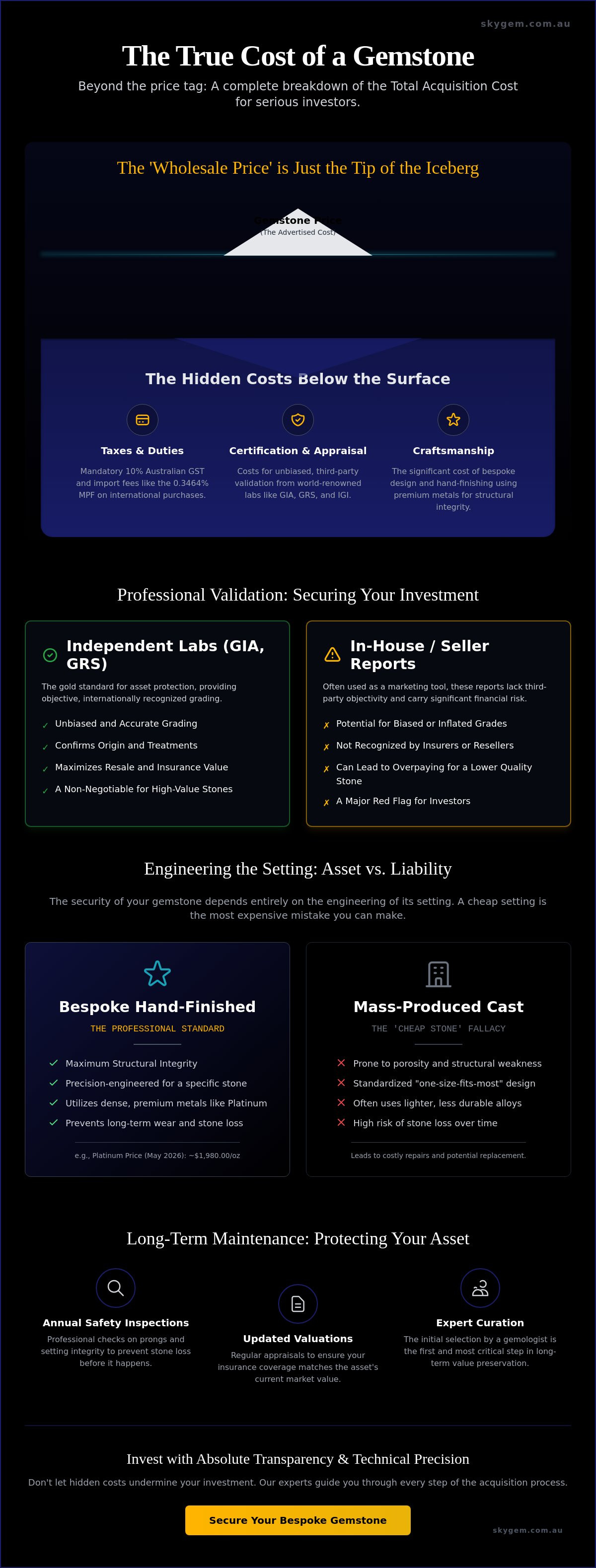
What if the most significant expense in your gemstone acquisition isn't the stone itself? It's a common frustration for investors to find a loose teal sapphire or natural emerald at a competitive price, only to realize the final cost of a finished piece far exceeds the initial quote. This discrepancy often points to the hidden costs of buying a gemstone that many wholesalers omit from their marketing materials.
We understand that a high-level investment requires absolute transparency and technical precision. You deserve to know how logistical factors, such as the 0.3464% Merchandise Processing Fee or the updated April 2026 GIA certification schedules, impact your bottom line. This guide provides a comprehensive breakdown of the total acquisition cost, ensuring you feel confident whether you're selecting a lab-grown diamond or a rare unheated ruby.
We will examine the essential expenses that safeguard your purchase, from international import duties to the structural integrity of premium metals like platinum, which reached approximately $1,980.00 per ounce in May 2026. You'll gain a clear understanding of the bespoke design process and the long-term maintenance required to protect your asset for a lifetime.
Key Takeaways
- Define Total Acquisition Cost (TAC) to understand the full financial commitment beyond the initial stone price.
- Distinguish between independent third-party certifications and in-house reports to ensure your investment is accurately validated by recognized authorities.
- Identify the hidden costs of buying a gemstone from international sources, specifically the mandatory 10% Australian GST and associated import duties.
- Evaluate the engineering differences between mass-produced cast settings and bespoke hand-finished pieces to prevent structural failure and stone loss.
- Establish a long-term maintenance strategy, including professional safety inspections, to preserve the integrity and value of your asset for a lifetime.
Beyond the Carat: Understanding the Total Acquisition Cost
When evaluating a significant investment in a precious gemstone, looking at the stone's price tag in isolation is a common strategic error. A professional approach requires calculating the Total Acquisition Cost (TAC). This metric encompasses the raw material price, complex logistics, and the high-precision craftsmanship required to transform a loose mineral into a durable piece of jewellery. Understanding the hidden costs of buying a gemstone requires looking past the invoice of the loose stone to the total project lifecycle.
Many buyers are drawn to "wholesale" prices, yet these figures are often misleading. In a professional context, a wholesale price represents a raw commodity cost without the necessary quality controls or consumer protections. It's essentially a price for an unvetted component. There's also a critical distinction between market value and retail replacement value. While market value reflects what you might pay for the raw material today, retail replacement value accounts for the cost of recreating the entire finished asset, including the specialized labour and design expertise involved in bespoke production.
Value-added services form the backbone of a successful acquisition. Expert curation and sourcing act as a technical consultancy, where a specialist applies the science of gemology to filter out stones with structural instabilities or optical flaws that an untrained eye would miss. This professional oversight ensures that the stone you select is not just aesthetically pleasing, but technically sound for its intended application.
Market Price vs. Retail Price: The Markup Explained
A reputable jeweller serves as a rigorous quality filter. When sourcing natural sapphires or emeralds, a specialist may inspect dozens of stones to find a single specimen that meets professional standards for clarity and durability. This curation process carries overheads, but it effectively prevents the buyer from making a costly mistake by purchasing a stone with "windowing" or internal fractures. Additionally, maintaining a transparent supply chain and ensuring ethical sourcing requires ongoing regulatory adherence and administrative investment, which are reflected in the final retail price.
The 'Cheap Stone' Fallacy
Discount auction sites and unverified international wholesalers often list gemstones that carry hidden defects. These stones frequently suffer from poor proportions, which drastically reduce their light return and brilliance. Correcting these issues often requires "re-cutting" the stone, a process that results in a significant loss of carat weight and additional lapidary fees. Choosing a stone based solely on a low entry price often results in escalating costs for corrective work or the eventual replacement of a structurally compromised gem.
Professional Validation: The Costs of Certification and Independent Appraisals
Validation is the cornerstone of any secure gemstone investment. While an "in-house" certificate might provide a basic description, it lacks the objective authority of a third-party report from an internationally recognized laboratory. Relying on a seller's own grading is a significant financial risk. If the grading is inaccurate, you might overpay for a stone that doesn't meet the stated specifications. The hidden costs of buying a gemstone without independent validation often emerge during resale or insurance claims, where the true quality of the stone is finally scrutinized.
Premium specimens, such as natural emeralds or unheated sapphires, typically have certification costs integrated into their market price. This isn't a simple administrative fee; it's a reflection of the stone's verified rarity. Laboratories like the GIA (Gemological Institute of America), GRS (GemResearch Swisslab), and IGI (International Gemological Institute) provide the technical precision required to confirm a stone's identity, origin, and any treatments it may have undergone. For those seeking verified assets, exploring a curated selection of precious gemstones provides a secure starting point for your project.
Reputable Labs: GIA, GRS, and Beyond
Securing a report from a top-tier lab involves complex logistics. Professional jewellers must manage the costs of secure international shipping and high-value insurance to transport stones to facilities in the U.S. or Hong Kong. As of January 1 and April 1, 2026, the GIA updated its gemstone certification fees, with pricing structured around the stone's carat weight. This rigorous process is why Natural GIA Certified Diamonds command a price premium over uncertified alternatives. You're not just paying for a document; you're paying for a standardized baseline of market security that protects your capital.
Independent Valuations for Insurance
In the Australian market, a retail receipt is rarely sufficient for high-value jewellery insurance. Insurers require an independent gemmological valuation to establish a retail replacement value. A professional appraisal typically costs between $50 and $200 for a single item, though some specialists charge hourly rates ranging from $150 to $195. These valuations are critical when referencing ruby price guides, as the "unheated" status of a stone can exponentially increase its appraised value. Without this documentation, you risk being under-insured, which is a hidden cost that only becomes visible during a loss event.
- Third-party labs provide objective grading that in-house reports cannot match.
- Certification fees are influenced by stone weight and origin identification requirements.
- Independent appraisals are mandatory for establishing accurate insurance premiums, typically 1% to 2% of the appraised value annually.
The International Import Trap: GST, Duties, and Hidden Shipping Fees
Many Australians are enticed by the lower sticker prices displayed on North American or European gemstone platforms. However, these prices are deceptive because they exclude local regulatory requirements. The 10% Goods and Services Tax (GST) is mandatory for any import valued over $1,000 AUD. This isn't an optional fee; it's a legal requirement that Australian Customs enforces strictly. When you factor in these hidden costs of buying a gemstone from overseas, the perceived savings often evaporate before the stone arrives in the country.
Beyond the GST, logistical partners like FedEx or DHL apply their own "Customs Entry" or "Brokerage Fees" for handling the necessary paperwork. These aren't standard shipping costs. They are administrative charges for navigating complex tariff schedules. For context, U.S. Customs applies a Merchandise Processing Fee of 0.3464% for formal entries, and similar administrative hurdles exist for Australian imports. If you decide to return a stone to an international seller, these duties and brokerage fees are generally non-refundable. This creates a significant sunk cost that can represent a large percentage of your initial capital.
Calculating the True Cost of Import
To determine if an international purchase is financially viable, you must use a specific formula: (Stone Price + Shipping + Insurance) x 1.10 (GST) + Brokerage Fees. Often, sourcing precious gemstones locally is more cost-effective because the boutique has already absorbed the complexities of international logistics and certification. While you might review GIA's official fee schedule and assume certification is a minor line item, the cumulative cost of secure international transport for grading adds up quickly. The hidden cost of time and the stress of managing customs clearance should also be quantified in your decision-making process.
Insurance During Transit
Risk management is a critical technical consideration for any high-value acquisition. If a loose stone is lost or damaged during international transit, the burden of proof and the recovery process often fall on the buyer. High-value third-party transit insurance is essential but carries its own premiums. Most local boutiques manage this risk internally. They ensure the asset is only handed over once it has cleared all regulatory hurdles and passed a final quality inspection. This partnership approach protects your capital from the volatility of global shipping networks and the complexities of international insurance claims.
Engineering the Setting: Why Craftsmanship is a Critical Investment
Structural integrity is the most overlooked variable in the total acquisition cost of fine jewellery. While the gemstone often commands the majority of the budget, the engineering of the setting determines whether that stone remains secure for decades or is lost within months. Many commercial retailers utilize mass-produced "cast" settings to reduce production overheads. These components are often porous and lack the density of hand-forged or high-pressure cast pieces. This technical deficiency is a primary source of the hidden costs of buying a gemstone, as a thin, low-metal-weight setting is significantly more prone to bending under daily wear.
The material cost of the setting is a transparent yet substantial metric. As of May 15, 2026, the spot price of gold reached approximately $4,543.80 per ounce, while platinum was valued at $1,980.00 per ounce. A premium setting requires a higher volume of these alloys to ensure the prongs don't pull back or snap. Utilizing CAD design and 3D prototyping allows a technical consultant to visualize the stone's seat before the metal is even poured. This precision ensures a perfect fit, which is a level of security that "one-size-fits-all" settings simply cannot provide. Investing in metal integrity at the outset prevents the catastrophic financial loss of the primary gemstone later.
Bespoke Design and Manufacturing Fees
The labour hours required for custom-made engagement rings reflect a commitment to technical excellence. Hand-setting a gemstone involves a master setter meticulously moving metal over the stone's girdle to ensure a permanent bond. This process is more expensive than machine setting because it accounts for the unique geometry of each individual stone. It's a critical investment in safety that mass-produced alternatives ignore, effectively eliminating the hidden costs of buying a gemstone that arise from structural failure.
The Price of Precision
Complex styles, such as Trilogy Engagement Rings, require significantly more labour to align three stones with mathematical precision. If you purchase a mass-produced ring and attempt to "fix" it to fit a specific stone, you'll often pay more in corrective labour than you would for a bespoke build. High-precision structural design ensures that every prong and bezel acts as a fail-safe against the catastrophic loss of a primary gemstone. To ensure your investment is protected by superior engineering, consider a custom-made engagement ring in Melbourne tailored to your specific stone.
The Cost of Ownership: Long-term Maintenance and Security
Acquiring a high-value asset like a precious gemstone is the beginning of a long-term technical partnership. Maintaining the physical integrity of the piece requires a structured approach to preventative care. Neglecting these requirements is one of the major hidden costs of buying a gemstone, as minor structural issues can escalate into significant repair bills or the total loss of the stone. A professional maintenance schedule typically involves a technical inspection every six to twelve months. This ensures the prongs remain secure and the metal hasn't suffered from stress fractures or thinning.
Insurance premiums represent a significant recurring cost of gemstone ownership. Generally, annual premiums range from 1% to 2% of the item's appraised value. For a piece appraised at $8,000, this equates to a yearly expenditure of $80 to $160. This ongoing investment provides financial security against theft or accidental damage, ensuring that your capital remains protected. Identifying these potential issues early mitigates the hidden costs of buying a gemstone that stem from deferred maintenance and unmanaged risk.
Resizing and Structural Adjustments
Resizing is a complex engineering task that varies significantly depending on the ring's design. While men's plain wedding bands are relatively straightforward to adjust, women's diamond wedding bands or intricate halo settings require much more labour. Proper resizing involves a cut-and-join method rather than "stretching" the metal, which can compromise the structural integrity and loosen the stones. Bespoke engagement rings are often engineered with future adjustments in mind, featuring a solid metal section at the base of the band. This design foresight reduces the technical difficulty and cost of future modifications.
Professional Maintenance Schedule
A rigorous maintenance schedule should include prong tightening and "re-tipping." Over years of wear, the metal tips holding a natural diamond or sapphire in place will naturally thin. Re-tipping involves adding new metal to these points to restore their original strength. Many local boutiques offer lifetime cleaning and safety checks as part of their service. These programs are invaluable, as they allow a professional to identify wear before it leads to a catastrophic failure. This proactive approach saves thousands in potential repair costs over a decade of ownership.
To ensure your investment is managed with complete transparency, book a consultation with our technical consultants to discuss a comprehensive quote for your custom piece.
Securing Your Investment Through Professional Transparency
A successful gemstone acquisition is defined by technical foresight and a comprehensive understanding of the total project lifecycle. By moving beyond the sticker price, you protect your capital from the hidden costs of buying a gemstone, such as uncalculated import taxes and the structural risks associated with inferior settings. We've established that long-term viability depends on a combination of rigorous certification and high-precision engineering that accounts for the physical properties of the stone.
Our approach prioritizes technical precision and aesthetic longevity. We specialize in expert GIA and GRS certified sourcing, ensuring every specimen meets the highest international standards before it reaches our workshop. This is paired with bespoke Australian craftsmanship and comprehensive lifetime maintenance support to safeguard your asset for decades to come. Our role is to act as your technical consultant, providing the data needed for a confident and secure purchase.
If you're ready to proceed with a partner dedicated to absolute transparency and engineering excellence, we invite you to Explore our transparently priced collection of Bespoke Engagement Rings. Taking the time to understand the logistical and technical variables ensures your final piece is a reliable and enduring investment.
Frequently Asked Questions
Is GIA certification included in the price of a gemstone?
Reputable retailers typically include the cost of GIA or GRS reports in the listed price for high-quality specimens, such as natural diamonds or emeralds. However, the certification represents a tangible expense that scales with the stone's carat weight according to the GIA's updated 2026 fee schedules. If you purchase an uncertified stone, you must budget for the laboratory fees and the secure international transit required to validate the asset's quality.
Do I have to pay GST if I buy a gemstone from an overseas website?
You are legally required to pay 10% GST on any gemstone or jewellery import valued over $1,000 AUD. This tax is calculated on the combined value of the stone, shipping, and insurance. It is one of the most frequently overlooked hidden costs of buying a gemstone from international platforms, often resulting in an unexpected invoice from customs before the item is released for delivery.
Why is a custom-made setting more expensive than a ready-to-wear one?
Custom-made settings require individual CAD modelling and high-precision hand-finishing to ensure a perfect fit for a specific stone's unique geometry. Unlike mass-produced cast settings, which are built for standardized dimensions, bespoke pieces utilize higher metal weights and expert labour to ensure structural longevity. This engineering prevents the long-term expenses associated with prong failure or the catastrophic loss of the primary gemstone.
How much should I budget for independent gemstone insurance in Australia?
Standard annual premiums for jewellery insurance in Australia typically range between 1% and 2% of the item's appraised value. For a ring appraised at $8,000, you should expect to pay between $80 and $160 per year for comprehensive coverage. It's essential to maintain an up-to-date gemmological valuation, as insurers require current data to establish accurate retail replacement values for your policy.
What are the customs entry fees for importing jewellery into Australia?
Beyond GST, importing jewellery involves a Merchandise Processing Fee (MPF) and courier brokerage charges. As of May 2026, formal entries attract a fee based on the cargo's value, with a minimum charge of $32.71 and a maximum of $689.44. These logistical charges, combined with non-refundable duties, increase the total acquisition cost significantly compared to sourcing your gemstone from a local boutique.
Are there hidden costs in choosing lab-grown diamonds over natural ones?
While lab-grown diamonds offer a lower initial price point, they carry different long-term financial considerations. Their market value has historically shifted as production technology scales, which may impact their future resale or trade-in potential. Additionally, some insurers require specific lab-grown appraisals to establish replacement costs, adding a layer of administrative maintenance to your ownership strategy that differs from natural assets.
Does the origin of a sapphire affect its hidden costs?
Geographic origin directly impacts importation expenses due to country-specific tariffs and logistics. In 2025, specific tariffs as high as 50% were introduced for goods from certain regions. While Australian sapphires sourced locally avoid these international levies, importing stones from certain hubs can introduce substantial hidden costs of buying a gemstone that aren't visible on the initial international invoice, including higher origin-report fees from laboratories.
Will a jeweller set a stone that I bought elsewhere, and what are the fees?
Some jewellers will set a stone purchased elsewhere, but this service usually involves a specific setting fee to cover the labour and technical risk. Because the jeweller didn't source the stone, they can't verify its internal structural integrity before work begins. You should check whether the workshop's insurance covers client-supplied stones, as many professionals require you to maintain your own coverage during the setting process.