
The GIA Triple Excellent Diamond Guide: Maximising Brilliance and Value in 2026

Could a GIA Triple Excellent certificate be misleading you into overpaying for a diamond that lacks true fire? It's a common concern for those commissioning a bespoke setting, especially when the difference between a stone that sparkles and one that feels flat often lies in technical data hidden beneath a top-tier grade. You likely want the security of a premium certificate, but you're also wary of the jargon that complicates the decision-making process.
This GIA triple excellent diamond guide will help you master the nuances of light performance so you can choose a stone with confidence. We'll show you how to identify the specific proportions within the Excellent range that deliver the best return on investment. You'll learn why this designation is now a hallmark of natural round brilliant diamonds following the 2025 grading shifts. From understanding the interplay of polish and symmetry to evaluating the visual impact of a stone in person, this guide provides the technical framework you need to secure a diamond of lasting brilliance and value in 2026.
Key Takeaways
- Define the "Triple X" standard by examining how the intersection of Cut, Polish, and Symmetry establishes the baseline for professional-grade brilliance.
- Identify the narrow "sweet spot" of proportions that creates superior light performance, moving beyond the basic certificate grade to find a truly exceptional stone.
- Navigate the 2026 market landscape with this GIA triple excellent diamond guide, which clarifies the critical grading differences between natural and lab-grown diamonds.
- Evaluate the long-term ROI of premium cut grades to ensure your selection serves as a reliable asset with lasting aesthetic and investment value.
- Understand the importance of pairing a Triple Excellent diamond with a master-crafted bespoke setting to protect the stone's integrity and maximise light entry.
What is a GIA Triple Excellent Diamond? Defining the "Triple X" Standard
The term "Triple Excellent," often abbreviated as "Triple X" within professional trading circles, represents a specific technical milestone for a round brilliant diamond. It signifies that a stone has earned the highest possible grade from the Gemological Institute of America (GIA) in three distinct categories: Cut, Polish, and Symmetry. While the GIA itself does not officially use the phrase "Triple Excellent" on its reports, the industry has adopted it as a shorthand for peak performance. This GIA triple excellent diamond guide establishes why this combination is the baseline for any high-value acquisition in 2026.
Achieving this status requires a meticulous balance of geometry and craftsmanship. The Diamond cut grade evaluates how effectively the stone interacts with light, while Polish and Symmetry focus on the precision of the finishing process. In the current market, where natural diamonds are increasingly viewed as exclusive symbols of enduring value, the Triple Excellent rating serves as a critical quality assurance marker. It provides a level of liquidity and market confidence that lower grades cannot match, ensuring the stone meets the rigorous standards required for a premium investment.
The Anatomy of a GIA Grading Report
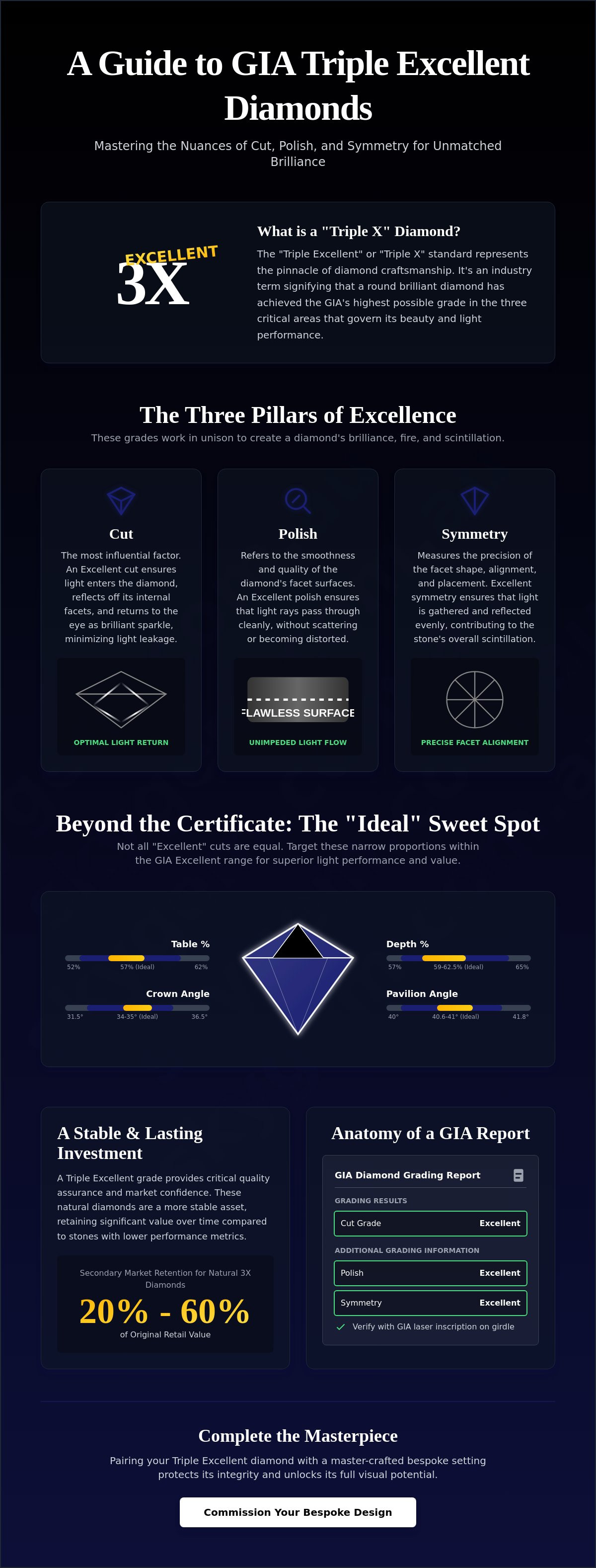
A standard GIA report for a natural diamond provides a comprehensive data set. You'll find the Cut grade prominently in the "Grading Results" section, while Polish and Symmetry are listed under "Additional Grading Information." The proportions diagram is equally vital; it illustrates the specific angles and percentages that dictate light return. For security, most Triple Excellent stones feature a GIA laser inscription on the girdle. This allows for immediate verification against the digital record, providing a permanent link between the physical stone and its technical credentials.
Why "Excellent" is the Benchmark for Luxury
The technical gap between an "Excellent" and a "Very Good" grade is often visible to the naked eye as a loss of fire and scintillation. Choosing a Triple Excellent stone ensures that the diamond's physical properties are optimised to prevent light leakage. For those investing in custom-made engagement rings, this grade is the essential starting point for a successful design. It also impacts long-term viability. Natural diamonds with this rating typically retain between 20% and 60% of their retail value on the secondary market, making them a more stable choice than stones with lower performance metrics.
The Three Pillars of Excellence: Cut, Polish, and Symmetry
The brilliance of a diamond isn't an accident of nature; it's a result of precise engineering. While Section 1 defined the "Triple X" trade term, this GIA triple excellent diamond guide focuses on the technical mechanics of light. When Cut, Polish, and Symmetry align at the "Excellent" level, they work in unison to produce three distinct visual effects: brilliance, which is the total white light return; fire, the dispersion of light into spectral colours; and scintillation, the flashes of light as the stone moves. According to GIA's Triple Excellent standard, these three pillars ensure that light enters through the table, reflects off the pavilion facets, and returns to the eye with minimal leakage.
Technical precision in these three areas creates a stone that looks larger and more vibrant than its carat weight might suggest. In the 2026 market, where consumers are increasingly educated on performance metrics, understanding these pillars is essential for making an informed investment. A diamond with a subpar cut or poor finish will appear dull or "dark" even if it possesses high colour and clarity grades.
Diamond Cut: The Master of Brilliance
Cut is the most influential factor in a stone's appearance. The table percentage and total depth are primary metrics used to prevent light from escaping through the bottom or sides of the diamond. However, the true "engine room" of performance lies in the relationship between crown and pavilion angles. If the pavilion is too deep, light leaks out the side; if it's too shallow, it creates a "fish-eye" effect that lacks depth. The diamond cut grade acts as the definitive engineering blueprint that transforms raw carbon into a high-performance gem capable of maximum light return. Achieving an Excellent grade means these proportions are within a narrow range that balances brightness and fire perfectly.
Polish and Symmetry: The Finishing Touches
Polish refers to the smoothness of each facet surface after the cutting process. Even a well-proportioned stone can lose its lustre if surface defects like pit marks, scratches, or microscopic burn marks from the polishing wheel are present. These imperfections act as tiny obstacles that scatter light rather than reflecting it cleanly. Symmetry focuses on the physical alignment and shape of the facets. Common flaws include off-centre tables, misshapen facets, or "wavy" girdles. Even minor symmetry issues can cause light to reflect at incorrect angles, creating noticeable "dark spots" or areas of extinction within the stone that diminish its overall sparkle.
Selecting a stone with these technical credentials ensures your investment maintains its visual impact over time. For those ready to begin their search, you can explore available stones through our natural white diamond selection tool.
Beyond the Certificate: Finding the "Ideal" Within Excellent
A GIA Excellent grade is a technical threshold, not a guarantee of visual perfection. This GIA triple excellent diamond guide must address a critical reality: the GIA "Excellent" grade is a broad category that encompasses a wide range of proportions. Two diamonds can both hold a Triple Excellent rating yet exhibit markedly different visual personalities. One might appear exceptionally bright but lack fire, while another might show intense spectral colours but feel slightly dark in certain lighting. To find the "Ideal" stone for a bespoke setting, you must look at the specific proportions within the certificate's data.
A significant debate exists between the traditional "60/60" diamond and modern "Super Ideal" proportions. A 60/60 stone, featuring a 60% table and 60% depth, was historically favoured for its "big and bright" appearance, focusing heavily on brilliance. However, these stones often sacrifice fire and scintillation. Modern technical standards lean towards a "steep-deep" combination or specific "Super Ideal" ranges that prioritise a smaller table to allow for more spectral dispersion. Because the GIA report only provides physical measurements, professional buyers often use diagnostic tools like ASET (Angular Spectrum Evaluation Tool) or Idealscope imagery. These tools reveal light leakage and optical symmetry that a standard certificate cannot describe, ensuring the stone performs as expected in real-world environments.
The Sweet Spot Proportions for Round Brilliants
Technical consultants often recommend a specific "sweet spot" within the Excellent range to ensure a balanced light return. For a natural diamond, aiming for a table percentage between 54% and 57% is ideal. This allows for a larger crown area, which is necessary for light dispersion. Pairing this with a crown angle of 34 to 35 degrees and a pavilion angle of 40.6 to 40.9 degrees creates a stone with total internal reflection. This precise combination ensures that light doesn't leak through the pavilion but is instead directed back through the crown facets.
Light Performance: Brilliance, Fire, and Scintillation
Understanding these three metrics helps you evaluate a stone's "lived" performance in an engagement ring setting. Brilliance refers to the total white light reflected from the diamond's internal and external surfaces. Fire is the dispersion of that white light into its component spectral colours, creating the "rainbow" flashes. Scintillation is the dynamic sparkle produced by the interplay of light and dark areas as the observer moves. A truly high-performance stone balances all three, avoiding the "flat" look common in diamonds with poorly matched angles.
Triple Excellent in 2026: Natural vs. Lab-Grown Diamonds
In 2026, the diamond market has reached a clear bifurcation. While the "Triple Excellent" designation remains the definitive benchmark for natural round brilliant diamonds, the technical landscape for lab-grown stones has shifted. As of October 1, 2025, the GIA updated its grading policy for lab-grown diamonds, moving away from the traditional 4Cs in favour of "Premium" and "Standard" classifications. This GIA triple excellent diamond guide highlights that while the market still uses "Triple Ex" as a performance shorthand, the certification process now differs significantly depending on the stone's origin.
The choice between natural and lab-grown often comes down to a balance of scale and investment stability. Lab-grown diamonds now account for over 55% of engagement ring sales, largely driven by a significant pricing gap. A 1-carat natural GIA Triple Excellent diamond typically costs approximately $4,200, whereas a lab-grown stone of comparable visual performance averages around $1,000. This price difference allows consumers to secure much larger centre stones; the average carat size for lab-grown engagement diamonds has reached 2.45 carats, compared to 1.16 carats for natural stones. Despite this, GIA certification remains the gold standard for both, providing the technical data required to verify light performance.
Choosing Between Natural and Lab-Grown Triple Ex
Natural diamonds continue to be positioned as exclusive symbols of rarity and enduring value. They offer superior resale characteristics, typically retaining between 20% and 60% of their original retail price on the secondary market. For those prioritising long-term asset value and the unique narrative of a mined stone, natural GIA certified diamonds are the logical choice. Alternatively, lab-grown stones appeal to those focused on the intersection of modern technology and ethical transparency. You can explore our range of natural GIA certified diamonds to compare these technical specifications in detail.
Technical Consistency in Modern Diamond Growth
Modern growth methods, specifically Chemical Vapour Deposition (CVD) and High Pressure High Temperature (HPHT), allow for extreme precision in the initial crystal structure. Because lab-grown diamonds are produced in controlled environments, achieving "Excellent" polish and symmetry is often more consistent than with natural rough. This technical reliability ensures that even at lower price points, these stones meet high performance metrics. To see how these specifications translate to visual brilliance, you may browse premium lab-grown diamonds through our live inventory.
Whether you prioritise rarity or scale, ensuring your selection meets these rigorous grading standards is the only way to guarantee a high-performance stone. For a tailored recommendation on which diamond origin best suits your project, you can consult with our specialists through our engagement ring design service.
Maximising Triple Excellent Performance in Bespoke Settings
A high-performance diamond is only half the equation; the structural engineering of the setting determines how that light is actually perceived. This GIA triple excellent diamond guide has detailed the technical specifications of the stone, but the final aesthetic success depends on the setting's ability to facilitate light entry. In a master-crafted bespoke setting, every component is designed to celebrate the stone's optical properties rather than merely securing its weight. When a Triple Excellent diamond is paired with an inferior, mass-produced mount, the metal can obstruct the very facets responsible for brilliance and scintillation.
Prong placement is a critical technical consideration. Minimalist claw designs are often preferred for Triple Excellent stones because they reduce the amount of metal covering the crown facets, allowing light to enter from more angles. Conversely, poorly positioned or overly bulky prongs can cast internal shadows, creating dark spots that diminish the stone's fire. The objective is to achieve a balance between structural security and maximum exposure, ensuring the pavilion and crown angles work as the engine room of the diamond's performance.
The choice of metal also influences the perceived colour and lustre of a Triple Excellent stone. Platinum and 18K white gold provide a neutral, reflective backdrop that enhances the crisp, white light return of D-to-F colour grades. However, for stones slightly lower on the colour scale, 18K yellow or rose gold can provide a warm contrast that makes the diamond appear whiter by comparison. Our design philosophy focuses on this intersection of technical precision and aesthetic design, treating the setting as a functional extension of the diamond's grading report.
Solitaire and Halo Designs for Triple Ex Diamonds
Solitaire settings remain the definitive choice for showcasing an Excellent cut grade, as they provide the most unobstructed path for light. For those seeking to enhance the visual impact of their stone, halo settings can be engineered to amplify the "visual carat weight" of a Triple Excellent diamond. By surrounding the centre stone with smaller, high-performance diamonds, the overall scintillation is increased without compromising the integrity of the primary stone. You can view our bespoke engagement ring styles to see how these designs interact with premium-cut stones.
The Consultation Process: Selecting Your Perfect Stone
Selecting a diamond requires more than just reading a certificate; it involves interpreting technical data in a real-world environment. Working with a technical consultant allows you to verify the "sweet spot" proportions discussed in earlier sections of this guide. It's essential to view your Triple Excellent diamond under various lighting conditions, from diffused office light to direct sunlight, to truly appreciate its fire and scintillation. To begin this technical evaluation, you can book a custom ring consultation with our specialists to ensure your investment meets the highest standards of brilliance and value.
Securing Lasting Brilliance for Your Bespoke Project
Mastering the technical data within a GIA report is the essential first step toward acquiring a high-performance diamond. This GIA triple excellent diamond guide has established that while the Triple X rating is a vital quality marker, true brilliance is found by targeting the "sweet spot" of proportions that maximise light return. Whether you're prioritising the rarity of a natural stone or the scale of a lab-grown diamond, the technical framework remains consistent. Precision in cut, polish, and symmetry creates the necessary foundation for an exceptional piece of jewellery.
At SkyGem & Co., we act as your technical consultants to ensure your selection delivers maximum visual impact. From our expert consultations in the heart of Melbourne, we specialise in identifying GIA certified natural and lab-grown diamonds that exceed standard expectations. Our bespoke designs are tailored to your unique vision and budget; we ensure the setting is engineered to celebrate the stone's specific optical properties. Start Your Journey: Design a Bespoke Ring with a GIA Triple Excellent Diamond and secure a stone that will perform brilliantly for a lifetime.
Frequently Asked Questions
Is a Triple Excellent diamond worth the extra cost?
Yes, the premium for a Triple Excellent stone is justified by its superior light performance and higher market liquidity. This designation ensures the diamond meets the most rigorous engineering standards for brilliance and fire. In the professional trade, these stones are easier to value and resell, typically retaining a higher percentage of their original retail price compared to stones with lower cut grades.
Can a GIA Triple Excellent diamond have fluorescence?
Yes, fluorescence is a separate characteristic and isn't a factor in the Cut, Polish, or Symmetry grades. While many GIA Triple Excellent diamonds have "None" or "Faint" fluorescence, some may have "Strong" or "Very Strong" ratings. It's vital to inspect these stones personally; strong fluorescence can occasionally cause a high-performance diamond to appear hazy or milky in direct sunlight.
What is the difference between GIA Excellent and AGS Ideal?
The primary difference lies in the grading methodology used by each laboratory. GIA uses a proportion-based system that compares a stone's measurements against a database of millions of diamonds. The American Gem Society (AGS) uses a ray-tracing system to measure actual light performance. Many professionals consider the AGS "Ideal" grade to be slightly more stringent than the GIA "Excellent" grade.
Does GIA grade fancy shape diamonds as Triple Excellent?
No, GIA only provides an official Cut grade for standard round brilliant diamonds. For fancy shapes like Ovals, Pears, or Cushions, the report only includes individual grades for Polish and Symmetry. While you might hear the term "Double Excellent" for these shapes, a technical "Triple Excellent" status doesn't exist on an official GIA report for any shape other than round.
How does Triple Excellent impact the resale value of a diamond?
A Triple Excellent rating significantly enhances a stone's long-term value retention. Natural diamonds with this status are highly sought after by wholesalers and private buyers alike. Because the technical credentials are universally recognised, these stones offer better liquidity and typically retain between 20% and 60% of their retail value on the secondary market in 2026.
Can I see the difference between Excellent and Very Good symmetry with the naked eye?
While an untrained observer may struggle to identify specific symmetry flaws, the cumulative effect on sparkle is often visible. Very Good symmetry can cause light to reflect at slightly incorrect angles, leading to subtle dark spots or "extinction" within the stone. In a high-performance bespoke setting, the precision of Excellent symmetry ensures a more even and vibrant distribution of light.
Is a 1.00ct Triple Excellent diamond larger than a 1.00ct Good cut diamond?
Not necessarily in physical diameter, but it will appear more vibrant and better proportioned. A Good cut stone often hides its weight in a deep pavilion, making it look smaller than its carat weight suggests. Conversely, a shallow Good cut stone might look wider but will lack brilliance. A Triple Excellent stone has optimised dimensions that balance diameter with light performance.
Should I prioritise Triple Excellent over a higher colour or clarity grade?
Yes, cut quality should always be the priority because it dictates the stone's overall fire and brilliance. A well-cut diamond can effectively hide a slight colour tint or small inclusions by reflecting an intense amount of light. This GIA triple excellent diamond guide suggests that a stone with slightly lower colour but an Excellent cut will often look more impressive than a D-colour stone with a poor cut.
Disclaimer
This article is for general informational purposes only and may include AI-assisted content. Pricing, specifications, and availability are subject to change. For accurate advice and current information, please contact SkyGem & Co. directly. Nothing in this content constitutes professional or financial advice.