
Peach Sapphire Engagement Rings: Guide to Rarity, Design & Durability

Why settle for a gemstone that will cloud and scratch within years when you can secure a permanent legacy in the exact same hue? While morganite is often praised for its soft tones, it lacks the structural resilience required for a lifetime of daily wear. A peach sapphire engagement ring offers a superior technical alternative, providing a 9.0 rating on the Mohs scale and a brilliance that remains untarnished by time. We understand that selecting a rare, unheated sapphire involves more than just an aesthetic preference; it requires a deep dive into gemological grading and precision engineering.
You might feel overwhelmed by the subtle distinctions between "peach" and the prestigious Padparadscha, or perhaps you worry that these delicate tones will look washed out once set in metal. This guide will clarify those technical nuances, helping you identify stones with high "life" and brilliance. We will explore how a bespoke, CAD-led design process ensures your ring balances tonal beauty with lifelong structural integrity. From understanding why rare Padparadscha varieties have seen a 158% surge in valuation since early 2023 to selecting the right 18ct gold alloy to complement your stone, you'll gain the confidence to commission a piece that is both a technical triumph and a personal masterpiece.
Key Takeaways
- Understand why a peach sapphire engagement ring is the superior technical alternative to morganite, offering a 9.0 Mohs hardness for lifelong durability and brilliance.
- Master the distinction between peach and Padparadscha nomenclatures to ensure your investment aligns with gemological rarity and accurate market valuation.
- Learn how to evaluate "life" and light performance in unheated stones, ensuring your selection maintains high brilliance and avoids a "washed out" appearance in different lighting.
- Discover how to engineer tonal harmony by selecting 18ct rose gold or platinum settings that specifically complement the apricot or blush undertones of your gemstone.
- Gain insight into the CAD-led bespoke process, moving from the precision sourcing of rare stones to the final hand-finished assembly of a secure and structurally sound setting.
The Allure of Peach Sapphires in Bespoke Jewellery Design
Peach sapphires aren't merely a seasonal trend; they represent a significant technical shift in how we approach bespoke bridal design. As a variety of the mineral corundum, these gemstones exhibit a sophisticated spectrum of apricot, champagne, and blush hues. Selecting a peach sapphire engagement ring reflects a growing preference for "skin-tone" complementary aesthetics. Instead of the high-contrast sparkle of a traditional white diamond, these stones offer a tonal harmony that feels integrated with the wearer's natural complexion. This shift toward warm, muted palettes allows for a level of creative expression that standard colourless stones cannot provide.
Beyond their visual appeal, the structural benefits of these gemstones are paramount for long-term viability. Sapphires possess a Mohs hardness of 9.0, making them exceptionally resistant to surface abrasion and impact. This physical durability is essential for an asset intended for daily wear over several decades. When we consult on bespoke projects, we focus on how these physical properties support the security of the setting, ensuring the stone remains as brilliant as the day it was first set.
Symbolism and Modern Significance
Choosing a peach sapphire signals a move toward quiet luxury and understated elegance. These stones represent clarity and resilience, qualities that are physically mirrored in their dense crystal structure. In a market saturated with mass-produced designs, a peach sapphire allows for a unique path. It appeals to those who value regional expertise and precision engineering over generic branding. The soft, warm glow of the stone provides a sophisticated backdrop for intricate metalwork, enabling us to design rings that feel both modern and timeless.
Why Peach Sapphires Outperform Other Coloured Stones
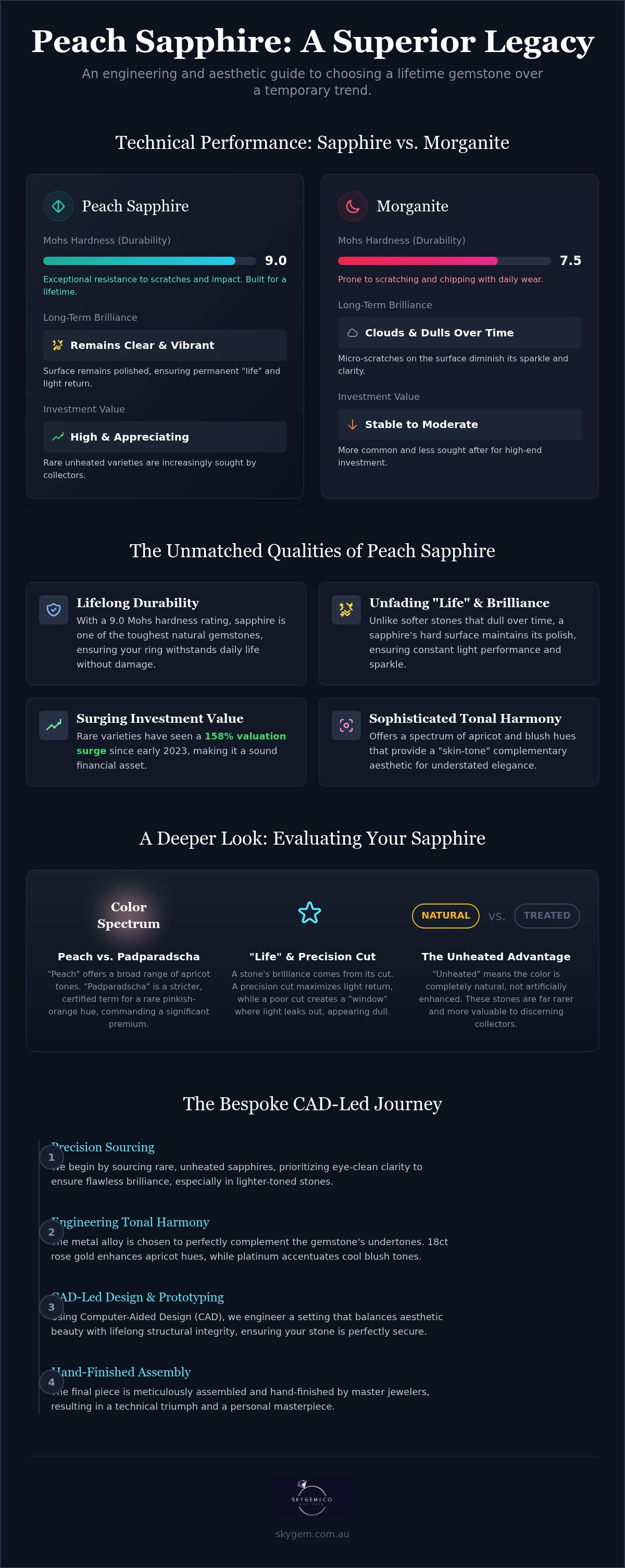
While many are initially drawn to the similar hues of morganite, the technical performance of sapphire is vastly superior. Morganite is a softer stone that frequently clouds over time due to microscopic scratches on the surface. In contrast, a sapphire maintains its "life" and light return because its surface remains polished and intact. High-clarity, unheated peach sapphires also hold significant investment value. As global demand for rare, earth-mined precious gemstones continues to outpace supply, these unheated varieties become increasingly sought after by collectors and couples alike. This combination of durability and rarity makes them the premier choice for those seeking a coloured gemstone that won't compromise on performance.
Evaluating Gemstone Quality: The Technical Nuance of Peach Hues
The distinction between a standard peach sapphire and a certified Padparadscha is one of the most critical technical nuances in the market. While both belong to the corundum family, a Padparadscha must exhibit a precise, light-to-medium pinkish-orange hue reminiscent of a tropical lotus blossom. Because these stones are exceptionally rare, they command a significant premium and are subject to strict gemological grading standards. A peach sapphire engagement ring offers a broader tonal range, including apricot and champagne hues, providing a similar aesthetic with more flexibility in carat weight and budget. This allows for a bespoke design that prioritises visual harmony over restrictive nomenclature.
Evaluating the "life" of a stone is often more important than its raw carat weight. A precision-cut sapphire will exhibit superior light return, whereas a poorly cut stone may appear "dead" or have a large "window" where light passes straight through. This technical precision is what differentiates a premium bespoke piece from a commercial-grade ring. Transparency in the supply chain is also paramount. When sourcing natural sapphires, we prioritise eye-clean clarity. Lighter-toned stones are less forgiving of internal inclusions, so ensuring the gemstone is free from visible flaws is vital for maintaining its brilliance across different environments.
The Rarity of Unheated Peach Sapphires
The term "unheated" indicates that the gemstone has not undergone thermal enhancement to artificially intensify its colour. Discerning buyers often seek out these stones because they preserve the organic, earth-born saturation of the crystal. Unheated varieties are increasingly rare. Some rare, unheated varieties have seen a 158% surge in valuation since early 2023, reflecting their status as a high-value asset. These stones often contain microscopic "silk" or "fingerprint" inclusions. These aren't flaws; they're the geological signatures that prove the stone’s natural origin and unheated status.
Colour Saturation and Tonal Balance
The spectrum of peach spans from pale champagne to deep, saturated apricot. Secondary hues play a significant role in the final look of the jewellery. A stone with a strong pink secondary hue will feel romantic and soft, while one with orange undertones appears more vibrant and modern. It's essential to view these stones in different lighting environments. A sapphire that looks perfect under studio lights might shift its tonal balance in natural sunlight. If you want to explore these technical specifications in detail, you can book a technical consultation to view our current inventory of rare gemstones.
Durability and Performance: Peach Sapphire vs. Alternative Gemstones
A peach sapphire engagement ring is often selected for its ethereal colour, but its technical performance is what justifies its status as a premier heirloom. On the Mohs scale of mineral hardness, sapphires rank at 9.0. This makes them the second hardest natural material used in jewellery, surpassed only by diamonds. This distinction is critical because many stones with similar hues, such as morganite, sit significantly lower on the scale at approximately 7.5 to 8.0. While a difference of one or two points may seem negligible, the scale is non-linear. A sapphire is exponentially more resistant to the surface abrasions that cause softer stones to "fuzz" or lose their lustre over decades of daily wear.
When comparing light performance, a sapphire offers a different optical experience than natural diamonds. Diamonds are prized for their "fire" or the dispersion of white light into spectral colours. Sapphires, however, possess a higher refractive index than most coloured gems, resulting in a deep, vitreous glow. This "life" within the stone ensures that even in lower light environments, the peach hues remain vibrant rather than appearing flat. This makes them a reliable choice for those who value consistent visual performance across various settings.
The 'Forever' Factor: Hardness and Toughness
It's vital to distinguish between hardness and toughness in a technical context. Hardness refers to a stone's resistance to scratching, while toughness describes its ability to resist chipping or fracturing under impact. Sapphires possess excellent toughness due to their lack of "cleavage" planes. This means they're less likely to split if accidentally knocked against a hard surface. Because of this resilience, they require less frequent maintenance and professional refinishing than beryl-group stones. Regular cleaning with mild soap and a soft brush is usually sufficient to maintain the stone's high-level performance and prevent the buildup of oils that can dull its brilliance.
Peach Sapphire vs. Pink Diamond
Couples often compare peach sapphires to rare pink diamonds when seeking a romantic tonal profile. While a pink diamond offers intense sparkle, a peach sapphire provides a warmer, more holistic glow that many find more wearable for a range of fashion styles. Choosing a peach sapphire engagement ring also allows for significant budget optimisation. You can secure a high-carat, unheated sapphire for a fraction of the cost of a similarly sized pink diamond. This financial flexibility allows for a more complex bespoke setting, ensuring the structural security of the ring is never compromised for the sake of the gemstone's size.
Designing the Bespoke Setting: Engineering for Tonal Harmony
Setting a peach sapphire is a technical exercise in colour theory and structural engineering. The metal choice directly impacts the gemstone’s perceived saturation and light performance. 18ct rose gold is a frequent choice because its copper content harmonises with the stone’s blush undertones, creating a seamless, liquid aesthetic. Conversely, platinum or 18ct white gold provides a crisp, high-contrast frame that makes the apricot hues pop. This modern approach highlights the stone's edges and brilliance without warming the internal colour. We focus on how the setting architecture allows light entry from multiple angles to maintain the stone's "life" across different environments.
Choosing the Right Metal for Your Lifestyle
Platinum is the industry standard for long-term durability. It's a naturally white, dense metal that doesn't require rhodium plating, which simplifies ongoing maintenance. While white gold is slightly harder due to its alloy composition, it requires periodic replating to maintain its bright finish. We're also seeing a resurgence in 18ct yellow gold for bespoke projects. This metal adds a vintage-inspired warmth that complements champagne-toned stones particularly well. When designing a peach sapphire engagement ring, we must account for how the metal's internal reflections shift the stone’s appearance. A rose gold basket can make a pale stone look more saturated, while a white metal setting can make it appear brighter and more neutral.
Structural Setting Styles: Solitaire, Trilogy, and Halo
Engineering the "head" of the ring requires CAD precision to ensure the gemstone sits at the optimal height for light entry. A solitaire setting prioritises the central stone, allowing maximum light to enter from the sides and bottom. For those seeking more complexity, trilogy engagement rings use diamond side stones to frame the sapphire. This creates a brilliant contrast that draws the eye toward the centre stone’s unique colour. We often recommend pear or marquise-shaped diamonds to create a tapered look that elongates the finger.
Security is just as vital as aesthetics. While traditional prongs offer elegance, a low-profile basket or a partial bezel provides superior protection for the sapphire's girdle. We use CAD-led design to ensure every prong is positioned to secure the stone without obstructing the light path. This technical balance ensures the ring remains a permanent asset that resists the rigours of daily wear while maintaining its structural integrity over decades.
The Bespoke Journey: Creating Your Custom Peach Sapphire Ring
The creation of a bespoke peach sapphire engagement ring follows a rigorous, five-stage protocol designed to eliminate technical uncertainty. Our process acts as a technical consultancy, ensuring that every design decision supports both the aesthetic goals and the long-term structural integrity of the piece. We move methodically from initial education to final delivery, maintaining a focus on precision at every milestone.
- Stage 1: Consultative Discovery and Gemstone Education. We begin by providing the gemological data necessary to understand the nuances of unheated stones and tonal grading.
- Stage 2: Precision Sourcing. Sourcing rare Precious Gemstones involves vetting candidates for eye-clean clarity and high light return metrics.
- Stage 3: Advanced CAD Design and 3D Visualisation. Digital blueprints are generated to ensure mathematical symmetry and optimal setting height.
- Stage 4: Master Craftsmanship and Hand-Finishing. Our specialists execute the physical build, focusing on secure prong placement and high-polish finishes.
- Stage 5: Final Inspection and National Delivery. Every ring undergoes a multi-point quality check before being securely dispatched to clients across Australia.
The Technical CAD-Led Design Process
Our methodology relies heavily on CAD precision. These digital blueprints allow us to test the structural integrity of a setting before any metal is cast. This is particularly vital for national clients who cannot visit a studio in person. Through high-resolution digital rendering and remote approval phases, we provide a transparent and secure design experience. This mathematical approach ensures that complex bespoke styles remain balanced and durable, regardless of the stone's unique dimensions.
Lifetime Maintenance and Professional Care
Long-term viability is a core pillar of our design philosophy. A peach sapphire engagement ring is a permanent asset that requires ongoing professional care to maintain its performance. We recommend annual inspections to check prong security and ensure the stone remains protected against the rigours of daily wear. Regular professional cleaning removes the microscopic buildup of oils that can dull the vitreous lustre of a sapphire. Our commitment to your project extends far beyond the initial delivery, providing a partnership that looks ahead to the maintenance of your heirloom.
Securing Your Legacy with Technical Precision. Selecting a peach sapphire engagement ring is a decision that balances aesthetic distinction with rigorous engineering standards. By prioritising unheated gemstones with a Mohs hardness of 9.0, you secure a piece that resists the surface abrasions common in softer alternatives. Our GIA-trained technical consultants provide the gemological oversight necessary to source stones with exceptional light performance, ensuring your selection maintains its "life" in any environment.
The transition from a rare crystal to a finished heirloom relies on advanced CAD design and mathematical symmetry. This process allows us to serve national clients with the same precision found in a local studio, providing a transparent path from digital visualisation to master hand-finishing. Whether you choose 18ct rose gold for tonal harmony or platinum for structural security, your ring will stand as a permanent testament to quality and design. Schedule Your Bespoke Engagement Ring Consultation.
We look forward to acting as your technical partners in creating a bespoke piece that reflects your unique relationship and values.
Frequently Asked Questions
Is a peach sapphire durable enough for an engagement ring?
Sapphires are exceptionally durable and highly suitable for daily wear in an engagement ring. With a rating of 9.0 on the Mohs scale, they're the second hardest natural material available, surpassed only by diamonds. This high level of scratch resistance ensures the gemstone remains brilliant over decades. Unlike softer stones like morganite, a peach sapphire engagement ring won't cloud or scratch easily, making it a technically superior choice for a lifelong asset.
What is the difference between a peach sapphire and a Padparadscha sapphire?
The primary distinction lies in the strictness of the colour grading and the resulting rarity. A certified Padparadscha sapphire must exhibit a delicate, specific balance of pink and orange, reminiscent of a lotus blossom. Peach sapphires encompass a broader spectrum of apricot and champagne hues. While Padparadscha varieties are among the world's rarest gems, high-quality peach stones offer a nearly identical aesthetic with greater flexibility in carat weight and budget.
Which metal is best for a peach sapphire engagement ring?
Metal selection depends on whether you wish to enhance or contrast the stone's undertones. 18ct rose gold is a popular choice for a peach sapphire engagement ring as its copper content harmonises with the warm, blush hues of the gemstone. For a more modern and crisp aesthetic, platinum or 18ct white gold provides a high-contrast frame that makes the peach tones appear more vibrant. We often use CAD precision to ensure the setting architecture allows maximum light entry.
Are peach sapphires more expensive than blue sapphires?
Standard peach sapphires are typically more accessible than high-grade cornflower or royal blue sapphires. However, unheated stones with exceptional clarity and "life" can command a premium due to their rarity. If a stone is certified as a true Padparadscha, its price can exceed that of traditional blue varieties and even some diamonds. The valuation depends heavily on the saturation of the hue and the precision of the cut rather than carat weight alone.
Can I design a custom peach sapphire ring remotely?
You can absolutely design a bespoke ring remotely through our streamlined national consultation process. We utilise advanced CAD design and 3D visualisation to provide digital blueprints that ensure mathematical symmetry and structural integrity. This technical approach allows clients across Australia to review and approve every detail of the setting architecture before manufacturing begins. Our process ensures a secure and transparent experience, delivering a custom piece that meets precise specifications without needing a studio visit.
What is the difference between an unheated and a heated peach sapphire?
Unheated sapphires are stones that possess their natural, earth-born colour without any thermal enhancement. These rare varieties are highly sought after by collectors and often command a premium because their saturation is entirely organic. Heated sapphires undergo a standard, stable industry process to improve clarity and intensify colour. While both are durable, unheated stones often contain microscopic "silk" inclusions that serve as a geological signature of their natural origin and investment value.
How do I choose the right diamond accents for a peach sapphire?
Selecting diamond accents requires a balance between contrast and harmony. High-colour diamonds, such as those in the D-F range, create a brilliant, crisp border that draws the eye toward the warmth of the central sapphire. We often recommend pear or marquise shapes for trilogy settings to elongate the design. If the ring is set in 18ct rose gold, the diamonds will reflect the metal's warmth, resulting in a softer, more integrated look that complements the stone's apricot tones.
Should I look for a GIA certificate for a peach sapphire?
Obtaining an independent gemological report is essential for verifying the stone's origin and treatment status. A GIA certificate provides an authoritative assessment of whether a sapphire is unheated or has undergone thermal enhancement. This documentation is particularly critical for stones marketed as Padparadscha, as the nomenclature significantly impacts market value. We prioritise transparency and education, ensuring every rare gemstone in our collection is backed by reputable certification to provide confidence in your investment.
Disclaimer
This article is for general informational purposes only and may include AI-assisted content. Pricing, specifications, and availability are subject to change. For accurate advice and current information, please contact SkyGem & Co. directly. Nothing in this content constitutes professional or financial advice.