
The Definitive Guide to Diamond Pendant Necklaces: Craftsmanship, Styles, and Selection

A diamond pendant necklace is frequently perceived as a purely aesthetic acquisition, yet it's actually a rigorous exercise in structural engineering where a single micron of metal determines if a stone remains secure for a lifetime. You likely appreciate the brilliance of a well-cut stone, but you may also share the common concern that a delicate setting might fail or that the distinction between natural and lab-grown value is becoming increasingly opaque.
This guide serves as your technical consultant, helping you master the nuances of selecting a piece that balances architectural integrity with the exceptional brilliance expected of a bespoke heirloom. We'll analyse the anatomy of secure settings, compare the latest 2026 market dynamics of natural and lab-grown stones, and provide a technical matrix for pairing pendant weights with appropriate chain gauges. By the end of this article, you'll have the confidence to choose and maintain a piece designed for long-term viability and intergenerational use.
Key Takeaways
- Learn how specific setting architectures, such as bezel or prong configurations, impact both the light performance and the structural security of your centre stone.
- Discover the technical differences between natural and lab-grown stones to select a diamond pendant necklace that aligns with your specific value and aesthetic requirements.
- Understand the distinction between mass-produced templates and bespoke manufacturing to ensure your piece is engineered for long-term durability.
- Master professional maintenance protocols to protect the structural integrity of your jewellery from common environmental degradants and prevent accidental stone loss.
- Gain insights into the consultation process, moving from high-level conceptual vision to the granular selection of GIA-certified or premium lab-grown diamonds.
Understanding Diamond Pendant Styles: From Solitaire to Halo
A diamond pendant necklace functions as more than mere ornamentation; it is a permanent asset within a refined jewellery collection. To define what is a pendant from a technical perspective, we must look at how the suspension mechanism interacts with the wearer's movement and the specific geometry of the setting. These pieces serve as versatile staples because they bridge the gap between daily professional wear and formal requirements, provided the architectural integrity of the piece is sound.
The Timeless Solitaire: Elegance in Simplicity
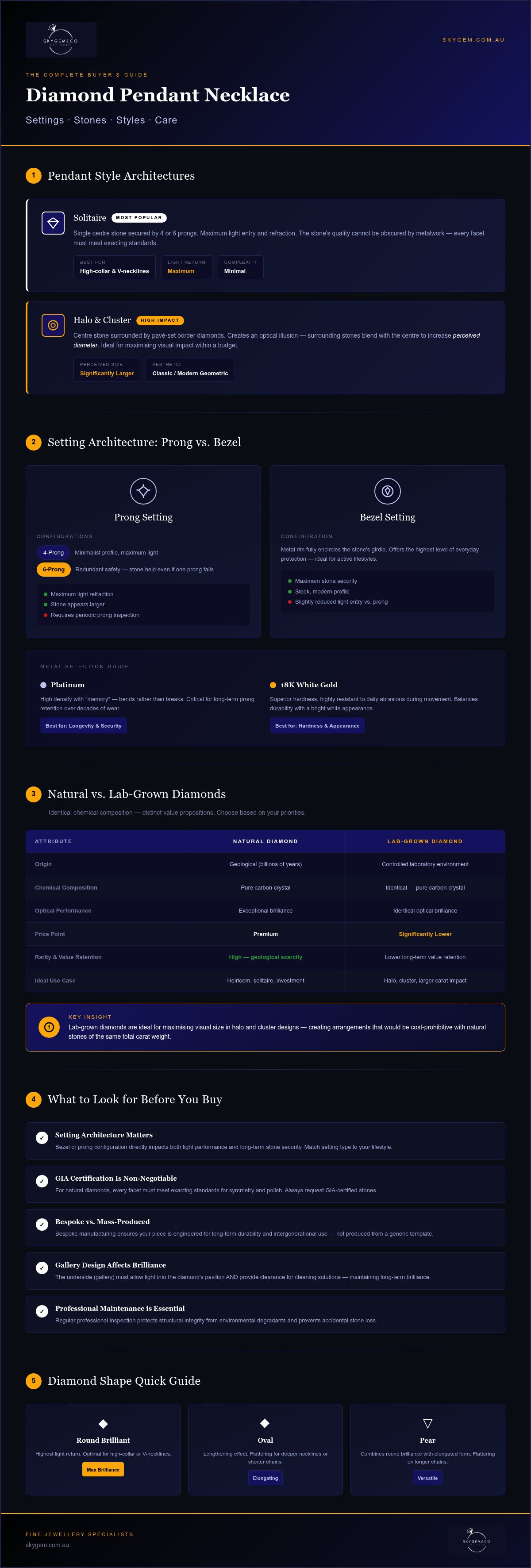
The solitaire configuration remains the most direct expression of diamond quality. It focuses entirely on a single centre stone, typically secured by four or six prongs to allow for maximum light entry and refraction. In a solitaire design, the diamond shape dictates the entire aesthetic profile and how the piece sits against the skin. Round brilliant cuts offer the highest level of light return and are optimal for high-collared or V-necklines. Conversely, fancy shapes such as the oval or pear provide a lengthening effect, which can be more flattering for deeper necklines or shorter chains.
Because the stone is the sole focus, the technical specifications cannot be obscured by complex metalwork. This style highlights the GIA-certified quality of the stone, where every facet must meet exacting standards for symmetry and polish. For many collectors, natural white diamonds represent the gold standard for solitaires due to their geological rarity and long-term value retention. The simplicity of the solitaire ensures that the focus remains on the stone’s performance rather than the setting's complexity.
Halo and Cluster Designs: Maximising Brilliance
Halo and cluster designs introduce a secondary layer of optical complexity. A halo setting involves a central stone surrounded by a border of smaller pavé-set diamonds. This creates a strategic optical illusion; the surrounding stones blend with the centre diamond to increase the perceived diameter of the pendant. It is a highly effective way to achieve a high-impact visual signature. Cluster settings take this concept further by grouping several smaller diamonds of similar size to mimic the appearance of a much larger single stone, often resulting in a vintage-inspired or contemporary geometric aesthetic.
These styles are particularly useful for those who want to balance a specific project budget with a desire for significant brilliance. By using lab-grown diamonds in the halo or as the primary cluster components, designers can create expansive, light-catching arrangements that would be cost-prohibitive with natural stones of the same total carat weight. Whether you choose a classic halo to accentuate a primary stone or a multi-stone cluster for a more modern feel, the goal remains the same: to create a cohesive unit that performs exceptionally under various lighting conditions.
Technical Precision: Anatomy of a High-Performance Pendant Setting
The structural integrity of a diamond pendant necklace depends entirely on the engineering of its setting. While many focus on the stone's aesthetics, the setting serves as the primary defence against impact and mechanical failure. A high-performance setting must balance the contradictory requirements of maximum light exposure and absolute security. This technical framework ensures that the stone remains a permanent fixture rather than a high-risk asset.
Metal selection is the first critical hurdle. Platinum is often preferred for its density and "memory"; it tends to bend rather than break, which is crucial for retaining prongs over decades of wear. However, 18K white gold offers superior hardness, making it highly resistant to the daily abrasions that occur during movement. The underside of the piece, known as the gallery, is equally vital. A well-designed gallery allows light to enter the pavilion of the diamond while providing enough clearance for cleaning solutions to reach the stone's surface, maintaining its brilliance over time.
Prong vs. Bezel: Balancing Aesthetics and Security
Choosing between prongs and a bezel is a matter of lifestyle engineering. A 4-prong setting provides a minimalist profile that exposes the maximum surface area for light refraction. For those prioritising security, a 6-prong configuration offers a redundant safety mechanism; if one prong is damaged, the stone is still held by five others. This level of technical precision is a hallmark of custom-made jewellery, where tolerances are measured in fractions of a millimetre to ensure a perfect fit.
Bezel settings, which encircle the entire diamond in a metal rim, are the optimal solution for active lifestyles. They protect the girdle from chipping and prevent the stone from catching on fabrics. If you're looking for a bespoke solution that matches your daily rigours, you might consult with a specialist to determine the best mounting for your specific stone and lifestyle needs.
Chain Selection: The Structural Foundation
A pendant's security is only as strong as the chain that supports it. Different link architectures provide varying levels of tensile strength and durability:
- Cable Chains: The standard for solitaire pieces, offering a classic aesthetic with reliable strength-to-weight ratios.
- Wheat Chains: Composed of intertwined teardrop links, these offer the highest level of durability for heavier pendants.
- Box Chains: Highly resistant to kinking, these provide a modern, geometric look that complements contemporary designs.
The relationship between pendant weight and chain gauge is critical. A heavy 2-carat stone requires a thicker gauge, typically 1.2mm or higher, to prevent stretching or snapping. Length also dictates how the piece interacts with your wardrobe. A 40cm chain typically sits at the base of the neck, while a 45cm chain falls slightly lower, making it suitable for V-necklines or button-down shirts.
Natural vs. Lab-Grown Diamonds: Selecting Your Perfect Centre Stone
Choosing the centre stone for a diamond pendant necklace requires an understanding of the technical and economic distinctions between natural and lab-grown origins. While both materials are identical in their chemical, physical, and optical properties, they serve different project goals. Natural diamonds are geological assets formed under extreme pressure over billions of years; lab-grown diamonds are the result of advanced technological synthesis. Both are comprised of pure carbon in a cubic crystal structure, meaning they exhibit the same refractive index and a Mohs hardness of 10. The decision rests on whether you value geological rarity or the ability to maximise stone dimensions within a specific budget.
The Rarity of Natural Diamonds
Natural diamonds derive their primary value from geological scarcity and the complex logistics of extraction. For many Australian buyers, the heritage and enduring value of a natural stone make it the preferred choice for a legacy piece intended to retain value over generations. This is particularly relevant when exploring natural color diamonds, which offer a level of uniqueness that is difficult to replicate in high-volume production. When selecting a natural stone, GIA certification is a non-negotiable requirement. It provides a technical audit of the stone's provenance and quality, ensuring that the asset is accurately graded according to international standards.
The Innovation of Lab-Grown Diamonds
The primary advantage of lab-grown diamonds lies in their accessibility and the ability to "trade up" in size and clarity. Data from the first half of 2026 indicates that lab-grown diamonds are approximately 73% cheaper than their natural counterparts on average. This price delta allows for the acquisition of a higher-clarity stone for a fraction of the cost of a natural equivalent. This shift has led to lab-grown diamonds accounting for roughly 47% of the diamond jewellery market in early 2026. For many, the appeal lies in the ability to secure a larger, high-performance stone that remains ethically and environmentally transparent. You can find more detailed analysis in our lab-grown diamonds resources.
Regardless of the origin you choose, quality assurance is paramount. Every stone should be accompanied by a report from a recognised laboratory like the GIA or IGI. These documents verify that the stone meets the required performance metrics for cut, clarity, and colour. Choosing between the two is ultimately a balance between the prestige of geological rarity and the practical benefits of modern innovation. Both options, when set with technical precision, will provide the same visual brilliance and structural durability for your diamond pendant necklace.
Bespoke Creation: Designing a Custom Diamond Necklace
A significant distinction exists between template-based design tools and true bespoke manufacturing. Many retailers offer "Build Your Own" interfaces, which essentially allow you to pair a specific stone with a mass-produced, pre-cast mount. While convenient, these templates often lack the structural nuances required for a truly unique stone. True bespoke engineering involves creating a one-off technical blueprint specifically for your diamond. This ensures that the mounting's tolerances are perfectly matched to the diamond's unique dimensions, providing a level of security that mass-produced items cannot replicate.
The initial phase of the bespoke process is a technical consultation. During this session, we define your aesthetic vision and select a centre stone that meets your specific performance requirements. This collaborative approach allows us to act as technical consultants, helping you balance the stone's light performance with the setting's architectural integrity. If you're ready to begin your own design journey, you can start a bespoke consultation with our specialists to define your vision.
From Concept to CAD: Visualising the Heirloom
Computer-Aided Design (CAD) serves as the bridge between creative imagination and technical reality. By using 3D rendering, you can view the diamond pendant necklace from every angle before a single gram of metal is cast. This digital modelling is essential for adjusting the pendant's proportions to ensure it sits flat against the skin rather than tilting or flipping during movement. It allows for the precise placement of the bail, ensuring the piece maintains a stable centre of gravity. This stage is where we verify that the technical specifications align perfectly with your desired aesthetic outcome.
Master Craftsmanship in the Final Setting
While the digital model establishes the mathematical foundation, the physical realisation of the piece requires the steady hand of a master jeweller. Once the piece is cast in your chosen metal, it undergoes rigorous hand-finishing. A master setter ensures that each prong is perfectly symmetrical, applying even tension to the girdle of the diamond to prevent any future movement. The final polishing process is equally critical; it enhances the metal's reflective properties to complement the stone's brilliance. To see this level of precision across other jewellery types, you can explore our work on bespoke engagement rings, where the same standards of custom excellence are applied.
Investment Value and Longevity: Caring for Your Fine Jewellery
The acquisition of a diamond pendant necklace represents a commitment to a permanent asset, but its long-term viability depends on a disciplined maintenance schedule. While we've discussed the architectural integrity of bespoke settings, even the most robust 18K gold or platinum mount is subject to the rigours of daily wear. Structural fatigue can occur over time, particularly in the prongs or the bail, where constant friction against a chain can thin the metal. Regular inspections are not merely about maintaining aesthetic brilliance; they are a technical necessity to prevent the catastrophic loss of the centre stone.
Daily environmental factors significantly impact the performance of your jewellery. Common household chemicals, perfumes, and lotions contain oils and abrasives that can accumulate behind the stone or within the gallery. This buildup creates a film that disrupts the diamond's refractive index, dulling its natural fire. More critically, certain chemicals like chlorine can cause stress corrosion cracking in lower-carat gold alloys, though 18K gold remains highly resistant. Treating your pendant as a precision instrument ensures that its light performance and structural security remain uncompromised over decades of use.
Daily Care and Storage
Effective maintenance begins with simple daily protocols. You should adopt a "last on, first off" rule, ensuring your jewellery is only applied after cosmetics and perfumes have fully dried on the skin. This prevents chemical residues from becoming trapped in the setting's intricate crevices. When not in use, store your diamond pendant in a dedicated fabric-lined compartment. Because diamonds possess a Mohs hardness of 10, they will easily scratch other gemstones or metalwork if left loose in a communal jewellery box. For routine cleaning, a solution of mild, phosphate-free soap and warm water is sufficient to remove surface oils without damaging the metal's integrity.
Professional Inspections and Restoration
An annual professional audit is vital for high-value pieces. During these sessions, we examine the setting under high magnification to identify signs of prong lifting or thinning. We also utilise ultrasonic cleaning, which employs high-frequency sound waves to create cavitation bubbles that dislodge compacted debris from areas inaccessible by manual cleaning. This is followed by high-pressure steam polishing to restore the metal's original reflective properties. As technical consultants for your collection, we provide comprehensive jewellery repair and maintenance services to ensure your heirloom remains in peak condition. These proactive measures transition your diamond pendant necklace from a one-off purchase into a multi-generational legacy.
Securing Your Legacy Through Technical Excellence
Selecting a diamond pendant necklace is a process that integrates personal aesthetic with the rigours of structural design. You now understand that the distinction between a mass-produced item and a bespoke heirloom lies in the precision of the setting and the verified quality of the stone. By prioritising architectural integrity and choosing between GIA Certified Natural Diamonds or premium lab-grown options, you ensure your piece performs exceptionally for a lifetime. These technical choices are what transform a simple accessory into a permanent asset.
At SkyGem & Co., we act as your technical consultants to bridge the gap between creative vision and premium Australian craftsmanship. Our expert bespoke design services focus on creating pieces that offer both immediate brilliance and long-term viability. We invite you to explore our curated collection of Diamond Pendants or book a bespoke consultation to begin your design journey. Investing in technical excellence today ensures a beautiful asset that you'll be proud to pass down for generations. We look forward to helping you create a piece that reflects your unique standards.
Frequently Asked Questions
How much does a high-quality diamond pendant necklace cost in Australia?
The cost of a diamond pendant necklace in Australia is determined by several technical variables, primarily the 4Cs of the centre stone and the complexity of the bespoke setting. Natural diamonds carry a premium due to geological rarity, while lab-grown options offer a lower entry point for similar carat weights. Rather than focusing on a single price point, consider the total value as a balance between stone certification and the weight of the 18K gold or platinum mount.
Can I wear my diamond necklace every day, including in the shower?
While diamonds possess a Mohs hardness of 10, wearing your necklace in the shower is not recommended for long-term brilliance. Exposure to hard water minerals and soap residues creates a film on the pavilion of the stone, which disrupts light refraction. Over time, these deposits can be difficult to remove without professional ultrasonic cleaning. To maintain the piece's performance, it's best to remove it before using personal care products or entering chlorinated environments.
What is the most secure setting for a diamond pendant?
A bezel setting is technically the most secure configuration for any diamond pendant. By encircling the entire girdle of the stone in metal, it provides a physical barrier against impact and prevents the stone from catching on fabrics. While prong settings allow for more light entry, the bezel offers superior protection for those with active lifestyles. This setting architecture is frequently chosen for its modern aesthetic and exceptional durability in daily wear environments.
How do I know if the diamond in my necklace is real?
The most reliable method to verify a diamond's authenticity is through a technical audit of its GIA or IGI certification. High-quality stones feature a microscopic laser inscription on the girdle that matches the unique serial number on the laboratory report. Home tests, such as the "fog test" or "water test," are scientifically unreliable. We recommend using a professional diamond loupe to verify the inscription against your official documentation to ensure the stone's provenance.
Which chain length is best for a solitaire diamond pendant?
For a solitaire diamond pendant, a length of 40cm or 45cm is generally considered optimal depending on the wearer's physical proportions. A 40cm chain typically positions the pendant at the base of the neck, making it ideal for open collars or crew necklines. A 45cm chain provides a slightly lower drop, which is better suited for V-necklines or layering. The choice should also account for the pendant's weight to ensure the chain maintains a stable drape.
Is a lab-grown diamond necklace worth buying as an investment?
Lab-grown diamonds are valued for their immediate accessibility and size, but they generally offer lower long-term resale value compared to natural stones. Current market data suggests that lab-grown diamonds typically retain only 10-15% of their initial purchase price. For those prioritising investment value and intergenerational heritage, natural diamonds remain the superior choice. However, lab-grown stones are an excellent option for those seeking maximum visual impact within a specific project budget.
What is a floating diamond necklace and how does it work?
A floating diamond necklace creates the optical illusion that the stone is suspended on the chain without a visible bail. This is achieved through a "hidden bail" design or by drilling a hole directly through the diamond, though the former is preferred for preserving the stone's structural integrity. This minimalist approach allows the light to interact with the stone from all angles, resulting in a contemporary look that emphasises the diamond's brilliance over the metalwork.
How often should I have my diamond pendant professionally cleaned?
You should have your jewellery professionally inspected and cleaned at least once every twelve months. During these annual checks, a specialist examines the prongs for signs of thinning or lifting and verifies the integrity of the chain links. Professional ultrasonic cleaning and steam polishing remove the compacted oils and debris that home cleaning cannot reach. This proactive maintenance schedule is essential for protecting your investment and preventing the accidental loss of the diamond.
Disclaimer
This article is for general informational purposes only and may include AI-assisted content. Pricing, specifications, and availability are subject to change. For accurate advice and current information, please contact SkyGem & Co. directly. Nothing in this content constitutes professional or financial advice.