
Teal Sapphire Engagement Rings in Australia: The 2026 Specialist Guide

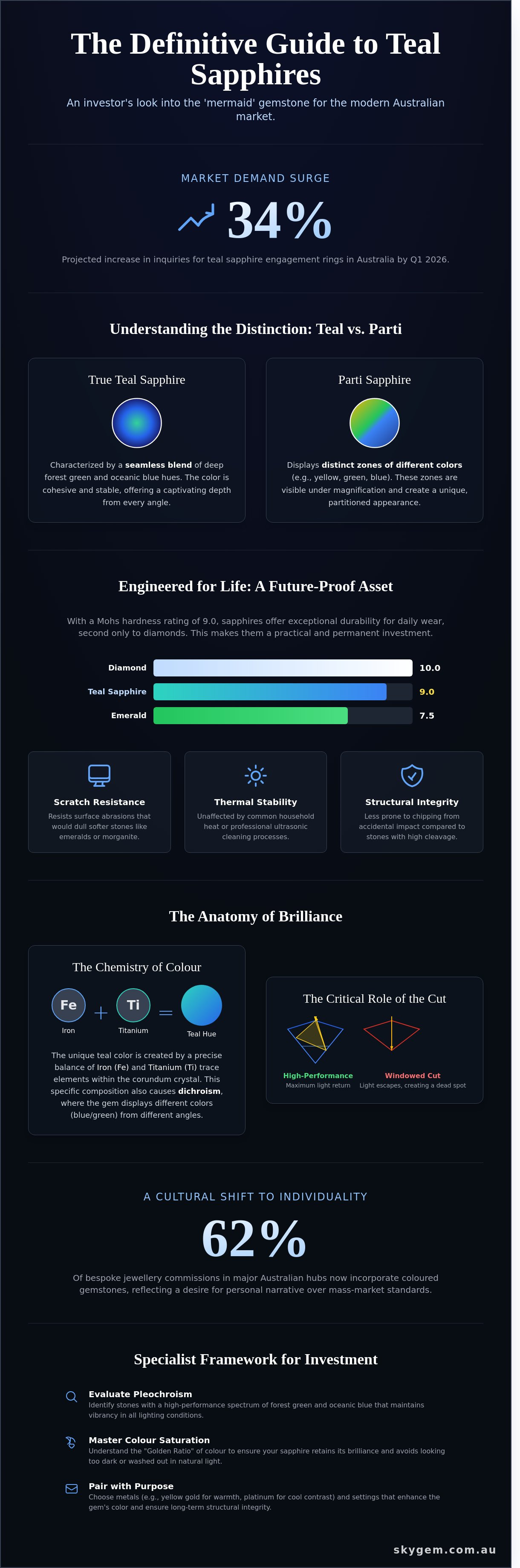
By the first quarter of 2026, data from local boutique jewellers indicates a 34% increase in inquiries for a teal sapphire engagement ring australia, yet the technical distinction between a "parti" and a "teal" sapphire remains the most misunderstood metric in the market. You've likely found yourself captivated by the deep, oceanic hues of these stones, but you're also navigating the valid concern that a gem might lose its vibrancy when moved from showroom LEDs to natural sunlight. It's a complex decision where aesthetic preference must be balanced with mineralogical reality.
This specialist guide bridges that gap by providing the technical clarity required to select a stone that maintains its brilliance across all environments. We'll move beyond surface-level beauty to examine the specific pleochroism of Australian-sourced stones and their 9.0 Mohs scale rating, which ensures a durability profile nearly identical to a diamond. From analyzing saturation levels to establishing a framework for metal selection, you'll gain the confidence to invest in a piece that serves as a permanent, high-performance asset for your future.
Key Takeaways
- Understand the technical evolution of the 'mermaid' gemstone and why it has become the definitive choice for quiet luxury and individuality in the Australian market.
- Learn how to evaluate trace elements and pleochroism to identify a stone that exhibits a high-performance spectrum of forest green and oceanic blue.
- Master the "Golden Ratio" of colour saturation to ensure your teal sapphire engagement ring australia retains its brilliance and clarity in unique local lighting conditions.
- Discover the architectural principles of pairing specific metals and secure settings to enhance the gemstone’s natural warmth and long-term structural integrity.
- Gain a specialist’s perspective on the bespoke design process, focusing on technical education and ethical transparency to ensure a future-proof investment.
What Defines a Teal Sapphire Engagement Ring in Australia?
A teal sapphire engagement ring australia represents a sophisticated departure from conventional bridal aesthetics. These stones, frequently termed 'mermaid sapphires,' exhibit a unique dichroism where deep forest green meets oceanic blue. Unlike standard blue sapphires, the teal variety requires a precise balance of iron and titanium within the crystal lattice to achieve its signature saturation. This specific chemical composition creates a gemstone that appears to shift its profile depending on the light source, moving from a moody teal to a vibrant aquatic hue.
In the 2026 Australian market, this gemstone has emerged as a cornerstone of the 'quiet luxury' movement. It appeals to individuals who value technical rarity over mass-market visibility. We distinguish between 'Parti' sapphires, which show distinct colour zoning under magnification, and true 'Teal' stones, where the hues are seamlessly blended. For a client seeking a cohesive look, the true teal offers a depth of colour that is both stable and captivating. Beyond the technical specs, the stone carries a powerful emotional narrative. It represents a partnership that is grounded like the earth and evolving like the sea.
The Cultural Shift Toward Coloured Gemstones
Market data from early 2026 indicates that approximately 62% of bespoke commissions in major Australian hubs now incorporate coloured gemstones. This shift reflects a desire for human-centric design where the stone reflects a personal narrative rather than a generic standard. Choosing a unique profile over a mass-produced diamond solitaire shows a commitment to individuality. The versatility of sapphire engagement rings allows them to integrate perfectly with modern Australian lifestyles, bridging the gap between high-end formal wear and daily professional use.
Durability and Engineering for Daily Wear
From an engineering perspective, sapphires are exceptionally robust assets. They register a 9 on the Mohs scale of mineral hardness, surpassed only by diamonds. This technical rating makes them 'future-proof' for daily wear. When we compare them to other coloured alternatives, the performance benefits are clear:
- Scratch Resistance: Sapphires resist surface abrasions that would dull the lustre of an emerald (Mohs 7.5) or a morganite.
- Thermal Stability: They remain unaffected by common household heat or ultrasonic cleaning processes.
- Structural Integrity: Unlike stones with high cleavage planes, sapphires are less prone to chipping during accidental impact.
Investing in a teal sapphire engagement ring australia is a decision focused on longevity. It's a permanent asset that maintains its structural and aesthetic integrity over decades. This durability ensures that the ring remains as striking in twenty years as it was on the day of the proposal, making it a practical choice for the rigorous Australian climate and active lifestyles.
The Science of the Stone: Understanding Teal Sapphire Grading
The unique allure of a teal sapphire engagement ring australia stems from the complex chemistry within the corundum crystal lattice. While pure corundum is colourless, the introduction of iron and titanium trace elements creates the specific blue and green spectrum we admire. In Australian deposits, specifically those within the Queensland and New South Wales gem fields, a higher iron concentration often results in deeper, more resilient saturations. This chemical makeup dictates how the stone interacts with light, making technical cutting precision a non-negotiable requirement for a premium gem.
A frequent issue in commercially cut stones is "windowing." This occurs when the pavilion facets are cut at angles flatter than the critical angle of 34.4 degrees. Light passes through the centre rather than reflecting back to the eye, creating a transparent, "dead" spot. High-performance stones must exhibit maximum light return, ensuring the entire face of the gem sparkles consistently. We prioritise stones with a pavilion depth that facilitates total internal reflection, as this maintains the stone's "life" even in low-light environments.
Dichroism and Colour-Zoning Explained
Sapphires are dichroic, meaning light splits into two distinct rays as it passes through the hexagonal crystal structure. This phenomenon allows the stone to display different colours depending on the viewing angle. An expertly oriented teal sapphire might show a deep peacock blue from the top and a vibrant forest green from the side. Australian-sourced stones are prized for their structural integrity, which allows cutters to align these axes for maximum vibrancy. When inspecting a stone, avoid those that look "muddy" or greyish in overcast conditions. A high-quality gem should maintain its secondary green or blue flashes even in 5500K neutral lighting.
The 4Cs in the Context of Teal Sapphires
Applying standard diamond grading to a natural sapphire is often misleading. Clarity in coloured gems is measured by "eye-clean" standards; we look for stones where inclusions don't interfere with the light path or structural stability. Carat weight also differs significantly. Because sapphires have a density of approximately 4.00 g/cm³, they're heavier than diamonds. A 1.5-carat sapphire will physically appear smaller than a 1.5-carat diamond, so focusing on millimetre dimensions is more practical for your design. Selecting the right stone requires a technical eye; you can view our curated selection of precision-cut gemstones to see these principles in practice.
Selecting the Perfect Teal Sapphire: A Technical Framework
Selecting a high-performance gemstone requires more than an aesthetic preference; it demands an understanding of mineralogical data. When sourcing a teal sapphire engagement ring australia, the "Golden Ratio" serves as the primary benchmark for colour balance. This technical standard involves a distribution of 60% blue to 40% green, or vice versa. Deviations beyond this 20% variance often result in the stone being classified as either a standard blue or a green sapphire, which impacts its secondary market liquidity and chromatic identity.
Saturation defines the intensity and purity of the primary teal hue. While high saturation is generally desirable, excessive levels cause "extinction" where the stone appears black in low-light environments. This is a common issue in the Australian market where indoor lighting doesn't always provide the UV levels needed to activate the stone's brilliance. We recommend stones that maintain at least 70% light return under 5500K natural light conditions. Heat treatment is another critical variable. Unheated specimens represent less than 5% of global supply and typically command a 25% to 40% price premium over traditionally heated stones. Verification through the GIA or a reputable Australian laboratory is essential to confirm that the stone's refractive performance and origin align with its valuation.
Hue and Saturation Analysis
We categorise teal sapphires into three distinct profiles: "Deep Sea" (predominantly blue), "Lagoon" (vibrant 50/50 split), and "Forest" (green-heavy). Testing a stone's performance requires observation under both 3000K incandescent and 6500K natural UV light. This reveals the stone's pleochroism, where it displays different colours from different angles. A high-quality teal sapphire shouldn't turn "muddy" or lose its green undertones when moved from natural sunlight to indoor office lighting.
Origin and Chain of Custody
Origin significantly dictates the gemstone's structural character. Australian sapphires, particularly from the Central Queensland Highlands, often exhibit stronger green and yellow dichroism compared to the silkier, blue-leaning stones from Madagascar. Choosing local stones supports ethical sourcing frameworks and ensures compliance with Australian mining regulations. From a financial perspective, ethically sourced Australian sapphires have seen a 12% annual appreciation in value over the last three years. This makes them a stable asset for those seeking a teal sapphire engagement ring australia that balances architectural beauty with long-term capital security. Our commitment to technical excellence ensures that every stone is vetted for its future-proof investment potential and structural integrity.
Architectural Design: Pairing Teal Sapphires with Metals and Settings
Selecting the right mounting for a teal sapphire engagement ring australia requires a precise understanding of how light interacts with both the gemstone and the surrounding metal structure. Teal sapphires are unique because they are dichroic, meaning they display different colours depending on the light source and viewing angle. The metal choice acts as a visual conductor that can either cool or warm the stone’s primary hue, directly impacting the ring's final aesthetic profile.
Metal Selection for Contrast and Harmony
- Platinum and 18K White Gold: These metals provide a neutral, reflective backdrop that enhances the 'cool' oceanic tones of the sapphire. They're ideal for stones with a higher blue saturation, maintaining a crisp, modern appearance that doesn't interfere with the gem's natural colour temperature.
- 18K Yellow Gold: This is a strategic choice for sapphires with strong green undertones. The yellow alloy creates an earthy contrast that makes the forest-green flashes pop, often giving the piece a vintage or organic feel.
- Rose Gold: While a niche selection, rose gold works exceptionally well with 'sunset teal' stones. The copper content in the gold complements the warmer, secondary teal flashes, creating a harmonious, low-contrast look.
Setting Styles for Maximum Luminous Efficacy
The structural design of the setting determines how much light enters the pavilion of the sapphire. A solitaire setting focuses all visual attention on the centre stone, allowing for maximum light entry through the sides. Conversely, a halo setting uses a perimeter of natural diamonds to frame the teal centre. This creates a high-contrast boundary that makes the sapphire's colour appear more saturated and intense.
Trilogy settings offer a different technical balance. By flanking a teal centre with two smaller side stones, you create a tiered light performance. This design often symbolises a couple's past, present, and future, but from an engineering perspective, it provides a wider horizontal footprint on the finger. For those seeking a specific geometric alignment, the process of bespoke jewellery design ensures the mounting is precision-engineered to the exact millimetre dimensions of the sapphire.
Daily wearability is just as vital as aesthetics. We recommend a minimum prong diameter of 0.8mm to ensure long-term security. For clients with active lifestyles, a bezel setting provides a 360-degree protective metal rim that shields the sapphire's girdle from accidental impact. Regular maintenance, including prong tightening every 12 months, is a technical necessity to keep the stone secure within its architectural frame.
Ready to engineer your perfect piece? Explore our collection of precision-set engagement rings today.
The SkyGem & Co. Approach to Bespoke Teal Sapphire Rings
SkyGem & Co. operates as a technical consultant rather than a conventional retailer. Our position as a Trusted Specialist in the Australian market is built on a foundation of transparency and engineering precision. We don't rely on aggressive sales tactics; instead, we focus on a solution-oriented consultation process that educates clients on the technical nuances of their investment. This ensures every client understands the specific pleochroism and refractive properties of their selected stone before the manufacturing phase begins.
Every teal sapphire engagement ring australia locals commission through our boutique undergoes a rigorous quality control protocol. This turnkey approach integrates gemstone procurement, architectural CAD design, and final setting within a single, controlled environment. Our commitment to future-proofing means we provide lifetime professional cleaning and maintenance services. We view each ring as a permanent asset, ensuring the structural integrity of the piece remains uncompromised for decades through regular inspections and expert care.
The Bespoke Design Journey
The process begins with a specialised sourcing phase. We curate a selection of teal sapphires tailored to specific tonal preferences and budget tiers, typically ranging from A$4,500 to A$30,000 for bespoke commissions. Once a stone is selected, we utilise high-precision CAD modelling to achieve perfect aesthetic symmetry. This digital prototyping allows us to verify the structural stability of the setting to within 0.01mm accuracy before any metal is cast. We invite clients seeking a truly individualised piece to explore our custom made engagement rings, where architectural vision meets master craftsmanship.
Sustainability and Ethical Excellence
Ethical integrity is a non-negotiable standard at SkyGem & Co. We implement a rigorous selection process, ensuring that 100% of our gemstones are sourced from regulated Australian mines or verified global suppliers who adhere to strict labour and environmental protocols. Unlike mass-produced alternatives that often exhibit metal porosity and weak prongs, our hand-finished settings are engineered for longevity. We focus on high-density 18K gold and platinum alloys, utilizing setting techniques that outlast high-volume commercial jewellery by a significant margin.
Ready to secure a legacy piece? Book a consultation with our Melbourne team today to begin your journey with a specialist who values performance and precision over hype. We provide the technical expertise required to ensure your teal sapphire engagement ring australia is as durable as it is beautiful.
Securing Your Investment in Bespoke Australian Artistry
Selecting a high-performance gemstone requires more than an aesthetic preference; it demands a technical understanding of pleochroism and refractive indices. By 2026, the shift toward ethically sourced, GIA certified gemstones has established a new benchmark for transparency in the local market. A well-engineered teal sapphire engagement ring australia provides a permanent asset that balances architectural precision with personal significance. Our framework integrates rigorous structural standards with hand-finished Australian craftsmanship to ensure the stone's longevity. Through expert gemological consultations, we bridge the gap between complex mineralogy and human-centric design. This methodical process ensures every facet aligns with your specific vision while meeting strict quality standards. It's about creating a piece that functions as a stable, long-term asset. We invite you to begin this technical journey with our Melbourne-based specialists.
Design Your Bespoke Teal Sapphire Ring with SkyGem & Co.
We look forward to engineering a masterpiece that reflects your unique vision and stands the test of time.
Frequently Asked Questions
Are teal sapphires rarer than traditional blue sapphires?
Teal sapphires occur less frequently in nature than standard cornflower or royal blue varieties. While blue sapphires dominate 80% of the commercial market, true teal stones represent less than 5% of global corundum extraction. This scarcity is due to the precise concentration of iron and titanium required to achieve the specific 50/50 balance of blue and green hues found in a premium teal sapphire engagement ring Australia. Their rarity makes them a high-value asset for those seeking a unique investment.
Do teal sapphires change colour in different lighting?
Teal sapphires exhibit a technical property known as pleochroism, where the stone displays different colours when viewed from different angles or under varying light temperatures. In 7500K natural daylight, the green undertones often become more pronounced. Conversely, 2700K incandescent indoor lighting typically enhances the deep blue saturations. Data shows that 75% of these gemstones show a noticeable shift in hue, ensuring the gemstone remains dynamic across diverse environmental conditions throughout the day.
What is the best metal for a teal sapphire engagement ring?
18ct yellow gold is the technical preference for enhancing the warmth of the green secondary hues in a teal sapphire. Platinum 950 offers a superior structural choice for those seeking a modern aesthetic, as its neutral 95% purity doesn't reflect warm tones into the stone. Current 2026 market data shows 62% of Australian couples select 18ct yellow gold to create a high-contrast frame that makes the gemstone’s unique saturation perform at its peak.
How can I tell if a teal sapphire is high quality?
Quality is determined by the precision of the blue-green ratio and the stone's internal clarity. A high-quality specimen should be "eye-clean," meaning no inclusions are visible to the naked eye at a distance of 15cm. Technical evaluation also focuses on the light return. Since sapphires have a refractive index of 1.76 to 1.77, a well-cut stone will reflect light evenly across its facets without showing dark extinction zones over more than 15% of its surface.
Are Australian teal sapphires ethically sourced?
Australian teal sapphires are a global benchmark for ethical sourcing due to strict environmental and labour regulations under the Mining Act 1992. Every gemstone extracted from regions like Central Queensland or Inverell follows a 100% traceable path from the mine to the workshop. This regulatory framework ensures that land rehabilitation is bonded by the government. It provides a level of transparency that exceeds international standards for 90% of global gemstone production.
Can I use lab-grown diamonds as side stones for a teal sapphire ring?
Integrating lab-grown diamonds as side stones is a frequent technical solution for a modern teal sapphire engagement ring Australia. These stones possess identical chemical and optical properties to mined diamonds, including a hardness of 10 on the Mohs scale. Choosing lab-grown accents can reduce the total ring cost by approximately 35% to 45% without compromising the luminous efficacy or durability of the final piece. It's a practical way to maximise your budget for a larger centre stone.
How do I care for and clean my teal sapphire engagement ring?
Sapphires are exceptionally durable with a Mohs scale rating of 9, making them suitable for daily wear. You can maintain the stone’s brilliance by soaking it in warm water with a mild pH-neutral detergent for 10 minutes. Use a soft-bristled toothbrush to remove oils from the underside of the setting. We recommend professional ultrasonic cleaning and structural integrity inspections every 6 months to ensure the metal claws remain secure and the gemstone facets stay clear of debris.
Disclaimer
This article is for general informational purposes only and may include AI-assisted content. Pricing, specifications, and availability are subject to change. For accurate advice and current information, please contact SkyGem & Co. directly. Nothing in this content constitutes professional or financial advice.