
Star Ruby Buying Guide: The 2026 Expert Handbook to Rare Asterism

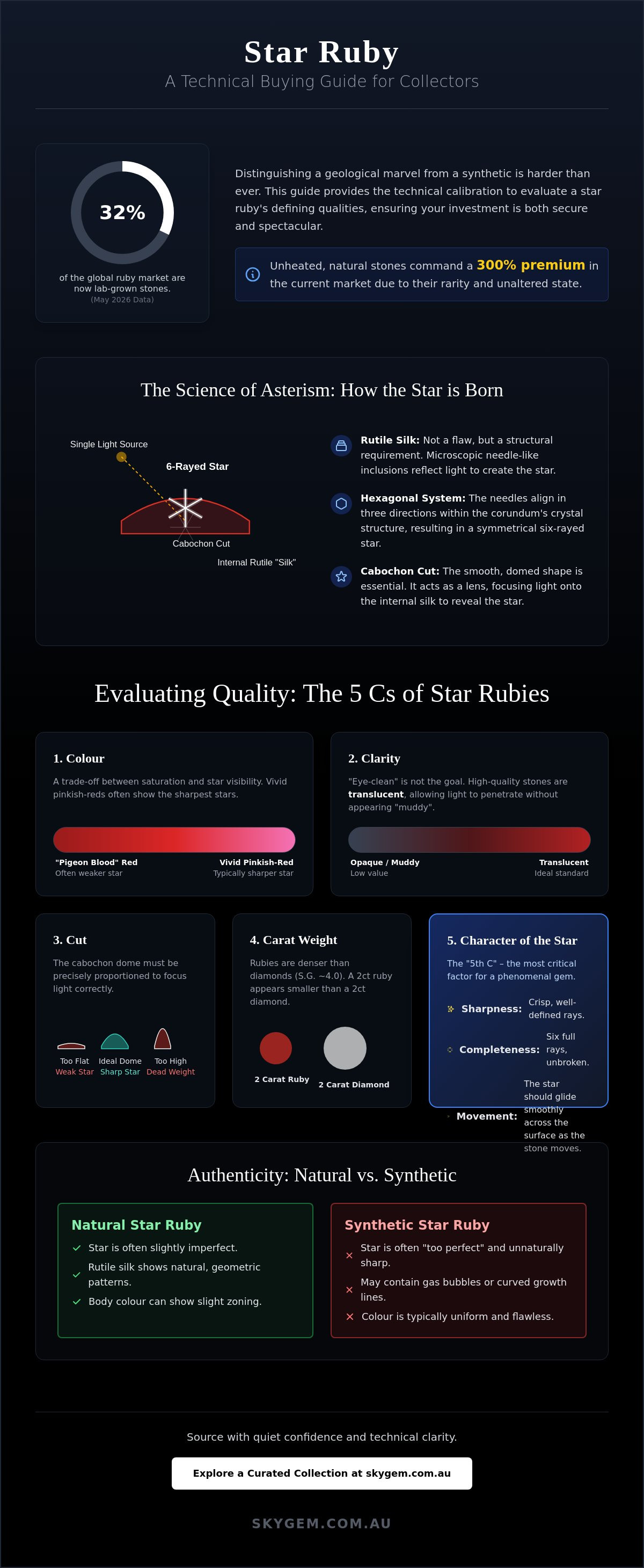
Did you know that lab-grown stones now account for 32% of the global ruby market as of May 2026? This surge makes it increasingly difficult to distinguish a genuine geological marvel from a synthetic "Linde" star without technical expertise. You likely understand that a star ruby's value lies in its rare asterism, yet the trade-off between a vivid "Pigeon Blood" body colour and a sharp, six-rayed star can feel like a complex engineering puzzle. It's frustrating when the rutile silk that creates the star also threatens the stone's transparency and ultimate market value.
This star ruby buying guide provides the technical calibration you need to select a world-class gemstone for your next bespoke jewellery project. We'll help you master the nuances of light and symmetry to ensure your investment is both secure and spectacular. You'll learn how to evaluate star sharpness with precision, understand why unheated stones command a 300% premium in the current market, and choose settings that protect the delicate cabochon cut. From assessing GIA's 2026 fee structures to identifying AI-verified origins, this handbook ensures you source with quiet confidence and technical clarity.
Key Takeaways
- Master the science of asterism by understanding how rutile silk density impacts both the sharpness of the six-ray star and the stone's overall translucency.
- Navigate the critical balance between vivid body colour and star visibility to select a gemstone that maintains optical performance under diverse lighting conditions.
- Utilise this star ruby buying guide to distinguish natural specimens from "too perfect" synthetic alternatives, ensuring your investment aligns with 2026 authenticity standards.
- Learn to engineer bespoke jewellery settings that provide structural protection for the cabochon dome without compromising the light reflection required for asterism.
- Explore the 2026 market landscape for unheated rubies to understand why these rare, untreated stones represent a superior asset for high-level collectors.
Understanding Asterism: The Science Behind the Star Ruby
Asterism is a complex optical phenomenon, not a superficial coating or a surface-level reflection. It occurs when light reflects off microscopic, needle-like inclusions of rutile, commonly referred to as silk in the jewellery industry. These needles align themselves in three specific directions within the corundum's hexagonal crystal system. Because the host crystal follows this hexagonal geometry, the resulting reflection manifests as a symmetrical six-ray star. This star ruby buying guide emphasises that the presence of silk is a fundamental marker of natural origin, provided the distribution follows these rigid geometric rules. To reveal this effect, lapidaries must cut the stone en cabochon. This smooth, domed shape acts as a convex lens, focusing light onto the internal silk to manifest the star. For a ray to appear crisp and central, the light source must be oriented perpendicular to the inclusions within the stone.
The Role of Rutile Silk in Gemstone Integrity
Silk isn't a flaw; it's a structural requirement for asterism. A high-quality natural ruby requires a precise density of rutile to perform optically. If the silk is too sparse, the star appears weak or "ghost-like" under direct light. Conversely, excessive silk density can cloud the stone, severely reducing its transparency and market value. While most specimens feature six rays, ultra-rare 12-ray stars occur when two different sets of inclusions, typically rutile and hematite, coexist within the same crystal. The Science Behind the Star dictates that this internal architecture is what separates a world-class investment piece from a commercial-grade stone.
Why Natural Star Rubies are Geologically Rare
Geological conditions rarely produce the perfect alignment of chemistry and physics required for asterism. Historically, the Mogok region of Burma and the alluvial deposits of Sri Lanka have been the primary sources for these phenomenal stones. Most rubies discovered in these regions are faceted to highlight their red body colour and internal clarity. This practice makes a high-quality star ruby a niche collector's item, as the rough material must possess both significant silk and sufficient colour saturation to be viable. Unlike standard faceted rubies, which prioritise light return through the crown, star rubies prioritise the internal reflection off the silk. This fundamental difference in optical objectives ensures that top-tier star rubies remain significantly rarer than their faceted counterparts, often representing less than 1% of a mine's total ruby output.
Evaluating Quality: The 4Cs and the "5th C" of Star Rubies
Evaluating a phenomenal gemstone requires a technical recalibration of the traditional 4Cs framework. While colour remains a primary value driver, this star ruby buying guide highlights that the presence of asterism introduces a critical "5th C": the Character of the star. Unlike faceted stones where brilliance is the objective, the value of a star ruby is determined by the synergy between body colour and the optical performance of the internal silk. Achieving a balance between a saturated red and a visible star is a rare geological feat. The very inclusions that create the star often impede the stone's transparency, making the selection process a matter of finding the perfect optical compromise.
- Colour: In the world of star rubies, the trade-off is significant. While a "pigeon blood" red is the pinnacle for faceted stones, deep saturation often results in a weak, "ghostly" star. Stones with a vivid pinkish-red tone frequently exhibit the most striking asterism.
- Clarity: You won't find "eye-clean" star rubies because the silk is what creates the effect. Instead, translucency is the gold standard. A stone should allow light to penetrate and reflect off the silk without appearing "muddy" or completely opaque.
- Carat: Rubies are denser than diamonds, with a specific gravity of approximately 4.0. This means a 2-carat star ruby will have a smaller visual footprint than a 2-carat diamond.
- Cut: The cabochon must be cut with precision. A dome that is too flat won't focus the light to form a star, while a dome that is too high adds "dead weight" to the base without improving the visual effect.
The 5th C: Character of the Star
The star's quality is judged by three technical metrics: sharpness, centring, and symmetry. Sharpness refers to how well-defined the rays appear under a single point light source, such as a halogen bulb or direct sunlight. The rays should be crisp, not blurry or diffused. Centring is equally vital; the star's junction must sit at the exact apex of the cabochon. Finally, symmetry requires all six rays to be straight and of equal length, extending to the base of the stone. Evaluating these factors is essential when you browse natural rubies for a bespoke jewellery project.
Body Colour vs. Star Intensity: Finding the Sweet Spot
Finding a stone that excels in both colour and star intensity is the ultimate challenge for collectors. Geologically, dark red stones often lack the translucency needed for a sharp star. Technical experts suggest prioritising "vivid" saturation over "dark" tones to ensure the star remains visible in ambient light. According to Natural vs. Synthetic Star Rubies, the most valuable specimens maintain a rich red while displaying a star that "pops" against the background. In the 2026 market, stones that achieve this "sweet spot" command a significant premium, often valued 20% to 30% higher than those with a compromised or weak star effect.
Authenticity Check: Natural vs. Synthetic Star Rubies
The presence of a six-ray star isn't an absolute guarantee of natural origin. As lab-grown rubies now account for 32% of the global market in 2026, distinguishing between geological rarities and synthetic counterparts requires a technical eye. This star ruby buying guide identifies the "too perfect" star as the primary red flag for buyers. In nature, rutile silk is rarely distributed with mathematical precision. If the rays are unnaturally sharp, ultra-thin, and remain vivid even in low light, the stone is likely a synthetic "Linde" ruby. These lab-created gems were engineered to produce a hyper-idealised asterism that rarely occurs in the earth's crust. While they hold a place in the vintage jewellery market, they lack the intrinsic value and geological soul of a natural ruby.
Surface diffusion represents a more deceptive treatment. In this process, a natural but starless ruby is heated with chemicals to create a thin layer of asterism on the surface. Unlike a true star ruby, where the silk is integrated throughout the crystal lattice, a diffused star is merely a "painted" optical effect. For high-value acquisitions, a lab report is non-negotiable. As of April 1, 2026, the GIA fee for a Colored Stone Identification and Origin Report starts at A$90 for stones up to 1.99 carats. These redesigned 2026 reports provide the storytelling and technical data needed to confirm a stone's authenticity and treatment status.
Detecting Treatments: Heat and Diffusion
Technical experts prioritise unheated specimens because high-temperature heat treatments often dissolve the delicate rutile silk, destroying the star effect. Consequently, most genuine star rubies are unheated, commanding a premium of 150% to 300% over heat-treated stones. To spot a diffused star, examine the stone from the side under magnification. If the star appears to sit on the surface like a film rather than emerging from within the body, it's a treated stone. You can also refer to a ruby price guide to understand how these treatments impact market valuation in Australia.
The "Movement Test" for Genuine Asterism
A natural star is a dynamic optical event. When you move a single-point light source, such as a torch or a smartphone flash, the star should glide fluidly across the cabochon's surface. It follows the light. If the star remains static or appears to be "stuck" in one position regardless of the light's angle, the stone is a fake. This movement test is the most practical tool for any buyer. Genuine asterism depends on the interaction between light and internal silk; if that interaction feels mechanical or rigid, the stone's origin is likely artificial.
Designing the Setting: Bespoke Considerations for Star Rubies
Designing a setting for a phenomenal gemstone requires a technical departure from the logic used for faceted diamonds. While facets are engineered to reflect light through the crown via internal angles, a star ruby depends entirely on its exterior geometry to focus light onto internal rutile silk. This star ruby buying guide emphasises that the cabochon cut creates a distinct architectural profile, often resulting in a stone that sits higher than a traditional solitaire. Even though ruby is a robust 9 on the Mohs scale, the large surface area of the exposed dome remains vulnerable to abrasions and knocks. Selecting a high-performance metal like 18K white gold or platinum is recommended. These metals provide a neutral, high-contrast backdrop that enhances the saturation of the red body colour without the warm chromatic interference found in yellow gold alloys.
The "undercut" or base of the stone is a critical factor in the final design's success. Lapidaries often leave the base of a star ruby unpolished or "heavy" to retain carat weight, which can make the stone appear bulky in a standard setting. A bespoke approach involves measuring the stone's depth and curvature precisely to ensure the ring doesn't feel top-heavy or catch on clothing. It's a balance of engineering excellence and aesthetic proportion that requires a specialist's eye for detail.
Claw vs. Bezel Settings for Cabochons
A full bezel setting provides a protective metal rim around the entire perimeter of the gemstone. This is the most secure option for active wearers, as it shields the ruby's edges from chipping. However, some collectors feel a bezel can hide the stone's side profile. Multi-claw settings, specifically those with six prongs, are a popular alternative. They mirror the hexagonal symmetry of the star itself and allow more light to interact with the stone's surface from different angles. For a truly tailored fit, you should consider a custom made engagement ring that accounts for the specific millimetre dimensions of your cabochon.
Enhancing the Star with Accent Diamonds
Adding accent stones should serve to frame the star, not compete with it for visual dominance. A halo of natural white diamonds creates a frame of brilliance that focuses the viewer's attention on the central asterism. This technique is particularly effective for stones with slightly lighter body colours. The trilogy approach is another classic choice, pairing the star ruby with two side diamonds to create a balanced, three-stone silhouette. This design helps transition the height of the cabochon down to the band, creating a more cohesive and comfortable piece of jewellery. If you're looking to create a unique piece, you can consult with our technical specialists to finalise your bespoke design.
Investment and Procurement: Sourcing with SkyGem & Co.
The 2026 market for rare unheated star rubies is currently defined by a significant supply-side squeeze. Political instability in Myanmar as of March 2026 has disrupted traditional trade routes from the Mogok region, contributing to a projected 12% price increase for high-quality untreated stones this year. This star ruby buying guide emphasises that procurement in the current climate requires both technical expertise and a robust global network. SkyGem & Co. operates as a technical consultant in this landscape, leveraging established partnerships to ensure ethical procurement and bypass high-risk supply chains. We focus on sourcing stones that meet strict Australian standards for origin and treatment transparency, ensuring your investment is a secure, long-term asset.
Our consultation process begins with the technical evaluation of a loose natural ruby. We analyse the stone's optical performance under various lighting conditions before moving to the CAD design phase. This stage is vital; the orientation of the star must be mathematically aligned with the ring's geometry to ensure the rays remain central. During final quality assurance, our specialists verify that the setting process hasn't compromised the stone's asterism or structural integrity. It's a methodical approach that mirrors the precision required in large-scale architectural design, resulting in a piece that is as durable as it is aesthetic.
The Importance of Certified Transparency
We believe that hard data should underpin every high-value gemstone acquisition. SkyGem & Co. insists on GIA Identification and Origin Reports for all significant rubies, particularly given the new GIA fee structure that came into effect on April 1, 2026. These reports were redesigned in January 2026 to provide enhanced gemological storytelling, which is essential for documenting the "unheated" status that drives a 300% price premium. You can consult our Ruby Price Guide to understand how these certifications influence the valuation of stones that can exceed A$32,000 per carat for top-tier material. Our guarantee ensures that every stone is natural, ethically sourced, and fully compliant with international trade regulations.
Starting Your Bespoke Journey
We invite you to schedule a private consultation for custom-made rings at our professional studio. To make the most of your session, please bring any design inspiration, your intended budget in A$, and your specific preferences regarding star sharpness versus body colour. We'll provide a technical breakdown of how different settings will impact the stone's visual performance. The timeline for a hand-finished, bespoke star ruby ring typically ranges from six to eight weeks. This schedule allows for the meticulous craftsmanship and rigorous quality checks necessary to produce a world-class piece of jewellery that functions as a permanent and evolving asset.
Securing Your Investment in Rare Asterism
Selecting a world-class star ruby is a technical process that extends far beyond mere aesthetics. As this star ruby buying guide has detailed, the value of your acquisition depends on the precise synergy between rutile silk density and body colour saturation. You now understand that a sharp, centred star is a rare optical event that requires both geological luck and expert lapidary skill. Protecting that investment involves more than just selecting a stone; it requires a bespoke setting engineered to shield the cabochon while allowing light to perform. It's a methodical approach where engineering excellence meets architectural beauty.
At SkyGem & Co., we act as your technical consultants to ensure every gemstone meets the highest standards of transparency and origin. Our boutique service provides a solution-oriented approach to high-end jewellery for clients across Australia. We combine GIA Certified Natural Rubies with expert CAD design and hand-finished craftsmanship to create a permanent asset for your collection. Begin your bespoke star ruby journey with a SkyGem & Co. consultation. We look forward to partnering with you to capture the rare, enduring beauty of natural asterism.
Frequently Asked Questions
What is the most valuable colour for a star ruby?
A vivid "Pigeon Blood" red is the most valuable colour for a star ruby. According to 2026 market data, a "Pigeon Blood" designation from a reputable laboratory like GRS can increase a stone's value by 20% to 30% over standard vivid red specimens. While deeper reds are highly prized, the stone must retain enough translucency to allow the star to perform optically without appearing "muddy."
Can a star ruby be used for an engagement ring?
Star rubies are highly suitable for engagement rings because they possess a hardness of 9 on the Mohs scale. This makes them the second hardest natural gemstone used in jewellery, surpassed only by diamonds. Because they are cut as cabochons, we recommend a protective bezel or a multi-claw setting to shield the exposed dome from accidental abrasions during daily wear.
How can I tell if my star ruby is natural or synthetic at home?
You can perform a movement test using a single point light source like a smartphone torch. A natural star will glide fluidly across the surface as you move the light, following the beam's direction. Synthetic stars often appear "stuck" in place or are unnaturally sharp and perfect. Given that lab-grown rubies account for 32% of the market in 2026, home tests should always be verified by a GIA report.
Do star rubies need special care compared to faceted rubies?
Star rubies require more cautious cleaning protocols because the rutile silk inclusions can be sensitive to high-frequency vibrations. It is technically advisable to avoid ultrasonic cleaners and steam cleaning, as these can potentially stress the internal structure of the stone. A solution of warm soapy water and a soft brush is the safest method for maintaining the stone's luminous efficacy and surface polish.
Why does the star in my ruby look blurry in some rooms?
The sharpness of the asterism depends entirely on the light source's quality and its angle of incidence. Diffused lighting, such as standard office fluorescent tubes or cloudy Australian skies, scatters light and causes the rays to appear blurry or diffused. For the star to appear crisp and well-defined, the stone requires a single, strong point source like a halogen bulb or direct sunlight.
Are unheated star rubies more valuable than heated ones?
Unheated star rubies are significantly more valuable, typically commanding a premium of 150% to 300% over heat-treated counterparts. This star ruby buying guide highlights that high temperatures often dissolve the rutile needles required to create the star effect. Finding a natural, unheated stone with a sharp star is a rare geological event that represents a superior investment for collectors.
What is the difference between a star ruby and a star sapphire?
The primary difference is the presence of chromium, the trace element responsible for the ruby's red hue. Both gemstones belong to the corundum species, but they are classified based on colour saturation. If the stone's primary colour is red, it is a star ruby; if the colour is pink, purple, or blue, it is technically classified as a star sapphire.
Does the size significantly impact the price of a star ruby?
Carat weight has an exponential impact on price because large, high-quality crystals are exceptionally rare in nature. In the 2026 market, commercial quality star rubies retail for approximately A$3,750 per carat, while top-grade Burmese stones can exceed A$32,000 per carat. As the size increases, the technical difficulty of finding a stone with a perfectly centred, symmetrical star also rises, driving the premium higher.
Disclaimer
This article is for general informational purposes only and may include AI-assisted content. Pricing, specifications, and availability are subject to change. For accurate advice and current information, please contact SkyGem & Co. directly. Nothing in this content constitutes professional or financial advice.