
Star Ruby Asterism: How Ruby and Sapphire Stars Differ

A star ruby’s defining star is an optical effect created within the gem, not a marking on its surface. Understanding what asterism is in a star ruby starts with the fine, aligned inclusions that reflect light into a six-rayed pattern. The effect is usually easiest to see on a smooth, domed cabochon under a direct point of light.
It’s natural to notice a ruby’s red colour first, but colour and asterism have different causes. Chromium mainly produces the red, while microscopic inclusions create the moving star. The star can appear to shift as the gem or light changes position, so its visibility is part of the optical effect, not a flaw.
This guide explains which minerals contribute to asterism, how inclusions can produce six- or twelve-rayed stars, and why rubies and sapphires can show related but distinct effects. You’ll also learn how lighting and a cabochon cut influence what you see, so the star’s appearance makes sense as a feature of the gemstone’s internal structure.
Key Takeaways
- Rutile and other fine mineral inclusions can contribute to a ruby’s star by reflecting light from within the stone.
- Compare ruby and sapphire stars by their shared corundum structure, while remembering that colour and star effect have distinct causes.
- The arrangement of inclusions determines whether a star shows six rays or, in exceptional cases, twelve.
- Use a direct point of light to see the star clearly, then observe how its position changes as the light or viewing angle shifts.
- Assess the star as part of the whole gemstone: its visibility depends on the internal pattern, cut and lighting conditions.
Which Minerals Create the Star?
A star ruby’s asterism occurs when light interacts with fine, aligned mineral inclusions inside the corundum. Rutile is the main star-forming mineral, though hematite and ilmenite can also occur in star-producing material.
Needle Inclusions and Asterism
Asterism forms when microscopic, needle-shaped inclusions reflect light in an organised pattern within a gemstone. In corundum, rutile needles can align along three crystallographic directions, creating intersecting bands that become visible as a star in a suitably cut stone. Their alignment matters: scattered needles may cloud the gem without producing a clear pattern. This structure helps explain why two rubies can look different under the same light.
Rutile Silk and Other Inclusions
Rutile silk is a fine network of rutile needles inside a gemstone, named for its thread-like appearance. Rutile is titanium dioxide, with the chemical formula TiO₂, and its oriented crystals commonly create the reflective structure behind a ruby’s star. Hematite and ilmenite may also occur as fine mineral phases in star ruby. The type, distribution and alignment of these inclusions influence whether the internal pattern appears as silk, a distinct star, or both.
Rutile Inclusions and Light Reflection
Rutile inclusions create asterism by reflecting and scattering light along their aligned directions. In a cabochon-cut ruby, light interacting with these internal bands can form bright lines that meet across the domed surface. The star is an optical effect, not a coloured feature painted or etched onto the gem. Its clarity depends on the arrangement of inclusions and how light reaches the stone, so the same ruby may show a stronger pattern in one setting than another.
Three directions of aligned rutile needles can produce the intersecting bands associated with a six-rayed star. These directions are described as 120 degrees apart, with equivalent crystallographic directions also expressed as 60 degrees apart. The lines of reflected light follow the inclusion structure, so their symmetry depends on the needles’ orientation within the ruby. This is why the star’s pattern can reveal something about the stone’s internal structure.
Heating matters because it can alter the fine inclusions responsible for asterism. If rutile needles dissolve or lose their organised structure during treatment, the silk and resulting star may become less distinct or disappear. The effect depends on changes within the individual stone; heating does not create the aligned needle pattern behind a natural star. A clear star is associated with inclusions that remain present and suitably oriented.
When assessing a star ruby, consider the visible pattern alongside its underlying inclusions. Dense rutile silk may reduce transparency, while well-aligned inclusions can produce a recognisable star. These features are related but not identical: silk describes the fine internal needles, while asterism describes the star-shaped light effect they help create. Together, they explain how mineral structure and reflected light give a cabochon its characteristic appearance.
What is a Star Ruby?
A star ruby is a ruby whose internal structure produces a visible, star-shaped pattern. Its smooth cabochon cut and the lighting determine how clearly that pattern appears.
Cabochon Cutting and Star Visibility
A cabochon is a gemstone cut with a smooth, rounded dome rather than flat facets. This shape allows a star pattern to appear continuously across the surface instead of breaking across faceted planes. The dome’s height and the position of the internal inclusions affect where the lines meet and where the star appears. A well-aligned cut makes the effect easier to observe.
Cabochon Cutting and Lighting
A cabochon-cut star ruby displays its asterism most clearly under a single, strong point of light. Direct sunlight or a focused flashlight can reveal the pattern, while diffuse lighting may soften or hide it. As the stone or light moves, the star shifts across the dome. This offers a practical way to observe the effect, though visibility still depends on the ruby’s internal structure.
Star Sharpness, Centering, and Value
Star quality is judged by how clearly its rays appear and how well they meet near the centre of the cabochon. A sharp, centred, highly visible four-rayed star can be more valuable than a weak, blurry six-rayed star on a similar stone. Ray count alone doesn’t determine visual quality. Alignment, definition and visibility all contribute to the overall impression.
Natural and synthetic stones can both display asterism, so a star’s appearance alone doesn’t establish its origin. Natural star rubies show an effect from internal inclusions, while synthetic corundum can also form stars, often with exceptionally perfect, sharp patterns. An imitation may reproduce the visual effect without being ruby. Determining origin requires considering more than the star’s shape.
Care helps protect the polished dome of a star ruby. Clean it with warm water and mild soap, then handle it gently because its cabochon cut and inclusions call for careful treatment. Store the gem away from surfaces that could scratch its finish. Ruby has a Mohs hardness of 9, but that hardness doesn’t prevent its polished surface from being scratched by contact with harder material.
Unlike a faceted ruby, a star ruby is shaped to display an optical effect across its domed surface. The cut must work with the stone’s crystal structure and internal pattern: changing the orientation can affect the star’s position and visibility. A single direct light source reveals the rays more effectively than broad, diffused illumination. Together, cut and lighting determine how the asterism appears when viewed.
Star ruby and star sapphire
Ruby and sapphire are both varieties of corundum, with the chemical formula Al₂O₃. A ruby’s red colour comes mainly from chromium, while its star comes from aligned internal inclusions. Star sapphires show the same broad optical phenomenon, but have a different body colour. Their shared mineral family explains why both gems can produce asterism without making their appearance identical.
A star ruby typically displays six rays, as does a star sapphire. In each gem, intersecting bright lines create the star pattern across a smooth, domed surface. The colour beneath those lines remains an important visual distinction: star rubies range from red to purplish red, while sapphire is identified by its own body colour. The star describes the optical effect, not the gemstone’s colour category.
An ordinary ruby lacks a visible star, even though it shares the same corundum identity and red colour as a star ruby. The difference is visible asterism, which depends on suitable inclusions and their alignment within the stone. A star ruby isn’t a separate mineral species; it is a ruby displaying this additional optical feature. Comparing two red stones under direct light can reveal whether one shows intersecting rays.
A cat’s-eye gemstone presents a different visual pattern: one bright band rather than several rays crossing at a central point. This distinction helps separate a chatoyant appearance from a star effect when viewing a cabochon. A star sapphire or star ruby shows intersecting lines, while a cat’s eye is recognised by its single luminous strip. The surface shape alone doesn’t determine which effect appears.
Star sapphires are more commonly associated with asterism, but star rubies share the same corundum basis. Both can show a six-rayed star, and exceptional star rubies may display twelve rays. Some star sapphires from Thailand also contain hematite and rutile needles that form a twelve-ray pattern. These examples show that ray count and colour are separate features: the star’s geometry doesn’t identify whether the gem is ruby or sapphire.
For a practical comparison, observe the body colour first, then examine the pattern under a direct point of light. Red or purplish-red material with intersecting rays appears as star ruby; a sapphire appears as star sapphire. A single band suggests a cat’s-eye effect instead. Natural sapphires also vary in appearance, so consider colour and optical pattern as distinct characteristics, not interchangeable labels.
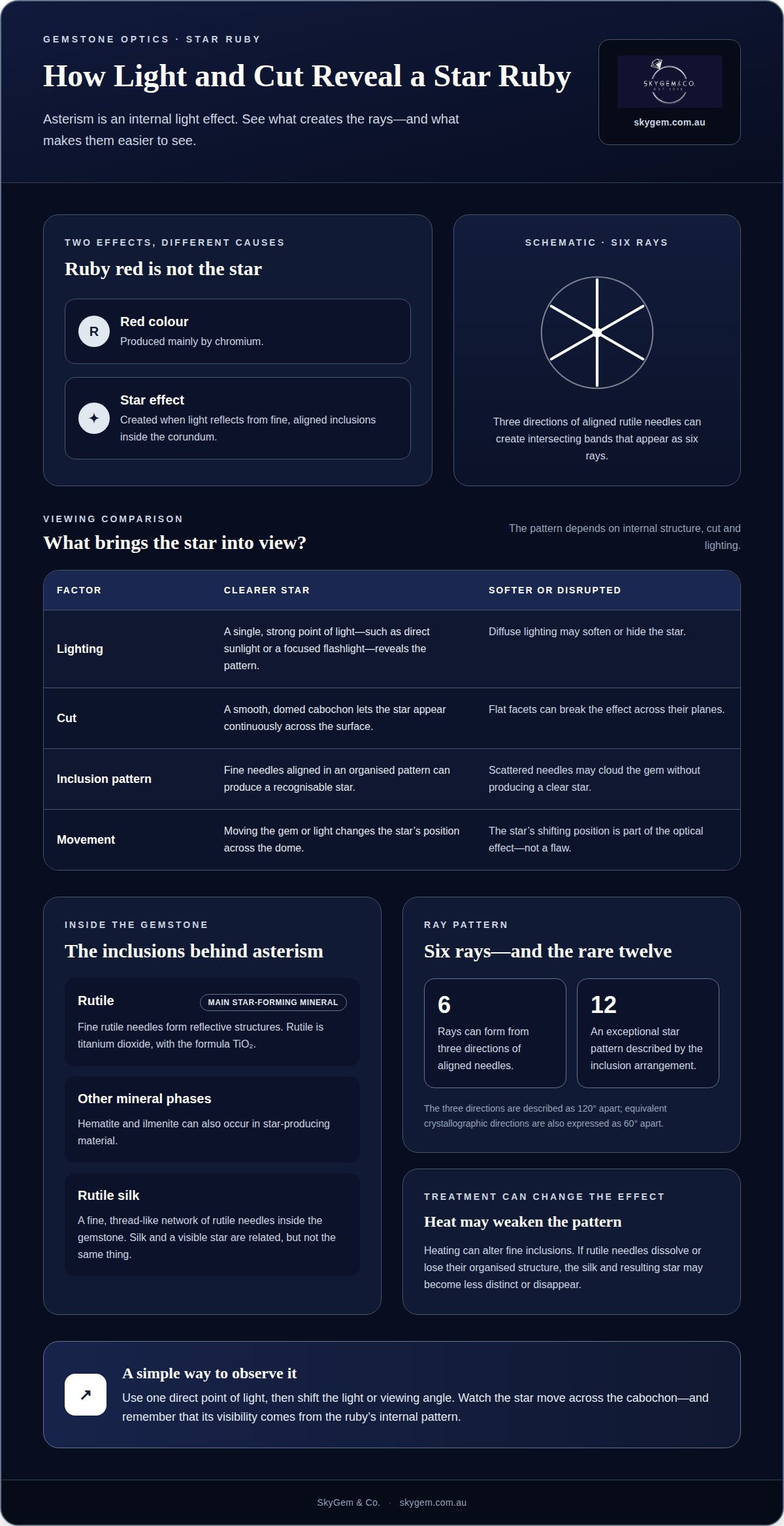
The formation of six-rayed and twelve-rayed stars
Ray count describes the visible geometry of a gemstone’s star, not its colour or mineral name. A star ruby is recognised by its red corundum body and asterism, while the number of visible rays describes the pattern across its cabochon. This distinction matters because ray count alone cannot identify a gemstone or establish whether it is natural.
Six rays are the typical pattern in star rubies. Twelve-rayed stars are an exceptional variation, distinct from the more familiar appearance. The count records the lines visible to the observer; by itself, it doesn’t explain the stone’s origin or how clearly the pattern appears. Those are separate characteristics to consider when describing a star ruby.
Twelve rays can also occur in star sapphires. Some star sapphires from Thailand contain hematite and rutile needles associated with a twelve-ray pattern. This example shows that the same ray count can appear in different colours of corundum. The count describes the optical appearance, while the gemstone’s colour identifies whether the corundum is ruby or sapphire.
Ray numbers vary across star gemstones. Four-rayed stars are typical of garnets, star diopside can show four rays, and star topaz can display eight. These patterns provide useful comparisons, but they don’t make the stones members of the same mineral family. Ruby remains corundum; the star’s ray count describes how its optical pattern appears.
When examining a star, count the distinct lines extending from its centre rather than judging only its overall brightness. Six- and twelve-rayed patterns differ in visible geometry, but either may appear sharp or less defined depending on the individual stone. The number of rays is one descriptive feature, not a complete assessment of the star’s quality.
For a natural star ruby, an exceptional twelve-ray pattern is notable because six rays are more typical. Still, consider unusual ray count alongside the star’s clarity and centring, the ruby’s colour, and the pattern’s visibility under suitable light. Separating these observations helps describe what is visible without treating rarity or ray number alone as a measure of overall value.
Movement of the star under changing light
The star’s apparent movement helps you observe its alignment across a ruby’s domed surface. Keep the light in place and turn the cabochon gradually; the bright pattern shifts in relation to the gem’s outline. The inclusions themselves remain fixed inside the stone. What changes is the direction from which their reflected light reaches the viewer.
Change one viewing condition at a time. First, hold the ruby steady and move your viewing position; then return to the original position and tilt the stone slightly. Watching the star respond to each adjustment separately helps show how the pattern relates to the cabochon’s orientation. Slow movement is easier to interpret than turning the gem quickly.
Observe where the rays meet as the star shifts. Their apparent centre can move across the dome, while the cabochon’s edge remains a stable reference. This contrast helps distinguish asterism from a surface mark: a scratch or blemish stays fixed against the gem’s outline, while the star’s position responds to viewing geometry. The pattern’s changing relationship to the surface creates the sense of motion.
The star’s definition may also change during a small tilt. In one position, the rays can look balanced; in another, some lines may appear less distinct. This variation shows how the pattern appears across the stone, rather than indicating that its internal features have changed. Compare several positions before forming an impression of the star’s overall appearance.
For a mounted ruby, the setting can limit how freely you tilt or turn the cabochon. Observe the visible dome from different angles without forcing the ring or putting pressure on the stone. The setting’s rim may also cover part of the gem’s edge, so assess the star within the exposed area. A loose stone allows a broader view of its outline and pattern.
Note the star’s position relative to a stable feature, such as the top of the setting or one end of an oval cabochon. Then change the angle and watch how the pattern shifts. This comparison is more informative than judging a single glance, particularly when the star looks uneven from one position. Its changing appearance is a normal part of viewing asterism and shows how the polished dome presents the effect.
SkyGem & Co.
SkyGem & Co. offers natural ruby and ruby rings for those considering how ruby’s colour and distinctive features might translate into jewellery. The gemstone and setting shape the finished piece, so consider which visual qualities matter most to you. If you’re exploring ruby jewellery after learning about star effects, contact SkyGem & Co. to discuss your interests and ring options.
Choose a Ring That Reflects Your Style
Understanding what asterism in a star ruby means can help you recognise the distinctive character of a star gemstone. It can also clarify what you want from a ring’s centre stone: a visible optical feature, a particular colour, or the balanced sparkle of a faceted design. Next, consider how that preference works with the ring’s overall shape and setting.
SkyGem & Co. offers Solitaire Engagement Rings, Halo Engagement Rings and Trilogy Engagement Rings. Each setting provides a different design framework for a centre stone, allowing the ring’s proportions and visual emphasis to guide your choice. Whether you’re drawn to a gemstone’s natural character or comparing ring styles, begin with the qualities that matter most to you.
Take your time choosing a design that feels personal and enduring. A clear idea of your preferred look is a strong place to begin.
Frequently Asked Questions
Do the Red Color and the Star Come From the Same Cause?
No. Chromium mainly gives ruby its red colour, while internal inclusions create the star effect. These are separate features of the same corundum gemstone. For example, a red ruby without a visible star still gets its colour from chromium. Whether a star appears depends on the stone’s internal structure and how its cut and lighting reveal that structure.
Does the star show under any light?
No. A star is easiest to see with a single, direct light source, such as sunlight or a flashlight. Diffuse indoor lighting can reduce its contrast, making the pattern faint or difficult to see. For a useful comparison, view the same stone under direct light and then in softer room light. A change in visibility reflects the lighting, not a change in the ruby.
How Does Asterism Occur?
Asterism occurs when light interacts with organised internal features in a gemstone to form a star-like pattern. In a ruby, the effect appears on a smooth cabochon rather than across a conventional faceted surface. The pattern can look different as the viewing angle changes. A single bright light source helps distinguish the star from reflections caused by nearby lights or objects.
Is it more valuable than a regular faceted ruby?
Not automatically. A star ruby and a faceted ruby are valued for different visual qualities, so the star alone doesn’t establish which is more valuable. In a star ruby, the star’s sharpness, centring and visibility matter; a weak, blurry star can be less desirable than a clearly defined one. Colour and the gemstone’s overall condition also influence its appeal.
Is it the same as a star sapphire?
They share the mineral family corundum, but differ in gemstone identity and colour. Red or purplish-red corundum is ruby; other corundum colours are classified as sapphire. Both can display a star, so the optical effect doesn’t make a ruby and sapphire the same stone. When describing or assessing either gem, compare the body colour separately from the rays.
What is asterism in a star ruby?
Asterism in a star ruby is the visible, star-shaped light pattern across the gemstone. It forms when light interacts with aligned inclusions inside the ruby. This is an optical effect, not a marking added to the polished surface. The term “star ruby” describes a ruby displaying this effect, while “ruby” identifies the red variety of corundum.
How does asterism form in star rubies?
Fine mineral inclusions inside a ruby create the structure that produces asterism. Their arrangement influences the star’s shape and definition, while the cabochon cut and lighting determine how clearly it appears. A star may look strong under direct light but subdued in diffuse conditions. The inclusions stay inside the gemstone as its visible pattern changes.
What causes the six-rayed star effect in a star ruby?
The common six-rayed effect results from light reflecting along three aligned directions of rutile needles inside the corundum. Each reflective band appears to extend in opposite directions, producing six visible rays. Their alignment influences how evenly the rays meet. Exceptional star rubies can show twelve rays, but ray count alone doesn’t establish the star’s sharpness or overall visual quality.