
Solitaire Engagement Rings: The 2026 Guide to Classic Elegance and Technical Precision

The setting holding your diamond is doing more structural work than it appears. Most people shopping for solitaire engagement rings focus almost entirely on the stone itself, which is understandable, but the prongs, the shank geometry, and the precise relationship between metal and girdle are what determine whether that diamond stays exactly where it belongs for the next fifty years.
You're right to want a ring that looks effortlessly elegant and feels completely secure. The anxiety around high settings is legitimate, and the confusion between natural and lab-grown diamonds is one of the most genuinely complex decisions in modern jewellery buying. The 4Cs, meanwhile, are taught as a checklist when they're actually a system of interrelated trade-offs that only make sense once you understand how each variable affects the others.
This guide cuts through that complexity. Drawing on the principles of precision setting design and transparent diamond grading, you'll learn exactly how to evaluate a solitaire for structural integrity, optical performance, and long-term aesthetic value, so your final choice is one you can make with confidence rather than guesswork.
Key Takeaways
- Solitaire engagement rings place the entire visual and structural burden on a single stone and its setting, which means understanding the engineering behind prong and bezel configurations is essential before you commit to a design.
- Cut quality is the single most critical of the 4Cs for a solitaire diamond, and learning how to evaluate it independently will protect you from overpaying for grades that don't translate into visible brilliance.
- The choice between a natural GIA-certified diamond and a lab-grown diamond involves trade-offs in value, provenance, and long-term resale that are far more nuanced than most retailers explain — this guide breaks down exactly what each option means for your specific priorities.
- A bespoke design process, from initial consultation through stone sourcing and CAD modelling, follows a precise sequence that aligns your budget with the right combination of setting style and diamond quality.
- Bi-annual professional prong inspections are not optional maintenance — they are the single most effective measure for preventing stone loss and preserving the structural integrity of your ring across decades of daily wear.
What Defines a Solitaire Engagement Ring in 2026?
At its most precise definition, a solitaire engagement ring features a single gemstone mounted on a precious metal band, with no accent stones competing for attention. That structural simplicity is not a limitation. It's a deliberate design philosophy that places every gram of optical and emotional weight on one stone, one setting, and the relationship between them.
The solitaire remains the most consistently chosen engagement ring style in Australia, and the reason isn't nostalgia. It's that the format is genuinely versatile across taste, budget, and lifestyle in ways that more elaborate designs are not. A well-executed solitaire reads as elegant at a formal dinner and understated at a beach wedding. It stacks cleanly with a wedding band. It doesn't date. Understanding the history and tradition of engagement rings reveals that the solitaire's dominance isn't a trend cycle — it's a design principle that has held across more than a century of changing aesthetics precisely because it subordinates decoration to the stone itself.
The psychological appeal is worth taking seriously. When a ring presents a single stone without distraction, the eye has nowhere else to go. That focus creates a sense of purity and intentionality that cluster or halo designs, however beautiful, can't replicate. The stone becomes the statement, not the setting around it.
What has shifted in 2026 is the definition of what that single stone can be. Round brilliants remain the benchmark for light performance, but oval, elongated cushion, and pear shapes now represent a substantial portion of solitaire engagement rings sold in Australia. Metals have diversified too: 18ct white gold and platinum remain the technical standard for durability, but rose gold and two-tone configurations have moved from novelty into mainstream consideration. And increasingly, couples are choosing coloured centre stones, with Australian sapphires in particular gaining traction as ethically sourced, geologically distinctive alternatives to diamonds.
The Anatomy of a Solitaire Setting
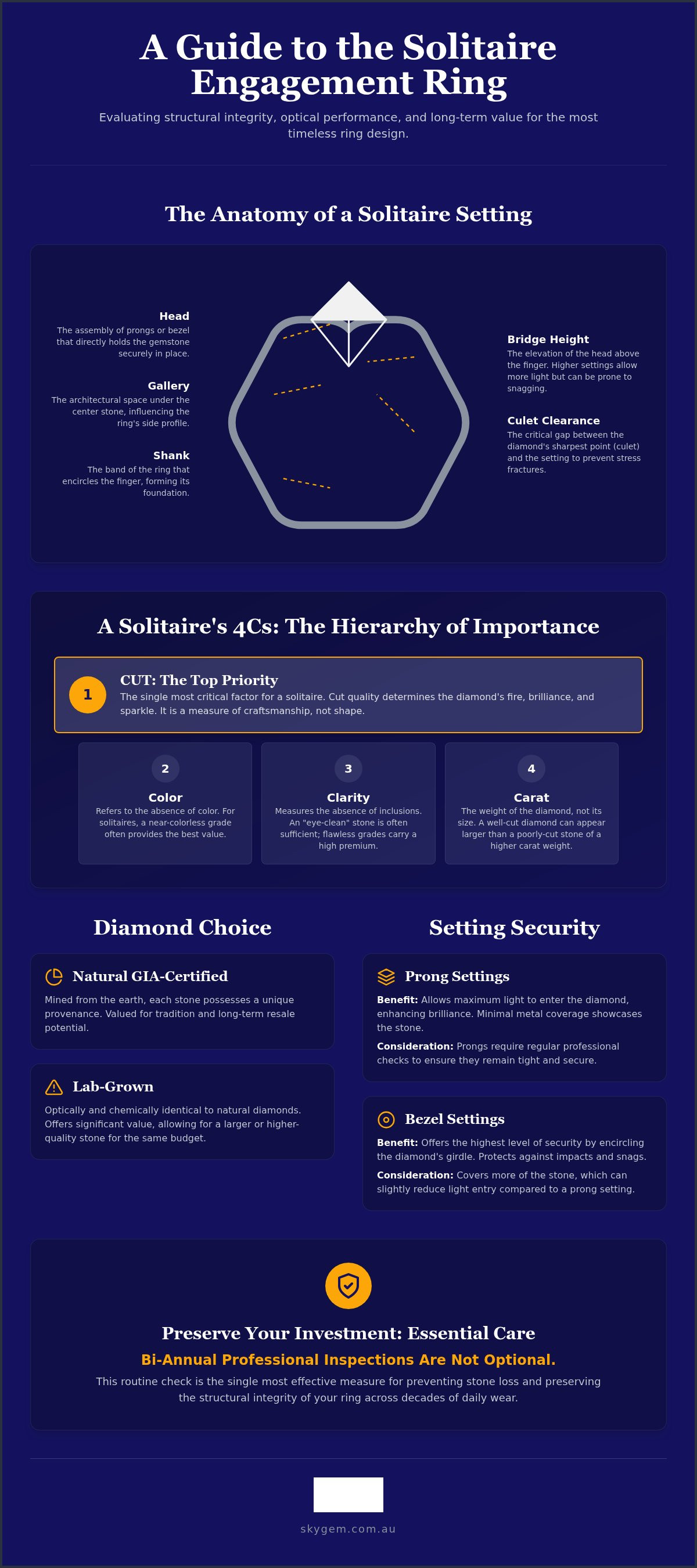
Every solitaire has three structural zones: the shank (the band that encircles the finger), the head (the prong or bezel assembly that holds the stone), and the gallery (the architectural space between shank and stone). The bridge height, which is the elevation of the head above the finger plane, directly affects how much ambient light reaches the diamond's pavilion. A higher bridge allows more lateral light entry, which benefits brilliance, but increases the ring's profile and its exposure to snagging. Lower-profile settings trade some optical performance for wearability. Neither is categorically superior; the right choice depends on the wearer's daily environment and the stone's specific cut geometry. One often-overlooked detail is culet clearance: the small gap between the diamond's lowest point and the interior of the setting. Adequate clearance prevents stress fractures at the culet under impact, which is particularly relevant for pointed fancy shapes like marquise and pear cuts.
Symbolism and Heritage
The solitaire's lineage traces to the late 19th century, when advances in diamond cutting and the discovery of South African deposits made single-stone rings commercially viable for the first time. The form has since absorbed successive waves of design influence, from Edwardian filigree to mid-century modernism to the clean Australian minimalism that characterises much of the current market. That adaptability is precisely why the solitaire endures: its core architecture is neutral enough to carry any aesthetic overlay without losing coherence. For couples considering coloured stones, the solitaire format is equally well-suited, and the growing availability of unheated, origin-certified precious gemstones means that choosing something beyond a white diamond no longer involves compromising on provenance or documentation standards.
The Engineering of Security: Selecting the Right Setting
Setting selection is where structural engineering and aesthetic intention either align or conflict. The prong configuration, bezel geometry, and metal alloy you choose don't just determine how a ring looks on day one; they determine how it performs across decades of daily wear, exposure to moisture, and the thousand small impacts that accumulate in any active life. For solitaire engagement rings, where a single stone carries everything, this decision carries proportionally more weight than in any other ring format.
Prong settings remain the dominant choice because they do something no other configuration can match: they hold the stone while exposing the maximum possible surface area of the diamond to incoming light. The girdle sits in the prongs' grip, the pavilion is open to ambient light from below, and the crown faces the world unobstructed. That optical openness is precisely why prong-set diamonds look larger and more brilliant than equivalent stones in full bezels. The trade-off is mechanical. Each prong is a discrete point of contact, and if one wears thin or bends, the stone's retention is compromised. This is why professional prong inspection matters as much as the initial setting quality.
Bezel settings invert that trade-off entirely. A continuous metal wall encircles the girdle, eliminating the risk of prong failure and providing genuine protection against edge chipping, which is a meaningful concern for stones with thin girdles or pointed shapes. The aesthetic is cleaner, lower-profile, and inherently modern. For wearers with active professions or physical hobbies, a full bezel is often the structurally correct answer, even if it marginally reduces the stone's apparent size. Semi-bezel configurations, which wrap only the opposing sides of the girdle, offer a middle position: partial protection with greater light entry than a full bezel allows.
Tension settings, where the stone appears suspended between two compressed ends of the shank, create the most dramatic floating illusion. They require precise engineering to maintain adequate clamping force across the stone's girdle, and the metal must be dense enough to hold that tension without relaxing over time. This makes metal selection inseparable from setting style.
The Four-Prong vs. Six-Prong Debate
Four prongs expose more of the diamond's crown and create a cleaner visual geometry, which is particularly effective for round brilliants where you want the stone's outline to read as circular rather than softened. Six prongs add two additional contact points, distributing retention force more evenly around the girdle and providing a meaningful safety margin if one prong is damaged. They also round out the apparent silhouette of the stone slightly, which suits some fancy shapes well. Prong shape matters too: claw prongs taper to a point and recede visually; round prongs are more prominent but distribute clamping pressure over a larger girdle surface; flat tab prongs create a vintage character while offering broad, stable contact. None of these is categorically superior; the right choice depends on the stone's specific girdle thickness and the wearer's lifestyle.
Metal Selection for Longevity
Platinum's density, sitting at roughly 21.4 grams per cubic centimetre, means it doesn't wear away so much as it displaces under friction, which keeps prong mass intact over decades in a way that softer alloys cannot replicate. It's the technically correct choice for a tension setting or any configuration where prong integrity is the primary security mechanism. 18ct white gold offers a brighter initial colour and is generally more workable for intricate designs, but it requires rhodium plating maintenance to preserve its white tone as the alloy's natural warmth surfaces over time. Yellow and rose gold introduce warmth that can complement lower-colour diamonds beautifully, and their alloy compositions offer good workability for complex prong geometries, though they're softer than platinum under sustained daily wear.
Understanding how the 4Cs of diamond quality interact with your setting choice is essential here; a well-cut stone in a structurally sound setting will outperform a higher-graded stone in a poorly engineered one. If you're working through these decisions for a bespoke piece, exploring the custom design process is the most direct way to align setting architecture with your specific stone and lifestyle requirements.
The Solitaire Diamond: Prioritising the 4Cs
A solitaire setting is unforgiving in the best possible way. Without side stones, halos, or decorative metalwork to distribute visual attention, every characteristic of the centre diamond is fully exposed to scrutiny. This changes how you should weight the diamond quality factors established by the GIA, because the relative importance of each C shifts considerably when a stone has nowhere to hide and nothing to compete with.
Cut is the non-negotiable priority. Not colour. Not carat. Cut. A poorly cut diamond of excellent colour and clarity will look flat and lifeless in a solitaire, while an Excellent or Ideal-cut stone in a more modest colour grade will produce the kind of light return that stops people mid-sentence. The reason is physics: cut quality determines how efficiently the stone captures and redirects ambient light through its crown facets. In a solitaire engagement ring, that optical performance is the entire visual argument. Accepting a Good or Very Good cut grade to afford a higher colour or clarity grade is a trade-off that consistently disappoints in practice.
Clarity requirements follow a clear logic for solitaires. The standard you're targeting is eye-clean: no inclusions visible to the naked eye at normal viewing distance. In most round brilliants, this is achievable at VS2 or even SI1, depending on inclusion type and placement. Inclusions positioned near the table or directly under the crown are more visible than those toward the girdle or pavilion. The absence of flanking stones means there's no optical noise to absorb minor imperfections, so a borderline SI1 that might pass unnoticed in a halo design can be distracting as a solitaire centre stone. Always review inclusion maps, not just grade letters.
Colour interacts directly with your metal choice in ways that create genuine budget flexibility:
- D to F (Colourless): Optimal for platinum and white gold settings, where any warmth in the stone is amplified by the cool metal surround.
- G to H (Near-Colourless): The practical sweet spot for white metal settings; visually indistinguishable from colourless to the unaided eye in most lighting conditions.
- I to K (Faint Colour): Genuinely well-suited to yellow or rose gold settings, where the metal's warmth absorbs and flatters the stone's natural tone rather than contrasting against it.
Carat weight deserves a specific clarification. What matters visually is the stone's face-up diameter, measured in millimetres across the table, not its weight. Two diamonds graded at 1.00ct can have meaningfully different face-up sizes depending on how the cutter distributed mass. A stone with a slightly deep pavilion carries weight below the girdle where it contributes nothing to visible size. Comparing millimetre measurements alongside carat weight gives you a far more accurate picture of what you'll actually see on the finger. For a round brilliant, a well-cut 1.00ct stone typically measures around 6.4 to 6.5mm; if a stone of the same weight measures 6.1mm, the depth profile warrants scrutiny.
Natural vs. Lab-Grown Diamonds
Both natural and lab-grown diamonds are chemically, physically, and optically identical. The distinction is geological origin, not material composition. Natural diamonds carry provenance, rarity, and a heritage that many buyers consider intrinsic to the symbolism of the purchase. Lab-grown diamonds offer the same optical performance and independent certification at a significantly lower price point, which allows buyers to prioritise cut and size without compromising on grading standards. The long-term resale market for lab-grown stones is still maturing, which is a legitimate consideration for buyers who value future liquidity. For those whose priority is maximising the stone's visual impact within a defined budget, lab-grown white diamonds represent a technically sound and ethically transparent choice. Neither option is categorically superior; the right answer depends on what you're actually buying the stone to represent.
The Significance of GIA Certification
Independent grading from the GIA is not a premium add-on for a significant solitaire purchase; it's the baseline standard of transparency. A GIA report documents cut grade, colour, clarity, carat weight, fluorescence, and a detailed inclusion plot, all assessed by graders with no commercial relationship to the seller. When reading a report for a solitaire stone, pay particular attention to the cut grade for round brilliants and the clarity plot for fancy shapes. One category to avoid entirely in a high-exposure solitaire setting: clarity-enhanced or laser-drilled stones. These treatments are sometimes disclosed quietly and can compromise structural integrity under the sustained daily contact that a solitaire setting involves. Insist on a GIA report that confirms the stone is unenhanced, and verify this against the natural white diamond grading documentation before committing to a purchase.
Designing a Bespoke Solitaire: The Custom Process
A bespoke solitaire engagement ring isn't simply a standard design with your initials engraved inside. It's an engineering sequence that begins with a conversation about priorities and ends with a finished piece calibrated to a specific stone, a specific hand, and a specific life. The difference between that process and clicking through an online ring builder isn't cosmetic; it's structural. An expert consultation surfaces decisions that a self-service tool can't anticipate, such as how your chosen stone's girdle thickness affects the prong geometry required to hold it securely, or how your daily environment should inform the bridge height.
The consultation phase is where budget alignment happens honestly. Rather than starting with a carat target and working backwards, the more productive approach is to establish the non-negotiables first: cut quality, setting style, metal, and approximate face-up size. From there, stone sourcing from a curated inventory of loose diamonds becomes a process of finding the specific combination of grades that delivers the visual result you want within the budget you've defined, rather than chasing round numbers on a grading report.
Once a stone is selected, CAD modelling translates the design intent into precise three-dimensional geometry. Every proportion is rendered from multiple angles before any metal is touched: the shank profile, the head elevation, the prong length relative to the stone's crown height. This stage catches conflicts that aren't visible in a flat sketch, such as a head that sits too high for the planned wedding band pairing, or a gallery depth that would create a cleaning trap beneath the pavilion.
Hand-finishing is where longevity is determined. Polishing wheel pressure, prong tip rounding, and the final burnishing of the bezel edge all affect how the ring wears over years of daily contact. A prong tip that's been correctly rounded rather than left sharp will resist snagging and maintain its grip on the girdle without developing stress fractures at the contact point. This level of detail isn't achievable through automated production.
Proportions and Ratios
Band width should be proportional to the stone's face-up diameter, not its carat weight. A round brilliant measuring 6.5mm across the table typically suits a shank between 1.8mm and 2.2mm; wider bands visually compress the stone's apparent size by reducing the contrast between metal and diamond. A tapered shank, which narrows as it approaches the head before widening again at the base, creates an optical illusion that makes the centre stone read as larger than its measurements suggest. It also ensures the ring sits flush against a straight-sided wedding band without creating a gap at the join, which is a detail worth confirming in the CAD model before manufacture. You can review guidance on wedding ring pairing to understand how shank geometry affects the stacking relationship between both rings.
Bespoke vs. Ready-to-Wear
When the timeline is short, a ready-to-ship solitaire is a structurally sound and aesthetically considered option, not a compromise. These pieces are designed to accommodate a range of stone dimensions and are finished to the same standards as bespoke work. The meaningful limitation is fit: a ready-made head is engineered to standard girdle diameters, and a stone at the edges of those tolerances may sit with slightly more or less prong contact than a custom-engineered head would provide. For stones with unusual girdle thickness or non-standard fancy shapes, a bespoke head built to the stone's exact measurements is the technically correct choice.
Hidden details are worth considering at the design stage rather than as an afterthought. Inside-the-band engravings require sufficient shank wall thickness to accommodate the inscription depth without compromising structural integrity. A concealed halo, where a ring of small stones is set into the underside of the head, adds light return from below the diamond's pavilion and creates a private detail visible only when the ring is removed. Both are decisions that need to be incorporated into the CAD model before casting, not added after the fact.
If you're ready to begin the design sequence, the custom engagement ring process outlines each stage from initial brief through finished piece, with the technical consultation at its centre.
Maintenance and Care for Your Solitaire Ring
The engineering precision that goes into a well-made solitaire engagement ring doesn't sustain itself. Daily wear introduces a cumulative load of chemical exposure, micro-impacts, and debris accumulation that gradually affects both the stone's optical performance and the setting's structural integrity. Understanding what that process looks like, and intervening at the right intervals, is the difference between a ring that looks as considered at twenty years as it did on day one and one that quietly deteriorates until something fails.
Daily habits matter more than most wearers realise. Chlorine, found in swimming pools and household bleach, degrades gold alloys at the molecular level over time, weakening prong bases in ways that aren't visible until a stone shifts. Hand lotions and soaps create a residue film on the pavilion facets that progressively dulls light return, the same optical performance you prioritised when selecting the stone. Removing your ring before heavy manual tasks, contact sports, or chemical handling isn't overcaution; it's basic structural maintenance.
Home Cleaning vs. Professional Servicing
For routine home cleaning, warm water with a small amount of mild dish soap and a soft-bristled toothbrush is both safe and effective. The target is the pavilion and the gallery beneath it, where skin oils and soap residue accumulate and create the clouding effect that makes an otherwise excellent diamond look flat. Avoid ultrasonic cleaners at home if your stone has any surface-reaching inclusions, as cavitation can propagate existing fractures. Rinse thoroughly and dry with a lint-free cloth.
Professional servicing operates at a different level entirely. A jeweller's ultrasonic clean uses calibrated frequency and temperature to dislodge debris from areas a brush can't reach, followed by steam cleaning and a hand polish that restores the metal's surface finish. Critically, this service also includes a prong inspection under magnification: checking tip wear, girdle contact pressure, and any micro-fractures at the prong base. This is where problems are caught before they become stone loss events.
Bi-annual professional inspections are the single most effective maintenance measure for solitaire engagement rings. The red flags a trained eye looks for include:
- Prong tip rounding or thinning: A prong that has worn below the stone's girdle line provides insufficient retention and requires re-tipping before it fails.
- Stone movement: Any detectable rocking or rotation of the centre stone when gently tested indicates the prong contact points have loosened.
- Shank thinning: The underside of the band wears fastest through daily friction; a shank that has thinned below its original gauge needs assessment for structural reinforcement.
- Bezel edge lifting: In bezel or semi-bezel settings, a metal wall that has begun to separate from the girdle requires immediate re-burnishing.
Insurance and appraisal deserve the same attention as the physical ring. A current replacement appraisal, updated every few years to reflect market movements, is the document your insurer needs to provide meaningful cover. Specialist jewellery insurance, rather than a general household contents rider, typically covers stone loss and accidental damage with fewer exclusions. Retain your GIA grading report and original purchase documentation alongside the appraisal; together, these form the provenance record that supports both insurance claims and any future resale.
The SkyGem & Co. Commitment
SkyGem & Co. operates as a technical consultant across the full life of your jewellery, not only through the design and purchase process. Whether you're commissioning a bespoke solitaire engagement ring or sourcing a stone from the loose diamond inventory, the relationship extends to ongoing guidance on maintenance intervals, prong inspection standards, and stone care specific to your setting configuration. For clients across Australia, secure national shipping and handling protocols ensure that rings requiring professional servicing can be managed without compromise to the piece's safety.
If you're ready to begin the process of designing a ring built to last, book a bespoke consultation and bring your questions about stone selection, setting architecture, and long-term care. That conversation is where precision begins.
Your Solitaire Starts with the Right Foundation
Choosing a solitaire engagement ring well means understanding that every decision connects. Cut quality drives optical performance. Setting geometry determines long-term security. Metal choice shapes how the stone reads on the finger for decades. And consistent maintenance is what keeps that precision intact. These aren't isolated considerations; they're a system, and getting them right together is what separates a ring that endures from one that simply exists.
For buyers navigating this process in 2026, the fundamentals haven't changed: GIA-certified diamonds, expert bespoke CAD design, and hand-finished settings remain the technical baseline for a piece built to last. What has changed is the depth of information available to make that decision confidently.
If you're ready to translate that understanding into a ring designed specifically for your stone, your hand, and your life, SkyGem & Co. supports clients across Australia with national shipping and end-to-end bespoke consultation. Design your bespoke solitaire engagement ring and begin with a conversation built on precision, not guesswork.
Frequently Asked Questions About Solitaire Engagement Rings
Is a solitaire engagement ring better than a halo?
Neither is objectively better; they serve different design intentions. A solitaire places the entire visual argument on one stone, creating a focused, timeless aesthetic that doesn't date. A halo amplifies the apparent size of a smaller centre stone and adds sparkle through the surrounding diamonds. The practical distinction is maintenance: a halo introduces dozens of additional small stones, each requiring secure setting and periodic inspection, whereas a solitaire concentrates all structural responsibility on a single, well-engineered head.
If your priority is longevity with minimal complexity, the solitaire's architecture is inherently simpler to maintain and inspect over decades of daily wear.
How many carats should a solitaire engagement ring be?
There's no universal answer, and chasing a specific carat number is one of the most common mistakes in diamond buying. What actually matters is the stone's face-up diameter in millimetres, which determines how it reads on the finger. A well-cut 0.90ct round brilliant often appears larger than a poorly proportioned 1.10ct stone because the cutter distributed mass more efficiently above the girdle. Focus on millimetre measurements and cut quality first, then align carat weight with your budget.
For most hands, a round brilliant between 6.0mm and 6.5mm across the table reads as a confident, proportionate size without overwhelming the finger.
Do solitaire rings snag on everything?
High-profile prong settings can catch on fine fabrics and knitwear, but this is a function of bridge height and prong tip geometry rather than the solitaire format itself. A lower-profile setting with correctly rounded prong tips minimises snagging considerably. If your daily life involves a lot of fabric handling, a bezel or semi-bezel configuration eliminates the issue entirely by enclosing the girdle in a continuous metal wall. The key is matching the setting profile to the wearer's actual lifestyle rather than defaulting to the most visually dramatic option.
Can I change the setting of my solitaire ring later?
Yes, resetting a diamond into a new head or an entirely different setting style is a standard jewellery procedure, provided the stone's girdle dimensions are compatible with the new configuration. The process involves carefully removing the stone from its existing prongs or bezel, assessing the girdle for any wear or chipping, and setting it into the new mount. It's worth having a professional inspection done at the same time to confirm the stone's condition before it's secured into new metalwork.
If you're considering a significant design change, a bespoke head built to your stone's exact girdle measurements will always provide better prong contact than adapting a standard-size head.
Which diamond shape looks best in a solitaire setting?
The round brilliant remains the benchmark for optical performance in a solitaire because its 57 or 58 facets are specifically engineered to maximise light return through the crown. That said, oval and elongated cushion cuts have gained significant traction because they create an elongating effect on the finger while delivering strong brilliance. Pear and marquise shapes offer similar elongation with a more distinctive silhouette. The honest answer is that cut quality within any shape matters more than the shape itself; a well-cut oval will outperform a poorly cut round brilliant every time.
Is platinum or white gold better for a solitaire ring?
Platinum is the technically superior choice for long-term prong integrity. Its density means it displaces rather than wears away under daily friction, keeping prong mass intact over decades. 18ct white gold is more workable for intricate designs and has a brighter initial finish, but it requires periodic rhodium plating to maintain its white tone as the alloy's natural warmth surfaces. For a solitaire engagement ring worn daily, platinum's structural longevity justifies the higher initial cost, particularly in prong-set configurations where the metal's mass directly determines stone retention.
How do I make my solitaire diamond look bigger?
Several setting and design choices create a larger face-up appearance without changing the stone's carat weight. A tapered shank that narrows as it approaches the head makes the centre stone read as proportionally larger by contrast. Claw prongs, which taper to a fine point, expose more of the crown than round or flat tab prongs. Choosing a stone with an optimal depth percentage ensures mass is distributed across the table rather than hidden below the girdle. A thin, delicate band also amplifies the stone's visual presence relative to the ring's overall geometry.
Are solitaire rings more expensive than other styles?
Not inherently. A solitaire's cost is driven almost entirely by the centre stone's grades and carat weight, with relatively modest metalwork costs compared to halo or trilogy designs. A halo ring, by contrast, requires a centre stone plus a complete surround of accent diamonds, each individually set and graded. For a given total budget, a solitaire often allows you to allocate more toward cut and stone quality rather than distributing spend across multiple smaller stones. The format is genuinely scalable across a wide range of budgets without compromising its core design integrity.