
Solitaire Engagement Rings Melbourne: The 2026 Comprehensive Buying Guide

A solitaire ring is the ultimate test of a jeweller’s skill, where the absence of accent stones demands absolute perfection in diamond selection and setting engineering. When you begin your search for solitaire engagement rings melbourne, the process often feels more like a complex technical procurement than a simple purchase. It’s natural to feel overwhelmed by the intricate specifications of the 4Cs or the structural anxiety of ensuring a significant centre stone remains securely seated for decades.
We understand that you're looking for more than just a piece of jewellery; you’re seeking a partnership with a technical consultant who prioritises precision over sales hype. This 2026 comprehensive guide is designed to help you master the technical and aesthetic nuances of the solitaire form, ensuring you select a piece that balances timeless design with expert craftsmanship. We'll provide clarity on the value stability of GIA-certified natural diamonds versus lab-grown options and explain why the architectural integrity of a bespoke setting is non-negotiable. From the rising popularity of elongated oval cuts to the subtle physics of prong tension, you’ll gain the confidence to invest in a ring that retains its aesthetic appeal and structural soundness for a lifetime.
Key Takeaways
- Learn why the structural integrity of claw settings is vital for stone security and how to choose between high-set and low-set designs based on your daily lifestyle requirements.
- Understand the current market landscape for solitaire engagement rings melbourne, including the distinct value propositions of GIA-certified natural and lab-grown diamonds in 2026.
- Discover how specific diamond shapes, such as the classic round brilliant or the elongated oval, influence both the visual footprint and the light performance of your piece.
- Explore the bespoke CAD design process used to ensure your solitaire ring achieves a precise balance between architectural strength and minimalist aesthetic appeal.
- Gain insights into sourcing high-quality diamonds through a global network to find a centre stone that meets rigorous technical standards and long-term viability.
Defining the Solitaire Engagement Ring
A solitaire is defined by the presence of a single, central gemstone mounted on a precious metal band. This configuration removes all peripheral distractions, placing the entire focus on the technical properties and aesthetic brilliance of the primary stone. For clients seeking solitaire engagement rings melbourne, the choice often reflects a commitment to architectural simplicity. The history of the engagement ring demonstrates that while styles fluctuate, the single-stone setting remains the enduring benchmark for elegance. It symbolises a singular focus and purity of intent, making it a powerful choice for a lifetime commitment.
Because there are no accent stones to mask inclusions or poor light return, the solitaire demands a high-quality centre gem. It’s the preferred choice for showcasing GIA-certified diamonds where the cut precision and clarity are paramount. The absence of side stones allows for maximum light entry from all angles, facilitating the internal reflection and refraction that create the "fire" and "scintillation" desired in a premium piece. This design prioritises the performance of the diamond above all else.
The Appeal of Minimalist Design
The minimalist nature of a solitaire setting isn't merely an aesthetic choice; it's a strategic design decision. By limiting the metalwork around the stone, a jeweller ensures that light reaches the pavilion and crown with minimal obstruction. This transparency is why solitaires never go out of style across generations. They represent a timeless quality that remains immune to the transient nature of fashion trends. Achieving the right balance between the diamond's carat weight and the band's width is a critical engineering challenge. A band that's too thin might compromise structural integrity, while one that's too wide can make the centre stone appear smaller than its actual dimensions. We focus on these proportions to ensure the ring feels balanced on the hand.
Versatility in Modern Jewellery
One of the greatest technical advantages of the solitaire is its adaptability. It serves as a neutral foundation that allows for diverse styling options later in the project lifecycle. For instance, pairing solitaires with women’s diamond wedding bands can transform a simple look into a more complex, layered set. This flexibility means the ring adapts easily to both contemporary and vintage aesthetics depending on the chosen metal or claw style. Additionally, the solitaire offers a clear path for long-term evolution. The straightforward nature of the setting makes it easier to upgrade or reset the stone in the future, ensuring the piece remains a permanent and evolving asset rather than a static purchase.
Technical Considerations for Solitaire Settings
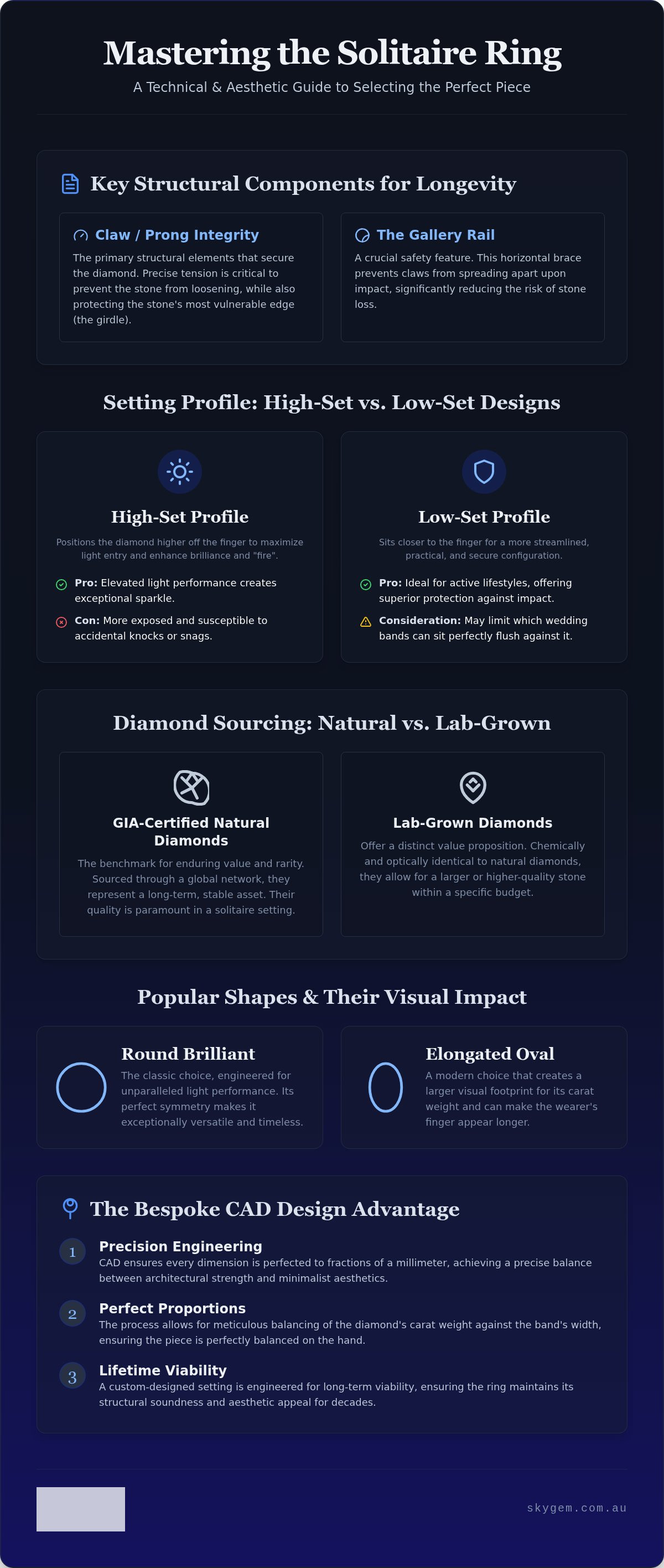
Selecting solitaire engagement rings melbourne involves more than evaluating diamond carats; it requires a deep understanding of the engineering that ensures a stone remains secure for a lifetime. The prongs, or claws, serve as the primary structural components of the ring. They don't just hold the diamond in place; they act as a protective barrier for the stone's girdle, which is its most vulnerable point. A well-engineered setting balances the need for light entry with the physical requirements of stone retention.
A critical safety feature often overlooked in mass-produced jewellery is the gallery rail. This horizontal band of metal encircles the prongs below the girdle, acting as a structural brace. It prevents the prongs from pulling apart or splaying if the ring is accidentally knocked. Without this rail, the risk of stone loss increases significantly. Precision hand-setting is vital here. A master jeweller must apply exact tension to each claw so they sit flush against the diamond's facets, ensuring there are no gaps where fabric could snag and compromise the setting.
The debate between high-set and low-set designs usually centres on the trade-off between brilliance and practicality. High-set rings allow maximum light to enter the pavilion, which can enhance the stone's fire. However, they are more susceptible to impact in active daily life. Low-set designs offer a more streamlined profile and better protection but may limit the types of wedding bands that can sit flush against them. If you're unsure which configuration suits your daily routine, you can book a technical consultation to discuss your specific requirements.
Prong Configurations: 4 vs. 6 Claws
The choice between 4 and 6 claws affects both the ring’s security and its visual geometry. A 4-prong configuration creates a modern, square-like appearance and exposes more of the diamond's surface area to light. In contrast, a 6-prong setting offers superior security by providing more points of contact. It also helps maintain the round silhouette of a brilliant cut stone. The shape of the claw itself—whether it is a delicate round bead, a sharp eagle claw, or a protective V-prong—subtly shifts the ring's aesthetic character from vintage to contemporary.
Structural Integrity and Metal Choice
Metal selection is a performance-based decision. Platinum is highly recommended for solitaires due to its density and "memory." Unlike gold, platinum doesn't wear away over time; the metal merely displaces, making it exceptionally durable for holding a single, heavy stone. 18ct white gold is a harder alternative but requires periodic rhodium plating to maintain its bright finish. We also focus on the "wedding-fit" aspect of the design. This ensures the setting is engineered to allow a wedding band to sit perfectly flush, preventing unnecessary wear between the two rings over the years.
Natural vs. Lab-Grown Diamonds in Solitaire Designs
When evaluating solitaire engagement rings melbourne, the choice between natural and lab-grown diamonds is a primary technical consideration. Optically, physically, and chemically, these two stones are identical. Both consist of pure carbon arranged in a cubic crystal structure, resulting in the same hardness and refractive index. However, because a solitaire setting leaves the diamond completely exposed, the precision of the cut and the clarity of the stone become your most critical performance metrics. There are no peripheral gems to mask light leakage or internal inclusions, so the quality of the centre stone must be absolute.
For both origins, GIA certification acts as the essential regulatory standard. It provides an objective technical audit of the stone's properties, ensuring that the diamond you select meets the specific performance criteria required for a high-tension solitaire setting. Without this documentation, it’s impossible to verify the stone's long-term value or its structural integrity. You can explore our technical data on lab-grown diamonds Australia to understand how these stones perform in minimalist designs.
Sourcing Natural GIA Certified Diamonds
Natural diamonds remain the benchmark for rarity and long-term value retention. These stones represent a finite geological asset, which appeals to clients looking for a piece with historical significance. In a single-stone ring, the 4Cs must be balanced with extreme care. We recommend prioritising the "Cut" grade above all else; an Excellent cut ensures the stone achieves maximum scintillation, which is the defining characteristic of a premium solitaire. You can view our current technical inventory of natural diamonds to see how different clarity and colour grades impact the visual footprint of the ring.
The Rise of Lab-Grown Diamonds
Lab-grown diamonds have emerged as an innovative choice for modern solitaires, particularly for those prioritising scale and budget efficiency. In 2026, market data indicates that lab-grown diamonds can be 60% to 85% cheaper than natural diamonds of the same size and quality. This price stability allows you to achieve a significantly higher carat weight without compromising on the technical specifications of colour or clarity. Beyond the financial advantages, many clients select lab-grown stones for their transparent ethical footprint and lower environmental impact. They offer a practical solution for creating a high-impact, architectural ring that aligns with modern sustainability standards.
Choosing the Right Diamond Shape for a Solitaire Ring
The geometry of the centre stone is the most significant aesthetic variable when commissioning solitaire engagement rings melbourne. While the setting provides the structural foundation, the diamond shape dictates the ring's character and light performance. Round Brilliants remain the technical benchmark for total internal reflection. Facets numbering 58 are precisely engineered to return the maximum amount of light to the observer's eye. Recent market data indicates a significant shift toward elongated shapes; reports from 2025 showed oval cuts rising to 33% of sales while round cuts decreased to 36%. Elongated silhouettes, including the Pear and Marquise, offer a distinctive profile that breaks from traditional symmetry to create a more personalised aesthetic.
Maximising Scintillation and Fire
For a Round Brilliant solitaire, the GIA Cut grade is the most critical performance metric. Triple Excellent ratings are the gold standard, confirming that the stone’s cut, symmetry, and polish all meet the highest technical requirements. Fire and scintillation are the direct results of this precision. Fancy shapes like oval cut natural diamonds require even greater attention to symmetry. Symmetry issues in an oval can lead to the "bow-tie" effect, where a dark shadow appears across the centre of the stone due to light leakage. Selecting a stone with a balanced length-to-width ratio ensures the scintillation pattern remains consistent across the entire surface.
Visual Proportions and Finger Shape
Perceived size is often more important than carat weight alone. Visual footprint refers to how large the diamond appears face-up; elongated shapes often appear larger than round diamonds of the same weight. Budget efficiency is improved when choosing a shape that maximises this surface area. Length-to-width ratios must be matched to the wearer's finger during the technical consultation to ensure a flattering fit. Emerald cut natural diamonds offer a sophisticated, architectural look that emphasises clarity through a "hall-of-mirrors" effect. Clarity is paramount for emerald cut natural diamonds because their large step-cut facets make internal inclusions more visible to the naked eye. This level of technical detail ensures that solitaire engagement rings melbourne remain a permanent asset rather than a fleeting purchase.
The Bespoke Design Process at SkyGem & Co.
Commissioning solitaire engagement rings melbourne at SkyGem & Co. is treated as a high-precision engineering project rather than a simple retail transaction. Our process begins with a technical consultation where we translate your aesthetic vision into measurable design parameters. We define clear objectives regarding budget, metal choice, and stone performance. Leveraging an extensive global network, we source specific GIA-certified diamonds or gemstones that meet these rigorous standards. This ensures every project starts with a foundation of verified quality and transparency, removing the guesswork often found in traditional jewellery shopping.
From Concept to CAD
The transition from a conceptual sketch to a physical piece involves advanced Computer-Aided Design (CAD). This technology allows for the structural perfection required in a minimalist solitaire. The advantage of custom made engagement rings lies in the ability to adjust prong heights and band widths to the nearest tenth of a millimetre. You aren't limited by the generic proportions of off-the-shelf settings. Instead, you can visualise the ring through detailed digital renders, ensuring the balance between the centre stone and the band is exactly as intended before the metal is cast. This phase is vital for verifying that the design meets your lifestyle requirements and aesthetic goals.
Quality Assurance and Final Setting
Once the casting is complete, the ring undergoes a meticulous hand-finishing process. Our master jewellers refine the metal surface to a mirror finish, preparing it for the final stone setting. This is a critical stage where the centre stone is levelled and secured within its claws. We apply consistent tension to each prong to guarantee long-term stability, a step that mass-produced rings often rush. A perfectly level stone is essential for the light performance discussed in previous sections, as even a slight tilt can disrupt the scintillation pattern of a high-quality diamond.
Every bespoke piece must pass a rigorous internal inspection before it leaves our Royal Arcade boutique. We verify that the finished ring matches the CAD specifications exactly and that the stone's girdle is adequately protected. To conclude the partnership, we provide a full documentation package. This includes the original GIA certification and professional valuation documents, reinforcing the idea that your solitaire is a permanent and evolving asset. This methodical approach ensures your ring remains structurally sound and aesthetically brilliant for decades, reflecting the precision required in large-scale technical design.
Securing Your Legacy with Technical Precision
Selecting the right solitaire engagement rings melbourne is a decision that balances technical performance with aesthetic longevity. Throughout this guide, we've explored how the intersection of GIA-certified diamond selection and architectural setting integrity creates a piece that endures for generations. Whether you prioritise the geological rarity of a natural stone or the innovative scale of a lab-grown diamond, the structural security of the final piece depends entirely on the precision of its engineering and hand-finishing.
At our boutique in the historic Royal Arcade, we act as your technical consultant. We utilise bespoke CAD design to ensure every claw and gallery rail is positioned for maximum durability and light return. This methodical approach transforms a simple retail purchase into a long-term partnership focused on the technical success of your project. We're here to provide the expertise required to navigate these complex specifications with quiet confidence.
We look forward to helping you engineer a piece that remains a permanent and evolving asset in your personal collection.
Frequently Asked Questions
What is a solitaire engagement ring?
A solitaire is a ring featuring a single, central gemstone mounted on a precious metal band. It is a design that prioritises the performance and technical properties of the primary stone without the distraction of peripheral gems. This configuration allows for maximum light entry from all angles, making it the preferred choice for showcasing high-quality GIA-certified diamonds or rare gemstones that require absolute visual focus.
Why are solitaire rings so popular in Australia?
Solitaire rings are favoured nationally for their architectural simplicity and enduring aesthetic appeal. The design represents a purity that remains immune to transient fashion trends, making it a reliable long-term asset. This popularity is also driven by the style's versatility; a solitaire serves as a neutral foundation that can be easily paired with various diamond wedding bands to create a more complex, layered set as a couple's story evolves.
Is a 4-prong or 6-prong setting better for a solitaire?
The choice depends on your priority between light performance and structural security. A 4-prong setting creates a modern silhouette and exposes more of the diamond's surface area to light. Conversely, a 6-prong setting provides superior protection for the stone's girdle, which is its most vulnerable point. When commissioning solitaire engagement rings melbourne, we often recommend 6-prong configurations for larger stones to ensure the centre gem remains perfectly level and secure for decades.
How much should I spend on a solitaire diamond ring?
Your investment should be based on your specific budget and the technical performance you require from the centre stone. Because the solitaire design leaves the diamond completely exposed, it is advisable to prioritise cut quality and clarity over sheer carat weight. We provide expert consultations to help you navigate the 4Cs, ensuring you select a stone that balances price integrity with the visual brilliance required for a single-stone setting without overextending your resources.
Can I use a lab-grown diamond in a solitaire setting?
Lab-grown diamonds are an innovative and technically identical alternative to natural diamonds for any solitaire design. They share the same carbon structure, hardness, and refractive index as stones formed in the earth. Using a lab-grown stone often allows you to achieve a higher carat weight or superior clarity within a set budget. This makes them a practical choice for high-impact, minimalist rings that require a significant central stone to maintain their architectural integrity.
Which diamond shape makes a solitaire look the largest?
Elongated diamond shapes, such as oval, pear, and marquise cuts, typically offer a larger visual footprint than round brilliants of the same carat weight. This face-up size comparison is a key consideration for clients looking to maximise the impact of their ring. These shapes create a lengthening effect on the finger and provide a significant aesthetic presence while maintaining the clean, focused lines of a traditional solitaire engagement rings melbourne project.
How do I care for my solitaire engagement ring?
Ongoing maintenance is essential for the long-term viability of your ring. We recommend a professional inspection every twelve months to check the tension of the prongs and ensure the centre stone hasn't become loose. For daily care, cleaning the ring with a soft brush and mild soapy water will remove oils that can dull the stone's scintillation. This routine prevents the accumulation of debris that can compromise the setting's structural integrity and aesthetic appeal.
Do solitaire rings work with all wedding bands?
Solitaire rings are highly adaptable, but the setting height dictates which wedding bands will sit flush. A wedding-fit design is specifically engineered to allow a straight band to sit perfectly against the engagement ring without a gap. Low-set solitaires may require a contoured or shadow band to accommodate the basket. Our bespoke CAD process allows us to adjust these parameters to the nearest tenth of a millimetre to ensure a seamless, professional fit.
Disclaimer
This article is for general informational purposes only and may include AI-assisted content. Pricing, specifications, and availability are subject to change. For accurate advice and current information, please contact SkyGem & Co. directly. Nothing in this content constitutes professional or financial advice.