
Signs Your Partner Is Ready for a Proposal

What if the clearest sign isn’t a sudden change in your partner’s behaviour, but a pattern in the conversations you’re already having? It’s natural to wonder whether signs your partner is ready for a proposal are meaningful or simply part of growing closer. A thoughtful question about your future may feel significant, but it isn’t proof that a proposal is planned.
Shared commitment and proposal preparation are related, but they’re not the same. Look for consistent signs that you’re aligned on a life together while staying open-minded about when, or whether, a proposal may happen. This distinction can help you feel prepared without turning everyday moments into a test.
This article explains how to recognise meaningful patterns without treating them as guarantees, what clues may suggest proposal planning, and how to talk comfortably about the future and ring preferences. If your partner is actively planning, sharing what you like can offer useful direction without requiring you to uncover a surprise. The aim is clarity and connection, not certainty from clues alone.
Key Takeaways
- Look for recurring changes connected to shared plans rather than treating one behaviour as confirmation.
- The signs your partner is ready for a proposal may include ring questions, conversations with trusted people, or unusual plans, but none can confirm timing.
- Notice whether future conversations are mutual and specific, rather than based on vague or one-sided assumptions.
- Consider the context around possible clues, and avoid assigning them a proposal date.
- Share your comfort level and ring preferences openly, without needing to dictate how or when a proposal happens.
Signs Your Partner May Be Considering a Proposal: Start With Patterns
It’s understandable to look for meaning in a partner’s questions or changes in routine when you’re thinking about the future. But no single behaviour confirms that a proposal is coming. A more useful indicator is a recurring change connected to shared plans or engagement, especially if it differs from how your partner usually communicates.
There’s a difference between discussing a relationship milestone and making a proposal plan. A conversation about marriage may show that your partner is comfortable considering a shared future. More specific preparation, such as asking about ring preferences or involving someone close to you, may suggest they’re taking practical steps. Neither guarantees that a proposal is imminent.
When a change in behaviour may be meaningful
Look for repeated conversations about commitment, marriage or building a life together, rather than giving one comment too much weight. Consider whether your partner follows up and makes room for your perspective. A change is more informative when you compare it with their usual communication style, not with a universal checklist. Context can help you notice what’s different without assuming you know why.
For example, a partner who rarely discusses long-term plans but starts asking how you imagine married life may be signalling growing interest in the topic. That’s meaningful as a conversation, but it doesn’t reveal a proposal date or confirm that a plan is underway.
Why one clue cannot predict a proposal
A trip might be a holiday, a private conversation could be about something unrelated, and an unusual question may have a practical explanation. Even familiar traditional proposal elements can shape expectations without showing how any particular couple will approach the decision. Treat these moments as prompts to consider the broader relationship, not as evidence in a countdown.
Patterns matter more than isolated surprises: repeated, mutual conversations can show shared direction, while a single clue can’t establish intent or timing.
This is why the signs your partner is ready for a proposal are best read with care. Notice whether commitment comes up consistently, whether both of you contribute to future plans, and whether the change makes sense in context. Avoid turning a surprise dinner, a weekend away or a passing question into a promise. Uncertainty about a proposal doesn’t mean your relationship lacks commitment. Couples can feel secure together while having different timelines or communication styles. If you need clarity about the future, an open conversation is more reliable than trying to decode one moment.
Shared-Future Conversations: Signs of Relationship Readiness
Talking comfortably about marriage or long-term plans can indicate that both partners are willing to consider a shared future. That matters, but it doesn’t tell you whether a proposal is planned or when one might happen. Relationship readiness is about mutual openness to commitment, not a guaranteed date or hidden schedule.
Being ready to build a life together is not the same as having planned a proposal. Keeping these ideas separate helps you assess the relationship on its own terms, rather than treating every future-oriented conversation as evidence of an imminent engagement. Research exploring the concept of commitment readiness offers context for thinking about readiness as more than a proposal clue.
Future plans that include both partners
Notice whether conversations about priorities and decisions make space for both people. You might discuss where you’d like to live, how you’d approach a major change, or what you each want from the years ahead. The key isn’t agreeing on every detail; it’s whether each partner contributes and listens. A single romantic comment can feel reassuring, but a pattern of mutual participation gives a clearer picture of how you approach a shared future.
Plans don’t need to follow a prescribed sequence. Couples make decisions at different paces, and readiness can’t be measured against someone else’s timeline. Pay attention to whether you can talk openly and return to the subject over time, rather than trying to infer a proposal date from one conversation.
How difficult moments can inform readiness
Readiness can also show in how you handle differences. Disagreements are part of many relationships; what may be more revealing is whether you can discuss an issue respectfully, hear each other’s concerns and work towards a solution together. This offers context about your partnership, not a pass-or-fail test for marriage. A healthy relationship doesn’t need to be conflict-free.
Consider whether challenging conversations lead to greater understanding or remain unresolved because one person’s perspective is repeatedly dismissed. No single disagreement can define a relationship, and no couple handles every issue perfectly. Look at the broader pattern of respect, repair and shared problem-solving.
The signs your partner is ready for a proposal can be difficult to distinguish from signs that they feel secure discussing commitment. That overlap is normal. If your conversations are open, mutual and consistent, you can recognise meaningful relationship readiness without assuming proposal logistics are already underway. If your expectations differ, a calm discussion about what commitment means to each of you can create clarity without demanding a particular outcome or timeline.
Proposal-Planning Clues: Ring Questions, Trusted People, and Surprises
Some clues relate less to emotional readiness and more to practical preparation. A partner may ask about rings, consult people who know you well, or make plans that seem out of character. These behaviours can suggest they’re organising a surprise, but they can also have other explanations. Treat them as possibilities, not proof or a reliable countdown.
Consider the purpose and context of a question or change rather than trying to assemble a checklist. Your partner might be gathering information quietly because they want to choose thoughtfully, or they may simply be curious about your preferences. Either way, sharing what matters to you can be useful without assuming a ring has already been selected.
Questions about rings and personal preferences
Questions about jewellery you like, stone choices, ring styles or everyday comfort may be relevant if they come up alongside broader conversations about commitment. They could help your partner understand what you’d enjoy wearing, including your preferences for fit, practicality or appearance. You can answer naturally, for example, by mentioning whether you favour a simple look or a particular gemstone, without pressing for a reason.
If you’d like to put your preferences into words, explore different engagement ring styles for ideas. That can be useful whether or not a proposal is being planned. A ring-related question alone doesn’t establish that a purchase has been made or that a proposal is close.
Changes in plans or conversations with trusted people
Your partner might seek input from a friend, relative or another trusted person who understands your tastes. You could notice someone close to you asking about your preferences, or your partner being less forthcoming about a plan they’d usually discuss. Those details may fit with a surprise, but they aren’t conclusive. People also ask others for advice about celebrations, gifts and ordinary decisions.
Unusual plans deserve the same careful interpretation. A private outing, changed arrangements or a trip could be connected to a proposal, but each has many possible explanations. Secrecy, spending changes and travel aren’t dependable evidence on their own, so don’t treat them as signs of a set timeline.
In short, the signs your partner is ready for a proposal may include practical preparation, but clues are useful only when considered alongside the relationship and circumstances. You don’t need to investigate or test your partner to make sense of them. Share ring preferences as part of an open conversation about what you like, not as a way to force certainty about what may happen next.
How to Read the Signs Without Creating Pressure or False Certainty
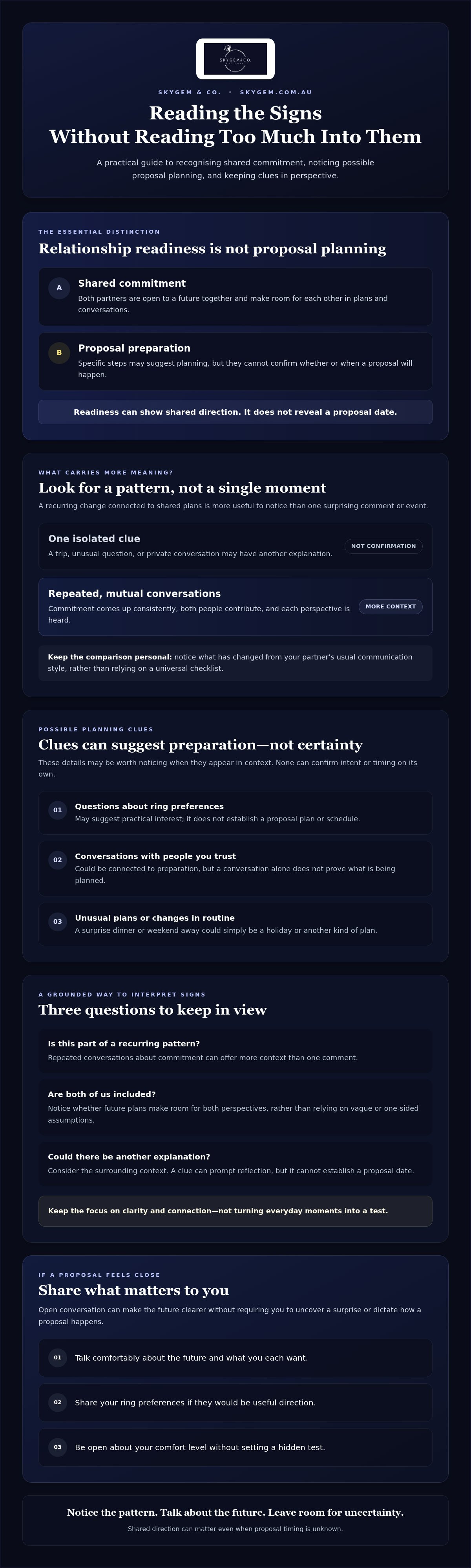
Even several suggestive moments can’t confirm that a proposal is planned. To keep your interpretation grounded, follow a simple sequence: notice whether a behaviour repeats, consider what else might explain it, then resist assigning it a date. This lets you acknowledge possible preparation without turning ordinary plans or conversations into a countdown.
Direct communication is more reliable than decoding hints. If uncertainty is affecting important decisions, such as whether you’re aligned on marriage or your next steps together, it’s reasonable to talk about shared intentions. You can seek clarity about the relationship without asking your partner to reveal a surprise or promise a particular timeline.
A low-pressure way to talk about the future
Choose a calm moment and use open-ended prompts that invite both perspectives. You might ask, “How do you picture commitment in our future?” or “What would you want us to consider before taking a next step?” Then share your own hopes and listen to theirs. The aim isn’t to secure reassurance or test your partner’s answer. It’s to understand how each of you feels and whether you can discuss your expectations honestly.
Give the conversation room to develop. Your partner may need time to think, and you may discover that you have different assumptions about what marriage means or when you’d feel ready. That information can be useful even if it doesn’t resolve the question of a proposal immediately.
Keeping a possible surprise intact
You can share broad preferences without asking your partner to disclose their plans. Mention whether you like wearing jewellery every day, what styles appeal to you or whether you have gemstone preferences. This can help someone plan thoughtfully without asking them to propose. Keep the conversation focused on what feels comfortable and meaningful to you, while leaving the timing and format open.
If you’re actively planning a proposal, consider discussing ring preferences in a way that respects your partner’s comfort and leaves room for their choice. A jewellery consultation can also be an optional resource if you’re already exploring ring possibilities. Neither a preferences conversation nor a consultation confirms that a proposal is imminent.
Try not to monitor every change for evidence. Constant clue-checking can make ambiguous details feel more certain than they are and draw attention away from how the relationship works day to day. The signs your partner is ready for a proposal can suggest preparation, but they can’t confirm a proposal or its timing. Focus on shared understanding first, and let any surprise remain a surprise if that’s what you both want.
If a Proposal Feels Close: Share Preferences and Choose Your Next Step
Possible clues can leave you wondering what to do next. You don’t need to confirm a proposal is coming before talking about what matters to you. The right next step depends on your role: if you’re hoping to receive a proposal, share preferences without asking for a particular moment; if you’re planning to propose, start with your partner’s comfort and priorities.
If you may be receiving a proposal
Bring up ring preferences naturally, perhaps while discussing jewellery or personal style. You could mention whether you’d enjoy wearing a ring every day, which shapes or settings appeal to you, or whether you’re drawn to a diamond or a coloured gemstone. This gives your partner helpful information if they’re planning, while leaving them free to choose how and when to act. You don’t need to buy a ring, investigate your partner’s intentions or make assumptions to be prepared.
If you are planning to propose
Use what you know about your partner’s preferences, lifestyle and comfort to guide your decisions. Think about whether they’ve expressed a preference for a private or more social moment, and whether a ring should suit their everyday routines. Consider your budget as part of planning, without treating a particular price or style as a measure of commitment.
If a custom ring feels right, a consultation can be an optional way to discuss preferences and bespoke engagement-ring design. Sharing details such as preferred style, diamond or gemstone choices, and practical considerations can help inform the design. Keep the process centred on your partner rather than matching a trend or creating a particular kind of proposal.
Whether you’re waiting or preparing, ring preferences are useful information, not proof of timing. The signs your partner is ready for a proposal can prompt a thoughtful conversation, but your next step can simply be to share what you value and listen to what matters to them. A jewellery consultation is another option if you’re actively exploring a bespoke engagement ring.
Choose Clarity Over Clues
The signs your partner is ready for a proposal are best understood as possibilities, not promises. Repeated, mutual conversations can show that you’re aligned on commitment, while questions about rings or unusual plans may hint at preparation without confirming a proposal or its timing. If uncertainty affects an important decision, an honest conversation about your shared future is more dependable than decoding every gesture.
If you’re planning a proposal, sharing preferences can help you make a thoughtful choice while preserving the meaning of the moment. SkyGem & Co. offers bespoke engagement-ring design and manufacturing, with natural GIA-certified and lab-grown diamond options. Consultations are tailored to individual preferences and budget, offering a considered way to explore ring possibilities.
Whether you’re waiting, planning or simply talking about what comes next, you can move forward at a pace that feels right for both of you.
Frequently Asked Questions
What are the most common signs your partner may be considering a proposal?
Recurring conversations about marriage, shared plans that include both partners, questions about ring preferences and discreet conversations with people close to you may suggest your partner is preparing. A change in plans or extra privacy could also have other explanations. Look for a pattern that fits your relationship rather than relying on one moment. Even several clues can’t confirm that a proposal is coming or indicate when it might happen.
Does talking about marriage mean my partner is ready to propose?
No, talking about marriage doesn’t necessarily mean your partner is ready to propose. It can show they’re willing to discuss commitment, explore what a shared future could look like or understand your expectations. Notice whether the conversation feels mutual and whether both of you can speak honestly about hopes and concerns. A discussion about marriage is valuable in its own right, but it doesn’t confirm that a proposal plan exists.
Can asking about my ring preferences mean a proposal is coming?
It can be a clue, but a question about rings doesn’t prove a proposal is planned. Your partner might be trying to understand what jewellery you enjoy, how comfortable you are wearing a ring or which gemstones appeal to you. They could also be asking out of general curiosity. Share your preferences if you want, but avoid assuming a ring has been chosen or that a proposal is close.
How can I tell if my partner is ready for marriage, not just planning a surprise?
Look beyond proposal logistics and consider how you both approach commitment. Can you discuss expectations, make important decisions together and address disagreements respectfully? Those patterns offer context about relationship readiness, though no checklist can determine it for every couple. Surprise planning concerns the details of a possible event; readiness involves whether both partners feel comfortable discussing a shared future and what commitment means to them.
What if I notice signs but my partner has not mentioned marriage?
Don’t treat clues as a substitute for a conversation about your future. Your partner may have several reasons for a change in behaviour, and they may not be thinking about a proposal at all. If marriage matters to you, raise the broader topic in a calm, open way. Asking what each of you hopes for can create clarity without requiring your partner to disclose a surprise or commit to a timeline.
Should I ask my partner directly if they are planning to propose?
You can ask, but first consider whether you need certainty about a surprise or clarity about your shared intentions. If the future feels unclear, talk about marriage and what each of you wants rather than testing your partner for a proposal date. Open-ended questions make room for both perspectives. If you’d prefer to preserve a possible surprise, discuss commitment without asking whether a proposal is already planned.
How can I share engagement ring preferences without spoiling a proposal?
Share broad preferences as part of an ordinary conversation about personal style, comfort or jewellery you enjoy. You might mention whether you prefer a simple or more detailed design, or whether you’re drawn to diamonds or coloured gemstones. You don’t need to ask whether your partner is planning a proposal. Sharing what you like gives them useful context while leaving the timing and details of any surprise in their hands.