
Questions to Ask Before Commissioning a Bespoke Ring: The Essential Checklist

A breathtaking digital render of a custom ring means absolutely nothing if the physical piece cannot survive the structural rigours of daily wear. True bespoke ring design requires a rigorous technical consultation, not merely aesthetic order-taking. When you begin evaluating production partners, knowing the precise technical questions to ask before commissioning a bespoke ring will protect your investment from structural vulnerabilities and unforeseen manufacturing delays.
It's common to feel anxious about hidden costs, extended timelines, or the complexities of gemstone certification, especially given the recent updates to GIA grading standards. You deserve absolute transparency from initial CAD design to final stone setting. This guide outlines the critical technical, material, and structural questions to ask a jeweller before commissioning your custom ring. By applying this objective framework, you will gain the confidence to verify metal purities, evaluate certified gemstones, and establish a seamless design-to-manufacturing experience that ensures the long-term viability of your piece.
Key Takeaways
- Approach your commission as a technical partnership rather than a retail transaction to ensure the final design meets rigorous engineering standards.
- Insist on independent gemmological certification for lab-grown or natural diamonds to confirm you're receiving the exact specifications you've paid for.
- Identify the critical questions to ask before commissioning a bespoke ring to evaluate a maker's proficiency with CAD design and master craftsmanship.
- Define clear project milestones and warranty terms to prevent delays and ensure your piece remains a durable, long-term asset.
Understanding the Bespoke Ring Process: Why the Right Questions Matter
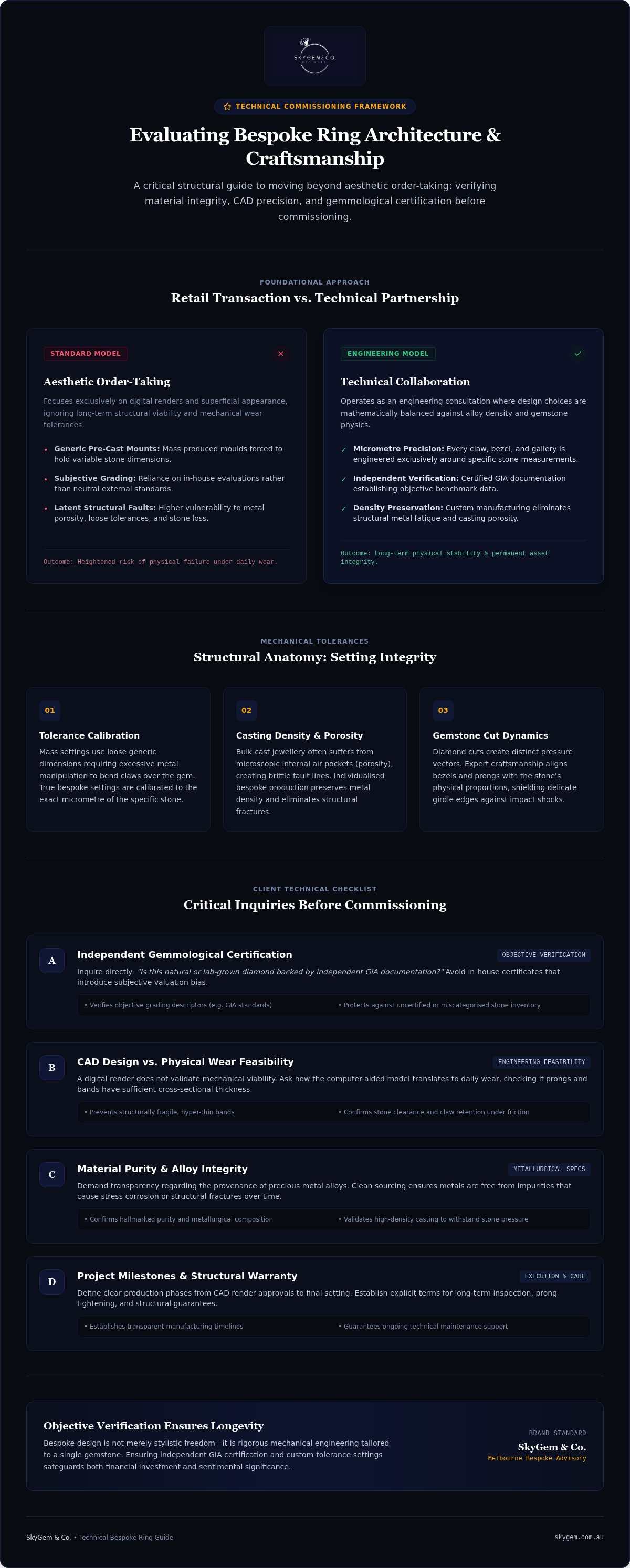
Commissioning a bespoke ring is far more than a standard retail transaction; it is a high-level technical collaboration. While the visual appeal of a design often captures initial attention, the long-term success of the project relies on structural engineering and material precision. Approaching this process as a technical project ensures that your aesthetic desires don't compromise the physical integrity of the piece. Identifying the right questions to ask before commissioning a bespoke ring acts as a safeguard, protecting both your financial investment and the emotional weight of the commission.
Vetting an artisan based on their technical proficiency prevents common failures such as stone loss, metal fatigue, or porous castings. A professional jeweller should act as a technical consultant, balancing the delicate proportions of a design with the rigours of daily wear. This partnership requires a shared understanding of performance metrics, where every design choice is justified by its contribution to the ring's longevity and stability.
Defining Bespoke vs. Mass-Produced Settings
The structural differences between a truly bespoke setting and a mass-produced cast are significant. Mass-produced rings are typically created from generic moulds designed to fit a range of stone sizes, often resulting in "loose" tolerances that require excessive metal manipulation to secure the gem. In contrast, bespoke craftsmanship focuses on creating a setting that respects the individual proportions and unique geometry of a specific stone. This precision is best explored through a bespoke engagement rings guide, which details how individualised manufacturing eliminates the vulnerabilities found in bulk-cast jewellery.
Bespoke craftsmanship ensures that every claw and bezel is engineered to the exact micrometre of your specific gemstone's dimensions. By building the ring around the stone rather than forcing a stone into a pre-made setting, the jeweller maintains the metal's structural density and reduces the risk of future fractures.
Establishing a Technical Partnership with Your Jeweller
A seasoned jeweller should function as a consultant rather than a simple order-taker. This distinction is vital when navigating complex material choices and setting styles. You need a partner who understands the physical properties of precious metals and the physics of gemstone durability. For instance, they should be able to explain how the grading standards of the Gemological Institute of America (GIA) influence the setting requirements for specific diamond cuts.
Transparent communication during the vetting phase sets the tone for the entire manufacturing lifecycle. When you ask technical questions, you're testing the jeweller's ability to provide data-driven solutions. Professionals who prioritise long-term viability will be honest about whether a specific design is structurally sound or if it requires modification to survive decades of use. This level of transparency ensures that the final product is not only beautiful but remains a permanent and stable asset.
Essential Questions Regarding Material Integrity and Stone Certification
Selecting the physical components of a custom setting requires strict adherence to technical standards rather than pure aesthetic preference. Verifying material integrity and stone certification ensures your piece withstands daily environmental stressors while retaining its intrinsic value. When compiling your engineering criteria, the specific questions to ask before commissioning a bespoke ring must focus heavily on independent gemmological verification and the physical properties of your chosen alloys.
Vetting the provenance and ethical sourcing pipelines of a jeweller's inventory establishes a benchmark for quality. Transparent supply chains yield higher-grade raw materials, ensuring that your metals and gemstones are free from structural defects that could compromise the manufacturing process down the line.
Verifying Diamond and Gemstone Authenticity
A critical inquiry to present to your jeweller is: "Is this diamond accompanied by an independent GIA certification?" Relying on in-house grading introduces subjective bias, whereas independent laboratories provide an objective structural analysis. For those comparing natural diamonds with lab-grown diamonds, technical grading metrics differ significantly. Following recent regulatory updates, the GIA utilizes broader descriptors like "Premium" or "Standard" for newly submitted lab-grown stones rather than the traditional 4Cs scale applied to natural diamonds. Reviewing GIA's educational resources can help you understand these distinct reporting frameworks. When sourcing coloured stones like Australian sapphires, rubies, or emeralds, ask for origin reports and clarity enhancement disclosures to verify that the gemstone's structural stability hasn't been compromised by unstable treatments.
Assessing Precious Metal Composition and Durability
Metal selection directly dictates the lifespan of your setting, prompting the question: "What are the performance differences between platinum and 18ct gold for this setting?" Platinum offers superior density and a highly secure hold for delicate prongs due to its malleable nature, which displaces metal rather than losing it during abrasive contact. Conversely, 18ct gold is harder but more brittle, making it highly resistant to scratching but prone to microscopic metal loss over time. Understanding these physical properties helps you anticipate long-term maintenance requirements, such as the periodic rhodium plating needed to maintain the bright finish of white gold, compared to the natural patination of platinum. To evaluate how these metallurgical properties align with your specific lifestyle and design goals, you can consult an expert through our technical design booking portal to finalise your material specifications.
Questions to Clarify Design Precision and Manufacturing Techniques
The transition from a conceptual brief to a physical asset requires a methodical manufacturing workflow. Precision engineering bridges the gap between a conceptual sketch and a structurally sound piece of fine jewellery. When evaluating a maker's technical capability, the questions to ask before commissioning a bespoke ring should focus on the specific tools and milestones used to ensure micro-precision. A professional jeweller will utilize modern technology to eliminate the human error often associated with traditional hand-carved waxes, ensuring that every component aligns with mathematical accuracy.
A transparent manufacturing process includes specific review milestones designed to protect the integrity of the project. You should expect to approve the digital model and, in some cases, a physical prototype before the final casting occurs. This iterative approach allows for the adjustment of fine details, such as claw thickness or gallery height, before precious metals are committed to the design.
Evaluating CAD Modelling and Visualisation Steps
Modern Computer-Aided Design (CAD) is essential for achieving flawless proportions, particularly for complex configurations. Ask your jeweller: "Do you provide detailed 3D CAD renderings before casting the metal?" This technology allows you to visualize the ring from every angle, ensuring that the symmetry is perfect and the stone sits at the optimal depth. Our engagement rings collection demonstrates how CAD integration facilitates a wide range of design diversities while maintaining consistent structural standards across every piece.
CAD is especially critical when working with unique stone shapes like ovals or emerald cuts. These elongated geometries require precise support structures to prevent structural vulnerabilities. Digital modelling allows the jeweller to calculate the exact volume of metal required to secure the stone without overshadowing its aesthetic brilliance.
Understanding Stone Setting and Structural Security
The choice of setting technique is a functional decision that dictates the ring's long-term durability. You must ask: "Which setting technique best protects this specific gemstone shape?" While traditional claws maximize light entry and brilliance, they may not be the ideal choice for stones with lower hardness ratings. The setting design must account for the gemstone's specific position on the Mohs scale to prevent chipping or abrasion.
- Bezel Settings: Provide a continuous metal rim that offers maximum protection for the gemstone's girdle, ideal for active lifestyles.
- Claw Settings: Use minimal metal to allow for high light refraction, though they require periodic checking to ensure the prongs remain secure.
- Channel Settings: Protect smaller accent stones by nesting them between two parallel walls of metal, reducing the risk of snagging.
By aligning the setting technique with the physical properties of the stone, the jeweller ensures the piece remains a stable, lifelong asset. This technical alignment is the cornerstone of a successful bespoke commission.
Checklist for Project Timelines, Warranties, and Long-Term Maintenance
Establishing a realistic roadmap for a custom project is essential to maintain high craftsmanship standards. Rushing a complex build often leads to compromised structural integrity. When vetting a jeweller, the questions to ask before commissioning a bespoke ring should extend into the logistical and post-production phases. A professional artisan will provide a detailed breakdown that accounts for every technical stage; this includes stone procurement, CAD design approval, casting, setting, and final hand-polishing.
Confirming these details early protects your emotional commitment and ensures the final piece is a durable asset. Transparency regarding lead times and maintenance requirements is a hallmark of a reliable technical partner.
Managing Expectations Around Craftsmanship Timelines
Ask: "What is the precise end-to-end lead time for this bespoke commission?" Stone procurement for specific Australian sapphires or GIA certified diamonds can take several days to weeks depending on rarity. Once the CAD model is approved, the casting and setting phases require meticulous attention. Rushing the final setting phase is particularly dangerous. It can result in improper prong alignment or insufficient metal overlap on the stone, which jeopardises the security of the gem. A rushed polish can also thin the band excessively, reducing its resistance to daily abrasive wear.
Clarifying Post-Purchase Support and Resizing Policies
Ask: "What structural warranty covers the setting against manufacturing defects?" A technical consultant should offer a warranty that specifically covers structural components. Routine servicing is a prerequisite for long-term viability. We recommend a professional prong inspection and ultrasonic cleaning every six to twelve months to identify microscopic wear before it becomes a failure point. Identifying a loose stone early is far more cost-effective than replacing a lost gem.
Additionally, clarify the physical limitations of future resizing. Intricate designs, such as full pavé bands or specific trilogy configurations, have limited mechanical flexibility. Altering the ring's circumference can stress the settings of side stones, potentially requiring a complete remake if the size change is significant. Understanding these limitations before the metal is cast prevents future frustration.
Commissioning Your Custom Piece with SkyGem & Co.
Choosing a manufacturing partner requires shifting focus from standard retail buying to a rigorous technical evaluation. SkyGem & Co. operates as your dedicated technical design consultant, ensuring that your bespoke fine jewellery project adheres to strict engineering standards. We eliminate the guesswork from custom manufacturing by replacing ambiguous sales pitches with clear precision metrics and transparent workflows. When compiling your checklist of questions to ask before commissioning a bespoke ring, our team provides data-backed answers that guarantee structural integrity and long-term viability.
Our Transparent Consultation and Design Framework
Our end-to-end design methodology bridges the gap between advanced digital imaging and traditional master goldsmithing techniques. The production lifecycle begins with loose stone selection, where we evaluate individual geometric proportions under magnification to ensure optimal light performance. Next, we utilize high-resolution CAD modelling to create an exact digital twin of your ring before any precious metal is cast. This digital phase allows us to verify structural tolerances, calculate precise metal volumes, and ensure absolute symmetry for classic Solitaire, Halo, or Trilogy configurations. Following your digital approval, the piece transitions to casting and master hand-finishing, where our goldsmiths refine the metal density and hand-set each stone to eliminate structural vulnerabilities. Technical education forms the core of our framework, helping you balance gemstone physics against your specific investment parameters. For a deeper look into how our technical workflows protect your asset, explore our comprehensive engagement rings guide.
Sourcing Premium Materials for Lasting Value
Long-term durability depends entirely on the physical properties of the raw materials selected for your setting. SkyGem & Co. provides direct access to a strictly vetted global inventory of natural GIA certified diamonds and premium lab-grown diamonds. For those seeking distinctive colour profiles, our specialists source exceptional coloured gemstones, including Australian sapphires, teal sapphires, and unheated rubies that exhibit superior crystal clarity. We focus on physical density and precise alloy composition to craft pieces designed for multi-generational durability and permanent aesthetic relevance. Every claw, bezel, and band is engineered to withstand daily wear while protecting your gemstone investment. Ready to begin your project? Schedule your custom design consultation with our team.
Engineering Your Legacy: The Path to a Structural Masterpiece
Establishing a clear framework of questions to ask before commissioning a bespoke ring transforms a complex procurement process into a controlled technical project. You now possess the objective criteria needed to evaluate gemstone certifications, metallurgical performance, and the precision of digital design workflows. These rigorous checks ensure your custom piece isn't just visually striking but remains a structurally sound asset for decades.
As an independent family-owned boutique, SkyGem & Co. prioritises technical transparency over aggressive sales tactics. We integrate advanced end-to-end CAD design with master stone setting to provide a reliable, consultation-led experience. By focusing on GIA certified diamonds and premium coloured gemstones, we guarantee that every design decision contributes to the permanent stability and lasting value of your ring.
We look forward to partnering with you to bring your unique vision to life with engineering excellence.
Frequently Asked Questions
How long does the bespoke ring commissioning process typically take?
The manufacturing process generally requires four to eight weeks from final design approval to completion. This timeline accounts for precise technical phases including raw material procurement, CAD adjustments, casting, and master stone setting. Sourcing exceptionally rare coloured gemstones or specific natural diamonds can extend this timeframe. Establishing clear milestones early helps prevent compressed production schedules that could jeopardize the structural integrity of your piece.
Can I bring my own gemstone or heirloom diamond for a bespoke setting?
We evaluate heirloom diamonds and client-provided gemstones on a case-by-case basis to verify their structural suitability. Our technical team must inspect the stone under magnification to check for existing micro-fractures along the girdle before casting a new setting. This protective assessment ensures the gem can safely withstand the mechanical pressures applied during the master stone setting process without chipping.
What is the difference between a custom ring and a bespoke ring?
Custom rings often modify an existing pre-made commercial mould, whereas a bespoke ring is engineered entirely from scratch around a specific stone's unique geometry. Identifying the right questions to ask before commissioning a bespoke ring helps clarify this distinction with your manufacturer. True bespoke production utilizes individualised CAD modelling and hand-finishing to eliminate the loose tolerances and structural vulnerabilities inherent in mass-produced casts.
How do I ensure the custom ring design will fit perfectly?
We utilize physical sizing bands alongside digital CAD calculations to establish an accurate circumference before manufacturing begins. The width and thickness of the final band affect how it sits on the finger, meaning a wider cigar band requires different sizing metrics than a minimalist solitaire. Verifying these dimensional properties during your initial consultation prevents the need for invasive structural alterations after casting.
Do bespoke rings come with an independent grading certificate?
All our central natural diamonds feature independent GIA certification, and our lab-grown diamonds are accompanied by reputable laboratory reports. Coloured gemstones, including our Australian sapphires, rubies, and emeralds, receive independent gemmological origin and treatment disclosures. We do not rely on subjective in-house grading, ensuring you receive completely transparent, third-party verification of your stone's physical attributes.
What happens if the final bespoke ring design needs to be resized?
Minor sizing adjustments can typically be executed in our workshop, depending on the specific setting configuration. Intricate designs like full pavé wedding bands or complex trilogy engagement rings have strict physical limitations because altering the curve can compromise prong alignment. Understanding these structural constraints is one of the essential questions to ask before commissioning a bespoke ring to ensure long-term viability.
How should I maintain a bespoke engagement ring over time?
Professional maintenance involves a structural prong inspection and ultrasonic cleaning every six to twelve months to ensure the settings remain secure. Daily abrasive wear can naturally displace metal over time, especially on finer claws or white gold bands requiring periodic rhodium plating. Catching microscopic movement early through routine servicing prevents stone loss and preserves the engineering integrity of your custom piece.