
Pros and Cons of Buying a Diamond Online: The 2026 Expert Guide

Did you know that by mid-2026, lab-grown diamonds account for approximately 61 percent of engagement ring center stones, yet many buyers still struggle to distinguish a high-performance asset from a "dead" stone on a digital display? When you evaluate the pros and cons of buying a diamond online, you aren't just comparing retail prices; you're managing a technical procurement process that requires precision. It's natural to feel anxious about whether a GIA-certified stone will exhibit the fire you expect or if you're falling into a "certificate trap" where the grading report masks poor light performance.
We agree that the digital marketplace offers unparalleled access to global inventory, but this efficiency shouldn't compromise the security of your investment. This guide provides a technical framework to help you secure a high-quality, ethically sourced diamond at a competitive price while maintaining boutique-level standards. We'll examine how to balance online selection with the expert vetting necessary to verify stone integrity and provenance in the current regulatory environment.
Key Takeaways
- Understand the 2026 digital landscape where global virtual vaults offer transparency but require a technical framework to filter for light performance.
- Identify the "certificate trap" by learning why two stones with identical GIA grades can exhibit vastly different levels of lustre and visual fire.
- Evaluate the pros and cons of buying a diamond online to balance the benefits of global price benchmarking with the necessity of expert physical vetting.
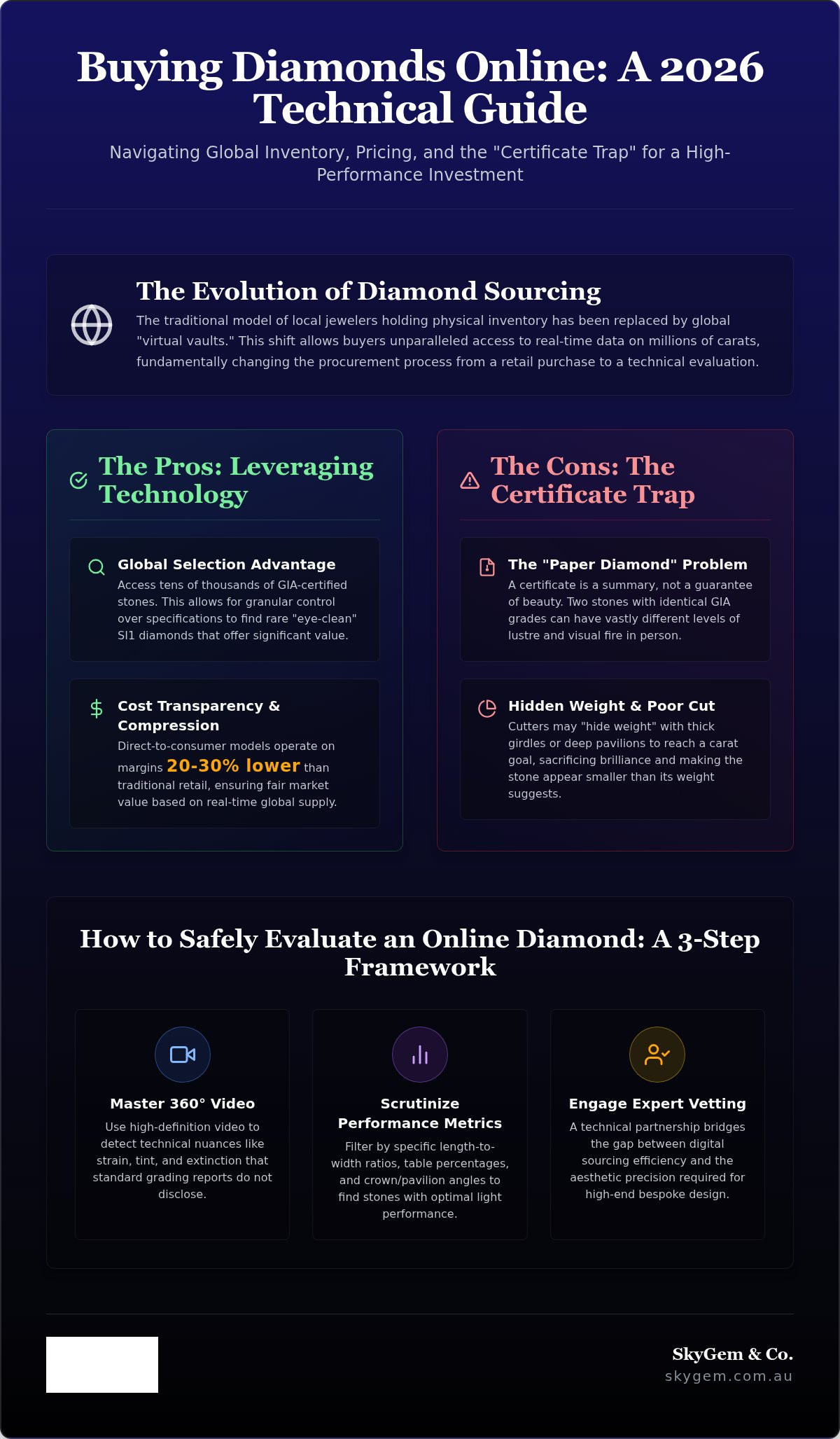
- Master the use of 360-degree high-definition video to detect technical nuances like strain, tint, and extinction that standard grading reports do not disclose.
- Discover how a technical partnership bridges the gap between digital sourcing efficiency and the aesthetic precision required for high-end bespoke design.
The Evolution of Diamond Sourcing: Why Buyers are Moving Online
The diamond industry has undergone a structural transformation. By 2026, the traditional model of local jewellers holding extensive physical inventory has largely been replaced by global "virtual vaults." This shift allows buyers to access real-time data on millions of carats of natural white diamonds and lab-grown alternatives from anywhere in the world. As you weigh the pros and cons of buying a diamond online, it's essential to understand that transparency in pricing is no longer a luxury but an industry standard. Advanced imaging and spectral analysis have replaced the traditional loupe for initial screening, providing a level of technical scrutiny that was previously impossible for the average consumer.
The modern digital marketplace operates on a framework of data-driven selection. Instead of choosing from the three or four stones a local boutique might have in a safe, you're now interfacing with a live database of the world’s most prestigious cutting houses. This evolution isn't merely about convenience; it's about the technical democratisation of the trade. Buyers now have the same visibility into wholesale availability as seasoned brokers, which fundamentally changes the power dynamic of the purchase.
The Selection Advantage: Accessing Global Inventory
Online platforms now provide direct access to tens of thousands of GIA-certified stones. This isn't just about quantity; it's about the precision of the search. Buyers can filter by specific length-to-width ratios or table percentages to find a stone that meets exact performance metrics. This granular control increases the probability of finding rare "eye-clean" SI1 diamonds, which offer significant value without visible inclusions. To learn more about diamond properties and how they influence these technical selections, one must look at the crystal structure that dictates light return. A larger pool allows you to be uncompromising on specifications that affect beauty, such as crown angles and pavilion depths, rather than settling for what is available locally.
Cost Transparency and Price Compression
Digital sourcing eliminates the significant overhead costs associated with maintaining a massive physical stock in a high-street boutique. This efficiency has led to price compression across the market. In 2026, price-matching algorithms ensure that consumers pay a fair market value that reflects real-time global supply. When considering the pros and cons of buying a diamond online, the reduction in retail margins is a primary benefit. Traditional markups, often inflated by inventory carrying costs, are bypassed in favor of a more direct procurement model. This allows for a more efficient allocation of your budget toward the actual quality of the stone rather than the retailer's operational expenses. Key benefits include:
- Reduced markups: Direct-to-consumer models often operate on margins 20-30% lower than traditional retail.
- Real-time pricing: Digital inventories update instantly to reflect fluctuations in the global diamond market.
- Comparative analysis: Users can compare identical GIA-graded stones across multiple platforms to ensure they aren't overpaying.
The Cons of Buying Online: Avoiding the Certificate Trap
A grading report is a technical summary, not a guarantee of beauty. When you weigh the pros and cons of buying a diamond online, you must recognise that the "paper diamond" problem is real. Two stones can share identical GIA grades for colour, clarity, and cut, yet look entirely different in person. This discrepancy often stems from technical nuances like internal strain or subtle tints that standard reports don't quantify. Cutters sometimes "hide weight" by making the girdle thicker or the pavilion deeper just to reach a specific carat threshold. This ensures a higher price on paper but results in a stone that lacks brilliance and appears smaller than its weight suggests.
Buying a significant symbol through a digital shopping cart can also create an emotional disconnect. Without physical interaction, you miss the opportunity to see how the stone reacts to your specific environment. If you're unsure how to interpret these technical nuances, our specialists can help you vet diamonds online in Melbourne to ensure your selection meets professional standards.
The Limitations of GIA and IGI Reports
A "Triple Excellent" cut grade covers a surprisingly broad range of proportions. It isn't a single point of perfection. Many stones at the lower end of this range still receive the top grade despite having light leakage. Furthermore, nuances like "BGM" (Brown, Green, Milky) are often omitted from standard reports. A stone might have VS1 clarity but appear hazy due to sub-microscopic inclusions or structural graining. Following GIA's online buying tips is a good start, but you must also scrutinise the "Comments" section. Phrases like "clarity grade is based on clouds that are not shown" can be a red flag for a stone that lacks transparency.
The Physical Reality: Scintillation vs. Static Grading
Static photos cannot convey "fire" and "life" in a stone. Scintillation, the play of light as the diamond moves, is the most critical factor for visual impact. Online listings often ignore the "bow-tie" effect in fancy shapes like ovals and pears. This dark shadow across the centre of the stone is a result of poor facet alignment and can ruin the stone's aesthetic. Fluorescence is another variable that reports simplify. While it can save you money on lower colour grades, strong blue fluorescence in a high-colour stone can make it look oily or milky in natural sunlight. These physical realities require a level of vetting that a standard digital filter simply can't provide.
- Lustre: The crispness of light reflections off the facet surfaces.
- Strain: Internal crystal distortions that can blur light paths.
- Tint: Subtle secondary hues (like grey or brown) that aren't reflected in the main colour grade.
The Pros of Online Diamond Buying: Leveraging 2026 Technology
While the previous section detailed the risks of "paper diamonds," the 2026 technological suite provides a robust countermeasure. Understanding the pros and cons of buying a diamond online requires an appreciation for how high-definition assets now outperform the human eye. Digital platforms have evolved from simple galleries into technical laboratories where every facet is scrutinised under conditions that a standard retail environment can't replicate. This data-first approach allows you to make decisions based on measurable performance rather than a salesperson's pitch.
360-degree HD video is the cornerstone of this evolution. By 2026, standard professional listings include 40x magnification, allowing you to identify inclusions and verify if they're truly "eye-clean" with far greater certainty than a traditional loupe provides. You can observe how light interacts with the stone's internal structure, detecting the fire and life that static grading reports fail to capture. This visual data, combined with global price benchmarking, ensures you're paying a fair market value based on real-time supply and demand across the international trade.
The rise of lab-grown white diamonds has further pushed the industry toward technical transparency. With lab-grown stones accounting for approximately 61 percent of engagement ring center stones in 2026, the online category has become a high-tech frontier. These stones are often accompanied by more comprehensive digital data than their natural counterparts, making them an ideal entry point for buyers who value technical precision and ethical clarity. The ability to source these alongside natural white diamonds provides a level of choice that physical inventory limits can't match.
Advanced Visual Assets and Light Performance Tools
To move beyond the basic 4Cs, professional buyers now use ASET (Angular Spectrum Evaluation Tool) and Idealscope images provided in digital listings. These tools are essential for verifying light leakage, particularly in the "Triple Excellent" range where performance varies significantly. Digital environments allow you to compare multiple stones side-by-side using these light maps, ensuring the stone you select doesn't just look good on paper but possesses genuine brilliance and optimal light return.
Curation and Filtering Algorithms
Modern search filters allow for a level of curation that physical boutiques can't match. You can filter for "Ideal" proportions, such as specific table percentages (54-57%) and depth percentages (60-62.5%), to find stones that maximise light return. This capability extends to niche categories, allowing you to source natural sapphires or natural rubies with specific origin certifications or "unheated" status directly from global cutting houses.
Finally, the standardisation of secure, insured shipping and 30-day return policies has mitigated the primary logistical risks. When you evaluate the pros and cons of buying a diamond online, the ability to inspect a stone in your own environment with a guaranteed return window provides a level of security that rivals any physical boutique. This logistical framework ensures your investment is protected from the vault to your doorstep.
How to Safely Evaluate an Online Diamond Purchase
Success in digital diamond procurement depends on a structured vetting process. When you weigh the pros and cons of buying a diamond online, your goal is to mitigate risk through technical verification. The first step is digital authentication. You must verify the certification number directly on the GIA or IGI official database. This confirms the report hasn't been tampered with and matches the stone's recorded history. Don't rely on the PDF provided by the vendor; go straight to the source.
The second step involves a visual performance audit. You should analyse the provided 360-degree video specifically for "dead spots" or excessive extinction. These are areas where light fails to return to the eye, appearing as dark, static patches during rotation. If a stone exhibits significant extinction, its brilliance is compromised regardless of its grade. We recommend a "Hybrid" route for final verification. This involves selecting your stone online but arranging for its delivery to a physical boutique where an expert can conduct a final inspection with you present.
Vetting the Vendor and Secure Logistics
Accountability is the primary differentiator between a reputable merchant and a faceless marketplace. A physical office or boutique provides a layer of security that digital-only entities cannot match. It ensures you have a point of contact for future maintenance of your engagement rings. Logistics must also be airtight. Ensure the vendor uses fully insured shipping and offers payment protection that acts as a secure bridge between your funds and the final delivery. Australian-based support is essential for managing warranty claims or resizing without the risks of international transit.
Post-Purchase Verification
Your due diligence shouldn't end when the package arrives. Once you receive the stone, perform these three technical checks:
- Laser Inscription: Use a high-power loupe to verify the report number laser-inscribed on the diamond’s girdle.
- Independent Valuation: Secure an appraisal from a third-party gemmologist to confirm the stone’s physical properties match the GIA report.
- Physical Audit: View the stone in various lighting conditions, including natural daylight and office lighting, to ensure its scintillation meets your expectations.
A 30-day return window is non-negotiable for online purchases because it provides the necessary timeframe to conduct a professional physical audit of the stone. If you require technical assistance in vetting a specific stone, you can explore our curated selection of diamonds online in Melbourne for a secure, expert-led experience.
SkyGem & Co.: Bridging the Gap Between Online Selection and Boutique Expertise
Most guides treat "online" and "boutique" as mutually exclusive options. At SkyGem & Co., we view these as complementary components of a sophisticated procurement strategy. When you analyse the pros and cons of buying a diamond online, the missing link is often the technical filter of an expert who understands how a stone will perform in a physical setting. We act as your technical consultant, curating the best of the global digital inventory to ensure you don't fall victim to a "paper-only" diamond that looks impressive on a report but lacks life in person. This approach provides the pricing advantages of the digital market with the security of professional verification.
Our process integrates Natural GIA Certified Diamonds into custom-made settings with a focus on long-term structural integrity. We don't just sell you a stone; we manage the intersection of gemmological precision and aesthetic design. By providing professional oversight on global listings, SkyGem & Co. eliminates the anxiety of "dead" stones and ensures every facet aligns with your project's technical requirements. This ensures that the light performance you see in a digital render translates perfectly into the physical world through a solution-oriented approach.
Bespoke Design Meets Digital Sourcing
Selecting a Solitaire Engagement Ring is a technical exercise in balance and proportion. Once we've sourced your diamond, we use advanced CAD design to visualise the final piece, ensuring the setting complements the stone's specific dimensions. This Melbourne-based expertise provides a layer of accountability that faceless global retailers can't offer. Our designers use these digital models to verify that the prongs provide maximum security without obscuring light return. We bridge the gap between a digital data point and a physical asset that exceeds your expectations through methodical, regional design.
A Curated Path to Perfection
For those exploring modern alternatives, our Ring Builder for Lab-Grown Diamonds offers a transparent, data-driven platform with the added security of professional vetting. SkyGem & Co. remains committed to education and transparency, providing the regional expertise necessary for ongoing jewellery maintenance and ethical sourcing. Our role is to act as your technical partner, ensuring that your choice reflects both aesthetic beauty and structural longevity. This partnership ensures your selection is a permanent, evolving asset rather than a one-off transaction.
Book a consultation to find your perfect diamond with SkyGem & Co.
Securing Your Investment with Technical Precision
The 2026 diamond market offers unprecedented transparency, but navigating the pros and cons of buying a diamond online requires a disciplined, data-first approach. You've seen that while digital vaults provide global access and competitive pricing, the "certificate trap" remains a significant risk for the uninitiated. Success lies in balancing advanced visual assets with the rigorous vetting of a physical boutique. By verifying GIA reports directly and scrutinising 360-degree high-definition video, you can secure a stone that possesses genuine fire rather than just an impressive grade on paper.
At SkyGem & Co., we act as your technical consultants to bridge this gap. Our expert GIA-trained consultants are specialists in bespoke engagement rings, providing the professional oversight needed to filter global inventory for optimal light performance. We ensure your selection is protected through secure, insured national delivery and local accountability. Whether you're sourcing a natural stone or a lab-grown alternative, our focus remains on structural integrity and aesthetic excellence.
Explore SkyGem & Co.’s Curated Diamond Selection Online and begin your journey toward a masterpiece built on technical precision and quiet confidence.
Frequently Asked Questions
Is it cheaper to buy a diamond online than in a store?
Yes, online sourcing typically offers lower pricing by eliminating the inventory carrying costs and high-street rent associated with traditional retail. Digital models often operate on margins 20-30 percent lower than physical boutiques. When evaluating the pros and cons of buying a diamond online, the cost efficiency of global price benchmarking is a primary advantage for technical buyers seeking fair market value.
How do I know if a diamond bought online is real?
Verification begins with the GIA or IGI certificate number. You must cross-reference this on the laboratory’s official database to confirm the stone's recorded history and technical specifications. Once the stone arrives, use a professional loupe to match the laser inscription on the girdle to the report. Independent valuations from a third-party gemmologist provide an additional layer of security for your investment.
What is the biggest risk when buying a diamond online?
The most significant risk is the discrepancy between a grading report and physical light performance. A stone may meet "Triple Excellent" criteria on paper but suffer from internal strain or hazy lustre that a report doesn't quantify. When weighing the pros and cons of buying a diamond online, this "certificate trap" is the most critical factor to manage to avoid purchasing a stone that lacks fire.
Should I buy a lab-grown or natural diamond online?
The choice depends on your priorities regarding budget and rarity. Lab-grown diamonds accounted for approximately 61 percent of US engagement ring center stones as of March 2026 because they provide a larger stone for the same expenditure. Natural diamonds remain the preferred choice for those seeking a finite technical asset. Both categories benefit from the transparency and detailed 40x magnification imaging available in the modern digital marketplace.
Can I return a diamond if I don’t like it in person?
Yes, a 30-day return policy is the industry standard for reputable online vendors. This window is essential because it allows you to conduct a physical audit in various lighting conditions and seek an independent appraisal to verify the stone's integrity. If a vendor doesn't offer a clear, insured return process, it represents a significant risk to your capital security and should be avoided.
Does GIA certification guarantee a good diamond?
A GIA report is a technical data sheet, not a guarantee of aesthetic beauty. It records dimensions and inclusions but misses nuances like secondary tints or "milky" transparency caused by sub-microscopic inclusions. You must use the report as a baseline; then apply expert vetting or high-definition video analysis to confirm the stone's actual light return and visual integrity before finalising the purchase.
How does shipping work for high-value jewellery in Australia?
High-value jewellery in Australia is typically moved via specialised, fully insured courier networks. These services provide end-to-end tracking and require secure signatures upon delivery to mitigate logistical risks. Reputable Australian vendors manage these secure logistics to ensure your investment is protected from the moment it leaves the vault until it reaches your hands, providing a reliable bridge between digital selection and physical possession.
What should I look for in an online diamond video?
Yes you should focus on light return and facet movement during rotation. You should look for "extinction," which appears as dark, non-reflective patches, and the "bow-tie" effect in fancy shapes like ovals or pears. High-definition videos allow you to verify if a stone is "eye-clean" and observe how light scintillates across the crown facets, ensuring the diamond possesses the visual "life" that a static report cannot convey.