
Platinum in Fine Jewellery: The Definitive Guide to the Noble Metal

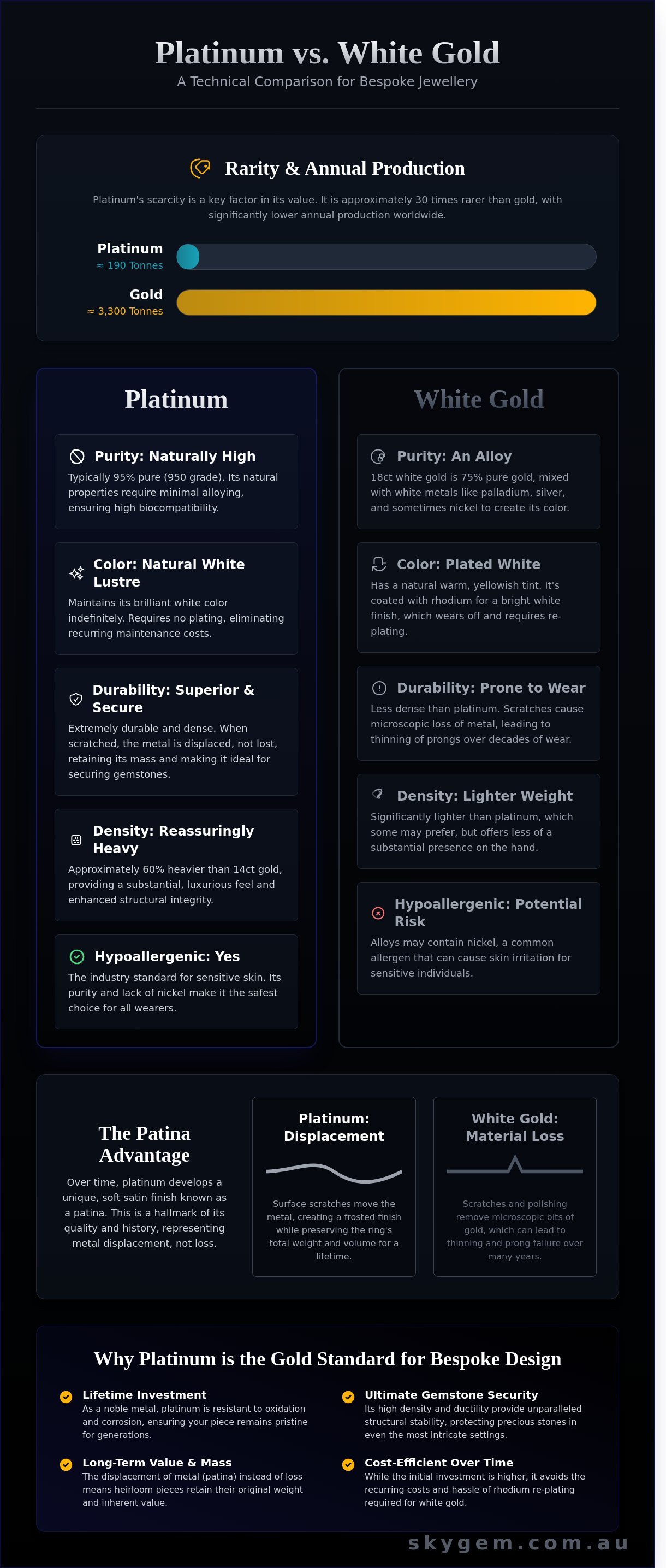
While gold often dominates the conversation, platinum is actually 30 times rarer, with annual global production sitting at approximately 190 tonnes compared to gold’s 3,300 tonnes. This scarcity isn't just a marketing metric; it represents a fundamental difference in material density and structural integrity. Selecting a metal for a bespoke engagement ring is a significant engineering decision where aesthetics must meet long-term performance. You likely want a piece that retains its natural white lustre without the constant need for maintenance or the risk of prong failure over decades of daily wear.
We understand that the choice between white gold and platinum often leads to confusion, especially when you're trying to justify a price premium for a lifetime piece. This guide provides a technical deep dive into the noble metal's unique properties, from its superior displacement resistance to its natural hypoallergenic status. We'll examine why platinum remains the gold standard for secure stone setting and provide a clear framework for maintenance, ensuring your investment remains a permanent asset in your collection.
Key Takeaways
- Understand the chemical properties that define platinum as a noble metal, ensuring your high-value investment remains resistant to oxidation and corrosion over a lifetime.
- Explore the technical advantages of density and ductility, which provide the structural stability required for intricate filigree and the secure setting of precious gemstones.
- Evaluate the long-term cost-efficiency of natural white metals against rhodium-plated alternatives, factoring in the recurring maintenance expenses common in the Australian market.
- Learn how the unique displacement of metal creates a distinguished patina, allowing heirloom pieces to retain their mass and value through decades of daily wear.
- Discover the SkyGem & Co. consultation process for matching 950-grade alloys with specific gemstone characteristics to ensure a future-proofed bespoke design.
What is Platinum? Understanding the Rarity of the Noble Metal
Platinum is a dense, malleable transition metal that occupies a unique position in both industrial engineering and high-end luxury. It's chemically unreactive, which qualifies it as a "noble metal." This classification isn't just a title; it describes the metal’s inherent ability to resist oxidation and corrosion, even when exposed to harsh environmental factors. While gold requires significant alloying to achieve comparable durability, platinum maintains its structural integrity and white lustre naturally. Its density is nearly double that of silver, providing a tactile sense of permanence that's immediately recognisable in hand.
The scarcity of this metal defines its premium market value in Australia. Geologists estimate that platinum is approximately 30 times rarer than gold. To put this in perspective, if every ounce of platinum ever mined were poured into a single block, it would occupy a space of roughly 8 metres cubed. This entire global supply would fit comfortably inside a standard Australian suburban living room. Annual global production sits at roughly 190 tonnes, which is a mere fraction of the 3,300 tonnes of gold produced annually as of 2023 data. This limited supply ensures its status as a stable, long-term asset for collectors and investors alike.
Its application spans millennia and reflects a history of technical appreciation. High-precision analysis of ancient Egyptian artefacts, such as the Casket of Thebes dating back to 700 BC, reveals traces of the metal used alongside gold. By the 18th century, European horologists began integrating it into complex watch movements. Today, it remains the pinnacle material for high-end horology and bespoke jewellery due to its weight and resistance to wear. It's a material that doesn't just hold a gemstone; it protects it through superior mechanical properties.
The Platinum Group Metals (PGM)
Platinum belongs to a family of six elements known as the Platinum Group Metals (PGM). This group includes ruthenium, rhodium, palladium, osmium, and iridium. While rhodium is frequently used as a sacrificial plating for white gold, platinum is the most prominent member for solid fine jewellery construction. Manufacturers typically introduce small percentages of iridium or ruthenium to the mix. These additions function as hardening agents, increasing the metal’s Vickers hardness score to ensure the finished piece withstands the rigors of daily wear without compromising the metal’s natural white colour.
Natural Purity vs. Gold Alloys
Platinum jewellery is prized for its high natural purity compared to other precious metals. The industry benchmark is 950 platinum, which consists of 95% pure metal and 5% alloy. This contrasts sharply with 18ct gold, which contains only 75% gold, with the remaining 25% composed of silver, copper, or zinc. Higher purity levels translate directly to better biocompatibility for the wearer. 950 platinum is the hypoallergenic standard for sensitive skin in 2026. Because it lacks the nickel often found in lower-quality white gold alloys, it presents a reliable solution for clients prone to dermatological reactions. This purity also ensures that the metal doesn't lose volume over decades of use. When the surface is scratched, the metal is merely displaced rather than lost, preserving the total weight of the piece for the long term.
The Technical Superiority of Platinum in Bespoke Jewellery
Choosing platinum for a bespoke engagement ring involves more than aesthetic preference; it's a decision based on metallurgical performance. The physical sensation of luxury often stems from density. This material is 11% denser than fine gold and approximately 60% heavier than 14ct white gold alloys. This weight provides a reassuring sense of stability on the hand that lighter metals cannot replicate. Research into Platinum's wear and tarnish resistance confirms that its high atomic weight contributes to a lifespan that far exceeds other precious metals commonly used in Australian jewellery.
High ductility is another hallmark of this metal. It can be drawn into microscopic wires without fracturing, which allows our artisans to create intricate filigree and complex galleries that maintain their shape under daily pressure. It's the reason why the world's most detailed historical pieces remain intact today. While other metals may become brittle over time, this one retains its structural integrity through decades of constant wear.
Thermal stability is vital for local conditions. Australia's climate can be harsh, with temperature shifts often exceeding 20 degrees Celsius in a single day. This metal has a low coefficient of thermal expansion, meaning it doesn't contract or expand significantly in heat. This keeps the "seatbelts" of your setting tight. It ensures your centre stone doesn't loosen or rattle, providing a level of security that's essential for high-value assets.
Metallurgical Density and Gemstone Safety
Security is the primary concern when housing high-value GIA diamonds. Gold prongs can become brittle over time due to work-hardening or chemical exposure. If a gold prong is struck, it's likely to snap. These prongs behave differently; they bend under extreme stress rather than breaking. This malleable nature absorbs impact, keeping the stone trapped within the setting. Master jewellers prefer this material for complex, multi-stone trilogy rings because the density allows for smaller, more discreet prongs that don't sacrifice safety. It's a superior choice for securing large solitaire diamonds where the value of the stone warrants the highest level of protection.
Vickers Hardness and Structural Integrity
Technical comparisons often focus on the Vickers hardness scale (HV). Standard annealed samples measure approximately 50 HV, but SkyGem & Co. utilises specific cold-worked alloys that reach 120 to 135 HV. While 18ct white gold is technically harder at 150 to 160 HV, it's also more prone to "metal loss" through abrasion. When gold is scratched, a tiny amount of metal is removed. When this metal is scratched, it merely displaces or shifts. This ensures the lifelong structural integrity of delicate pavé settings where metal volume is minimal. Our team provides technical consultations to help you select the right alloy for your specific design requirements.
Platinum vs. White Gold: A Comparative Analysis for 2026
Choosing between white gold and platinum involves more than aesthetic preference; it requires an understanding of metallurgical properties and long-term performance. While both metals appear similar on the shelf, their structural integrity and maintenance profiles diverge significantly over time. 18ct white gold is an alloy consisting of 75% pure gold mixed with white metals like palladium or silver. In contrast, most platinum jewellery in Australia is 95% pure, offering a level of density that provides a tactile sense of quality and ensures the piece remains secure on the hand.
The physical weight of a ring is often the first indicator of its composition. A platinum ring feels approximately 40% heavier than an identical design in 18ct white gold. This weight isn't just a luxury marker; it's a byproduct of the metal's high density. Because the rarity of platinum-group elements makes them difficult to extract and process, the material costs are often higher. Global production data from 2024 shows that only about 180 metric tonnes of platinum are mined annually, compared to over 3,000 tonnes of gold. This scarcity justifies the premium price point for those seeking a metal that's both exclusive and enduring.
The Truth About Rhodium Plating
White gold isn't naturally white. It's a yellowish alloy finished with a thin layer of rhodium to achieve its mirrored surface. Over a period of 12 to 24 months, this plating wears thin, revealing a dull yellowish undertone. Re-plating services in Australia typically cost between A$80 and A$150 per visit. Over a 10-year period, a wearer might spend upwards of A$1,200 just to maintain the ring's original appearance. Platinum requires no such intervention. It's naturally white through its entire cross-section and retains its brilliant lustre without chemical coatings.
Manufacturing Complexity and Craftsmanship
Working with this metal demands a higher calibre of technical expertise than traditional gold alloys. The melting point of the material sits at 1,768 degrees Celsius, which is nearly 700 degrees higher than gold. This thermal requirement necessitates specialised oxygen-hydrogen torches and high-heat crucibles that many standard workshops don't possess. It's a temperamental metal that requires a clean environment to prevent contamination during the casting process.
At SkyGem & Co., we bridge the gap between precision engineering and traditional art. We utilise advanced 3D CAD software to achieve exact tolerances in the initial design phase. Once the piece is cast, our master jewellers perform intensive hand-finishing to ensure every facet is polished to a mirror finish. This hybrid approach ensures that every piece meets the rigorous standards of the Australian luxury market while future-proofing the setting against the stresses of daily wear. It's a solution-oriented method that prioritises the long-term success of the commission over manufacturing speed.
When you factor in the lack of maintenance fees and the superior durability, the total cost of ownership for a dense white metal often balances out within the first decade. It's a permanent asset that doesn't thin out over time. While white gold loses microscopic amounts of metal every time it's polished, the surface of a denser metal merely shifts, preserving the original volume of the piece for generations.
The Life of a Platinum Ring: Patina, Care, and Maintenance
Choosing a platinum ring is an investment in a material that prioritises structural longevity and metallurgical stability. While white gold relies on sacrificial rhodium plating to maintain its appearance, platinum evolves through a unique physical process. This evolution is not a sign of wear but a testament to the metal's incredible density and ductility. Understanding the lifecycle of this metal allows owners to appreciate the shifting aesthetics of their jewellery while ensuring the precious stones remain secure within their settings for decades.
Metal Displacement vs. Metal Loss
The primary technical advantage of platinum lies in its reaction to daily friction and impact. When a gold ring is scratched, microscopic particles of the metal are shaved away, leading to a gradual thinning of the band over 15 to 20 years. Platinum behaves differently because its molecular structure is far more cohesive. When the surface is struck, the metal is simply displaced or pushed aside, creating a microscopic ridge or "furrow" rather than being lost to the environment. This characteristic ensures the integrity of the piece remains uncompromised by time. A platinum wedding band will retain its original mass for generations. This lack of metal loss is particularly critical for the prongs holding a centre stone, as they won't become brittle or thin out through repeated polishing cycles.
The Aesthetic Evolution of the Patina
Over time, the accumulation of these microscopic displacements results in a soft, matte finish known as a patina. Many enthusiasts of fine jewellery view this as a desirable trait that gives the piece an heirloom character. It provides a sophisticated, non-reflective backdrop that allows the brilliance of a diamond or the deep saturation of a sapphire to stand out more prominently. While a high-polish finish is the standard for new rings, the transition to a satin patina is a natural progression of the metal's lifecycle. Owners who prefer the original mirror-like sheen can opt for professional buffing, but doing so frequently is unnecessary given the metal's inherent beauty in its aged state.
Professional Cleaning and Maintenance
The SkyGem & Co. approach to maintenance focuses on technical precision and preventative care. We recommend a professional inspection every 12 months to verify the tension of the settings and the condition of the metal. Our maintenance protocol includes:
- Ultrasonic Cleaning: We use high-frequency 40kHz sound waves to dislodge accumulated oils and debris from hard-to-reach galleries beneath the stones.
- Microscopic Prong Inspection: Our specialists examine every claw under 10x magnification to identify potential snagging points or structural shifts.
- Steam Refinement: High-pressure steam removes any remaining residues, restoring the natural fire of the gemstones.
For at-home care between professional visits, a simple 20-minute soak in warm water with a pH-neutral detergent is effective. Use a soft-bristled toothbrush to gently clean the underside of the stones where lotions and soaps typically collect. This routine is safe for platinum and diamond combinations, ensuring the light performance of your stones remains at peak levels. If you notice a significant dulling of the metal that home cleaning cannot resolve, it may be time for a professional restoration. Our team provides comprehensive jewellery maintenance services to ensure your investment remains as secure as the day it was first worn.
Deciding when to re-polish is a personal choice. Because platinum doesn't lose mass, a professional polish every 24 to 36 months can restore the high-shine finish without compromising the ring's thickness. However, many clients find that the muted glow of a well-earned patina reflects a life well-lived, opting instead for simple cleaning to maintain the sparkle of the gems while embracing the character of the metal.
Bespoke Platinum Design at SkyGem & Co. Melbourne
SkyGem & Co. prioritises the use of 950 platinum, a high-purity alloy comprising 95% pure metal and 5% cobalt or ruthenium. This specific composition achieves a density of approximately 21.45 g/cm³, which is significantly higher than 18k gold. For our Melbourne clients, this technical specification translates to a ring that feels substantial on the hand and resists the gradual thinning that often affects softer metals after 15 or 20 years of daily wear. By sourcing our materials through strictly regulated Australian channels, we ensure that every piece meets the rigorous durability standards required for a lifetime of use.
Our 60-minute design consultations in the historic Royal Arcade focus on the synergy between the metal and your chosen gemstone. Whether you're selecting a 1.5-carat Ceylon sapphire, a deep red ruby, or a brilliant-cut diamond, we examine the light return under 10x magnification. Platinum provides a neutral backdrop that doesn't distort the colour grade of a high-quality stone, ensuring a D-grade diamond remains crisp and icy. We specialise in solitaire and trilogy designs because the inherent strength of this metal allows for more delicate, secure claws that don't obscure the gemstone's surface area, allowing for maximum light entry and dispersion.
The value of Australian-led design lies in our commitment to local craftsmanship. Every ring is designed and finished in Melbourne, allowing for a level of quality control that mass-produced imports can't match. We treat each commission as a technical partnership, where our experts guide you through the engineering requirements of your setting to ensure it stands up to the demands of the Australian lifestyle.
Customising Your Platinum Heirloom
We utilise advanced CAD technology to map the architectural balance of every bespoke piece. This software allows our designers to calculate the exact weight distribution of a ring, ensuring it won't spin on the finger even with a top-heavy gemstone. Many clients now request multi-tone designs, such as a "Toi et Moi" style that combines the cool luster of platinum with the warmth of 18k rose gold. This approach creates a striking visual contrast while maintaining the structural integrity of the primary setting. Explore our bespoke engagement ring process to see how we bridge the gap between digital precision and hand-finished artistry.
Why Choose SkyGem & Co. for Your Platinum Purchase?
Transparency is the foundation of our Melbourne CBD studio. We provide a comprehensive breakdown of costs, ensuring you understand the value proposition of a metal that is 30 times rarer than gold. Our expertise extends to both natural and lab-grown diamonds, providing you with an education-first environment to make an informed decision. We don't rely on high-pressure sales; instead, we focus on the technical merits of our settings and the long-term sustainability of the materials we use. Book a consultation at our Melbourne boutique to experience platinum in person and verify the superior weight and finish of our signature collections.
Investing in Structural Integrity and Timeless Performance
Selecting the right metal for a bespoke commission is a decision that impacts the long-term durability and maintenance of your investment. While 18ct white gold remains a common choice, platinum offers a density approximately 40% higher than its counterparts, providing a more secure setting for high-value gemstones. This technical superiority ensures that the metal doesn't wear away over time; instead, it develops a resilient patina that preserves the piece's original mass and structural integrity. Since 2018, SkyGem & Co. has operated from Melbourne's historic Royal Arcade, applying a methodical, consultant-led approach to every design. Our GIA-certified experts focus on the intersection of aesthetic precision and engineering excellence, particularly when setting rare unheated rubies or local Australian sapphires. We don't just create jewellery; we engineer future-proof assets designed for a lifetime of performance. Design your bespoke platinum engagement ring with SkyGem & Co. and secure a legacy that's built to last. Your journey toward a masterpiece starts with a technical consultation in the heart of Melbourne.
Frequently Asked Questions
Is platinum better than white gold for an engagement ring?
Platinum offers superior long-term durability and lower maintenance requirements compared to white gold. While white gold relies on a rhodium plating that wears off after 12 to 24 months, platinum maintains its structural integrity without the need for periodic replating. This makes it a more sustainable choice for a piece intended for daily wear over 50 years. It’s a reliable investment for those prioritising technical performance and longevity.
Why does platinum cost more than 18ct white gold?
The higher cost of platinum reflects its greater density and purity levels compared to gold alloys. A platinum ring is approximately 40% heavier than an identical 18ct white gold design, requiring more raw material by weight. Most platinum jewellery in Australia is 95% pure, whereas 18ct white gold contains only 75% gold. This results in a typical price premium of A$350 to A$700 for a standard wedding band.
Does platinum scratch easily?
The metal does scratch, but it doesn't lose metal volume when abraded. Unlike gold, which loses microscopic amounts of material with every scratch, this alloy develops a patina as the surface is merely displaced. This unique physical property ensures that a 10-gram ring retains its original mass after 20 years of wear. You can easily restore the high-polish finish through professional buffing, which costs approximately A$60 at most local workshops.
Is platinum hypoallergenic for people with sensitive skin?
This material is an excellent choice for individuals with sensitive skin because it's naturally hypoallergenic. Most white gold alloys contain nickel to achieve their colour, which causes allergic reactions in 15% of the Australian population. Because the alloy is used at 95% purity, it lacks these common irritants. It provides a biocompatible solution that remains comfortable for 24-hour daily use, even for those with severe metal sensitivities.
Will my platinum ring turn yellow over time?
The ring won't turn yellow over time because the metal is naturally white throughout its entire composition. White gold is an alloy of yellow gold that requires a rhodium surface coating to appear bright white. When this thin layer wears down, the underlying yellowish tint becomes visible. This precious metal maintains its cool, white lustre permanently, which eliminates the need for the A$90 biannual rhodium plating service required for gold.
Can platinum rings be resized or repaired?
These rings can be resized or repaired, though the process requires specialised high-heat equipment. The metal has a melting point of 1,768 degrees Celsius, which is much higher than gold's 1,064 degrees. This requires an oxygen-hydrogen torch or laser welder for precision work. Most Australian workshops charge a 25% premium for these repairs due to the technical expertise and the higher cost of specialized solder required for the job.
How do I clean my platinum jewellery at home?
You can clean your jewellery effectively by soaking it in a solution of warm water and mild, ammonia-free dish soap for 15 minutes. Use a soft-bristled toothbrush to gently remove accumulated oils from under the stone settings. After rinsing with clean water, dry the piece with a lint-free cloth. Performing this simple maintenance every 30 days ensures your jewellery maintains its professional aesthetic and prevents grime buildup.
What is the difference between 900 and 950 platinum?
The difference lies in the purity ratio, where 950 grade contains 95% pure metal and 900 grade contains 90%. In Australia, 950 is the industry standard for high-end jewellery because it offers the best balance of brightness and workability. The remaining 5% or 10% usually consists of iridium or ruthenium. These alloys increase the Vickers hardness of the metal from 50 to 130, ensuring the ring resists deformation.
Disclaimer
This article is for general informational purposes only and may include AI-assisted content. Pricing, specifications, and availability are subject to change. For accurate advice and current information, please contact SkyGem & Co. directly. Nothing in this content constitutes professional or financial advice.