
Pigeon Blood Ruby vs Vivid Red: Decoding the World’s Finest Crimson Gemstones

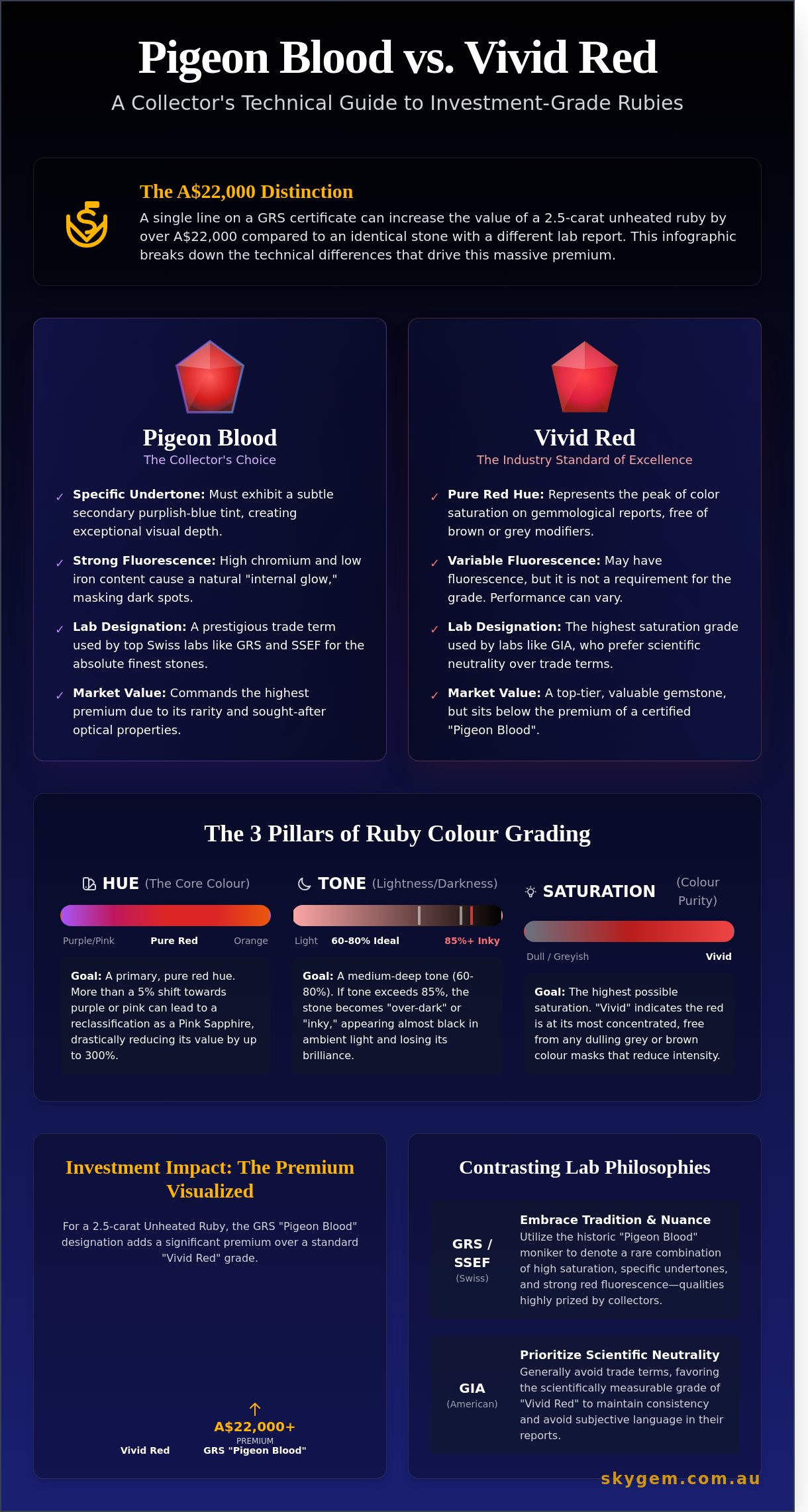
A single line on a GRS certificate can premium-price a 2.5-carat unheated ruby by upwards of A$22,000 compared to an identical stone with a different lab report. While the visual distinction in the debate of pigeon blood ruby vs vivid red is often imperceptible under standard lighting, the financial impact on your acquisition is absolute. You likely understand that these labels represent the pinnacle of the corundum family, yet the inconsistency between Swiss and American laboratory standards creates a technical barrier for the serious collector.
We agree that investing in a bespoke piece requires more than just faith in a marketing term. This guide delivers the technical criteria you need to move beyond the certificate and evaluate the actual light performance and trace elements of these gems. We'll break down the specific chromium levels and fluorescence requirements that define investment-grade rubies in the Australian market. This analysis ensures you've got the data to confidently select a stone that offers both architectural beauty and long-term capital stability for your next high-value jewellery project.
Key Takeaways
- Understand the fundamental gemmological pillars of hue, tone, and saturation to identify what truly constitutes a "Vivid Red" ruby.
- Learn the technical criteria that distinguish a pigeon blood ruby vs vivid red, specifically the requirement for subtle blue undertones as per GRS standards.
- Discover how natural fluorescence creates an "internal glow" that masks extinction, enhancing the gemstone's brilliance even in varied lighting conditions.
- Gain practical insights on evaluating ruby intensity under the specific southern hemisphere sunlight of Melbourne to make a sound investment for your bespoke engagement ring.
- Explore the SkyGem & Co. curation process, where technical origin data and hand-selection ensure your chosen ruby offers long-term aesthetic value and brilliance.
Understanding Ruby Colour Grading: Beyond the Red
Evaluating a high-end ruby requires a technical understanding of three specific metrics: hue, tone, and saturation. These pillars form the basis of Understanding Ruby Colour Grading, allowing gemmologists to categorise stones with the precision required for high-value transactions. While "Vivid Red" represents the peak of the saturation scale in modern gemmological reports, "Pigeon Blood" remains a historic trade term with origins in the Mogok Valley of Myanmar. International laboratories like the Swiss Gemmological Institute (SSEF) and the Gem Research Swisslab (GRS) apply strict criteria for these titles. A GRS report might designate a stone as "Vivid Red" based on its intensity, but only stones meeting specific fluorescence standards and a complete lack of brown undertones earn the "Pigeon Blood" label.
The distinction between a pigeon blood ruby vs vivid red grade often dictates the asset's long-term value. In the Australian investment market, these labels act as a shorthand for quality, yet they rely on different grading philosophies. GIA (Gemological Institute of America) generally avoids the "Pigeon Blood" moniker in favour of "Vivid Red" to maintain scientific neutrality. Conversely, SSEF and GRS use the "Pigeon Blood" term to denote a specific combination of high saturation and strong red fluorescence. This fluorescence, caused by low iron content, makes the stone glow under UV light, a feature highly sought after by collectors in Sydney and Melbourne who value stones that perform well in natural Australian sunlight.
The Anatomy of Ruby Hue
Hue refers to the actual colour perceived by the eye. In professional gemmology, investment-grade rubies must display a primary red hue. Secondary undertones like purple, orange, or pink are common; however, they directly impact the stone's valuation. If a stone exhibits more than a 5% shift toward a purple or pink secondary hue, laboratories often reclassify the specimen as a Pink Sapphire rather than a Ruby. This distinction is critical for buyers, as a certified ruby can command prices 300% higher than a sapphire of similar saturation. A "pure" red, devoid of these modifiers, remains the industry gold standard for those seeking maximum capital appreciation.
Saturation and Tone Explained
Saturation measures the vividness or strength of the colour. A "Vivid" rating indicates that the red is at its most concentrated, free from grey or brown masks. Tone describes the lightness or darkness of the gem. High-performance rubies typically sit within a 60% to 80% tone range. If the tone exceeds 85%, the stone appears "over-dark" or "inky." These stones lose their brilliance in the ambient lighting of an office or restaurant, appearing almost black rather than red. Maintaining a medium-deep tone ensures the gem maintains its visual "pop" when set in a platinum or gold solitaire, providing the high-contrast aesthetic that premium buyers expect.
- Hue: The primary colour, where a 95% pure red is the target for top-tier grading.
- Tone: The depth of the colour, ideally staying below the 85% "inky" threshold to preserve brilliance.
- Saturation: The intensity of the red, with "Vivid" representing the absence of dulling brown or grey masks.
- Lab Standards: GRS and SSEF apply the "Pigeon Blood" title only to stones with high fluorescence and specific chemical compositions.
When navigating the pigeon blood ruby vs vivid red landscape, it's essential to look beyond the certificate. The technical data provided by international labs ensures that the stone meets the baseline for its price bracket, but the interaction between tone and saturation determines how the ruby lives on the hand. A stone with 75% tone and "Vivid" saturation will outperform a darker 90% tone stone in almost every lighting condition. This focus on performance over mere labelling is what separates a standard purchase from a true legacy asset.
Pigeon Blood vs Vivid Red: The Technical Distinction
The technical distinction between a pigeon blood ruby vs vivid red is defined by a narrow window of colour science and light performance. While "Vivid Red" is a high-level grading that identifies stones with superior saturation and a medium-dark tone, the "Pigeon Blood" designation is a specific subset of this category. To achieve this prestigious title, a ruby must display a primary red hue with a very specific secondary purplish-blue tint. This subtle blue undertone is vital; it creates a visual depth and a "glow" that standard vivid reds cannot replicate. Without this secondary hue, a stone remains a high-quality vivid red but fails to meet the elite criteria established by major gemological laboratories.
Achieving this specific colour profile is rare. The blue undertone acts as a counterweight to the warmth of the red, resulting in a colour that appears more "pure" to the human eye under various lighting conditions. In the Australian market, where natural light is often intense, these subtle shifts in hue become even more apparent. A stone that looks vivid red in an office may shift toward a darker, less desirable "garnet" red if it lacks the correct balance of undertones. Professional collectors often look for this specific purplish-blue signature to ensure the stone maintains its vibrancy regardless of the environment.
The presence of "silk" is another technical factor that separates these two grades. While inclusions generally decrease a gemstone's value, microscopic rutile needles known as silk can actually enhance a Pigeon Blood ruby. These fine inclusions scatter light throughout the stone, creating a "softness" in the colour and preventing "extinction"-the dark areas where light isn't reflected. This internal light dispersion ensures the ruby glows from edge to edge. A Vivid Red ruby without silk might appear sharper or more transparent, but it often lacks the velvety, ethereal texture that defines the Pigeon Blood aesthetic.
Market data from 2023 auction cycles indicates that the price premium for the Pigeon Blood label is significant. For a high-quality 2-carat stone, a Vivid Red ruby might be valued at approximately A$18,000 to A$25,000 per carat. However, a stone of the same weight and clarity with a certified Pigeon Blood rating often commands between A$40,000 and A$60,000 per carat. This 120% to 140% price increase reflects the extreme geological scarcity of stones that meet every technical requirement. For those seeking an investment-grade asset, our team at SkyGem & Co. provides technical consultations to help you navigate these grading complexities.
The Role of Chromium in Colour Saturation
Chromium is the chemical element responsible for the intense red that defines these gems. In geological environments like Myanmar's Mogok Valley, rubies formed in marble-hosted deposits that are naturally low in iron. This is a critical distinction because iron acts as a "colour killer" that absorbs light and muddies the red hue. The Role of Fluorescence and Origin in Colour Intensity cannot be overstated; high chromium levels combined with low iron allow the stone to fluoresce under UV light. This fluorescence adds an extra layer of brightness, making the ruby appear as if it's illuminated from within, a hallmark of the pigeon blood ruby vs vivid red comparison.
Lab Grading Nuances: GRS vs GIA
Lab reports are the primary tool for identifying quality in natural rubies, but different labs use different terminology. GRS (GemResearch Swisslab) is the industry leader for "Pigeon Blood" branding, having formalised the criteria in the mid-1990s. They use a proprietary set of master stones to verify hue and saturation. Conversely, the GIA (Gemological Institute of America) maintains a more conservative stance. They typically use technical descriptions like "Vivid Red" and rarely use trade terms like Pigeon Blood on their standard reports. When you're reviewing a certificate, it's essential to understand that a GIA "Vivid Red" and a GRS "Pigeon Blood" may describe the same level of physical quality, despite the different nomenclature.
The Role of Fluorescence and Origin in Colour Intensity
The distinction between a pigeon blood ruby vs vivid red often relies on a phenomenon known as fluorescence. This optical characteristic occurs when chromium atoms within the gemstone absorb ultraviolet radiation and re-emit it as visible red light. In high-chromium, low-iron specimens typical of the Mogok Valley, this effect creates a visible "internal glow" that makes the stone appear as if it's illuminated from within. This secondary light source is critical because it masks extinction, the dark or black areas that appear in a gemstone due to light leakage or poor crystal structure. While a Vivid Red ruby might look exceptional under studio lighting, it can appear dull in overcast conditions if it lacks this reactive property.
Geological origin remains a primary driver of market value despite the rise of high-quality deposits across the globe. For decades, Burma (Myanmar) held a monopoly on the Pigeon Blood designation because its marble-hosted deposits naturally produce rubies with high chromium and negligible iron. However, the market shifted significantly between 2010 and 2021 as Mozambique emerged as a dominant force. Mozambique rubies from the Montepuez mines often meet the "Vivid Red" criteria and frequently achieve the Pigeon Blood grade from major labs. These African stones provide a different aesthetic, often showing higher clarity and larger carat weights than their Burmese counterparts, though they typically possess a higher iron content that slightly dampens the fluorescent response.
Unheated vs Heated: The Value Multiplier
An unheated ruby that reaches Pigeon Blood saturation represents the absolute peak of gemstone investment. Current Australian market data indicates that an unheated 2.00-carat Pigeon Blood ruby can command prices exceeding A$60,000, whereas a heat-treated stone of similar colour might trade for A$15,000 to A$20,000. Heat treatment is a standard industry practice used to dissolve "silk" inclusions and improve transparency, effectively cleaning secondary purple or brown tones to reach a Vivid Red appearance. While heated stones offer excellent visual performance for bespoke jewellery, unheated specimens are preferred for wealth preservation due to their extreme geological rarity.
The Fluorescence Test
Fluorescence does more than just add brightness; it contributes to the "velvety" texture that collectors prize. This soft, glowing appearance is caused by the scattering of light within the crystal lattice, a trait that the 2015 harmonisation of standards between the SSEF and Gübelin labs deemed essential for the Pigeon Blood title. Without strong fluorescence, a stone is typically capped at the "Vivid Red" grade regardless of its base saturation. By converting invisible ultraviolet energy into visible red light, fluorescence allows a ruby to maintain its vivid saturation even when positioned in deep shadow or low-light environments.
- Burma (Mogok): Characterised by high fluorescence and "swirly" colour zones.
- Mozambique: Known for exceptional transparency and "Vivid Red" consistency.
- Madagascar: An emerging source producing stones that rival the best African deposits in saturation.
- Thailand/Cambodia: Historically high in iron, leading to darker reds with minimal fluorescence.
Choosing between these categories requires a balance of technical performance and budget. While a Burmese stone offers historical prestige, a Mozambique Vivid Red ruby provides a modern, high-clarity alternative that meets rigorous international standards for colour intensity. Collectors should always verify these attributes through a reputable laboratory report that specifies both the colour grade and the presence of thermal enhancement.
Buying Guide: Selecting the Right Ruby for Your Engagement Ring
Selecting a high-quality ruby requires a technical understanding of how light interacts with the gemstone's crystal structure. In Australia, our environmental conditions play a significant role in this evaluation. The Southern Hemisphere sun provides a higher UV concentration than European or North American climates. In Melbourne, where the UV index frequently exceeds 11 during summer months, the fluorescence of a chromium-rich ruby becomes far more pronounced. When comparing a pigeon blood ruby vs vivid red, you'll notice the former often exhibits a stronger glow under our direct sunlight due to its specific chemical composition. It is a practical necessity to view stones at a Melbourne jewellery boutique during midday hours. This allows you to witness the stone's true saturation before the warmer, longer wavelengths of late afternoon light begin to mask the blue secondary undertones.
Budget allocation is the next critical technical decision. The "Pigeon Blood" designation is a trade name that often commands a 20% to 35% price premium over stones graded as "Vivid Red," even when the visual difference is negligible to the untrained eye. For a 1.50-carat gemstone, this name premium can equate to a price difference of A$4,000 or more. If your priority is the architectural integrity and overall aesthetic of the ring rather than a specific lab-certified keyword, prioritising a high-clarity Vivid Red stone is a logical engineering choice. It allows for a larger carat weight or a more complex custom setting within the same financial parameters.
Clarity standards for rubies differ from diamonds. Rubies are Type II gemstones, meaning they almost always contain internal characteristics. While "Loupe Clean" rubies are statistical anomalies representing less than 0.5% of global supply, "Eye Clean" stones are the professional standard for luxury jewellery. An Eye Clean ruby has no inclusions visible to the naked eye at a distance of 15cm. This level of clarity ensures that the light path through the stone isn't obstructed, maintaining the "fire" and brilliance required for a high-performance engagement ring.
Metal Pairings for Vivid Red Rubies
The choice of metal acts as a functional frame that shifts the viewer's perception of colour. 18K Yellow Gold, with its 75% gold purity, is an excellent thermal match for rubies with slight orange or warm undertones. Conversely, Platinum and White Gold are the superior technical choices for Pigeon Blood rubies. These cool-toned metals, often 95% pure in the case of Platinum, accentuate the subtle blue secondary hues that define the grade. Rose gold has seen a 15% increase in popularity for bespoke commissions since 2022, offering a modern, high-saturation look that blends seamlessly with the red spectrum.
Setting Styles for Maximum Brilliance
Setting geometry determines how much light enters the pavilion of the gem. A classic solitaire provides 360-degree light entry, which is essential for showcasing the depth of a Vivid Red stone. For those seeking higher contrast, the "Trilogy" effect is highly effective. By flanking a central ruby with two D-F colour diamonds, you create a sharp visual break that makes the ruby appear more saturated. When commissioning bespoke engagement rings, consider a low-profile basket setting. This protects the ruby's girdle while ensuring the stone remains the focal point of the engineering design.
Ready to evaluate these rare gemstones in person? Book a technical consultation with our specialist team to view our current inventory of certified rubies.
Bespoke Ruby Jewellery at SkyGem & Co. Melbourne
SkyGem & Co. operates with a technical rigour that ensures every ruby in our collection meets a defined standard of excellence. We provide full disclosure on every stone, including its geographic origin and any heat treatments applied. This transparency is vital because a ruby's value isn't just in its colour; it's in its history and structural integrity. We don't rely on vague marketing terms. Instead, we provide the hard data required for an informed acquisition.
Our curation process prioritises "life" and brilliance over mere nomenclature. While a laboratory report might assign a specific grade, we evaluate how the stone performs under varied lighting conditions. We've seen rubies with "Pigeon Blood" certificates that appear "sleepy" or overly dark due to poor crystal quality. Conversely, a high-quality "Vivid Red" stone often exhibits superior light return and fire. Helping our Melbourne clients understand the nuances of pigeon blood ruby vs vivid red is a core part of our service. We often find that a client can achieve a more vibrant aesthetic by selecting a top-tier Vivid Red stone, potentially saving 20% to 40% on the per-carat price compared to a stone with the "Pigeon Blood" trade name.
The journey from selecting loose gemstones to owning a finished heirloom involves a methodical design phase. We treat the creation of a ring like an architectural project. We focus on the engineering of the piece to ensure the ruby is protected while allowing maximum light entry. This balance of aesthetics and durability is what defines a SkyGem & Co. piece.
The SkyGem Consultation Experience
In our Royal Arcade boutique, we facilitate side-by-side comparisons under controlled 5500K daylight equivalent lighting. This allows you to see the actual saturation levels without environmental interference. Once you've selected a stone, our custom ring process begins with precise CAD modelling to visualise the final proportions. We then hand-finish every piece in our Melbourne workshop using high-density 18ct gold or platinum. These metals ensure the setting withstands daily wear for decades, protecting the stone's edges from impact.
Investment and Certification
We strictly recommend GRS (GemResearch Swisslab) or GIA (Gemological Institute of America) certification for any ruby purchase valued over A$5,000. These reports provide an objective baseline for your investment, verifying that the pigeon blood ruby vs vivid red distinction is backed by independent laboratory standards. Protecting your investment requires more than just a certificate. We provide a lifetime of professional cleaning and annual claw inspections to prevent stone loss. This proactive maintenance ensures your ruby remains a permanent and evolving asset. Book a consultation at SkyGem & Co. to find your perfect ruby.
Defining Your Legacy in Crimson
Navigating the technical nuances of a pigeon blood ruby vs vivid red gemstone requires a disciplined approach to gemmological data. While Pigeon Blood rubies represent the pinnacle of saturation and fluorescence under GRS and GIA standards, a Vivid Red classification provides a sophisticated alternative with exceptional light performance. Every stone in our inventory is backed by independent laboratory reports to verify its colour intensity and origin. At SkyGem & Co., we provide expert gemmological consultations within our boutique in Melbourne's historic Royal Arcade, a landmark of luxury since 1869. We specialise in GIA and GRS certified rubies that meet the rigorous demands of bespoke jewellery design. Selecting an engagement ring is a significant milestone that deserves the precision of a technical specialist. We invite you to view these remarkable stones in person to appreciate how light interacts with their unique crystalline structures. It's an opportunity to secure a rare asset that combines geological rarity with professional Australian craftsmanship.
Explore our Curated Collection of Ruby Engagement Rings
Frequently Asked Questions
Is Pigeon Blood ruby more expensive than Vivid Red?
Pigeon Blood rubies typically command a price premium of 30% to 50% over Vivid Red stones of similar weight and clarity. This price gap reflects the extreme rarity and historical prestige associated with the Pigeon Blood trade name in the global gem market. In the Australian retail landscape, a 1-carat Pigeon Blood ruby might be valued at A$15,000, while a comparable Vivid Red stone often retails for closer to A$10,000.
Can you see the difference between Pigeon Blood and Vivid Red without a microscope?
You can distinguish between these two grades with the naked eye when viewing them under standard D65 daylight conditions. A Pigeon Blood ruby exhibits a specific high-intensity saturation and a subtle blue undertone that creates a "glowing" effect. While Vivid Red stones are exceptionally bright and saturated, they lack the specific depth and internal fire required for the top-tier classification. Professional grading laboratories use master stones to ensure these visual distinctions remain consistent across the industry.
Does the origin of the ruby affect its Pigeon Blood status?
Origin remains a primary factor in valuation because laboratories like GRS and SSEF historically reserved the Pigeon Blood term for Burmese stones. While modern grading standards now allow gems from Mozambique or Madagascar to achieve this status, Burmese rubies still hold a 20% higher market value on average. Approximately 90% of the world's most famous rubies were sourced from the Mogok Valley, which established the technical benchmark for the pigeon blood ruby vs vivid red comparison.
Are all Pigeon Blood rubies unheated?
Not all Pigeon Blood rubies are unheated, but unheated specimens are significantly more valuable to collectors and investors. Around 95% of rubies in the global supply chain undergo heat treatment to improve their colour and clarity. An unheated Pigeon Blood ruby can fetch prices 2 to 3 times higher than a heated stone of the same grade. Australian buyers should always insist on a certificate from a reputable laboratory to verify the treatment status before finalizing a purchase.
What metal is best for a Pigeon Blood ruby engagement ring?
18ct yellow gold or platinum are the superior choices for a Pigeon Blood ruby engagement ring due to their durability and aesthetic compatibility. Yellow gold enhances the warm, rich tones of the gemstone, while platinum provides a secure, hypoallergenic setting that highlights the stone's depth. For an Australian bespoke piece, 18ct yellow gold offers the ideal balance of purity and structural integrity, ensuring the gem remains protected during daily wear over several decades.
How does fluorescence affect the price of a Vivid Red ruby?
Strong UV fluorescence can increase the market price of a Vivid Red ruby by 15% to 25% depending on the stone's iron content. This internal glow occurs when chromium in the ruby reacts to ultraviolet light, making the red appear more vibrant and "electric" in natural sunlight. In the pigeon blood ruby vs vivid red market, fluorescence is a key technical metric that dealers use to justify higher price points for stones that might otherwise have slightly lower saturation levels.
Is a Vivid Red ruby a good investment for an engagement ring?
A Vivid Red ruby represents an excellent investment for an engagement ring, especially for stones exceeding 2 carats in weight. High-quality rubies have demonstrated a steady annual price appreciation of approximately 5% to 8% over the last 10 years. While Pigeon Blood is the ultimate collector's grade, Vivid Red offers better practical value for Australian buyers. It provides the same 9.0 Mohs scale hardness, making it a durable asset that withstands the rigours of long-term wear.
Why is Burma (Myanmar) associated with the best Pigeon Blood rubies?
Burma is associated with the finest rubies because the unique geological conditions in the Mogok Valley produce stones with exceptionally low iron content. This chemical composition allows for maximum fluorescence and the specific "pigeon blood" hue that other regions struggle to replicate. Since the 6th century, Mogok has been the premier source for these gems. Even with the 2009 discovery of significant deposits in Mozambique, the Burmese pedigree remains the industry gold standard for technical excellence.
Disclaimer
This article is for general informational purposes only and may include AI-assisted content. Pricing, specifications, and availability are subject to change. For accurate advice and current information, please contact SkyGem & Co. directly. Nothing in this content constitutes professional or financial advice.