
Peach Sapphires: The Ultimate 2026 Guide to This Romantic Gemstone

A 106% surge in the valuation of sapphires with unique geological character since 2024 has officially moved the alternative gemstone into the professional spotlight. You likely want an engagement ring that feels deeply personal, yet you might feel hesitant about whether a coloured stone can match the durability and timelessness of a diamond. It's common to feel overwhelmed by the subtle distinctions between apricot, champagne, and true peach sapphires, especially when trying to avoid stones that appear overly brown or dull in certain lighting.
This 2026 guide provides the technical clarity you need to navigate the market with confidence. We'll explore the rare colour spectrum of these gems and offer expert advice on designing a bespoke engagement ring that highlights their natural brilliance. You'll learn how to identify the primary value drivers, select a metal and setting that complements the stone's specific undertones, and verify the ethical origins of your gemstone. By moving from high level aesthetic goals to granular technical specifications, we ensure your selection remains a reliable and enduring centrepiece. This approach treats your jewellery as a permanent asset, grounded in both performance and precision.
Key Takeaways
- Understand the mineral composition of peach sapphires, where the precise interplay of chromium and iron creates a unique pinkish-orange spectrum.
- Identify the critical differences between champagne, apricot, and true peach hues to ensure you select a stone with high saturation and minimal "muddy" undertones.
- Prioritise colour as the primary value driver while maintaining an "eye-clean" clarity standard for optimal brilliance in light-coloured corundum.
- Learn how to select the ideal metal for your bespoke ring, using rose gold for a harmonious aesthetic or platinum to create a modern, high-contrast look.
- Navigate the bespoke design process with a focus on technical precision and ethical sourcing to ensure your gemstone is a reliable, long-term asset.
What is a Peach Sapphire? Defining the Romantic Alternative
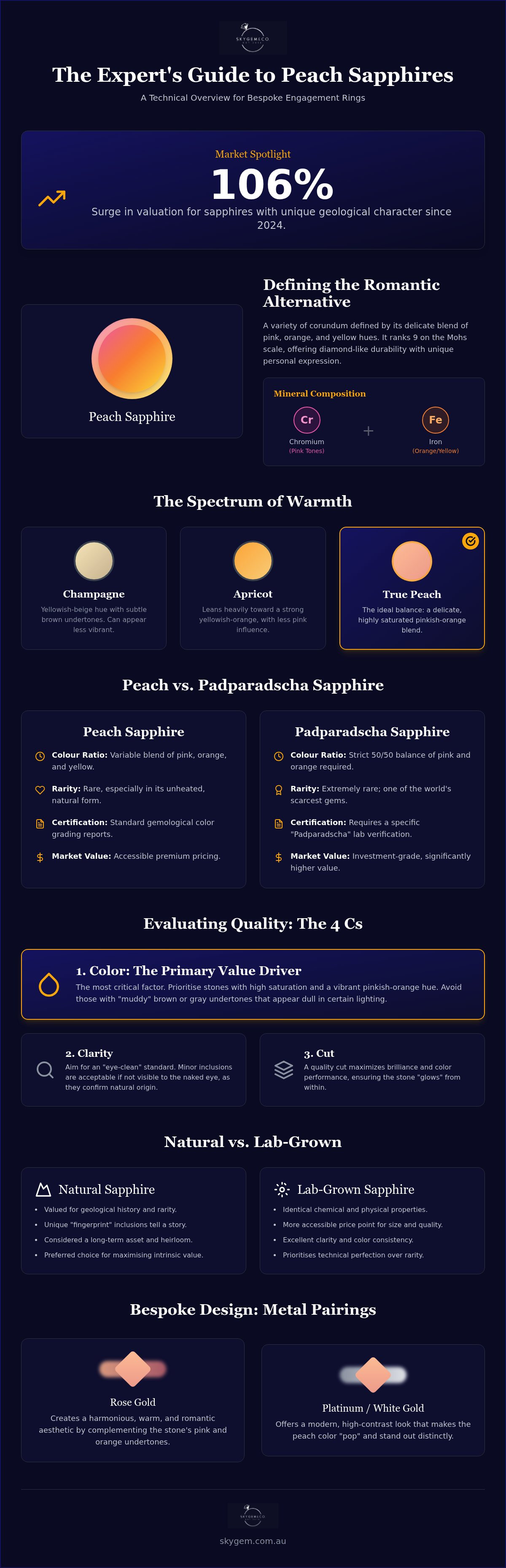
A peach sapphire is a sapphire exhibiting a blend of pink, orange, and yellow hues, reminiscent of a ripe peach or a sunset. Technically, this stone is a fancy-colour variety of the Sapphire gemstone, which belongs to the mineral species corundum. While some retailers mistakenly describe these gems merely as light pink, the presence of orange and yellow secondary hues is what defines a true peach specimen. Its distinct palette results from a rare chemical interaction between chromium, which provides pink tones, and iron, which introduces orange and yellow. These trace elements must exist in a precise ratio to achieve the delicate warmth that defines the category. In 2026, peach sapphires have emerged as a leading choice for non-traditional engagement rings, offering a sophisticated balance of technical durability and individual expression.
The Rise of Coloured Gemstones in Modern Engagement
The shift toward coloured stones reflects a broader move toward personalisation in bespoke jewellery. Modern couples often view traditional white diamonds as a standard baseline rather than a unique statement. Peach hues provide a "warm neutral" that complements various skin tones while maintaining the high-performance metrics expected of a sapphire. This aesthetic aligns with the "quiet luxury" movement, where value is found in rarity and refined beauty rather than overt flash. Because they rank 9 on the Mohs scale, these stones offer the reliability required for a project intended to last a lifetime. They serve as a bridge between the classic durability of a diamond and the expressive nature of a coloured gem.
Natural vs. Lab-Grown Peach Sapphires
When selecting a stone, you'll encounter both earth-mined and lab-grown options. Natural stones are valued for their geological history and unique "fingerprint" inclusions, which act as a signature of their origin. These microscopic features provide a narrative of the stone's formation over millions of years. This factor is often essential for those designing an heirloom piece. Lab-created versions offer the same chemical and physical properties as their natural counterparts but are available at a more accessible price point. While lab-grown stones provide excellent clarity and colour consistency, natural peach sapphires remain the preferred choice for those who prioritise rarity and long-term asset value. The choice typically depends on whether your project prioritises technical consistency or the intrinsic value of a rare natural resource.
The Spectrum of Warmth: Peach vs. Padparadscha Sapphires
Understanding the technical grading of warm-toned corundum is essential for selecting a stone that remains vibrant in all environments. The industry typically categorises these gems into three primary profiles: Champagne, Apricot, and true Peach. Champagne stones exhibit a yellowish-beige hue with subtle brown undertones, while Apricot stones lean heavily toward a yellowish-orange. True peach sapphires sit at the intersection of these tones, prioritising a delicate pinkish-orange balance. According to GIA's guide to sapphires, the value of these stones depends heavily on saturation. High-saturation stones appear to "glow" from within, whereas stones with low saturation or grey modifiers can look "muddy" or flat.
Lighting plays a critical role in how these hues perform. In natural daylight, the blue-weighted spectrum can make a peach stone appear cooler and more pink. Conversely, incandescent or warm indoor lighting emphasises the orange and yellow trace elements. This shift is why viewing a stone via high-definition video or in person is a necessary step in the procurement process. It's important to ensure the stone retains its character across different environments rather than washing out in bright light.
| Feature | Peach Sapphire | Padparadscha Sapphire |
|---|---|---|
| Colour Ratio | Variable blend of pink, orange, and yellow. | Strict 50/50 balance of pink and orange. |
| Rarity | Rare, especially in unheated form. | Extremely rare; one of the world's scarcest gems. |
| Certification | Standard colour grading reports. | Requires specific Padparadscha lab verification. |
| Market Value | Accessible premium pricing. | Investment-grade premium (158% surge since 2023). |
The Padparadscha Distinction
The term "Padparadscha" is derived from the Sanskrit word for "lotus colour," and it's reserved for a specific variety of sapphire that mimics the sunset. To qualify for this title, a stone must possess a delicate, light-to-medium-toned mix of pink and orange with no brown undertones. Because of this strict criteria, certified Padparadscha sapphires carry a significant premium. For many bespoke projects, a high-quality peach sapphire offers a nearly identical aesthetic profile with greater flexibility in carat weight and budget.
Identifying Secondary Hues
When evaluating a stone, you should look for "brightness" and "fire" rather than just the primary hue. The presence of brown or grey modifiers is the most common reason for a stone looking dull. These modifiers absorb light rather than reflecting it, which reduces the internal brilliance of the gem. You can explore our range of ethically sourced gemstones to see how different saturation levels affect the overall visual impact of a ring. High-definition video is often the best way to verify that a stone has the "life" and sparkle required for a high-end setting.
Evaluating Quality: The 4 Cs of Peach Sapphires
While the previous section detailed the visual spectrum of these gems, applying a technical framework to the "4 Cs" allows for an objective assessment of value. Unlike diamonds, where the absence of colour is often prized, the valuation of peach sapphires is driven by the specific interaction of hue, tone, and saturation. Hue refers to the primary and secondary colours, while tone describes the lightness or darkness of the stone. Saturation is the intensity of that colour. For a stone to truly "glow," it requires a medium tone combined with high saturation. If the tone is too dark, the stone loses its delicate peach identity; if it's too light, the colour may wash out under bright light.
Clarity and cut are equally vital in light-coloured corundum. Because these stones are lighter in tone, internal inclusions are more visible than they would be in a dark navy sapphire. We recommend an "eye-clean" standard as the baseline for any bespoke project. This means that no inclusions are visible to the naked eye when viewed from a standard distance. Furthermore, the precision of the cut determines how light interacts with the stone's internal facets. A poorly cut stone may exhibit "windowing," a technical flaw where the centre of the gem appears transparent and lacks light return. A well-proportioned cut ensures that the colour remains vibrant and consistent across the entire face of the gemstone.
- Colour: Hue should be a balanced pinkish-orange; tone should stay light to medium.
- Clarity: Eye-clean is the professional standard to ensure brilliance isn't obscured.
- Cut: Depth is required to prevent windowing and maximise light reflection.
- Carat: High-quality stones are most common in the 1 to 3-carat range.
Durability and the Mohs Scale
Sapphires rank 9 on the Mohs scale of hardness, making them the most reliable diamond alternative for daily wear. This rating indicates a high resistance to scratching and surface abrasion, which is essential for an engagement ring. To keep the stone's internal "glow" alive, regular maintenance is required. Oils from skin and lotions can build up on the pavilion facets, dulling the stone's fire. A simple cleaning with warm, soapy water and a soft brush is usually enough to restore its original lustre. This technical resilience ensures the piece remains a permanent asset rather than a delicate fashion item.
The Truth About Heat Treatment
Standard heat treatment is a widely accepted industry practice used to improve colour and dissolve microscopic inclusions. This process is stable and permanent, mimicking the natural heat of the earth. However, unheated sapphires that possess naturally vibrant peach hues are significantly rarer. These stones command a price premium of 30% to 50% due to their scarcity. When you're reviewing a GIA or independent lab report, always check the "Observations" or "Treatments" section. A professional report will explicitly state whether a stone is "N" (Natural/No Heat) or "H" (Heated), providing the transparency needed for an informed purchase.
Designing Your Dream Peach Sapphire Engagement Ring
Designing a ring for peach sapphires requires a technical understanding of how different metal alloys reflect light into the stone's pavilion. Because these gemstones are typically light in tone, the surrounding metal acts as a secondary light source that can either enhance or alter the stone's perceived hue. Selecting the right metal is not merely an aesthetic choice. It's a strategic decision to maximise the gemstone's natural saturation and ensure the final piece performs well in various lighting conditions.
Metal Pairing Framework
18K Rose Gold is the most frequent choice for those seeking a harmonious, monochrome aesthetic. The copper content in the gold alloy mirrors the pink trace elements in the corundum, creating a seamless transition between the stone and the band. This pairing is ideal for stones with a dominant pink hue. Conversely, Platinum and 18K White Gold provide a high-contrast environment. These cool-toned metals act as a neutral backdrop, which forces the eye to perceive the pink and orange tones more vividly. This is a professional strategy for highlighting stones that might otherwise appear too pale against the skin.
A specific design tip for stones with stronger yellow or apricot undertones is the use of 18K Yellow Gold. The rich yellow reflection from the metal can "boost" the secondary orange tones, making a stone with lower saturation appear more vibrant. This approach treats the metal as a tool to correct or enhance the natural properties of the gem. It's a technical solution for stones that sit on the warmer side of the peach spectrum, ensuring the "sunny" character of the stone isn't lost in a cooler setting.
Side Stones and Accents
While a solitaire engagement ring offers minimalist elegance, adding accent stones can provide a necessary reference point for the eye. Colourless diamonds, typically graded D-F, provide a stark white contrast that makes the warmth of peach sapphires stand out. Without a neutral reference point, a light-coloured sapphire can sometimes blend too much with the wearer's skin tone. Using pear or marquise-shaped side diamonds to frame an oval centre stone creates a tapered look that elongates the finger while providing additional brilliance.
For those seeking a vintage or floral-inspired aesthetic, cluster settings and trilogy designs offer more surface area for light reflection. A trilogy setting allows you to pair the centre stone with two smaller diamonds or even complementary coloured gems. This creates a complex light profile that can mask minor inclusions and maximise the internal "glow" of the sapphire. If you're ready to translate these technical concepts into a physical piece, you can start your bespoke design process with our expert consultants to ensure every specification meets your long-term vision.
Sourcing & Custom Jewellery with SkyGem & Co.
SkyGem & Co. operates as a technical consultant for those seeking high-quality gemstones. We prioritise transparency and education, ensuring you understand the value drivers of peach sapphires before making a commitment. Our global network of reputable suppliers allows us to source stones with specific hue and saturation profiles that are often unavailable in standard retail environments. Through expert consultations, we identify stones that meet your technical requirements while remaining within your designated budget. We treat every project as a partnership, focusing on the intersection of technical precision and your personal aesthetic goals. This collaborative approach removes the ambiguity often found in gemstone procurement, replacing it with data-driven decision-making.
The Bespoke Journey
The bespoke design process begins with a detailed technical brief. Once a stone is selected, we move to the initial CAD design phase. This step is critical because every sapphire has unique dimensions. We don't use standard, mass-produced settings. Instead, the mount is engineered to the exact millimetre of your stone's girdle and pavilion. This level of precision prevents stone movement and ensures the long-term stability of the setting. Following the digital phase, the piece undergoes rigorous quality control and meticulous hand-finishing. This methodical approach ensures that every facet of the ring is polished to a professional standard, supporting the structural integrity and longevity of the asset.
Ethical Sourcing and Trust
Reliability is built on a foundation of ethical sourcing and verifiable data. We work exclusively with suppliers who adhere to strict regulatory standards, ensuring all stones have conflict-free origins. For natural peach sapphires, we emphasise the importance of GIA certification or independent laboratory reports. These documents provide an objective audit of the stone's origin and treatment status, which is vital for maintaining the stone's value over time. By focusing on quality over hype, we help you create a heritage piece that functions as a permanent family asset. Our goal is to provide a solution-oriented experience where technical precision meets aesthetic excellence. This ensures your jewellery remains a viable and cherished item that can be passed down through generations with confidence.
Securing Your Heritage Gemstone Investment
Selecting peach sapphires involves a precise balance between technical specifications and individual expression. You now understand how trace elements influence saturation and why a 9 on the Mohs scale establishes these stones as a reliable, high-performance alternative to traditional diamonds. By applying the metal pairing frameworks discussed, you can ensure the gemstone's warmth is enhanced by the structural design of its setting. This methodical approach transforms a rare natural resource into a permanent asset that functions as a legacy piece for your family.
Our team acts as a technical consultant to provide the expert gemmological guidance required for such a significant project. We integrate bespoke CAD design services with a commitment to ethically sourced natural and lab-grown stones, ensuring every piece is engineered for longevity and aesthetic precision. To begin your journey toward a uniquely personal engagement ring, Book a Bespoke Consultation with SkyGem & Co. today. We look forward to partnering with you to create a heritage piece that will be cherished for generations.
Frequently Asked Questions
Are peach sapphires more expensive than diamonds?
Generally no. While these coloured gems are rarer than white diamonds, they remain a more accessible alternative for a bespoke engagement ring of similar size and clarity. However, rare unheated Padparadscha varieties have seen a 158% surge in valuation since early 2023, occasionally exceeding diamond prices at the investment level. For most projects, these stones offer significant value for their rarity and individual character, allowing for a larger centre stone within your specified budgetary framework.
Can I wear a peach sapphire engagement ring every day?
Yes, you can wear a peach sapphire ring daily because sapphires rank 9 on the Mohs scale of hardness. This technical rating makes them the most durable gemstone choice for an engagement ring after diamonds. They are highly resistant to surface scratching and structural abrasion, ensuring the piece remains a reliable asset throughout decades of wear. We recommend periodic inspections of the setting to maintain the structural integrity of the mounting and keep the stone secure.
What is the difference between a peach sapphire and a Padparadscha?
The difference lies in the strictness of the colour ratio and the resulting market scarcity. While "peach" describes a broad spectrum of pinkish-orange hues, a Padparadscha sapphire must exhibit a precise balance of pink and orange without any brown modifiers. This specific variety is one of the world's rarest gems. Choosing high-quality peach sapphires often provides a nearly identical aesthetic profile while allowing for greater flexibility in your project's carats and technical specifications.
Which metal is best for a peach sapphire ring?
The best metal depends on whether you want to harmonise or contrast with the stone's primary hue. 18K Rose Gold is ideal for a seamless look as it complements the pink undertones. Conversely, Platinum or 18K White Gold creates a neutral backdrop that highlights the coolness of the pink hues. For stones with stronger apricot tones, 18K Yellow Gold is a strategic choice to boost the sunny, orange secondary tones of the gem.
Do peach sapphires lose their colour over time?
No, the colour of a sapphire is chemically stable and won't fade or change due to light exposure or age. Unlike some other coloured gemstones, corundum's crystal structure locks in the chromium and iron trace elements that provide its hue. If your jewellery appears duller over time, it's usually due to a build-up of surface oils or lotions on the pavilion facets. Regular cleaning restores the stone's original internal brilliance and fire to its full capacity.
Should I choose a heated or unheated peach sapphire?
The choice depends on whether you prioritise natural rarity or colour consistency. Standard heat treatment is an industry-accepted practice that improves visual performance. Unheated peach sapphires are significantly rarer and often command a substantial price premium because their colour is entirely earth-created. For a heritage project where long-term asset value is the primary driver, an unheated stone with a GIA report is often the preferred technical selection to ensure the stone remains a permanent asset.
How do I clean my peach sapphire jewellery at home?
You can clean your jewellery at home using a solution of warm water and a few drops of mild dish soap. Use a soft-bristled brush to gently remove debris from behind the stone, as build-up in this area can obscure light return and dull the stone's glow. Rinse the piece thoroughly in clean water and pat it dry with a lint-free cloth. This simple maintenance routine ensures the stone's precision cut continues to perform at its peak.
Disclaimer
This article is for general informational purposes only and may include AI-assisted content. Pricing, specifications, and availability are subject to change. For accurate advice and current information, please contact SkyGem & Co. directly. Nothing in this content constitutes professional or financial advice.