
Peach Sapphire Engagement Rings: The 2026 Guide to Modern Romance

Choosing a soft-toned gemstone shouldn't mean compromising on the structural integrity of your daily-wear jewellery. While you may be drawn to the romantic aesthetic of stones like morganite, their lower durability often leads to surface abrasions and loss of lustre over time. A peach sapphire engagement ring provides a superior technical alternative, offering the same warm, champagne-to-sunset hues with the uncompromising hardness of the corundum family. This ensures your investment remains as resilient as it is beautiful.
We recognize that selecting a bespoke gemstone involves evaluating complex terminology and varying market standards. You're likely looking for clarity on the "padparadscha" distinction or concerned about how a stone's saturation shifts in different environments. This 2026 guide addresses those technical uncertainties directly. We'll examine the specific properties of unheated sapphires, the importance of updated GIA reporting standards, and how a professional design approach ensures your ring functions as a permanent, evolving asset for your future together.
Key Takeaways
- Understand how the corundum family’s Mohs hardness of 9 provides the structural durability required for a lifetime of wear, preventing the scratching and cloudiness common in softer stones.
- Learn the technical distinction between standard peach hues and rare padparadscha classifications to ensure your peach sapphire engagement ring meets specific investment and aesthetic standards.
- Discover how trace elements like iron and chromium influence colour saturation and how to evaluate a stone’s performance under both daylight and incandescent lighting.
- Explore how bespoke CAD design and precision cutting techniques, such as specific facet patterns in ovals and cushions, prevent "windowing" and maximise light return.
- Gain insights into utilizing updated GIA coloured stone reports to verify origin and treatment status, ensuring the long-term value of unheated, ethically sourced gemstones.
The Rise of the Peach Sapphire Engagement Ring
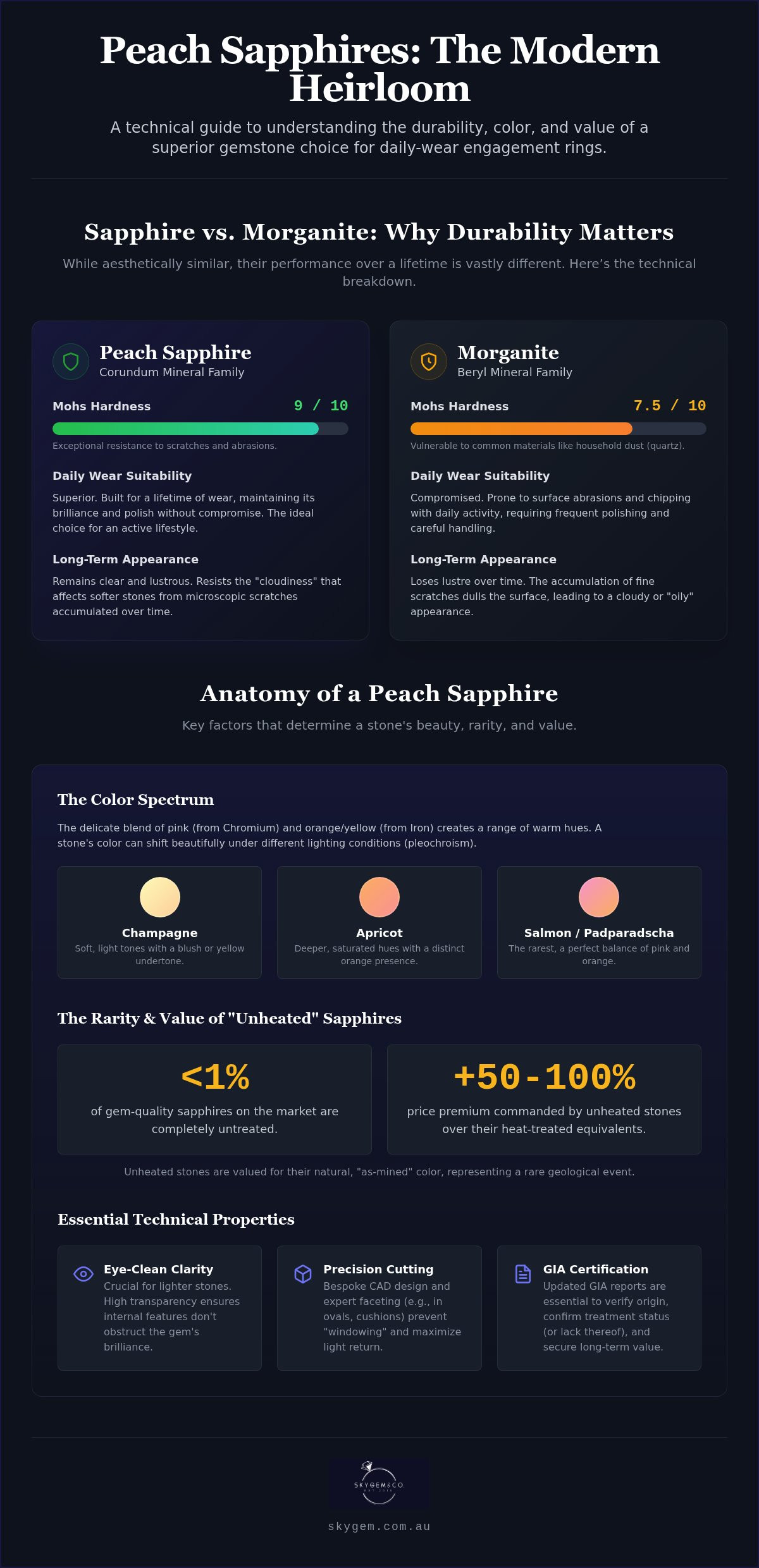
The peach sapphire is a sophisticated variety of the corundum mineral family, distinguished by its delicate blend of pink and orange hues. While traditional white diamonds have long dominated the market, modern couples are increasingly prioritising individuality and technical performance. A peach sapphire engagement ring serves as a high-performance, romantic alternative to both traditional diamonds and softer stones like morganite, offering superior durability for lifelong wear. This shift reflects a deeper appreciation for the Sapphire gemstone properties, specifically a Mohs hardness of 9, which ensures the stone withstands the rigours of daily activity without the scratching associated with softer beryl varieties.
Symbolically, these stones occupy a unique space. They combine the intense passion historically attributed to rubies with the serene, intellectual clarity of yellow sapphires. This creates a narrative of balanced partnership that resonates with contemporary design philosophies. Choosing this stone is a statement of intent, moving away from mass-market trends toward a more personalised expression of commitment.
The Aesthetic Appeal of Warm Tones
The popularity of peach hues stems from their exceptional versatility across a broad spectrum of skin tones. Unlike the stark brilliance of a D-colour diamond, the warmth of a peach sapphire provides a softer, more integrated look. This aligns with the "quiet luxury" movement, where value is found in subtle, high-quality materials rather than overt displays of wealth. Each stone is technically unique. Natural inclusions, often referred to as "silk," act as a microscopic fingerprint. These features verify the stone's natural origin and ensure that no two rings are identical.
A Modern Heirloom Choice
In 2026, the demand for non-traditional engagement rings has reached a new peak. Couples now view their choice of gemstone as a long-term asset. While the legendary "Padparadscha" sapphire remains the pinnacle of rarity due to its specific salmon-pink requirements, high-quality peach sapphires offer a similar aesthetic profile with significant investment potential. Untreated stones are particularly valuable. Research indicates that untreated sapphires make up less than 1% of gem-quality stones globally, often commanding a price premium of 50% to 100% over heat-treated equivalents. Madagascar continues to be a primary source for these high-end varieties, providing stones with the clarity and saturation required for heirloom-quality jewellery.
The Colour Spectrum: Understanding Champagne, Apricot, and Salmon
The visual profile of a peach sapphire is determined by a precise chemical intersection within the crystal lattice. Trace amounts of iron, which typically produce yellow hues, combine with chromium, the element responsible for pink and red tones, to create the diverse peach spectrum. Because these gemstones are pleochroic, they display different colours when viewed from different angles or under varying light sources. A peach sapphire engagement ring that appears softly champagne in natural morning light may shift toward a deeper apricot under warm, incandescent evening bulbs. This colour-shifting property is a hallmark of high-quality corundum and should be a key consideration during your selection process.
According to the Gemological Institute of America (GIA), the most coveted fancy sapphires exhibit a balanced saturation that doesn't appear overly dark or "inky." For lighter-toned stones, eye-clean clarity is essential. Because light passes through pale gems with less interference, internal inclusions are more visible than they would be in a dark blue or green stone. Selecting a stone with high transparency ensures that the brilliance of the cut isn't obscured by internal features. If you're exploring these unique variations, our consultants can help you compare precious gemstones to find the exact saturation level that meets your technical and aesthetic requirements.
The premium for unheated stones is a significant factor in 2026. While over 95% of sapphires on the market undergo heat treatment to enhance their appearance, untreated stones command a price premium of 50% to 100%. These unheated specimens are valued for their "as-mined" colour, representing a rare geological occurrence where nature provided the perfect conditions for saturation without human intervention.
Champagne and Soft Blush Hues
The lightest peach sapphires often feature a champagne or soft blush undertone. These stones are frequently mistaken for rare pink or champagne diamonds due to their high refractive index and sparkle. To maximise the impact of these pale, sophisticated hues, we often recommend 18K rose gold settings. The copper content in the metal pulls out the subtle pink flashes within the stone, preventing it from appearing washed out in bright environments.
Vivid Apricot and Deep Salmon Tones
Stones with higher concentrations of chromium lean toward vivid apricot and deep salmon. These deeper tones occupy the technical overlap with Padparadscha sapphire grading, though a true Padparadscha must meet very specific salmon-pink criteria. High-saturation stones maintain their "pop" even in low-light conditions, making them an excellent choice for those who want a gemstone that remains vibrant from day to night without losing its distinct colour profile.
Sapphire vs. Morganite: Why Durability Matters
While morganite offers a similar aesthetic profile, its mineral composition presents significant challenges for daily wear. According to the geology of corundum gemstones, sapphires possess a Mohs hardness of 9, making them significantly more resistant to surface abrasions than morganite, which sits at 7.5 to 8. This technical difference is the primary reason a peach sapphire engagement ring maintains its polish for decades, whereas softer stones often develop a "cloudy" appearance due to microscopic surface scratches. These scratches don't just dull the surface; they act as traps for dirt and oils, permanently compromising the stone's transparency.
The long-term maintenance of your jewellery depends heavily on how the gemstone interacts with daily contaminants. Sapphire's surface doesn't easily trap the microscopic debris found in hand lotions, soaps, or skin oils. This chemical stability ensures that the stone requires less frequent professional cleaning to maintain its original brilliance. In contrast, morganite is known to attract oils, which contributes to a rapid loss of lustre that can't always be rectified by simple cleaning. For a piece intended to be worn every day for a lifetime, these performance metrics are as critical as the stone's visual appeal.
With a high refractive index of approximately 1.76 to 1.77, sapphire bends light more efficiently than beryl-based stones like morganite, which typically feature a lower refractive index of roughly 1.57 to 1.58. This higher index results in a more vibrant light return, ensuring the stone remains lively even as it ages.
The Daily Wear Test
Engagement rings are subjected to mechanical stress that occasional-wear jewellery never encounters. Sapphire's lack of cleavage, which is a mineral's tendency to break along specific planes, provides superior resistance to chipping and structural failure. When you calculate the cost-per-year over a lifetime, the initial investment in a peach sapphire engagement ring proves more economical than replacing a damaged or dull morganite every five to ten years. Investing in a harder material ensures the facet edges remain sharp and the table of the stone remains free of the "rounding" effect seen in softer gems.
Refractive Index and Brilliance
The "sparkle factor" in a gemstone is a direct result of its light-bending properties and facet alignment. In a peach sapphire, the higher refractive index translates to sharper light return, particularly in precision-cut Ovals, Radiants, and Cushions. These cuts are engineered to maximise internal reflection, ensuring the stone doesn't "window" or lose its colour depth in the centre. To compare these properties across different varieties and observe how saturation levels interact with various lighting environments, you can Explore our collection of precious gemstones and consult with our technical team on stone performance.
Designing Your Bespoke Peach Sapphire Ring
The transition from selecting a loose gemstone to engineering a finished piece requires a technical understanding of light performance. In a peach sapphire engagement ring, the choice of cut is the most significant variable affecting colour intensity. Ovals and cushions are the preferred geometries because their deeper pavilions minimise "windowing." This occurs when light passes directly through the centre of the stone without reflecting back to the viewer, resulting in a pale, washed-out appearance. Precision faceting ensures that the stone's internal reflections amplify its unique apricot or salmon saturation, as discussed in previous sections regarding colour science.
Integrating side stones requires a balanced approach to contrast and light return. Colourless diamonds offer a stark, brilliant counterpoint that defines the boundaries of the central peach hue, making it appear more vivid. For a more fluid aesthetic, tonal gemstones such as light pink or champagne accents can create a seamless colour gradient across the finger. To ensure the structural integrity and aesthetic precision of these complex arrangements, you can Learn about our custom-made engagement ring process and how we use digital prototyping to refine every technical detail before manufacturing begins.
Selecting the Best Metal
The alloy you choose acts as a subtle colour filter for the gemstone. 18K rose gold is a frequent recommendation for stones with strong pink or salmon undertones, as the copper content in the metal reinforces these warm wavelengths. Conversely, platinum or white gold provides a neutral, premium frame that creates a crisp contrast, making the peach tones appear more distinct and modern. Yellow gold serves to enhance the warmth of champagne and apricot varieties, providing a classic look that feels integrated rather than high-contrast.
Setting Styles for Coloured Stones
Setting architecture should reflect the wearer's lifestyle and the stone's specific light-handling properties. Solitaire settings remain a preferred choice for a minimalist, stone-focused aesthetic, allowing maximum light entry from all angles to showcase the sapphire's clarity. Halo settings are technically advantageous for smaller stones, as they increase the total visual diameter and introduce additional "fire" through surrounding diamond accents. Trilogy designs offer a more complex narrative, often pairing a central peach stone with pear or baguette-cut side diamonds to create a sophisticated, wide-profile look. If you're ready to begin your design journey, we invite you to start your custom ring consultation with our design specialists today.
Sourcing and Crafting Your Ring with SkyGem & Co.
Securing a high-performance peach sapphire engagement ring requires more than just an aesthetic eye; it demands a rigorous procurement process. At SkyGem & Co., we act as technical consultants, sourcing ethically mined stones from reputable global suppliers in regions like Madagascar and Sri Lanka. Our focus remains on transparency, providing you with unheated specimens that retain their natural geological characteristics. Every stone we provide undergoes strict evaluation to ensure it meets the clarity and saturation standards established in our previous discussions on colour science.
Transparency in grading is the foundation of our partnership. When reviewing a sapphire certificate, you should look for specific data regarding origin and treatment status. As of January 1, 2026, the GIA has implemented redesigned coloured stone reports that offer enhanced storytelling and precise origin determination. These reports are essential for verifying that your peach sapphire is natural and untreated, which directly impacts its long-term investment value. We guide you through these metrics, ensuring you understand the technical specifications before committing to a bespoke design.
The Bespoke Journey
The transition from a loose gemstone to a finished piece of jewellery is a collaborative engineering project. Our process begins with an expert consultation where we discuss the intersection of your personal narrative and the stone's physical properties. Using advanced CAD design, we create a digital prototype that allows for precise adjustments to the setting's geometry. This ensures the final piece isn't just a ring, but a custom-engineered asset. Our master jewellers then hand-finish each setting, a method that provides superior security compared to mass-produced casts. This meticulous approach guarantees that the prongs are perfectly aligned with the stone's unique dimensions, preventing movement and wear over time.
Quality Assurance and Maintenance
Maintaining the structural integrity of your ring is a long-term commitment. Because sapphires are intended for daily wear, regular professional maintenance is necessary to monitor for potential issues like loosened prongs or accidental impact damage. We provide comprehensive cleaning and maintenance services to ensure your SkyGem piece retains its original brilliance. We recommend an annual technical inspection to verify the security of the setting, particularly for high-value unheated stones. If you're ready to begin the procurement process for a unique, durable gemstone, we invite you to Book a consultation to find your perfect peach sapphire with our specialist team.
Securing Your Bespoke Romantic Legacy
Selecting a peach sapphire engagement ring represents a sophisticated balance between technical performance and personal aesthetic. By choosing a stone from the corundum family, you've prioritised a Mohs hardness of 9; this ensures your investment remains resilient against the daily abrasions that compromise softer alternatives. This guide has detailed how specific trace elements and precision cutting influence light return, transforming a raw mineral into a vibrant, permanent asset for your future.
At SkyGem & Co., we act as your technical partners throughout this procurement process. Our specialists in unheated and rare sapphires provide the education necessary to navigate complex GIA reporting and saturation levels with confidence. Every piece we manufacture features hand-finished settings to ensure maximum gemstone security, supported by expert consultations with our master jewellers. We're dedicated to translating your vision into a durable, high-performance reality that respects both ethical sourcing standards and your unique design requirements.
Begin your bespoke journey with SkyGem & Co. today and discover a gemstone that perfectly reflects your personal story.
Frequently Asked Questions
Are peach sapphires more expensive than diamonds?
Peach sapphires are generally more cost-effective than natural diamonds of comparable size and clarity. While a high-quality diamond represents a substantial financial commitment, a sapphire allows you to secure a larger centre stone within a similar budget. Prices fluctuate based on origin and treatment; unheated stones from Madagascar command a premium due to their geological rarity. This makes them an excellent choice for couples seeking a high-impact aesthetic without the diamond price point.
Do peach sapphires change colour in different lighting?
These gemstones exhibit pleochroism, meaning they display different colours depending on the light source and viewing angle. A peach sapphire engagement ring may appear as a soft champagne in natural morning light while shifting toward a deeper apricot under warm, incandescent indoor bulbs. This dynamic behaviour is a technical hallmark of the corundum family. It ensures your ring maintains a unique visual profile that evolves throughout the day as environmental conditions change.
What is the difference between a peach sapphire and a Padparadscha sapphire?
Padparadscha is a specific, rare classification of sapphire that must meet strict gemological criteria for a delicate balance of pink and orange. While many "peach" stones are beautiful, only those with a particular salmon-pink saturation receive the Padparadscha designation from labs like the GIA. True Padparadschas are significantly more expensive and rarer than standard peach varieties. We recommend reviewing a certified report to verify any specific colour claims before your purchase.
Can I use a peach sapphire in a rose gold setting?
Rose gold is a highly recommended metal for these stones because the copper content in the alloy pulls out the pink and salmon undertones. This creates a cohesive, warm aesthetic that complements the gemstone's natural saturation. White gold or platinum provides a more modern, high-contrast look that makes the peach hue appear more distinct. Your choice of metal acts as a visual filter, subtly influencing the stone's perceived colour and overall performance.
How do I clean my peach sapphire engagement ring at home?
You can maintain your ring's brilliance by using a solution of warm water and a small amount of mild, degreasing detergent. Gently scrub the stone with a soft-bristled toothbrush, paying close attention to the area behind the setting where oils and lotions tend to accumulate. Rinse thoroughly and dry with a lint-free cloth. Unlike softer stones, sapphire's hardness prevents it from scratching during this routine maintenance, ensuring a lifetime of clarity and light return.
Are peach sapphires ethically sourced?
We ensure all our gemstones are ethically sourced from reputable global suppliers who adhere to transparent labour and environmental standards. Madagascar and Sri Lanka are primary sources for high-quality peach varieties, and we prioritise stones with verifiable origins. By selecting an ethically sourced peach sapphire engagement ring, you're supporting a supply chain that values both geological rarity and social responsibility. This commitment to transparency is central to our bespoke gemstone procurement process.
Is a peach sapphire hard enough for everyday wear?
Sapphires have a Mohs hardness of 9, making them one of the most durable gemstones available for daily wear. This rating is significantly higher than morganite, which sits at 7.5 to 8 and is prone to surface scratching and cloudiness over time. Because sapphire lacks "cleavage" planes, it's also highly resistant to chipping or breaking under mechanical stress. It's a technically superior choice for an engagement ring intended to be a permanent, lifelong asset.
What is the best cut for a peach sapphire to show its colour?
Oval and Cushion cuts are the most effective geometries for maximising colour saturation and light return. These deeper cuts prevent "windowing," a technical flaw where light passes through the centre of the stone and makes it appear pale or hollow. Precision faceting in these shapes ensures that light is reflected back to the eye, intensifying the apricot or blush tones. Our consultants can help you evaluate how different facet patterns influence the stone's overall visual performance.
Disclaimer
This article is for general informational purposes only and may include AI-assisted content. Pricing, specifications, and availability are subject to change. For accurate advice and current information, please contact SkyGem & Co. directly. Nothing in this content constitutes professional or financial advice.