
Peach Sapphire Engagement Rings: 2026 Australian Guide

What if the most sophisticated choice for your forever piece isn't a traditional diamond, but a gemstone that captures the specific, warm glow of an Australian sunset? Selecting a peach sapphire engagement ring in Australia has transitioned from a niche trend to a primary choice for those who value both aesthetic rarity and technical performance. You have likely noticed that the market is often flooded with varying descriptions like salmon, champagne, and blush, which can make it difficult to determine exactly what you're purchasing.
We understand that investing in a bespoke ring requires more than just an emotional connection; it demands technical assurance. This guide provides the clarity you need to navigate the grading differences between standard peach tones and the rare Padparadscha variety, while addressing common concerns regarding long-term durability. We'll examine how these stones perform on the Mohs scale and which metal alloys best complement their unique light-refraction properties. By the end of this analysis, you'll have a clear, professional path toward designing a custom piece that balances refined design with the rigorous standards of modern jewellery engineering.
Key Takeaways
- Differentiate between standard peach tones and the rare Padparadscha variety by understanding the specific pink-to-orange saturation ratios required for technical grading.
- Recognise why the 9 Mohs hardness of a sapphire makes it the superior coloured gemstone choice for long-term durability and daily wear.
- Learn how to select metal alloys and prong colours that technically enhance the brilliance of a peach sapphire engagement ring australia rather than muting its warm undertones.
- Identify the difference between eye-clean and loupe-clean stones to ensure your gemstone investment meets high clarity standards without paying for invisible characteristics.
- Understand how the bespoke CAD design process ensures your ring achieves a balance of personalised aesthetic and structural precision.
What is a Peach Sapphire Engagement Ring?
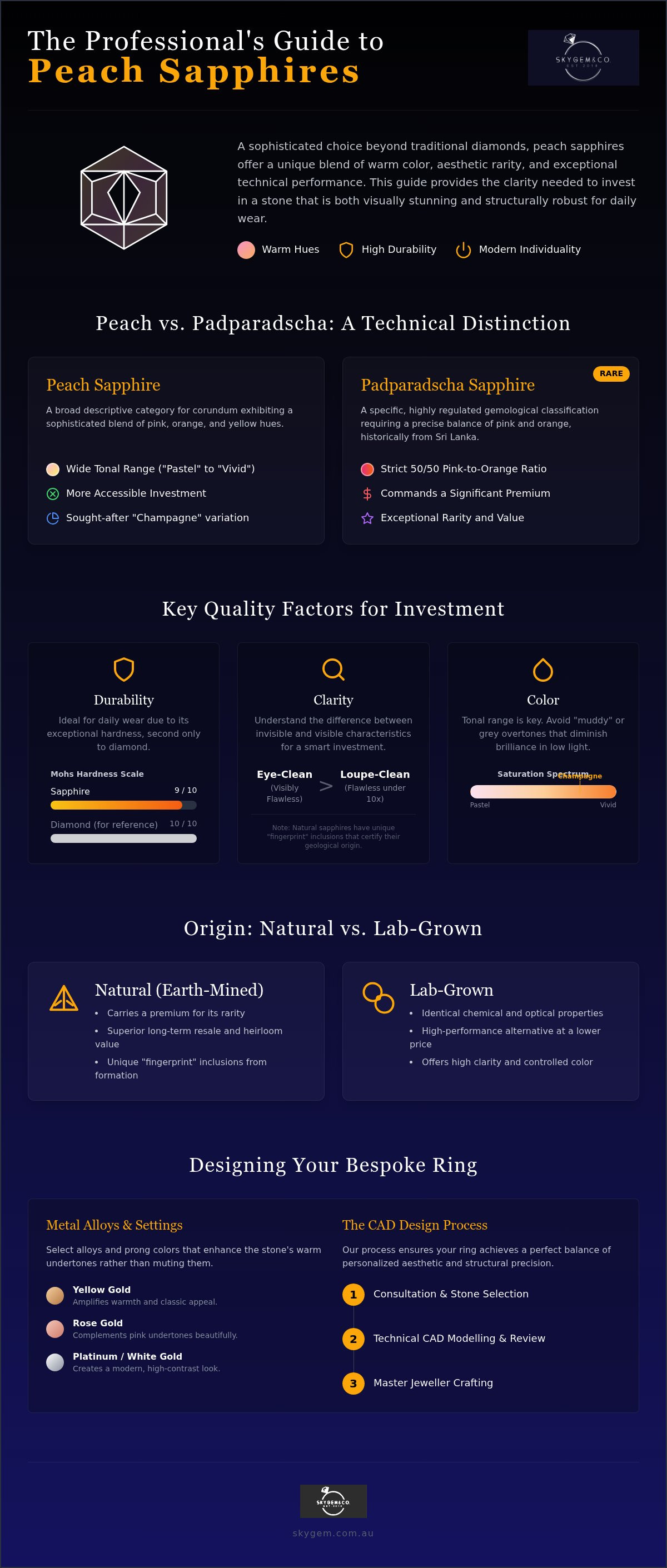
A peach sapphire is a naturally occurring variety of the mineral corundum. While most consumers associate this species with deep blues, these specific stones exhibit a sophisticated blend of pink, orange, and yellow hues. These Sapphire gemstone properties define the stone's physical integrity and visual depth, distinguishing it from other pastel gemstones. A peach sapphire ranks at a 9 on the Mohs scale of mineral hardness, making it an ideal candidate for the structural demands of daily wear.
In the context of a peach sapphire engagement ring australia, the stone represents a departure from the clinical brilliance of white diamonds. It symbolises a balance of warmth and modern individuality, offering a softer aesthetic that remains technically robust. Many Australian couples now prioritise gemstones that reflect a specific personal style rather than adhering to traditional norms. This shift is driven by a desire for a ring that feels both authoritative in its design and unique in its colour profile.
The Rise of Non-Traditional Gemstones in Australia
The Australian bridal market has seen a marked increase in the demand for 'champagne', 'salmon', and 'blush' palettes. This trend isn't merely about colour; it's about the technical value proposition. Peach sapphires often allow for a larger surface area and higher carat weight for a more accessible investment than a diamond of comparable size. Beyond the financial logic, there's a growing appreciation for the unique 'fingerprint' inclusions found in earth-mined stones. These minor internal characteristics serve as a certificate of the stone's geological history, ensuring that no two rings are identical.
Natural vs. Lab-Grown Peach Sapphires
Deciding between natural and lab-grown stones is a critical step in the bespoke design process. Natural peach sapphires are formed over millions of years and carry a premium due to their rarity and the complexity of their extraction. These earth-mined varieties typically hold superior long-term resale and heirloom value. Conversely, lab-grown options provide a high-performance alternative with identical chemical properties at a lower price point.
At SkyGem & Co., we maintain a strict policy of transparency regarding gemstone origin. Whether you select a natural sapphire or a lab-created variant, understanding the source is essential for project-based jewellery creation. This transparency ensures that your choice aligns with both your aesthetic goals and your long-term investment strategy.
Peach vs. Padparadscha: Understanding the Technical Distinction
Distinguishing between a standard peach sapphire and a true Padparadscha is a critical step in the procurement process. While the term "peach" is a broad descriptive category, "Padparadscha" refers to a specific, highly regulated colour classification. Historically sourced from Sri Lanka, a Padparadscha sapphire must exhibit a precise 50/50 balance of pink and orange. This specific ratio is exceptionally rare in nature, which is why these stones command a significant premium over standard peach varieties. When you select a peach sapphire engagement ring australia, understanding this technical boundary ensures you aren't paying Padparadscha prices for a stone that doesn't meet the strict gemological criteria.
The final hue of these gemstones is determined by the concentration of trace elements within the corundum crystal lattice. Chromium provides the pink saturation, while iron introduces the orange and yellow tones. The intersection of these elements must be perfectly balanced; an excess of iron can result in brownish or "muddy" overtones that diminish the stone's brilliance and value. SkyGem & Co. acts as a technical consultant during this phase, helping you evaluate stones based on their chemical purity and visual performance. If you are looking for specific stone types, you can explore our precious gemstones collection to see the variation in available hues.
Colour Saturation and Tonal Range
The tonal range of peach sapphires spans from "Pastel" to "Vivid." In the Australian market, the "Champagne Peach" shade has emerged as the most sought-after variant for custom jewellery. This specific tone offers a neutral warmth that complements a wide range of skin tones without appearing overly saturated. It's essential to scrutinise the stone under different lighting conditions to identify secondary overtones. High-quality specimens maintain their clarity and warmth, whereas lower-tier stones may appear grey or dark in low-light environments.
The 'Lotus Flower' Standard
The name Padparadscha is derived from the Sanskrit word for "lotus flower," reflecting the delicate, ethereal nature of the stone's colour. Because the distinction between a "pinkish-orange sapphire" and a "Padparadscha" can be subjective, a reputable lab certificate from an organisation like the GIA is mandatory for verification. This documentation provides the technical assurance that the stone meets the industry-standard colour ratio. For those beginning their search, viewing a variety of certified gemstones can provide the visual context necessary to make an informed decision regarding rarity and budget.
Selecting the Ideal Metal and Setting for Peach Tones
The choice of mounting material is as critical as the stone itself when commissioning a peach sapphire engagement ring australia. Metal alloys don't just secure the gemstone; they act as a reflective backdrop that fundamentally influences the stone's perceived saturation. Because sapphires are pleochroic, meaning they can show different colours from different angles, the surrounding metal can either "blend" with the stone for a monochromatic look or "pop" the primary hue through visual contrast. For instance, selecting 18K Rose Gold enhances the pink undertones of a peach sapphire, creating a seamless and sophisticated transition between the metal and the gemstone.
We also consider the technical impact of prong colour on the stone's brilliance. Using white gold or platinum prongs on a peach stone can increase the perception of light return, as these neutral metals reflect more "white" light into the crown facets. However, if your design goal is a unified, warm aesthetic, matching the prongs to a rose or yellow gold band is the superior choice. Because peach sapphires are frequently cut into unique cushion, oval, or pear shapes to maximise colour retention, standard commercial settings often fail to provide a secure or aesthetic fit. A bespoke CAD design ensures the setting perfectly contours to the specific dimensions of your stone, mitigating structural risks while maintaining a refined profile.
Rose Gold vs. Yellow Gold vs. Platinum
Rose Gold remains the most popular choice for those seeking a "seamless" romantic aesthetic. The copper content in the alloy mirrors the pink trace elements within the sapphire crystal, resulting in a soft, blush-toned appearance. Yellow Gold provides a high-contrast, vintage-inspired warmth that is particularly effective for stones with stronger orange or yellow secondary tones. For a crisp, modern look, Platinum or White Gold offers a neutral frame that highlights the orange-yellow facets and the stone's internal clarity without adding additional warmth to the hue.
Popular Setting Styles: Solitaire to Halo
Solitaire settings are the primary choice for showcasing the unique colour of a high-quality sapphire. This minimalist approach relies on the gemstone's quality and ensures it remains the central focus of the design. Conversely, halo designs utilise white diamond accents to increase the overall size perception and light-refraction of the piece. The contrast between the brilliant white diamonds and the warm peach centre stone creates a vivid focal point that is both technically impressive and visually striking. You can browse our bespoke engagement rings to evaluate how these different styles interact with various gemstone shapes.
Quality Factors: Durability, Clarity, and Cut
Technical performance is the cornerstone of any high-quality peach sapphire engagement ring australia. Because sapphires are a variety of corundum, they possess a Mohs hardness rating of 9. This makes them significantly more resilient than other coloured gemstones like morganite or emerald. For the active Australian lifestyle, this durability is essential. It ensures the stone resists the daily abrasions caused by contact with harder surfaces, maintaining its polish and structural integrity over decades of wear. While diamonds are the only harder mineral, sapphires offer the best balance of colour variety and industrial-grade toughness.
Clarity in coloured gemstones follows a different standard than diamond grading. We categorise stones as "eye-clean" rather than "loupe-clean." An eye-clean sapphire has inclusions that are invisible to the naked eye, which is the professional benchmark for high-end jewellery. Furthermore, the "windowing" problem is a technical flaw to avoid. A window occurs when a stone is cut too shallow, causing light to pass through the centre rather than reflecting back to the viewer. This results in a "dead" or transparent spot in the middle of the gem. Most sapphires undergo traditional heat treatment to dissolve trace silk and enhance colour saturation. While this is a standard industry practice, unheated specimens remain a rare and premium alternative for collectors seeking a completely natural stone.
Pleochroism and Light Performance
Peach sapphires are pleochroic, meaning they display different colours depending on the axis of light. You might observe a dominant orange flash from one angle and a soft pink hue from another. The intense UV levels of the Australian sun significantly impact this light performance, often making the pink undertones appear more vivid outdoors than under indoor fluorescent lighting. To manage this, SkyGem & Co. prioritises brilliant cuts for maximum light return or step cuts to highlight the stone's internal clarity and tonal depth. A well-executed cut ensures the stone remains "alive" in all lighting environments.
The Importance of GIA Certification
Independent verification is non-negotiable when procuring a high-value gemstone. A GIA report confirms the stone's dimensions, origin, and whether it has undergone any thermal treatments. This transparency protects your investment and ensures the technical specifications match the retail valuation. You can read our guide on GIA certification to understand how to interpret these technical reports. Before finalising your design, we recommend you view our collection of certified gemstones to compare different cut qualities and saturation levels in person.
Designing Your Bespoke Peach Sapphire Ring with SkyGem & Co.
Creating a peach sapphire engagement ring australia involves a structured, project-based approach that prioritises technical precision over off-the-shelf convenience. Unlike ready-to-wear retailers, we act as your technical consultants throughout the entire manufacturing journey. The process begins with an in-depth consultation where we evaluate your aesthetic vision against your practical requirements and budget. We discuss specific stone preferences, such as the desired pink-to-orange ratio and the intended metal alloy, ensuring the final design is structurally sound and visually balanced.
Once the design parameters are established, we leverage our network of reputable global suppliers to source a selection of gemstones that meet our rigorous quality standards. This sourcing phase is critical; we filter through dozens of specimens to find stones with the correct saturation and minimal windowing. After you select your centre stone, our team develops a detailed CAD (Computer-Aided Design) model. This allows you to visualise the ring in 3D from every angle, providing an opportunity to verify proportions and prong placement before any metal is cast. This level of digital prototyping eliminates the guesswork often associated with traditional jewellery making.
The final stage involves precision casting and meticulous hand-finishing. Our master jewellers refine every surface, ensuring the setting is polished to a mirror finish and the stones are secured with industrial-grade accuracy. This combination of modern technology and traditional labour results in a piece designed to last for generations.
The Custom Design Timeline
A bespoke project typically requires a 4 to 6 week manufacturing window. This timeline accounts for the precision required in stone sourcing, CAD adjustments, and the final setting process. We don't rush the cooling or polishing phases, as these steps are vital for the metal's long-term durability. By following this methodical schedule, we ensure the structural integrity of the final piece meets our high-performance benchmarks. You can start your custom ring journey by reviewing our previous project portfolios.
Transparent Pricing and Education
We believe that an informed client is a successful partner. Our pricing model is transparent, helping you balance gemstone size, colour quality, and metal weight to achieve the best value for your investment. We provide education on the trade-offs between different saturation levels and stone origins, ensuring you understand exactly where your budget is allocated. Furthermore, SkyGem & Co. remains committed to ethical sourcing, ensuring all materials are conflict-free and responsibly extracted. To begin the process of selecting your centre stone, book a consultation to find your perfect peach sapphire with our specialist team.
Securing Your Investment in Bespoke Craftsmanship
Choosing a peach sapphire engagement ring australia is a decision that balances aesthetic warmth with high-level technical performance. We've examined how the 9 Mohs hardness of corundum provides a reliable foundation for daily wear, outperforming softer alternatives. Understanding the precise colour ratios that distinguish peach from Padparadscha ensures that your investment is grounded in gemological fact rather than marketing jargon. By pairing these stones with technically compatible metal alloys, you create a piece that maintains its brilliance across all lighting conditions.
At SkyGem & Co., we act as your technical partners, providing expert consultations for bespoke designs and access to ethically sourced natural and lab-grown gemstones. Our focus on high-quality CAD modelling and hand-finished craftsmanship guarantees that your ring is a permanent asset, engineered for longevity. It's our priority to ensure your vision is executed with absolute precision. We invite you to design your bespoke peach sapphire engagement ring with SkyGem & Co. Your journey toward a unique, high-performance heirloom begins with a single, informed choice.
Frequently Asked Questions
Are peach sapphires as durable as diamonds for engagement rings?
Sapphires rank as a 9 on the Mohs scale of mineral hardness, which is second only to diamonds at 10. This high rating indicates exceptional resistance to scratching and surface abrasion, making them suitable for the rigours of daily wear. While diamonds possess a higher absolute hardness, sapphires offer sufficient structural integrity for a lifetime commitment without the risk of significant degradation over time.
What is the difference between a peach sapphire and a Padparadscha sapphire?
The distinction lies in the specific colour saturation and ratio. A true Padparadscha sapphire must exhibit a delicate 50/50 balance of pink and orange, traditionally verified by a gemological laboratory. Peach sapphires serve as a broader category that includes various blends of pink, orange, and yellow hues. Because Padparadscha stones are significantly rarer, they command a higher market premium than standard peach varieties.
Do peach sapphires sparkle as much as diamonds?
Sapphires exhibit a different light performance profile due to their lower refractive index compared to diamonds. While they don't produce the same level of "fire" or prismatic flashes, a well-cut stone offers a deep, lustrous glow. The brilliance of a peach sapphire engagement ring australia depends heavily on the precision of the cut, which ensures maximum light return from the stone's internal facets.
Which metal is best for a peach sapphire engagement ring?
18K Rose Gold is the most technically compatible metal for a peach sapphire engagement ring australia. This alloy contains copper, which mirrors the pink undertones of the gemstone to create a seamless, monochromatic aesthetic. For those preferring high contrast, Platinum or White Gold provides a neutral frame that isolates the stone's orange-yellow secondary flashes, making the centre stone appear more prominent.
Are peach sapphires more expensive than diamonds?
Peach sapphires are generally more accessible than white diamonds of comparable carat weight and clarity. This price differential allows for the procurement of a larger centre stone within the same project budget. However, rare unheated specimens or certified Padparadscha varieties can approach or exceed diamond pricing due to their extreme scarcity in the global market. Most standard peach varieties offer excellent value for bespoke projects.
Can peach sapphires be lab-grown?
Peach sapphires can be successfully grown in a laboratory environment, resulting in stones that are chemically and physically identical to their earth-mined counterparts. These lab-grown options provide a high-performance alternative for those prioritising budget or specific ethical considerations. SkyGem & Co. offers both natural and lab-created options, ensuring full transparency regarding the origin and manufacturing process of every gemstone in our inventory.
How do I clean and maintain my peach sapphire ring in Australia?
Routine maintenance involves cleaning the stone with warm water, mild detergent, and a soft-bristled brush to remove accumulated oils and debris. In the Australian environment, exposure to sunscreens and lotions can temporarily dull the stone's surface brilliance. We recommend a professional inspection once a year to verify the security of the prongs and the structural integrity of the setting, ensuring your piece remains in optimal condition.
Does the colour of a peach sapphire fade over time?
The colour of a natural or lab-grown sapphire is permanent and will not fade under normal conditions. The trace elements responsible for the peach hue are locked within the corundum crystal lattice, making them resistant to UV light and heat. Unlike some other coloured gemstones that can lose saturation over decades, a peach sapphire maintains its original tonal profile, ensuring the long-term visual success of your design.
Disclaimer
This article is for general informational purposes only and may include AI-assisted content. Pricing, specifications, and availability are subject to change. For accurate advice and current information, please contact SkyGem & Co. directly. Nothing in this content constitutes professional or financial advice.