
Pairing a Solitaire Engagement Ring with a Wedding Band: The 2026 Style & Technical Guide
The most overlooked detail in bridal jewellery isn't the diamond cut or the carat weight; it's the gap. That barely-there space between a solitaire engagement ring and a wedding band is where countless couples discover, too late, that their carefully chosen rings simply don't work together as a set.
If you've been staring at your solitaire engagement ring with wedding band options spread across a browser tab, feeling uncertain whether a curved band will sit flush, whether a diamond-set band will overshadow your centre stone, or whether mixing a lab-grown diamond band with a natural diamond solitaire is a technically sound choice, you're not alone. These are precise, legitimate concerns, and they deserve precise answers.
This guide approaches ring pairing the way a skilled jeweller does: as a structural and aesthetic problem with a logical, considered solution. You'll come away understanding the mechanical requirements of a flush fit, the visual principles that keep your solitaire as the focal point, and the real trade-offs between band styles, metal types, and diamond origins, so you can make a decision built on clarity rather than guesswork.
Key Takeaways
- Pairing a solitaire engagement ring with a wedding band is as much a structural challenge as an aesthetic one — understanding flush fits, contoured profiles, and setting geometry is essential before selecting any band style.
- The gap between your rings is determined by your solitaire's setting design, and there are specific engineering solutions, including Wed-Fit settings and precision-contoured bands, that can eliminate it entirely.
- Metal compatibility is non-negotiable: mismatched alloys with differing hardness ratings will cause the softer metal to wear prematurely, affecting both the longevity and appearance of your bridal set.
- Whether you choose a plain high-domed band or a diamond-set pavé design, the band style you select will either preserve or compete with your centre stone — and this guide explains exactly how to control that balance.
- A bespoke, CAD-designed bridal set is often the most reliable path to a zero-gap fit, and understanding what that process involves will help you ask the right questions before a single piece of metal is cast.
The Solitaire Legacy: Why It Remains the Premier Foundation for Bridal Sets
A solitaire engagement ring is defined by a single, unaccompanied centre stone, elevated above the finger with nothing competing for attention. No shoulder stones, no halo, no decorative metalwork flanking the setting. That deliberate restraint isn't a limitation; it's an architectural decision that gives the solitaire its extraordinary versatility as the foundation of a bridal set.
The design logic is straightforward: when the band carries no decorative commitment of its own, the pairing possibilities are essentially unlimited. A solitaire can accept a plain high-domed band with equal grace as it accepts a diamond-set pavé design. That's a structural advantage that halo or trilogy engagement rings simply don't share, because their shoulder profiles and existing stone arrangements impose strict constraints on what can sit beside them without visual conflict.
Solitaire settings have evolved considerably from the traditional four-claw Tiffany-style mount. Contemporary options include six-claw settings that offer greater stone security, tension settings that suspend the diamond between two compressed metal rails, and bezel settings that encircle the stone in a continuous metal collar. Each variant creates a different profile height and a different structural relationship with any adjacent band, which has direct consequences for how a solitaire engagement ring with wedding band will ultimately sit and wear together. Understanding your setting type before selecting a band isn't optional; it's the first technical decision in the process.
Visual Hierarchy in Bridal Sets
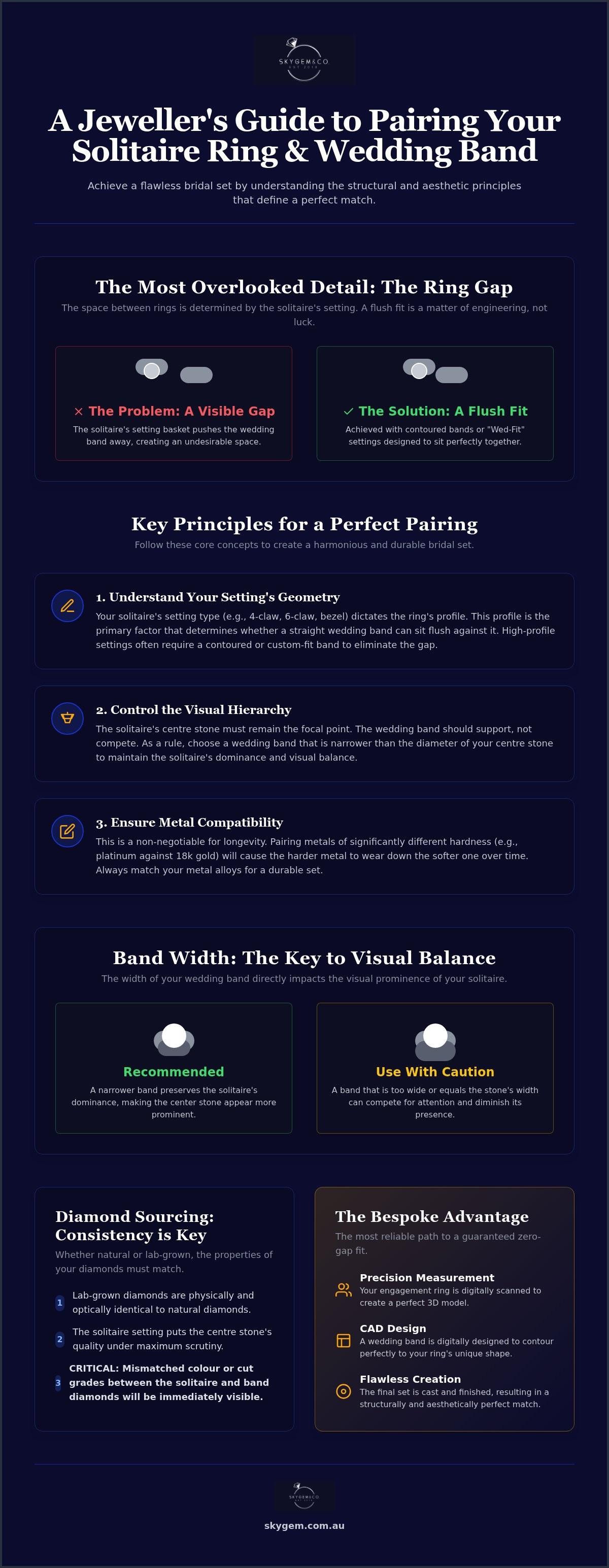
The principle governing every successful bridal set is straightforward: one element leads, the other supports. In a solitaire pairing, the centre stone is always the visual anchor, and every band decision should reinforce rather than challenge that hierarchy. Band width is the primary variable to control here. A wider band draws proportionally more visual weight from the finger, which can diminish the perceived presence of a smaller centre stone. As a general principle, bands narrower than the diameter of the centre stone tend to preserve the solitaire's dominance, while bands approaching or exceeding that diameter begin to compete with it. Texture, such as milgrain edging or a fine knife-edge profile, can add visual interest to a band without increasing its optical weight, making it a reliable tool for adding character while keeping the stone as the focal point.
Modern Variations: Lab-Grown and Natural Options
The solitaire setting is, by design, the most demanding showcase a diamond can face. With no surrounding stones to create a composite sparkle effect, the centre stone's individual optical performance is fully exposed. This is precisely why the solitaire has become the preferred setting for high-clarity, high-colour stones, whether natural or lab-grown diamonds.
Lab-grown diamonds are chemically, physically, and optically identical to their natural counterparts; they share the same hardness rating on the Mohs scale and the same refractive index, meaning their performance under daily wear conditions is directly comparable. The practical difference lies in origin and, typically, in cost relative to equivalent graded specifications. For a solitaire setting specifically, this matters because the budget efficiency of a lab-grown centre stone can allow for a higher colour and clarity grade within the same overall spend, which directly improves the visual performance of a design that puts that single stone under maximum scrutiny.
Pairing a solitaire engagement ring with wedding band that incorporates matched lab-grown diamond accents is also a technically sound approach, provided the stones are graded to consistent colour and cut specifications. A mismatched colour grade between a centre stone and band accent stones is immediately visible in a solitaire context, where there's no visual complexity to absorb the inconsistency. Selecting stones from a consistent grading source is the reliable way to avoid that outcome.
Structural Harmony: Understanding Flush Fits, Gaps, and Contoured Bands
The gap problem is, at its core, an engineering problem. When a solitaire engagement ring and a wedding band are placed side by side on the finger, the geometry of the engagement ring's setting determines whether those two pieces sit flush against each other or leave a visible, sometimes frustrating, space. Most guides skip past this entirely. Understanding it is what separates a bridal set that works from one that merely looks acceptable in photographs.
The culprit is almost always the setting's base profile. A four-claw or six-claw solitaire typically features a tapered mount that widens as it meets the finger, creating a curved or splayed base. A standard straight wedding band, with its uniform profile, physically cannot follow that curve. The result is contact at the outer edges and a gap at the centre, a condition that's immediately visible and often uncomfortable during daily wear.
The Role of Setting Height
Setting height determines the clearance available for any adjacent band. High-set solitaires, where the stone is elevated well above the finger on a tall mount, create a pronounced bridge between the base of the setting and the finger's surface. This bridge is the structural zone a wedding band must navigate. A low-set solitaire, by contrast, sits closer to the finger with a shallower bridge, which reduces the clearance issue but introduces its own constraints on band selection.
A Wed-Fit setting is a design solution where the setting's mount is raised or engineered with a precise notch or elevated base, allowing a straight-profile band to slide flush against it without a gap. It's a purpose-built approach that prioritises the mechanical relationship between the two rings from the outset, rather than trying to solve the fit problem after the engagement ring has already been made. If you're still in the process of selecting your solitaire, it's worth asking your jeweller whether the mount is designed with band compatibility in mind.
The gap aesthetic is also a legitimate design choice. Some wearers deliberately prefer a small, consistent space between their rings, either for comfort reasons or to allow each ring to be appreciated as a distinct piece. When that space is intentional and symmetrical, it reads as a design decision. When it's irregular or caused by structural mismatch, it doesn't.
Contoured and Curved Solutions
When a Wed-Fit setting isn't part of the original design, a contoured band offers the most reliable structural solution. Chevron-profile bands and tiara-style bands are shaped with a central point or curve that arches around the base of the solitaire's setting, eliminating the gap without requiring any modification to the engagement ring itself. These are particularly effective for low-set stones where the setting's base profile is pronounced and a straight band would visibly rock or sit unevenly.
The trade-off is worth understanding clearly:
- Worn together: A contoured band sits flush and creates a cohesive, integrated silhouette alongside the solitaire.
- Worn alone: The shaped profile can look asymmetrical or incomplete as a standalone piece, since its form is designed around the engagement ring's geometry rather than as an independent design.
- Long-term fit: Finger sizing fluctuations over time can affect how a shaped band sits, since its fit depends on the spatial relationship between both rings, not just the finger alone.
The most structurally reliable path for a pairing a solitaire engagement ring with wedding band without compromise is to design both pieces simultaneously. When a bespoke engagement ring is developed through a CAD-based design process, the wedding band's profile can be modelled alongside it from the start, with the setting height, base geometry, and band clearance all resolved before a single piece of metal is cast. That approach removes the guesswork entirely and produces a set where the flush fit is engineered in, not hoped for.
Metal fatigue from ring-on-ring contact is a practical maintenance concern that's rarely discussed. When two rings of differing hardness ratings rub continuously against each other during wear, the softer metal will show wear at the contact point over time. Ensuring both rings share the same metal alloy and, where possible, that their contact surfaces are finished and polished rather than textured at the point of contact, reduces this risk considerably. It's a detail worth raising with your jeweller before finalising any pairing.
Curation Styles: From Minimalist Metal to Diamond-Forward Brilliance
Once the structural fit between your rings is resolved, the aesthetic decision comes into focus: what does the band actually contribute to the overall composition? The answer depends entirely on what you want the set to say. A plain metal band and a diamond-set pavé band are not simply different price points; they're different design philosophies, each with distinct technical implications for how your solitaire engagement ring with wedding band performs visually over a lifetime of wear.
A high-domed plain band is the most enduring pairing choice for a reason that goes beyond tradition. Its smooth, uninterrupted surface creates a clean visual boundary that frames the solitaire without drawing the eye away from it. Dome height matters here: a higher dome adds a subtle three-dimensional presence that catches light similarly to a polished stone, while a flat-profile band reads as more architectural and contemporary. Neither is superior; the choice depends on whether you want the band to recede entirely or contribute its own quiet texture to the set.
Diamond-forward bands operate on a different principle. A pavé-set band distributes light across a continuous field of small stones, which amplifies the overall brilliance of the bridal set rather than concentrating it at the centre stone. Channel-set bands, where stones are set between two parallel metal rails, offer a cleaner, more linear expression of the same principle with better stone protection for daily wear. Both styles work well alongside a solitaire, provided the band stones are graded to match the centre stone's colour closely. A visible colour mismatch between the band and the solitaire is particularly unforgiving in this setting configuration.
Mixing stone shapes in a bridal set is a more considered approach than it might appear. A round brilliant solitaire paired with emerald-cut or baguette-cut band stones creates a deliberate contrast between the organic, multi-faceted sparkle of the centre stone and the step-cut clarity of the accent stones. This combination works precisely because the two cut styles don't compete; they occupy different parts of the visual spectrum, with the round brilliant delivering fire and the step cuts delivering a mirror-like, geometric flash.
The Impact of Band Width
Band width is one of the most consequential decisions in a bridal set, and it's frequently underestimated. A band that matches the width of the engagement ring's shank creates a symmetrical, unified silhouette. A narrower band creates a subtle contrast that keeps the solitaire visually dominant. The calculation that's often missed is the combined width of both rings on the finger: two rings worn together occupy more surface area than either does alone, and for smaller hand frames, this can create a stacked effect that feels heavier than intended. A useful practical test is to wear both rings together for a full day before committing to the pairing, paying attention to comfort at the knuckle as much as the visual proportion.
Full vs. Half-Eternity Bands
Eternity bands deserve specific consideration because their design has direct practical consequences. A full eternity band, set with stones around the entire circumference, cannot be resized after manufacture without disrupting the stone setting. A half-eternity band, set across the top portion only, retains resizability and is considerably more comfortable for active wearers, since the unset back section conforms more naturally to the finger's movement. For a band intended for lifetime daily wear, the half-eternity format is the more pragmatic choice for most wearers.
Incorporating Coloured Gemstones
Introducing colour into a wedding band is a design decision with genuine longevity implications. Australian sapphires and teal sapphires are among the most technically sound choices for a band worn daily alongside a diamond solitaire. Sapphire registers 9 on the Mohs hardness scale, making it resistant to the surface abrasion that softer stones like opal or pearl accumulate rapidly in everyday conditions. Teal sapphires, with their distinctive blue-green saturation, offer a contemporary alternative to blue that reads as distinctive without overwhelming the centre diamond's colourless brilliance.
The key principle when selecting coloured accent stones is tonal restraint. Stones with strong, saturated colour will draw the eye away from the solitaire if they're set prominently across the band's face. A more considered approach uses colour as a punctuation point, perhaps at the band's shoulders or as a single accent stone, rather than as a continuous field. That approach preserves the visual hierarchy while introducing a personal, distinctive element that distinguishes the set from any off-the-shelf configuration.
Technical Considerations: Metal Choice, Diamond Sourcing, and Longevity
Every decision made during the design of a bridal set has a consequence that extends decades into the future. Metal selection and stone sourcing aren't aesthetic preferences dressed up in technical language; they're material science decisions with real, measurable effects on how a solitaire engagement ring with wedding band wears, ages, and holds its value over a lifetime of daily contact.
Platinum vs. 18K Gold
The distinction between platinum and 18K gold goes well beyond colour. 18K gold is 75% pure gold alloyed with copper, silver, or palladium to achieve structural hardness, a composition that delivers warmth of colour alongside the rigidity required for fine stone settings. Platinum, by contrast, is typically 95% pure and considerably denser, which gives it a perceptible weight on the finger and a naturally higher resistance to the thinning that affects gold shanks over years of wear.
The critical difference in long-term behaviour is how each metal responds to surface contact. Gold loses volume when it's scratched; fine particles of metal are physically displaced. Platinum displaces rather than loses material, developing a surface texture called a patina over time. That patina can be polished away to restore a bright finish, or left to develop as a characteristic of the piece. Neither response is superior, but they are genuinely different, and a wearer who expects platinum to maintain a mirror finish indefinitely without periodic polishing will be disappointed.
White gold requires rhodium plating to achieve its bright, neutral tone, since the base alloy has a faint warmth. That plating wears through with daily contact, typically requiring reapplication every one to three years depending on wear conditions. Platinum requires no plating. For a bridal set worn continuously, that maintenance distinction is worth factoring into the long-term cost of ownership.
The hardness mismatch rule applies directly here: never pair a platinum engagement ring with an 18K gold wedding band, or vice versa. The harder alloy will abrade the softer one at the contact point, producing wear that's irreversible without professional resetting.
Lab-Grown vs. Natural Diamond Bands
Selecting a lab-grown diamond band to pair with a natural solitaire is a technically sound choice that's more common than most retailers acknowledge openly. Lab-grown and natural diamonds share identical physical and optical properties; a trained gemologist cannot distinguish them without specialist equipment. In a bridal set context, the practical question isn't origin, it's colour consistency. A band set with stones graded at a different colour temperature to the centre stone will create a visible tonal shift that's particularly unforgiving against a solitaire's unobstructed face. Sourcing band stones to match the solitaire's colour grade is the non-negotiable requirement, regardless of whether those stones are lab-grown or natural.
For natural diamonds, GIA certification provides an independently verified record of the stone's cut, colour, clarity, and carat weight. In a bridal set, that documentation matters for insurance, future resale, and the confidence of knowing the stone's specifications are independently confirmed rather than self-reported. Lab-grown diamonds from reputable grading laboratories carry equivalent documentation, and GIA now grades lab-grown stones with a distinct report format that confirms their origin clearly.
Resale value is a legitimate consideration. Natural diamonds, particularly those with strong GIA grades, retain secondary market value more reliably than lab-grown stones, where the market has shifted as production costs have decreased. If long-term asset value is a priority, a natural diamond solitaire with a lab-grown accent band represents a considered middle position: the centre stone retains its value profile, while the band delivers high optical performance at a more efficient price point, freeing budget for a higher colour or clarity grade where it matters most.
If you're working through these material decisions for a bespoke set, consulting with a specialist who works across both natural and lab-grown stone sourcing gives you the clearest basis for a decision built on verified specifications rather than general assumptions.
The Bespoke Advantage: Creating a Precision-Engineered Bridal Set
There's a fundamental limitation that no ready-to-wear collection can overcome: your solitaire engagement ring is a specific object with specific geometry, and a band designed without reference to that geometry is always an approximation. The bespoke approach exists precisely to close that gap, not as a luxury upgrade, but as an engineering solution to a problem that standardised production cannot reliably solve.
When both pieces of a solitaire engagement ring with wedding band are developed through a CAD-based design process, the relationship between them is resolved digitally before any metal is cast. The setting height, base profile, and shank taper of the engagement ring are modelled at exact scale, and the wedding band's contour is designed around those parameters directly. What you see in the rendered preview is what will be produced. That level of pre-production verification removes the guesswork that makes off-the-shelf pairings such a persistent source of disappointment.
Stone procurement follows the same logic. Sourcing loose stones to match a specific centre diamond's colour grade, cut proportions, and optical character requires access to a graded inventory and the technical knowledge to evaluate consistency across stones. A bespoke process allows band accent stones to be selected individually against the solitaire, rather than accepted as a pre-set batch with variable grading.
The Consultation Process
Arriving at a technical consultation with your existing engagement ring, a clear sense of your budget, and any reference imagery you've gathered gives a specialist the raw material to work with. The evaluation begins with the ring itself: setting height, shank width, base profile, and metal alloy are all assessed before any band option is discussed. That architectural read of your existing ring is what allows a specialist to recommend band styles with precision rather than preference. At SkyGem, the consultation process is built around transparency and education; you'll understand exactly why a particular band profile works for your setting, not just that it does. You can explore the full scope of that experience through SkyGem's engagement ring services.
Future-Proofing Your Set
A well-designed bridal set anticipates the rings that come after it. Planning for a future anniversary or eternity band means considering the combined shank width of three rings on the finger, not two, and ensuring the original pairing leaves enough spatial and proportional room for that addition without the set becoming visually crowded. Resizability is equally worth addressing at the design stage: plain-shank bands and half-eternity formats retain the ability to be sized, while full-eternity designs do not. Building that flexibility into the original specification costs nothing at the design stage and avoids a significant constraint later.
Precision fit, matched stones, and a set designed to accommodate your life over decades rather than just your wedding day: that's what a bespoke process actually delivers. Explore SkyGem's bespoke engagement ring services to begin designing a bridal set built around your ring's exact architecture.
Your Bridal Set, Built to Last a Lifetime
Pairing a solitaire engagement ring with wedding band is a decision with consequences that extend well beyond your wedding day. The key principles are worth carrying forward: structural fit comes before aesthetics, metal compatibility is non-negotiable, and colour consistency between your centre stone and band accents is what separates a cohesive set from a compromised one.
What this guide can't do is evaluate the specific geometry of your ring, your finger profile, or your stone's individual optical character. That requires a specialist who works from the piece itself, not from assumptions.
SkyGem & Co. is an independent, family-owned boutique specialising in bespoke design and manufacturing, with expertise across GIA-certified natural and lab-grown diamonds. Their process is built on technical precision and genuine transparency, so you understand every decision before it's made.
Book a bespoke consultation with SkyGem & Co. to design a pairing engineered around your ring's exact architecture. The right set is entirely achievable when it's built with precision from the start.
Frequently Asked Questions
Can I wear a straight wedding band with a low-set solitaire ring?
Yes, a straight band is often a practical choice for low-set solitaires, but the fit depends on your setting's specific base profile. Low-set mounts typically have a shallower bridge between the setting and the finger, which reduces the clearance gap that causes problems with high-set designs. The risk with a straight band isn't always a gap; it can be uneven contact where the band rocks slightly against the curved base of the mount. A professional assessment of your specific ring's geometry will confirm whether a straight profile works or whether a gently contoured band is the more reliable solution.
Is it okay to mix a natural diamond engagement ring with a lab-grown diamond wedding band?
It's entirely sound from a technical standpoint. Lab-grown and natural diamonds share identical physical and optical properties, so there's no structural or performance reason to avoid the combination. The one requirement that's non-negotiable is colour consistency: band stones must be graded to match your solitaire's colour grade closely, because a visible tonal difference is particularly obvious against a single-stone setting with no surrounding complexity to absorb it. Sourcing your band stones from a grading-verified inventory, rather than accepting a pre-set batch, is the reliable way to achieve that match.
Should my wedding band be the same width as my solitaire engagement ring?
Matching shank width creates a symmetrical, unified silhouette, but it isn't a rule. A band slightly narrower than the engagement ring's shank tends to preserve the solitaire's visual dominance, which is the primary design goal in most pairings. What's often underestimated is the combined width of both rings worn together; two bands that look proportionate individually can feel heavier or more crowded on smaller hand frames. Trying both rings together before committing, and considering how a third ring might eventually join the set, gives you a more accurate read of the final result than evaluating each piece in isolation.
Do I have to match the metal of my wedding band to my engagement ring?
Matching metal is strongly recommended, and not just for aesthetic reasons. When two rings with different alloy hardness ratings are worn in continuous contact, the softer metal will show wear at the contact point over time. Pairing a platinum engagement ring with an 18K gold band, or vice versa, creates exactly that hardness mismatch. Beyond longevity, white gold requires periodic rhodium replating to maintain its colour, while platinum develops a natural patina; if your rings are different metals, they'll age differently and diverge visually over time in ways that are difficult to correct without professional intervention.
What is a contoured wedding band, and do I need one?
A contoured band is shaped with a central curve or point, typically a chevron or tiara profile, that arches around the base of a solitaire's setting rather than sitting straight against it. It's the most practical solution when your engagement ring's mount creates a gap against a straight band and a Wed-Fit setting wasn't part of the original design. Whether you need one depends entirely on your setting's geometry. Not every solitaire requires a contoured band; some low-set designs sit comfortably against a straight profile. The only way to know for certain is to assess your specific ring's base profile rather than assuming one format will work.
How do I prevent my wedding band from scratching my solitaire setting?
The most effective preventive measure is ensuring both rings are made from the same metal alloy. When hardness ratings match, neither ring has a mechanical advantage over the other at the contact point, which significantly reduces abrasion. Beyond metal matching, the finish at the contact surface matters: polished, smooth contact edges wear more evenly than textured ones. Having both rings professionally checked and polished at the contact points every few years is a straightforward maintenance step that preserves the integrity of both pieces. A bespoke set designed with the contact geometry resolved from the start is the most reliable way to minimise this risk entirely.
Can I customize a wedding band to fit an heirloom solitaire ring?
Yes, and a bespoke process is often the only reliable way to achieve a precise fit with an heirloom piece. An heirloom solitaire typically has a setting profile, shank taper, and base geometry that no ready-to-wear band was designed to accommodate. A CAD-based design process allows a jeweller to model the heirloom ring's exact architecture and build a wedding band around those parameters directly, producing a contoured or straight profile that fits the specific piece rather than a generic approximation of it. Bringing the heirloom ring to a technical consultation is the essential first step; the ring itself, not a photograph, is what allows accurate measurements and modelling.
What are the most durable gemstones for a wedding band?
Sapphire is the most technically reliable coloured gemstone choice for a band intended for daily wear alongside a solitaire engagement ring with wedding band pairings in mind. Registering 9 on the Mohs hardness scale, sapphire resists the surface abrasion that accumulates rapidly in everyday conditions and won't be scratched by contact with diamond, which sits at 10. Australian sapphires and teal sapphires are particularly well suited to this application. Stones below 7 on the Mohs scale, including opal and pearl, are not recommended for bands worn continuously, as they'll show visible surface wear within a relatively short period of daily use.
Disclaimer
This article is for general informational purposes only and may include AI-assisted content. Pricing, specifications, and availability are subject to change. For accurate advice and current information, please contact SkyGem & Co. directly. Nothing in this content constitutes professional or financial advice.