
Padparadscha Sapphire Prices for Australian Buyers

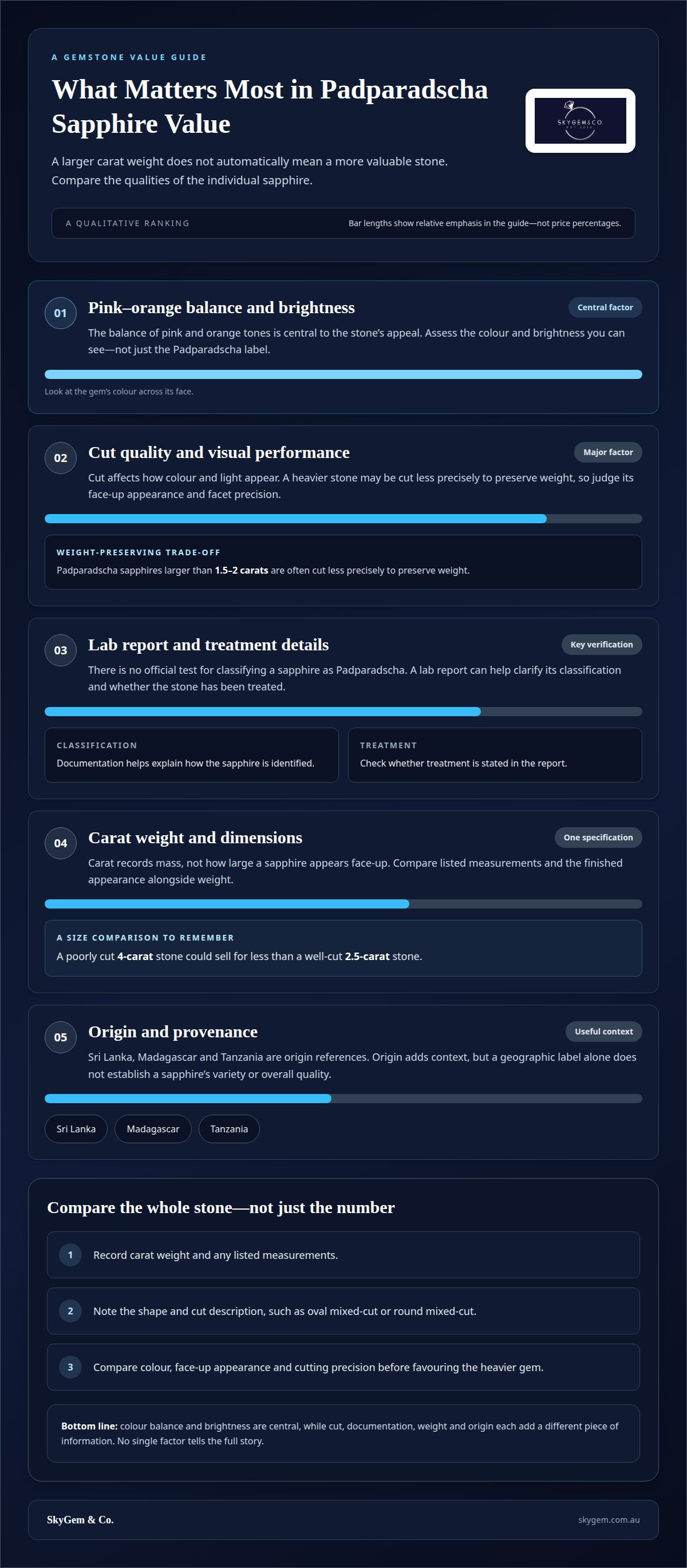
A larger Padparadscha sapphire isn’t automatically worth more: a poorly cut 4-carat stone could sell for less than a well-cut 2.5-carat stone. The price of a Padparadscha sapphire in Australia depends on the balance of pink and orange in its colour, as well as its cut, carat weight, origin and treatment. A lab report can help clarify how the stone is classified and whether it has been treated.
When comparing padparadscha sapphire prices in Australia, carat weight alone won’t tell you whether a stone offers strong value. Colour balance and brightness are central to its appeal, while the cut affects how colour and light appear across the gem. Because there’s no official test for classifying a sapphire as Padparadscha, reliable documentation is especially useful.
This guide explains what defines a Padparadscha sapphire, how to assess its colour and lab report, and which characteristics influence its value in Australia. You’ll also learn why treatment and cut matter, so you can compare more than a stone’s size or label.
Key Takeaways
- Assess whether a stone’s pink and orange tones are balanced, rather than relying on its Padparadscha label alone.
- Compare carat weight alongside cut quality and origin; a larger stone may not offer better value.
- Use a lab report to understand the sapphire’s classification and treatment history.
- Consider how treatment, condition and the quality of the individual stone can shape its resale appeal.
- Explore how Australian sapphires and different ring settings can suit your design preferences.
What is a Padparadscha Sapphire?
A Padparadscha sapphire belongs to the corundum family. Its name identifies a particular sapphire variety, while its origin describes where the gemstone was mined. These are separate details: a sapphire may be described as Sri Lankan, Madagascan or Tanzanian by origin, but that geographic label alone doesn’t establish its variety or overall quality.
Sri Lanka is a significant origin reference for this variety. Natural Padparadscha sapphires from Sri Lanka are prized for subtle saturation and exceptional clarity. These qualities describe stones that attract interest, not every sapphire from Sri Lanka. Origin adds context to an individual gem, but the stone’s own characteristics remain important to its assessment.
Madagascan and Tanzanian origins also appear in descriptions of Padparadscha sapphires. Two listings might name Madagascar and Sri Lanka respectively, while describing the same variety. Read the origin as provenance, not as a substitute for identifying the individual stone. This distinction keeps geographic information separate from the characteristics used to evaluate a gemstone.
Sri Lankan sourcing often appears in a stone’s description because origin can matter to buyers. The wording is precise: “sourced from Sri Lanka” refers to the stated source, while the variety name refers to the sapphire itself. Neither phrase explains every aspect of the gem. A useful assessment treats origin, identity and visible characteristics as distinct details.
Origin terminology also differs between mined gemstones and laboratory-created products. For a sapphire, Sri Lanka, Madagascar or Tanzania names a geographic source. By contrast, Australian lab-grown diamonds are identified by laboratory creation, not a mined sapphire locality. The distinction prevents a place name from being mistaken for a description of a gemstone’s variety or production method.
When comparing descriptions, note each stone’s stated origin, then consider it alongside the gem’s appearance and identity. A Sri Lankan sapphire and a Madagascan sapphire can both be described as Padparadscha, while their origins remain different. Keeping these details separate clarifies what a listing says without treating provenance as proof of every other claim about the gemstone.
Sapphires by carat weight, cut and origin
Carat weight records a sapphire’s mass, but it doesn’t describe how large the stone appears face-up. Compare stones by weight and dimensions where those details are available, then consider how the cut distributes colour and light. For instance, a 0.69-carat oval and a 0.63-carat oval are close in weight, but their appearance can still differ through proportions, colour and facet arrangement.
Cut descriptions give buyers a useful starting point. Listings include oval, round, octagon and radiant mixed cuts, each presenting the gemstone’s outline differently. A 1.020-carat oval mixed-cut sapphire, a 1.60-carat round mixed-cut sapphire and a 2.06-carat octagon-cut sapphire illustrate how varied shapes can be across listings. The shape that suits one collection or setting may not suit another.
Weight also affects how a cutter balances finished size against precision. Padparadscha sapphires larger than 1.5-2 carats are often cut less precisely to preserve weight. That trade-off means a larger stone may not show the same finish or visual performance as a smaller, more carefully cut example. A 4-carat stone with a poor cut could sell for less than a well-cut 2.5-carat stone.
Consider the cut in relation to the intended setting. An oval creates an elongated outline, while a round cut presents a more symmetrical face. Radiant mixed cuts combine a distinct outline with varied facets, and an octagon has a stepped perimeter. These descriptions identify shape, not quality by themselves. Inspect how the facets meet and whether the face-up appearance suits your design priorities.
A practical comparison can use three separate checks:
- Record the carat weight and any listed measurements.
- Note the shape and cut description, such as oval mixed-cut or round mixed-cut.
- Compare the face-up appearance and cutting precision before favouring the heavier gemstone.
For example, a 1.58-carat oval-cut sapphire and a 1.57-carat radiant mixed-cut sapphire have nearly identical weights, yet their outlines and facet patterns differ. That comparison shows why carat alone can’t identify the better fit. Review the individual stone in the context of the intended setting, and treat the weight as one specification among several, rather than a shortcut to quality.
If you’d like to discuss how cut and weight relate to a ring design, arrange a gemstone discussion.
Australian Padparadscha sapphire prices
For Australian buyers, compare amounts in Australian dollars and confirm what each listing covers. A loose sapphire price and a finished ring price describe different purchases. A ring’s total may include the gemstone, setting and other components, so it shouldn’t be compared directly with a loose-stone listing. First identify whether each figure applies to the same kind of item.
Price listings are individual offers, not a national tariff. A listing records the asking amount for a particular item at a particular time; it doesn’t establish a standard price across Australia. This matters when comparing local examples with a broad estimate. Treat each figure as specific to its listing, rather than turning one example into a universal per-carat rate.
The way an item is presented can also affect its listed price. Some listings describe a loose gemstone, while others show a completed ring. A ring’s total includes the stone, setting and finished design, so it represents more than the sapphire alone. Compare like with like: a loose stone with another loose stone, or finished jewellery with a comparable finished piece.
For a practical comparison in Australia, make a short record of the listings you’re considering. Note the advertised amount, currency, whether the sapphire is loose or set, and its stated weight. Also record whether the price applies to a specific item or is available on application. This makes differences between listings easier to interpret without assuming they share the same basis.
Price on application is different from a displayed amount. It means the listing directs buyers to obtain the price for that item rather than showing a figure. A sold-out listing with this wording isn’t a current offer for purchase. Keep availability and pricing format clear in your comparison notes.
Use this sequence to assess Australian listings:
- Confirm the amount is stated in Australian dollars.
- Identify whether the listing covers a loose sapphire or finished jewellery.
- Record the listed weight and whether a price is displayed or available on application.
- Compare only listings with a similar purchase format.
The answer to the Australian market question is straightforward: there isn’t one price that represents every Padparadscha sapphire. The most useful comparison is between current listings for the same type of purchase, with each amount tied to its specific item. That prevents a ring total, an old listing or a price-on-application entry from being mistaken for a direct benchmark.
What treatments are common for padparadscha sapphires, and how do they affect value?
Treatment status is a key detail when assessing a Padparadscha sapphire. Unheated stones are considered especially desirable, so an unheated description can influence how buyers compare examples. It doesn’t replace an assessment of colour, cut, clarity or documentation. Instead, it adds a distinct detail to the stone’s profile and can help explain why two otherwise similar sapphires attract different levels of interest.
Beryllium treatment became popular for sapphires in the 1990s. Its significance for today’s buyer is practical: treatment history should be treated as part of the gemstone’s identity, not as fine print. A listing that mentions beryllium treatment gives different information from one describing a sapphire as unheated. The terms shouldn’t be treated as interchangeable, and the distinction can affect how a buyer evaluates the stone.
Use a consistent review process for each candidate:
- Read the treatment wording in the listing and laboratory report.
- Confirm whether the stone is described as unheated or treated.
- Compare that information with the report’s identification of the gemstone.
- Assess treatment alongside colour, cut, clarity and carat weight.
This keeps treatment in perspective. An unheated description may support desirability, but it doesn’t establish the sapphire’s overall quality on its own. A well-documented stone still needs to be judged by its appearance and physical characteristics. Likewise, a treatment label alone doesn’t explain every difference between two listed prices. Compare stones with similar specifications before drawing conclusions.
A lab report or appraisal provides useful documentation. Buyers are advised to purchase a Padparadscha sapphire with an appraisal or lab report. Read the document’s exact wording rather than assuming it confirms every detail in the seller’s description. Consider the report and listing together, particularly when treatment status is part of the price comparison.
For example, compare two sapphires with similar colour descriptions and carat weights. If one is described as unheated and the other has a treatment noted, treatment is a relevant difference. It doesn’t determine which stone is the better choice by itself. Cut quality, clarity, colour balance and intended use still shape the assessment. A buyer choosing a centre stone may weigh these features differently from someone selecting a collection gem.
The practical takeaway is to make treatment visible in every comparison. Record the exact description, note the report wording, then compare the remaining attributes. Unheated status is desirable, while beryllium treatment has a specific place in sapphire treatment history since the 1990s. Clear documentation helps buyers understand what is being represented and make a more informed assessment of value.
What is the resale value of a padparadscha sapphire in Australia?
A Padparadscha sapphire’s resale value depends on the stone’s current qualities and supporting records, not simply its original retail price. For resale in Australia, distinguish the loose gemstone from a finished ring, since the setting and sapphire are separate parts of the item. A purchase receipt records the original transaction; it doesn’t establish what a later buyer will pay.
Start with the sapphire’s identity and documentation. A laboratory report can describe the stone and record findings relevant to its identification, while an appraisal provides a valuation at a particular point and for a stated purpose. These documents have different roles. Keep the original report with the gemstone, and ensure any appraisal clearly refers to the item being assessed, especially if the sapphire is set in jewellery.
Condition also matters when presenting a piece for resale. For a ring, inspect the sapphire and setting for visible wear or damage, and retain records of any changes. A loose stone and a completed ring aren’t directly comparable: the ring includes additional materials and workmanship, while the sapphire’s colour, cut, clarity, carat weight and treatment remain central to its own assessment.
Classification deserves particular care. There’s no official test for deciding whether a sapphire qualifies as Padparadscha, so the exact wording in a report can matter to a future buyer. A seller’s description shouldn’t replace the laboratory’s wording. Keep colour descriptions, origin claims and treatment details distinct. For example, “Sri Lankan” identifies a stated origin, while “unheated” describes treatment status. Neither phrase alone determines resale value.
For a clear record, organise these details before seeking a valuation:
- Gather the original receipt, laboratory report and any existing appraisal.
- Record whether the sapphire is loose or set in a ring.
- Document the stated colour, origin, cut, carat weight and treatment.
- Describe visible condition accurately and include records of changes to the jewellery.
Unheated status is considered desirable, but it doesn’t establish a resale price by itself. Colour balance, cut quality, clarity and documentation still shape the stone’s profile. Market rarity can support interest, but a retail listing and a resale assessment relate to different transactions. For Australian buyers and owners, the practical takeaway is to keep the gem’s identity and history traceable, then assess the complete item rather than relying on its purchase price alone.
SkyGem & Co.: Australian Sapphires
SkyGem & Co. offers Australian sapphires for buyers considering a gemstone of Australian origin. If you’re weighing Padparadscha colour and documentation against other sapphire options, comparing Australian sapphires can help clarify which characteristics matter most to you. The right comparison depends on the individual stones and your intended design, not origin alone.
For a ring, consider how the centre gemstone will work with the setting. Solitaire Engagement Rings keep attention on one central stone, while Halo Engagement Rings and Trilogy Engagement Rings offer different design arrangements. Comparing these styles can help connect your priorities for the sapphire with the look of the finished piece.
Discuss Australian sapphires and your preferred ring style with SkyGem & Co.
Choose a Sapphire That Fits Your Plans
Make your next step a considered design decision. Decide which characteristic matters most: colour balance, documented treatment history, or how the sapphire will sit in a finished ring. That priority gives the discussion a clear starting point and keeps the focus on suitability, not just a headline price.
Padparadscha sapphire prices in Australia are useful for comparison when you consider each stone’s details alongside its intended setting. SkyGem & Co. offers Solitaire Engagement Rings, Halo Engagement Rings and Trilogy Engagement Rings, with distinct setting styles to consider for your gemstone. Your preferences and any existing report can help shape a focused conversation about how the stone and design work together.
A considered choice starts with knowing what matters most to you. With that in mind, you can move forward with clarity and confidence.
Frequently Asked Questions
What is the price per carat of Padparadscha sapphire in Australia?
There’s no single price per carat that applies to every Padparadscha sapphire in Australia. To calculate a listing’s per-carat figure, divide the stone’s stated price by its carat weight, then compare it with stones of similar quality and treatment. The padparadscha sapphire price in Australia depends on the specific stone, so this calculation is a comparison tool, not a valuation or guarantee of resale value.
How much do natural Padparadscha sapphires cost by carat weight in Australia?
Natural stones don’t follow a fixed price ladder based on carat weight. A listing’s total can reflect the individual sapphire’s quality and whether the amount covers a loose stone or finished jewellery. Before comparing figures, identify what the listing includes and whether the stated weight refers to the sapphire itself. Comparing similar items on that basis helps avoid treating a ring’s total as the price of a loose gemstone.
How do colour, clarity, cut and origin affect Padparadscha sapphire prices?
These characteristics help distinguish one stone from another, rather than creating a simple price formula. First consider the overall appearance, then use clarity, cut and origin details to understand the specific stone. Origin provides geographic context but doesn’t establish quality by itself. A report and clear description let you assess whether the listing’s claims align with the stone being offered.
How can I verify that a sapphire is a genuine Padparadscha and not treated or synthetic?
Use a laboratory report to review the stone’s identification and any recorded treatment findings. Check that the report refers to the sapphire you’re assessing, and read its wording rather than relying only on the seller’s label. There’s no official test for classifying a sapphire as Padparadscha, so documentation can support an assessment but doesn’t establish a universally agreed classification. Natural origin and treatment status are distinct details in a report.
Where can I buy Padparadscha sapphires in Australia, and what do local jewellers charge?
SkyGem & Co. offers Australian sapphires and engagement ring styles, including solitaire, halo and trilogy designs. Assess any specific Padparadscha listing and its price on its own terms: there’s no single price across Australian jewellers. Distinguish a loose gemstone from a completed ring, and compare the stone’s description and documentation before treating different listings as equivalent.
How do Australian Padparadscha sapphire prices compare with international prices?
A reliable comparison matches similar stones and expresses both amounts in the same currency. Check that each figure refers to the same type of purchase, such as a loose gemstone rather than a finished ring, and compare stated weight, treatment and documentation. An international listing alone doesn’t establish an Australian value. Use Australian-dollar figures for local budgeting, and treat overseas examples as context rather than direct equivalents.