
Natural Ruby Buying Guide: The 2026 Australian Expert Reference

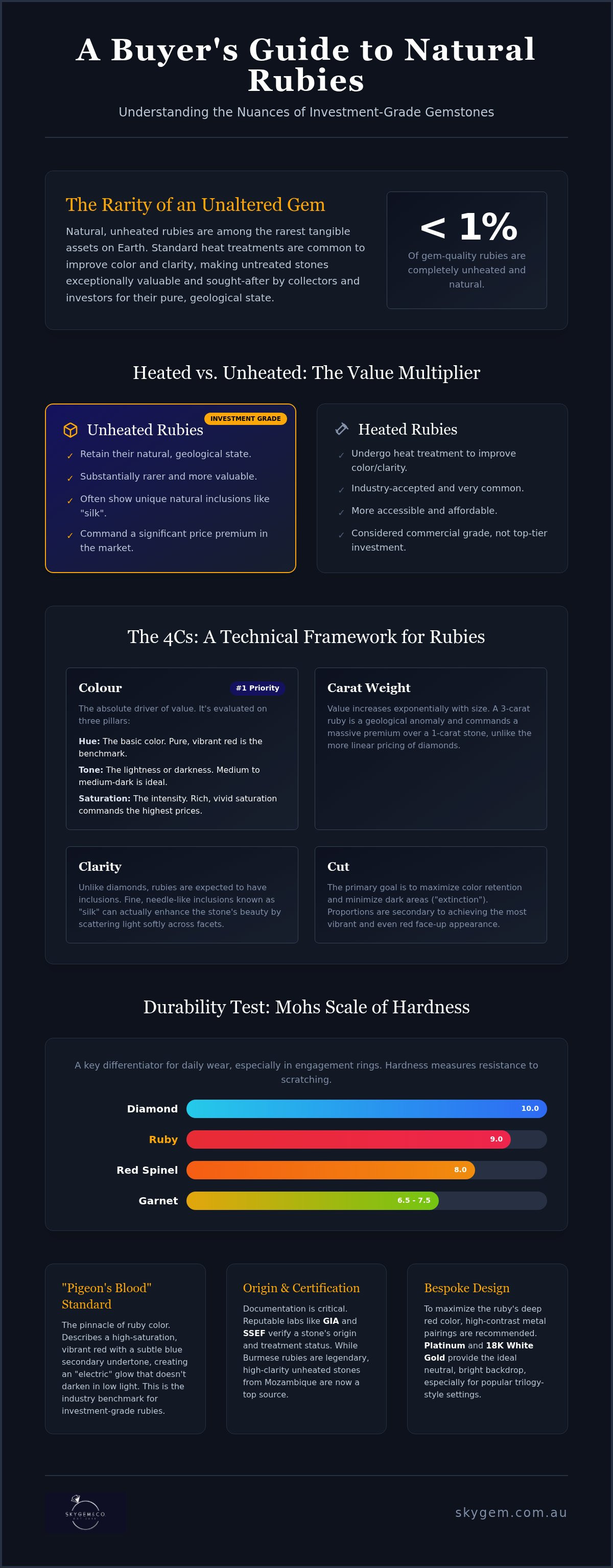
Less than 1% of the world's gem-quality rubies remain in their completely unheated, natural state. This makes them one of the rarest tangible assets on the planet. You probably recognise that a ruby is a significant investment, yet the vast price gap between a standard heated stone and an unheated specimen can often feel daunting. This natural ruby buying guide australia provides the technical clarity you need to distinguish between commercial grade treatments and investment grade gems.
It's common to feel concerned about the risk of glass-filled composites or the difficulty of verifying origin claims without expert guidance. We'll show you how to master the technical nuances of ruby quality, from the specific trace element saturation that creates the "Pigeon's Blood" hue to the 2026 certification standards required for a bespoke jewellery piece. By understanding the intersection of gemological precision and aesthetic design, you'll gain the confidence to secure a GIA-certified stone that serves as a permanent asset for your collection.
Key Takeaways
- Identify how Chromium levels dictate both the fluorescence and the deep red saturation essential for investment-grade corundum.
- Differentiate between standard heat treatments and unheated rubies to understand why the latter commands a substantial value multiplier in the 2026 market.
- Utilise this natural ruby buying guide australia to navigate international certification standards from GIA and SSEF, ensuring your stone's origin and treatment status are verified.
- Evaluate the shift from traditional Burmese sources toward Mozambique for high-clarity, unheated specimens that offer long-term viability for bespoke jewellery.
- Select optimal metal pairings, such as platinum or 18K white gold, to provide the high-contrast backdrop required for trilogy-style ruby settings.
Understanding the Natural Ruby: Corundum, Colour, and Rarity
The ruby belongs to the Corundum mineral species, essentially representing the red expression of the same mineral that produces sapphires. While corundum in its purest form is colourless, the presence of specific trace elements during the crystal's formation creates the vivid spectrum we value. In the case of the ruby, Chromium (Cr) is the essential catalyst. This element does more than just provide a red hue; it induces a natural fluorescence that allows the stone to glow from within when exposed to ultraviolet light. This chemical property is a cornerstone of any natural ruby buying guide australia, as it directly influences the stone's visual performance in our high-UV environment.
The rarity of these gems cannot be overstated. While the global diamond market is well-established, the supply of high-carat, gem-quality rubies is significantly more constrained. Finding a natural ruby over three carats with high transparency is an exceptional event. This scarcity, combined with the stone's historical prestige, positions the ruby as a premier choice for a custom made engagement ring in Melbourne or across Australia. Investors often seek these stones as "hard assets" because their value isn't just tied to fashion, but to the geological impossibility of their replacement.
The "Pigeon’s Blood" Standard
The term "Pigeon’s Blood" represents the pinnacle of ruby grading. Technically, it describes a vibrant, high-saturation red with a subtle blue secondary undertone. This blue tint creates a deeper, more "electric" red that doesn't "black out" in low light. In Australia, the intense natural sunlight can make some red gemstones look overly bright or washed out. However, a true Pigeon’s Blood ruby maintains its rich saturation. It is the industry benchmark for investment-grade natural rubies, often carrying a significant price premium due to its rarity and visual impact.
Ruby vs. Red Spinel and Garnet
A primary concern for many buyers is distinguishing a true ruby from aesthetic lookalikes like red spinel or garnet. The most critical differentiator is physical durability. Rubies sit at 9.0 on the Mohs scale of hardness, surpassed only by diamonds. Red spinel (8.0) and garnet (6.5 to 7.5) are softer and more prone to surface scratching or facet wear over decades of daily use. This hardness makes the ruby uniquely suitable for the rigours of an engagement ring. While spinels are beautiful, they lack the specific gravity and refractive index that give a ruby its signature "weight" and glow. Professional gemmological verification remains the only way to confirm these technical properties with certainty.
The 4Cs of Ruby Quality: A Technical Framework
While the diamond industry popularized the 4Cs, applying these metrics to coloured gemstones requires a technical shift in priority. In this natural ruby buying guide australia, we establish that colour is the absolute variable. While a diamond's value is often driven by the absence of colour and inclusions, a ruby’s worth is fundamentally defined by the presence of rich, saturated red. Professionals utilize the 4Cs of ruby quality as a baseline, but the weighting of these factors differs significantly from other precious stones.
After colour, carat weight serves as the primary value multiplier. High-quality rubies are exponentially rarer as they increase in size. A three-carat ruby is not simply three times the price of a one-carat stone; it is a geological anomaly that commands a massive premium. When evaluating these stones, we prioritize the visual impact of the red saturation over the technical perfection of the cut proportions. In rubies, the cut's primary function is to maximize colour retention and minimize "extinction" (dark areas), rather than simply creating brilliance.
Colour: Hue, Tone, and Saturation
Colour grading relies on three distinct pillars. Hue refers to the stone's basic colour; a "pure red" is the benchmark, while secondary hues of pink, purple, or orange can lower the valuation. Tone describes the lightness or darkness of the red. The most coveted stones sit in the medium to medium-dark range. Saturation represents the intensity of the hue. We also look for pleochroism, a property where the crystal displays different colours from different angles. A master lapidary will orient the crystal to ensure the most vibrant red is visible through the crown of the stone.
Clarity and the "Silk" Phenomenon
Expectations for clarity must be adjusted when viewing natural rubies. These gems are rarely "eye-clean" in the same way as diamonds or aquamarines. Fine, needle-like inclusions known as "silk" (rutile needles) are often a sign of natural, unheated origin. This silk scatters light across the facets, softening the colour and giving the ruby a velvety glow. However, you should be cautious of surface-reaching fractures or large "feather" inclusions. These can compromise the structural integrity of the gem, making it unsuitable for the daily wear required of an engagement ring. If you are beginning your search for an investment-grade stone, viewing a curated selection of precious gemstones can help you calibrate your eye to these natural characteristics.
Heated vs. Unheated Rubies: The Value Multiplier
In any natural ruby buying guide australia, the distinction between heated and unheated specimens represents the most significant factor in long-term valuation. Heat treatment is a standard industry practice where corundum is subjected to temperatures between 800°C and 1800°C. This process dissolves certain inclusions and intensifies the red saturation. While this treatment is widely accepted and stable, it makes the stone less rare. In contrast, an unheated ruby is a gem that reached its peak aesthetic beauty entirely through geological processes, without human intervention. These stones are exceptionally scarce; industry data indicates that less than 1% of all gem-quality rubies are unheated.
A critical warning for Australian buyers involves "glass-filled" or "composite" rubies. These are not simply treated gems but are low-grade, fractured corundum infused with high-lead content glass to create a false sense of clarity. These stones are fragile, unstable, and can be damaged by standard jewellery repairs or even household acidic liquids. They hold no resale value and are unsuitable for bespoke jewellery. Understanding the technical ruby treatments and origin is essential to ensuring your investment remains a permanent asset rather than a synthetic imitation.
Identifying Heat Treatments
Professional gemmologists identify heat treatment by examining internal inclusions under high magnification. In unheated stones, rutile "silk" remains intact and needle-like. In heated stones, these needles often appear melted or broken into small "dots". Other indicators include "halo" fractures around crystal inclusions caused by thermal expansion. Because unheated stones represent the pinnacle of geological rarity, they are the primary focus for SkyGem & Co., where technical precision meets aesthetic design. Full disclosure of these treatments is a regulatory requirement in the Australian market, ensuring transparency for every transaction.
Value Retention and Investment
The price-per-carat trajectory for unheated rubies has significantly outpaced heated stones over the last decade. Market data from 2026 shows that unheated rubies now command a premium of 150% to 300% over their heated counterparts of similar visual quality. This gap exists because investors view unheated stones as a finite "legacy" asset. For those commissioning a bespoke ring, selecting an unheated stone ensures the piece holds its value as a rare collector's item. You can consult SkyGem & Co.’s ruby price guide to understand how these premiums apply to current market availability and specific carat weights.
Origin and Certification: Why Documentation Matters
In the high-end gemstone market, a ruby’s origin is more than just a geographical detail; it's a primary driver of market value. Historically, the Mogok valley in Burma (Myanmar) has been the benchmark for quality. These rubies are prized for their low iron content, which allows for a high degree of natural fluorescence and a vibrant red hue. Because of their historical prestige and dwindling supply, Burmese rubies often carry a significant premium. However, Mozambique has recently emerged as the leading source for high-quality, modern unheated rubies. These stones frequently offer superior clarity and a rich, saturated red that rivals the finest historical specimens, making them a practical choice for contemporary bespoke jewellery.
Determining a ruby’s origin is a scientific process that goes beyond visual inspection. Gemmologists analyze trace element "fingerprints" within the crystal lattice. By measuring the concentrations of elements such as Gallium, Iron, and Magnesium, laboratories can pinpoint the geological environment where the ruby formed. This technical data is essential for any natural ruby buying guide australia, as it provides the objective proof required to justify a stone's valuation. Without a verified origin and treatment report, a ruby cannot be accurately appraised for insurance or resale purposes in the Australian market.
GIA and GRS Certification
The Gemological Institute of America (GIA) is widely considered the global gold standard for gemstone certification. A GIA report provides an unbiased assessment of the 4Cs and, crucially, a definitive statement on whether the stone has undergone heat treatment. Additionally, the GemResearch Swisslab (GRS) is highly regarded for its "Vivid Red" and "Platinum" reports, which are often used for the highest tier of investment-grade stones. When you examine a certificate, you must look for the "Comments" section. For an investment-grade gem, this section must explicitly state "No Indications of Heating". This single line is the difference between a standard commercial stone and a rare natural asset.
Ethical Sourcing in the Australian Market
Transparent supply chains are a critical requirement for modern investors who value long-term viability. Reputable suppliers must demonstrate a clear chain of custody, ensuring that gems are sourced from mines that adhere to international labour and environmental standards. This commitment to transparency is how SkyGem & Co. ensures ethical procurement for every project. The Australian jewellery industry plays a vital role in this by upholding strict regulatory standards that protect both the consumer and the integrity of the trade. If you're ready to begin your search for a documented, ethically sourced gem, you can browse our current selection of natural rubies to find a stone that meets these rigorous criteria.
Designing a Bespoke Ruby Engagement Ring
Selecting the structural framework for a ruby requires an understanding of colour theory and material science. To complement the intense red saturation of high-quality corundum, we recommend neutral-toned metals. Pairing a ruby with 18K White Gold or Platinum is the preferred technical choice. These metals provide a crisp, high-contrast backdrop that allows the stone’s primary hue to remain the focal point without the warm interference of yellow gold. This final stage of our natural ruby buying guide australia focuses on translating gemmological quality into a permanent, wearable asset.
The "Trilogy" style is a sophisticated configuration that pairs a central ruby with two diamond side stones. This arrangement creates a visual "fire" that contrasts with the deep, velvety red of the ruby, enhancing the overall brilliance of the piece. For smaller stones with exceptional saturation, a "Halo" setting can be utilized to expand the visual footprint of the ring while providing a protective perimeter of diamonds. Every project begins with a comprehensive bespoke design process, where we utilize high-precision CAD modelling to ensure the setting is engineered for both aesthetic balance and long-term durability.
The Solitaire vs. Trilogy Choice
A solitaire engagement ring remains the most direct way to highlight the purity of a rare, unheated ruby. It focuses the observer's attention entirely on the stone's internal glow and "silk" inclusions. In contrast, the trilogy ring offers a more complex narrative, often representing a couple's past, present, and future. During the custom design phase, we prioritize a low-profile setting. This technical adjustment protects the gem from lateral impacts, making it suitable for active professional lifestyles without compromising the stone's exposure to light.
Caring for Your Natural Ruby
Rubies are a superior choice for longevity when compared to softer stones like emeralds. Sitting at 9.0 on the Mohs scale, they're highly resistant to surface scratching and chemical erosion. However, professional maintenance is still essential to preserve the stone’s lustre. We recommend a gentle cleaning with warm, soapy water and a soft-bristled brush every few months to remove oils that can dull the stone's fluorescence. Annual inspections of the metal claws ensure the gem remains securely seated. The journey of acquiring a ruby is a three-part process: education on technical specs, selection of a certified gem, and the precision craftsmanship of the final setting. By following this methodical approach, you ensure your investment remains a legacy piece for generations.
Securing Your Investment Grade Gemstone
Selecting a natural ruby is a decision that balances geological rarity with technical design precision. As established in this natural ruby buying guide australia, prioritizing unheated stones with GIA or GRS certification ensures your acquisition remains a permanent and appreciating asset. By focusing on the specific trace element saturation of the "Pigeon's Blood" hue and the structural integrity of the final setting, you move beyond a simple purchase toward a strategic jewellery investment. A well-chosen gem serves as a legacy piece that maintains its lustre and value over time.
We provide direct procurement of GIA and GRS certified gemstones and specialized expert consultations for bespoke 18K gold and platinum designs. Our focus remains on unheated, investment-grade rubies that meet the rigorous technical standards of the contemporary market. This solution-oriented approach guarantees that every stone is verified for its origin and treatment status before it is integrated into a custom design. It's about creating a partnership that respects the long-term viability of your project.
Explore our curated collection of natural unheated rubies to begin your journey toward a bespoke masterpiece that holds its value for generations. Your pursuit of a rare and beautiful gem is a rewarding path when grounded in technical expertise and reliable documentation.
Frequently Asked Questions
Is a natural ruby more expensive than a diamond?
High-quality natural rubies often exceed the price-per-carat of colorless diamonds. While commercial rubies are more affordable, investment-grade specimens, particularly unheated ones, are significantly rarer than diamonds of comparable size. This rarity drives valuations higher for stones over two carats. Because the supply of large, natural rubies is geologically constrained, they remain one of the most valuable gemstones in the world for bespoke jewellery.
What is the best cut for a natural ruby engagement ring?
Oval and cushion cuts are the optimal choices for rubies because they align with the natural shape of the rough corundum crystal. These shapes minimize material loss while maximizing color saturation and weight retention. Unlike diamonds, where the round brilliant is the standard for light return, ruby lapidaries prioritize the depth of the red hue. A well-proportioned oval cut ensures the most vibrant color is visible through the crown.
How can I tell if a ruby is real or lab-grown?
Professional magnification is required to distinguish between natural and lab-grown rubies by identifying internal growth patterns. Natural specimens typically contain irregular mineral inclusions or rutile silk, whereas lab-grown stones often display curved striae or gas bubbles. A GIA or GRS certificate provides the only definitive verification of a stone's natural origin. Relying on certified documentation is essential for anyone using a natural ruby buying guide australia to secure their investment.
Why does the origin of a ruby affect its price so much?
Origin dictates the geological rarity and chemical composition of the stone, which directly influences its market value. Burmese rubies are historically prized for their low iron content and high fluorescence, while Mozambique rubies are sought for their modern clarity. As detailed in this natural ruby buying guide australia, origin acts as a primary value driver. Collectors and investors view specific locations as benchmarks for quality, resulting in significant price premiums for certain regions.
Are unheated rubies worth the extra cost for an engagement ring?
Unheated rubies are worth the premium for buyers seeking a finite, rare asset that offers superior long-term value retention. Because less than 1% of gem-quality rubies are unheated, they represent a significant geological anomaly. This scarcity makes them a stable investment compared to heated stones, which are readily available. For a bespoke engagement ring, an unheated ruby provides a unique narrative of natural beauty that hasn't been altered by human intervention.
Can I use a natural ruby in a solitaire setting safely?
Rubies are highly suitable for solitaire settings because they possess a Mohs hardness of 9.0, making them resistant to daily wear. While they're second only to diamonds in durability, the setting's engineering remains important for total protection. A low-profile design with robust claws will safeguard the gem from accidental impacts. This ensures the stone remains a permanent fixture in your jewellery collection without the risk of surface scratching or structural damage.
What is the difference between a ruby and a pink sapphire?
The difference is determined by the specific saturation and tone of the red hue, as both gems are varieties of corundum. A ruby must have red as its dominant color to qualify for the name. If the stone's primary hue is pink, it's classified as a pink sapphire. This distinction is often a technical boundary set by gemmological laboratories, and it significantly impacts the price-per-carat and overall market positioning of the gemstone.
How do I verify a GIA certificate for a ruby in Australia?
You can verify a GIA report by entering the unique identification number into the official GIA Report Check online database. This allows you to confirm that the stone's weight, measurements, and treatment status align with the laboratory's original findings. Verifying these details is a fundamental step in securing a high-value gem. It provides the technical certainty needed to ensure the documentation is authentic and accurately describes the ruby you are purchasing.
Disclaimer
This article is for general informational purposes only and may include AI-assisted content. Pricing, specifications, and availability are subject to change. For accurate advice and current information, please contact SkyGem & Co. directly. Nothing in this content constitutes professional or financial advice.