
Natural Emeralds: The 2026 Collector’s Guide to Quality, Origin, and Value

A flawless emerald is often a significant red flag in a market where the internal "jardin" serves as a gemstone's unique geological fingerprint. While many newcomers search for total clarity, seasoned collectors recognize that these internal inclusions are essential markers of authenticity for high-quality natural emeralds. If a stone appears too perfect, it likely lacks the rich history and value of a genuine mined gem.
You probably feel a sense of hesitation when faced with technical terms like "insignificant oil" or the recent June 2026 trade alerts regarding fraudulent treatment reports. It's understandable to worry about the structural integrity and long-term stability of such a delicate investment. This guide provides the technical precision required to navigate the current market, ensuring you can distinguish between "Muzo Green" saturation and lesser hues while securing a stone with a verifiable pedigree.
We'll provide a structured breakdown of the 2026 GIA report updates and the impact of new U.S. customs regulations on Colombian imports. You'll also learn how to choose bespoke settings that offer both aesthetic elegance and necessary protection, ensuring your piece remains a reliable asset for years to come.
Key Takeaways
- Understand how trace elements like chromium and vanadium define the specific hue and saturation levels of premium beryl.
- Learn to evaluate the "jardin" as a map of geological history, ensuring you select high-quality natural emeralds with authentic internal characteristics.
- Compare the prestigious glowing warmth of Colombian origins with the cooler tones and enhanced clarity typical of Zambian deposits.
- Navigate the complexities of emerald treatments by distinguishing between traditional cedar oiling and permanent synthetic resin enhancements.
- Discover how specific bespoke design choices, such as protective bezel settings and 18K gold pairings, can maximise both the security and visual impact of your gemstone.
What Defines a Natural Emerald? Understanding the Beryl Mineral
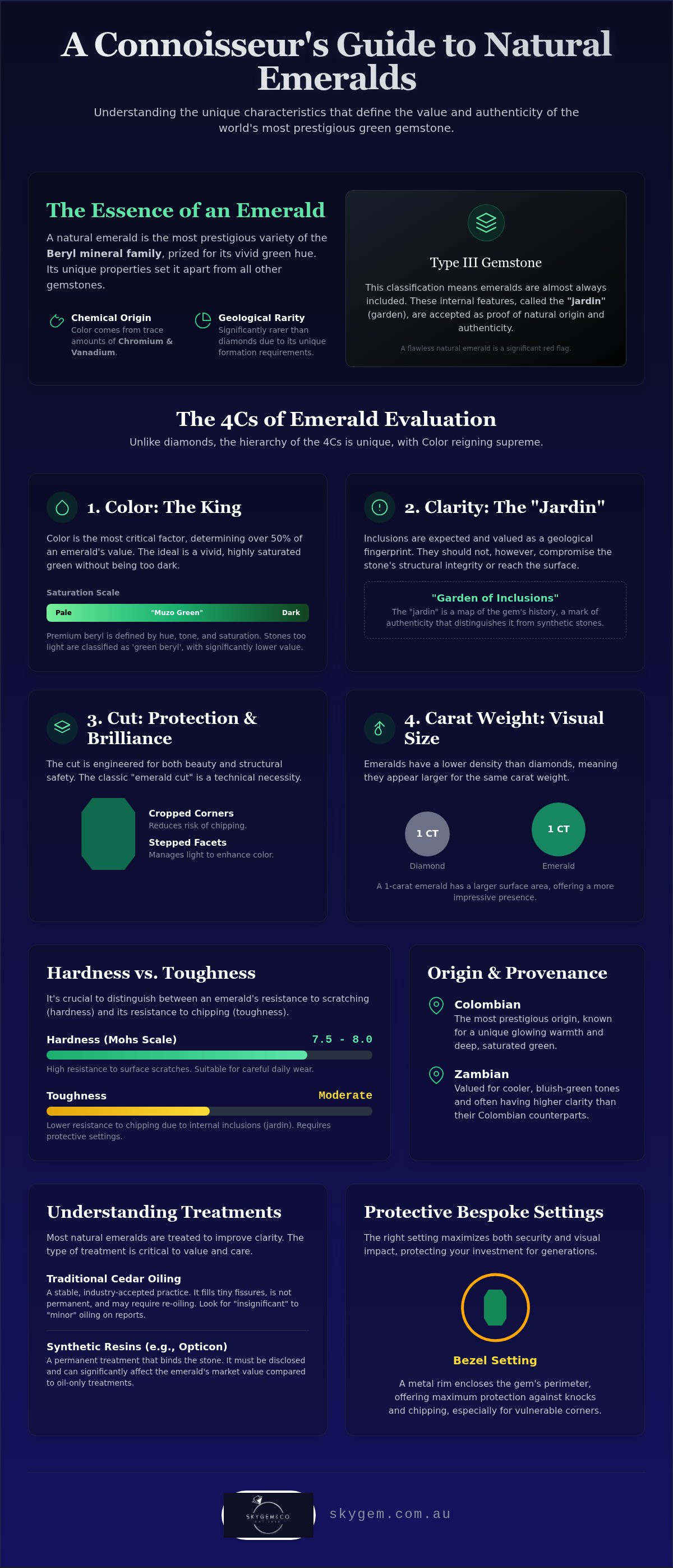
A natural emerald is the most prestigious variety of the beryl mineral, defined by its specific chemical composition and distinct crystal structure. While other beryl varieties include aquamarine and morganite, the emerald's signature green is produced by trace amounts of chromium, vanadium, and occasionally iron. These elements must be present in precise concentrations during formation to achieve the vivid saturation that distinguishes natural emeralds from common green beryl. If the colour is too light or lacks the necessary saturation, gemological labs will classify the stone simply as green beryl, which carries a significantly lower market value.
Understanding the classification system is vital for any collector. Emeralds are categorized as "Type III" gemstones. This technical designation acknowledges that these stones are almost always included. Unlike diamonds, where inclusions are often viewed as flaws, the "jardin" or garden within an emerald is a map of its geological history. These internal features are accepted as proof of origin and authenticity, provided they don't compromise the stone's structural integrity or reach the surface in a way that risks future cracking. This "Type III" status means that finding a stone with minimal inclusions is a rare occurrence that commands a significant premium.
The Rarity of Natural Emeralds vs. Other Gemstones
Emerald formation requires a rare geological coincidence. Beryllium, which forms beryl, is typically found in the Earth's crust, while chromium, which provides the green colour, is found deeper in the mantle. These two elements rarely meet under the right temperature and pressure conditions. This "geological impossibility" makes high-quality emeralds significantly rarer than diamonds. While diamonds are found in abundance across several continents, investment-grade emeralds are limited to specific pockets of the globe. Finding an eye-clean stone over two carats is an exceptional event, as the pressure required for formation almost always creates internal fissures.
The Mohs Scale and Structural Integrity
On the Mohs scale, emeralds rank between 7.5 and 8. This indicates high resistance to scratching, yet it's vital to distinguish between hardness and toughness. While an emerald is hard enough to resist surface wear, its "toughness" or resistance to chipping is lower than that of a sapphire or diamond due to its internal inclusions. These gems belong to the hexagonal crystal system, forming six-sided prisms. This structure provides stability, but the presence of the jardin means the stone requires careful handling and specific setting techniques to ensure long-term viability. Choosing a setting that protects the corners of the stone is a practical step for preserving these delicate assets.
The 4Cs of Emerald Evaluation: A Technical Framework
The systematic evaluation of natural emeralds requires a fundamental shift in priority compared to other precious stones. While the 4Cs of Emerald Evaluation remain the industry standard, the hierarchy of these factors is unique to the beryl family. Colour is the undisputed primary driver of market value. Unlike diamonds, where clarity often dictates the grade, an emerald's worth is largely determined by the specific saturation and tone of its green hue. A stone with minor inclusions but exceptional colour will consistently outperform a cleaner stone with a pale or "washed out" appearance.
The engineering of the cut serves a dual purpose: aesthetic brilliance and structural preservation. The classic "emerald cut" features stepped facets and distinctively cropped corners. These truncated corners are a technical necessity rather than a mere stylistic choice. Because beryl is prone to chipping under mechanical stress, removing sharp 90-degree angles significantly reduces the risk of impact damage during the setting process and daily wear. A well-proportioned cut also manages light leakage, ensuring the green remains consistent across the entire face of the gem.
Carat weight also behaves differently in this category due to the mineral's physical properties. Emeralds have a lower density than diamonds, which means a one-carat emerald will physically appear larger than a one-carat diamond of the same cut. This lower specific gravity allows for a more impressive visual presence on the finger without increasing the weight-based cost proportionally. When you're comparing stones, it's often more practical to look at the millimetre dimensions rather than the carat weight alone to understand the true scale of the piece.
Mastering Emerald Colour: The "Vivid Green" Standard
The most coveted stones exhibit a "vivid green" to "bluish-green" hue. Saturation is the key metric here; it measures the intensity or "strength" of the colour. You should aim for a tone that's deep enough to be rich but not so dark that it appears "inky" or black in low-light environments. Optimal saturation ensures the stone "glows" from within. If you're selecting a stone for a custom piece, viewing it under different light sources is essential to ensure the hue remains stable and vibrant.
The "Jardin": Why Inclusions Matter
Every natural emerald contains internal features known as the jardin. These often manifest as two-phase (fluid and gas) or three-phase (fluid, gas, and solid crystal) inclusions. These microscopic signatures are vital for distinguishing natural stones from synthetic lab-grown alternatives. However, you must scrutinize the stone for surface-reaching fissures. If an inclusion breaks the surface at a high-stress point, it can compromise the gemstone's long-term durability. Identifying a stone with a clean, well-distributed jardin is the hallmark of a savvy collector. For those seeking a balance between these technical requirements, exploring a curated selection of precious gemstones can help you identify the right intersection of colour and structural integrity.
Origin and Provenance: Colombian, Zambian, and Beyond
The geographic origin of natural emeralds serves as a primary indicator of both aesthetic character and market valuation. While the chemical foundation of beryl remains constant, the specific geological conditions of a mining region introduce trace element variations that define a stone's personality. These regional "fingerprints" are what collectors pay a premium for, as they dictate the rarity and historical prestige associated with the gem.
Colombian emeralds have long been regarded as the benchmark for quality, particularly those from the Muzo and Chivor mines. These stones are famous for a warm, "glowing" green that lacks the cooler undertones found in other deposits. This is largely due to their formation in sedimentary rocks, which results in low iron content. In contrast, Zambian emeralds typically form in metamorphic rock containing higher levels of iron. This chemical signature produces a cooler, slightly more bluish-green hue. However, Zambian deposits often yield stones with superior clarity and fewer internal fissures, offering a practical alternative for those seeking transparency and structural stability.
Beyond these two giants, Australian emeralds offer a unique, niche provenance. Deposits in regions like the New England district of New South Wales have a hand-fossicked history. While these stones are rarely found in the large sizes typical of South American mines, they represent a piece of regional geological heritage that appeals to local specialists. Regardless of the source, the origin acts as a technical baseline that influences every subsequent step of the evaluation process.
Comparing the "Glow" of Global Sources
The prestigious "oil-drop" or gota de aceite effect is an optical phenomenon almost exclusive to Colombian stones. It creates a velvety, liquid-like appearance within the gem's structure. While Zambian beryl may lack this specific glow, its "cleaner" nature means it often requires less intensive Emerald Treatments to meet transparency standards. When you examine a GIA or GR certificate, the origin determination is reached through microscopic analysis of inclusions and chemical fingerprinting of trace elements.
The Ethics of Sourcing Natural Gemstones
Transparency in the supply chain is a critical component of a gemstone's long-term value. A clear line of provenance ensures that your investment supports ethical extraction and trade practices. At SkyGem & Co., we prioritize a rigorous vetting process for all our natural gemstones, ensuring each piece is backed by reputable independent lab certification. This methodical approach acts as a safeguard, verifying that the stone's origin and lack of synthetic enhancement are technically accurate and ethically sound.
Emerald Treatments: The Facts About Oiling and Enhancements
Clarity enhancement is a fundamental reality for nearly 99% of all natural emeralds. Because these stones are classified as Type III gems, their internal fissures often reach the surface during the cutting process. Filling these fissures with a substance that matches the refractive index of beryl is an industry-standard practice designed to improve transparency. Without this process, even the most vivid green stones would appear cloudy or opaque. This treatment isn't considered a repair or a flaw, but rather a necessary final step in preparing the gem for a professional setting.
The choice of enhancement material significantly impacts a stone's long-term viability and market prestige. Traditional cedar oil is the preferred choice for high-end collectors. It's an organic, colourless substance that integrates seamlessly with the crystal's structure. However, cedar oil can dry out or change colour over several decades. In contrast, permanent synthetic resins offer greater stability and don't require maintenance, but they're often viewed with less favour by purists who value traditional methods. Understanding which material was used is a critical part of the procurement process.
Treatment levels are graded on a technical scale of Minor, Moderate, and Significant. A "Minor" grade indicates that the oil only occupies small, shallow fissures that don't compromise the stone's integrity. "Significant" enhancements suggest that the stone's appearance relies heavily on the filler, which can affect its resale value. The ultimate rarity is the "No Oil" emerald. These stones exhibit exceptional natural clarity without any foreign substances. Representing less than 0.1% of the market, these untreated gems are considered legacy assets and command the highest price premiums.
How to Read a Gemstone Grading Report
When reviewing a certificate, you must locate the "Clarity Enhancement" or "Comments" section. This is where a lab will disclose the extent of any treatments. GIA certification is the industry standard for natural emeralds because their reports provide a precise, objective analysis of enhancement levels. A report that states "Insignificant" or "Minor" enhancement is generally the target for premium bespoke projects, as it balances visual beauty with structural stability.
Long-term Care for Treated Emeralds
Maintaining a treated stone requires a specific technical protocol. You should never use ultrasonic or steam cleaners on an emerald. The high-frequency vibrations and heat can dislodge the oil or cause existing fissures to expand, leading to catastrophic failure of the stone. Instead, use a soft brush with mild soap and lukewarm water for routine cleaning. If a stone begins to lose its lustre after several years of wear, it can be professionally re-oiled by a specialist to restore its original depth and transparency.
Explore our curated collection of GIA certified natural emeralds to find a stone with a documented treatment profile that meets your technical requirements.
Designing Your Bespoke Emerald Jewellery
The transition from selecting a loose gemstone to engineering a final piece of jewellery requires a balance of metallurgical knowledge and aesthetic precision. When working with natural emeralds, the design must prioritize the protection of the stone's structural integrity without compromising its visual impact. Because beryl has lower toughness than sapphire or diamond, the setting serves as a functional shield against the mechanical stresses of daily wear. A well-executed bespoke piece acts as a permanent asset that preserves the gem's value through technical design.
Metal selection plays a vital role in how the emerald's colour is perceived. 18K yellow gold is frequently utilized because its warm tones complement the chromium-induced green, often making the stone appear more vibrant. Conversely, platinum or 18K white gold provides a crisp, architectural contrast that highlights the stone's saturation and clarity. For those seeking a modern aesthetic, platinum offers superior durability and a secure grip for the setting, though the fabrication requires a high level of precision to ensure the prongs don't exert uneven pressure on the stone's corners.
Integrating diamonds into the design serves both an aesthetic and a structural purpose. Beyond adding brilliance, diamonds can be positioned to act as a physical buffer. In a trilogy or halo configuration, the harder diamonds absorb side impacts that might otherwise reach the emerald's girdle. Our technical approach at SkyGem & Co. ensures that every design for custom engagement rings is built around the specific dimensions of the centre stone, providing a tailored fit that minimizes movement and risk.
Emerald Engagement Rings: Style and Durability
The emerald cut solitaire remains a benchmark for architectural elegance, showcasing the stone's depth and "jardin" through its long, stepped facets. However, for those concerned with longevity, a halo setting is a practical solution. The surrounding diamond border creates a "buffer zone" that protects the emerald from direct contact with hard surfaces. This design choice allows you to enjoy the vivid green of emerald rings while maintaining a level of security appropriate for a piece worn every day.
The Bespoke Consultation Experience
Our consultation process functions as a technical partnership. We guide you through the selection of a stone that aligns with your vision and budget, providing detailed analysis of its treatment history and origin. We utilize advanced CAD design to create a digital prototype of your piece. This ensures a precision fit for unique gemstone shapes, allowing us to adjust the setting to the exact millimetre before any metal is cast. This methodical workflow guarantees that the final piece is both a work of art and a stable, long-term investment.
Explore our curated collection of natural emeralds and begin your bespoke journey today to create a piece that reflects your personal style and professional standards.
Mastering the Future of Your Gemstone Collection
Navigating the technical landscape of high-end gemstones requires more than an appreciation for colour. It demands a methodical understanding of how origin, treatment levels, and structural integrity intersect to define market value. By prioritising GIA certified options and transparent grading, you ensure that your acquisition is a verifiable asset rather than a speculative purchase. Recognising the internal jardin as a signature of authenticity allows you to select natural emeralds with confidence, knowing that their unique geological history is preserved through expert craftsmanship.
Our team acts as technical consultants, providing expert gemmological consultations to help you navigate these complex variables. We specialise in bespoke 18K gold and platinum settings designed to protect your investment for decades. This solution-oriented approach ensures that every design choice, from bezel reinforcements to metal selection, serves the long-term viability of the piece. We're dedicated to ensuring your project meets the highest standards of durability and design.
Browse our exclusive collection of Natural Emeralds and begin building a legacy piece that balances technical precision with timeless aesthetic appeal. We look forward to partnering with you on your next bespoke project.
Frequently Asked Questions
Are natural emeralds suitable for everyday engagement rings?
Yes, they are suitable, but they require specific design considerations. While natural emeralds possess a hardness of 7.5 to 8, their toughness is lower due to internal inclusions. To ensure the stone survives daily impacts, we recommend protective settings like a bezel or a halo. These designs act as a structural buffer, shielding the vulnerable corners of the gem from mechanical stress and ensuring long-term durability.
What is the difference between a natural emerald and a lab-grown emerald?
The distinction is found in the stone's geological history and market rarity. Natural emeralds are formed over millions of years, containing a unique "jardin" of inclusions that cannot be perfectly replicated. While lab-grown stones share the same chemical properties, they lack the "geological fingerprint" and investment potential of mined gems. Collectors value the scarcity and historical prestige that only a natural specimen provides in the long term.
Why do most natural emeralds have inclusions (the 'jardin')?
Inclusions are a natural result of the turbulent conditions required for beryl to interact with chromium. This process almost always creates internal fissures and crystals, which gemmologists refer to as the "jardin." These features are not flaws but signatures of authenticity. They help distinguish natural emeralds from synthetic alternatives and provide a clear map of the stone's unique formation history, which is essential for proper evaluation.
How does origin (e.g., Colombian vs. Zambian) affect emerald price?
Origin acts as a technical baseline for pricing because it determines the stone's trace element composition. Colombian specimens often command the highest premiums due to their low iron content and historical reputation for a "glowing" green. Zambian stones often offer better clarity and structural stability at a more accessible price point. The market values specific regional characteristics, making origin a primary driver of collector demand and resale value.
What is the best cut for a natural emerald gemstone?
The rectangular emerald cut is engineered specifically to accommodate the physical properties of beryl. Its stepped facets and cropped corners are designed to protect the gemstone's most vulnerable points from chipping. This architectural cut also enhances the stone's depth and colour saturation. While other shapes are available, the emerald cut remains the most stable and traditional choice for high-value natural emeralds in bespoke jewellery design.
How should I clean and care for my natural emerald jewellery?
Professional care requires a gentle approach using mild detergent and lukewarm water. You should never subject these gemstones to ultrasonic cleaners or high-pressure steam, as these methods can strip away clarity-enhancing oils or expand internal fissures. A soft brush is sufficient for removing daily debris. If the stone's lustre fades over several years, it can be professionally re-oiled by a specialist to restore its original transparency and depth.
Is oiling a standard practice for all natural emeralds?
Oiling is an accepted industry standard for nearly all mined emeralds to improve their visual clarity. This process involves filling surface-reaching fissures with colourless cedar oil or synthetic resins. While "no oil" stones are the ultimate rarity for collectors, they represent a tiny fraction of the market. Most high-quality gems will show at least a "minor" level of enhancement on a reputable grading report to ensure they meet aesthetic standards.
What should I look for on a GIA certificate for an emerald?
You must scrutinize the "Clarity Enhancement" and "Geographic Origin" fields. These sections disclose the extent of any treatments, such as oiling, and verify where the stone was mined. A report from a reputable lab like the GIA provides the transparent data needed to confirm the stone's quality. Look for "Minor" or "Insignificant" enhancement levels to ensure you are acquiring a premium asset with long-term viability and documented pedigree.
Disclaimer
This article is for general informational purposes only and may include AI-assisted content. Pricing, specifications, and availability are subject to change. For accurate advice and current information, please contact SkyGem & Co. directly. Nothing in this content constitutes professional or financial advice.