
Mozambique Ruby Quality: The Ultimate Guide to the New Standard of Fine Jewellery

Could a discovery made in the Montepuez district in 2009 actually render the legendary mines of Myanmar secondary for the modern Australian collector? While Mogok rubies held the crown for centuries, the consistent transparency and vibrant saturation found in East Africa have redefined the global benchmarks for mozambique ruby quality. You likely recognize that investing in a primary gemstone for a custom setting requires more than just an eye for colour; it demands a technical understanding of how trace elements like iron and chromium influence both the stone's fluorescence and its ultimate market price.
We understand the hesitation that comes with navigating a market where a single heat treatment can alter a stone's value by 50% or more. This guide provides the technical expertise to distinguish between commercial-grade material and investment-quality gems. You'll gain a clear framework for comparing heated versus unheated options and the specific metrics used by laboratories like GRS or Gubelin to certify the "Pigeon's Blood" status. We'll examine why a 2-carat unheated Mozambique ruby can command upwards of A$30,000, ensuring you have the data needed to make an informed, high-value acquisition for your next bespoke project.
Key Takeaways
- Understand how the 2008 Montepuez discovery established Mozambique as the premier global source for high-grade red corundum, setting a new benchmark for the modern jewellery industry.
- Master the technical criteria used to evaluate mozambique ruby quality, focusing on the specific hue, tone, and superior transparency that distinguish these stones from traditional origins.
- Examine the 'Iron Factor' to understand why Mozambique rubies offer a deeper, more consistent red compared to the high-fluorescence glow characteristic of Burmese specimens.
- Evaluate the investment potential of unheated versus heated stones, including why 'no heat' certifications often command a premium of 2x to 3x the price in the Australian market.
- Gain professional insights into designing bespoke pieces, from selecting optimal metal pairings like 18K yellow gold to utilizing the ruby’s durability for high-performance engagement rings.
What is a Mozambique Ruby? Defining the Modern Standard
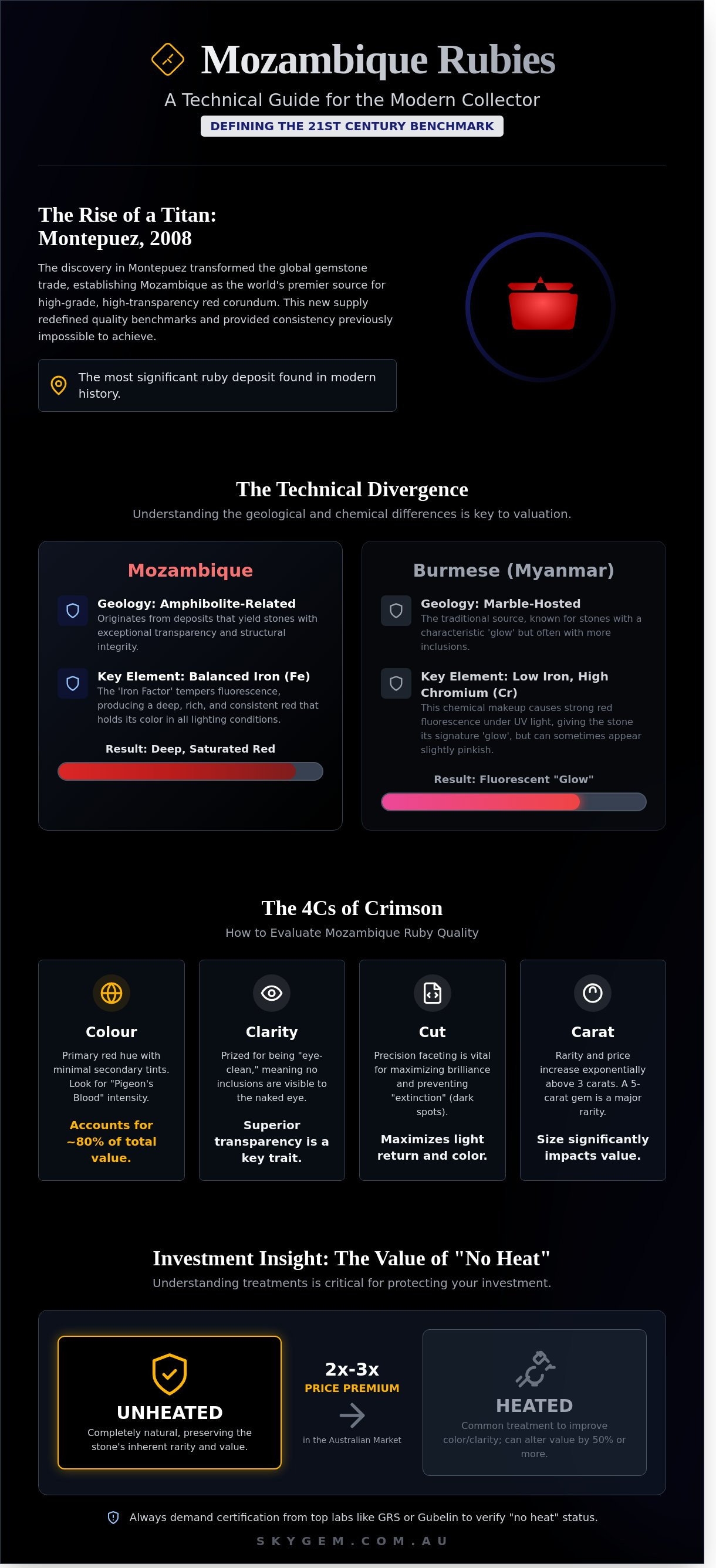
The 2008 discovery in the Montepuez district of Cabo Delgado province transformed the global gemstone trade. Before this date, the market relied on dwindling supplies from traditional sources or stones with heavy inclusions that required significant treatment. Mozambique now provides the majority of the world's high-grade red corundum. This shift is rooted in the region's unique geology. Unlike the marble-hosted deposits of Myanmar, Mozambique rubies typically originate from amphibolite-related deposits. This geological environment produces stones with a balanced iron content, resulting in exceptional transparency and a saturated red hue that rivals any historical origin. Mozambique ruby is the premier source of high-transparency, vivid red gemstones in the 21st century.
The Rise of Montepuez Rubies
The Montepuez mine is the most significant ruby deposit found in modern history. Its development introduced a level of scale and industrial precision previously unseen in colored stone mining. Modern collectors in Australia increasingly prioritise natural ruby specimens that come with a clear chain of custody. The implementation of ethical mining practices and structured auction platforms has ensured a consistent supply of high-quality material. When assessing mozambique ruby quality, professionals look for the combination of "Pigeon's Blood" intensity and the structural integrity that these African deposits provide. This reliability allows Australian designers to specify these stones for high-end architectural jewellery with confidence.
Mozambique vs. The World: A Quick Overview
For decades, Thai rubies were known for being overly dark, while Vietnamese stones often leaned toward pink. Mozambique material bridges this gap by offering the vibrant fluorescence of marble-hosted stones with the clarity of basaltic deposits. On GIA and GRS reports, the Mozambique origin now commands a significant price premium, often fetching 30% to 50% more than stones from Madagascar of similar appearance. In the Australian market, this origin has become the benchmark for investment-grade jewellery. Understanding The 4Cs of Crimson is essential for buyers to appreciate why mozambique ruby quality sets the current market price for loose gemstones in Sydney and Melbourne. The consistency of this material ensures that local jewellers can source matching suites for complex designs, a task that was nearly impossible with traditional sources.
Evaluating Mozambique Ruby Quality: The 4Cs of Crimson
Assessing mozambique ruby quality requires a technical understanding of the 4Cs, though the weighting differs significantly from diamond grading. Colour remains the primary price determinant, often accounting for 80% of a stone's total valuation. In the Australian market, professional gemmologists look for a balance of hue, tone, and saturation that achieves a "vibrant" appearance without becoming overly dark or "inky."
Mozambique deposits are typically found in amphibolite rock, which differs from the marble-hosted deposits of Myanmar. The Technical Divergence in their geological formation results in a higher iron content. This chemical composition provides the stones with a consistent, deep red that maintains its richness even in low-light environments. While Burmese stones rely on high fluorescence to "glow," a high-quality Mozambique ruby relies on its inherent saturation and superior transparency.
- Colour: Look for a primary red hue with minimal secondary tints of orange or brown.
- Clarity: Mozambique rubies are prized for being "eye-clean," meaning no inclusions are visible to the naked eye.
- Cut: Precision faceting is vital to prevent "extinction," where areas of the stone appear black due to poor light return.
- Carat: While small stones are plentiful, the rarity of a high-grade Mozambique ruby increases exponentially once it exceeds 3.00 carats. A 5.00-carat stone of investment quality is a genuine market rarity.
The 'Pigeon Blood' Standard in Mozambique Stones
The "Pigeon Blood" trade name is the most prestigious colour grade assigned by laboratories like GRS and GIA. To qualify, a stone must exhibit a vivid red hue with high saturation and no visible secondary undertones. While "Vivid Red" is an exceptional grade, Pigeon Blood rubies sit at the absolute peak of the mozambique ruby quality scale. In natural Australian sunlight, these stones display a pure, glowing red that doesn't shift toward pink or purple. This specific grade can command a premium of 40% to 60% over standard vivid red stones.
Clarity and Inclusions: What to Look For
Mozambique rubies generally offer higher transparency than their counterparts from other regions. Common internal characteristics include fine rutile needles, small crystals, or "fingerprint" inclusions. Because these stones are often more transparent, the cut becomes even more critical to ensure the gem has "life." A well-cut, eye-clean stone will exhibit a bright, internal sparkle that enhances its overall presence in a custom setting. If you're looking for a centrepiece with exceptional brilliance, you can browse our technical data on loose rubies to compare clarity grades. Higher transparency directly correlates to better light performance, ensuring the ruby doesn't look "sleepy" or dull in professional lighting conditions.
Mozambique vs. Burmese Rubies: The Technical Divergence
Understanding the geological composition is essential for evaluating mozambique ruby quality. The primary differentiator lies in the trace element concentration within the corundum crystal lattice. While both origins rely on chromium for their red hue, the presence or absence of iron dictates the stone's visual performance under different lighting temperatures.
Fluorescence and the 'Glow' Effect
Chromium provides the vibrant red colour in both origins. However, Burmese stones from the Mogok Valley typically lack iron, which allows the chromium to fluoresce intensely when exposed to ultraviolet light. Mozambique deposits, specifically those in the Montepuez region identified in 2009, contain higher iron levels. This iron acts as a chemical quencher that dampens fluorescence. While Burmese stones may glow in high-UV environments, they often appear pinkish or slightly orange in low light. Mozambique rubies remain optically stable. They maintain a deep, rich red from midday sun to evening incandescent lighting. When you're visiting a Melbourne jewellery boutique, you can verify this by using a long-wave UV torch; a Burmese stone will radiate a bright neon red, while the Mozambique variant will show a more subdued, velvet-like response.
Market Pricing and Rarity
The origin premium remains a powerful force in the Australian gemstone market. Historically, Burmese rubies have commanded prices 300% to 500% higher than African counterparts. For instance, a 2-carat Pigeon Blood ruby from Burma might exceed A$60,000 per carat at auction. In contrast, a stone of equivalent mozambique ruby quality often sits between A$12,000 and A$22,000 per carat. This makes them a technically superior choice for engagement rings where clarity and daily durability are paramount. Investors are noting the closing gap. As Burmese mines face depletion and trade complexities, the 15% annual appreciation seen in high-grade Mozambique material suggests a shift toward price parity by 2030. While Burmese rubies offer high fluorescence, Mozambique rubies provide superior clarity and a more saturated, consistent red at a better value point.
Treatments and Certification: Protecting Your Investment
The market value of a Mozambique ruby depends heavily on its treatment history. Most rubies found in retail environments undergo standard heat treatment to improve clarity and colour saturation. This process is stable and widely accepted within the Australian gemstone trade. However, unheated specimens command a significant price premium, often trading at 200% to 300% the price of their heated counterparts. For a high-grade 2.00-carat stone, this difference can mean the gap between A$12,000 and A$35,000.
While standard heat is acceptable, buyers must avoid "lead-glass filled" or "flux-healed" rubies. These treatments involve injecting materials into fractures to artificially enhance mozambique ruby quality. These stones are structurally compromised and don't hold their value over time. They are often sold in low-end retail markets but have no place in a serious investment portfolio or high-end jewellery piece. Understanding these distinctions is the first step in technical due diligence.
The Value of 'Unheated' Mozambique Rubies
An "unheated" ruby remains exactly as it was when mined from the Montepuez region. It has undergone no thermal enhancement to alter its internal structure. When reviewing a lab report, look for the "N" symbol, which stands for "No indications of heating." If you see "H," "H(a)," or "H(b)," the stone has been thermally modified. In the Australian market, unheated Pigeon Blood rubies are exceptionally rare. These stones represent less than 5% of the total Mozambique output, making them a primary target for collectors seeking long-term capital appreciation.
Navigating Gemstone Reports (GIA vs GRS)
Independent verification is the only way to ensure you're paying a fair price for the stated mozambique ruby quality. GIA provides a conservative, technical breakdown of a stone's properties. GRS is often preferred for coloured stones because they offer specific colour grading terms like "Pigeon Blood." SkyGem & Co. insists on independent certification for all loose gemstones to provide total transparency. Always verify the report number on the lab’s official website to confirm the digital record matches the physical document before finalizing any transaction.
Secure a certified investment-grade stone by browsing our curated collection of Mozambique rubies today.
Designing with Mozambique Rubies: Bespoke Inspiration
Designing around a high-tier gemstone requires a technical understanding of how light interacts with specific metal alloys. When assessing mozambique ruby quality, the stone’s primary hue and secondary undertones dictate the choice of setting. 18K yellow gold remains a traditional favourite because it complements the warm, orange-red flashes often seen in Mozambique material. Conversely, platinum or 18K white gold provides a crisp, neutral backdrop that allows the saturated "pigeon blood" tones to stand out without visual interference.
Ruby engagement rings have seen a 25% increase in demand among Australian couples seeking a durable yet distinct alternative to traditional diamonds. With a hardness of 9.0 on the Mohs scale, rubies are second only to diamonds in scratch resistance, making them ideal for daily wear. To maximise the visual impact, we recommend surrounding the centre stone with high-grade white diamonds, typically F colour and VS clarity or higher. This contrast creates a frame that draws the eye directly to the ruby's depth. The journey of creating a custom-made engagement ring begins with selecting a certified stone, followed by a detailed CAD design phase to ensure structural integrity and aesthetic balance.
The Solitaire vs. Halo Debate for Rubies
A solitaire setting is the preferred choice for stones with exceptional clarity and a deep, uniform colour profile. It removes distractions, allowing the mozambique ruby quality to be the singular focus. For stones under 1.5 carats, a diamond halo can effectively increase the perceived surface area by up to 30% while adding necessary brilliance. You can explore our solitaire engagement rings to see how minimalist prongs secure the gemstone while maximising light entry from the sides.
Caring for Your Mozambique Ruby
Rubies are exceptionally resilient. Their 9.0 Mohs rating means they resist the abrasions of daily life better than almost any other coloured gemstone. To maintain the stone’s vivid saturation, we recommend a professional ultrasonic clean every six months. At home, a simple solution of warm water and mild detergent with a soft-bristled brush is sufficient to remove oils. SkyGem & Co. provides comprehensive maintenance services for all fine jewellery in our Melbourne studio, ensuring your investment retains its lustre for decades.
- Durability: 9.0 on the Mohs Scale.
- Cleaning: Professional ultrasonic or warm soapy water.
- Frequency: Inspect settings annually to ensure prong security.
Securing Your Investment in the New Standard of Crimson
The Montepuez discovery in 2009 redefined the global market, establishing a technical benchmark for mozambique ruby quality that often surpasses 20th-century Burmese output in both clarity and scale. Selecting an investment-grade gemstone requires a methodical approach to the 4Cs, specifically focusing on unheated provenance and GIA-certified transparency. These data points aren't just specifications; they're the primary drivers of long-term value in the Australian jewellery landscape. Since 2015, the demand for ethically sourced African rubies has grown by over 40%, making precise gemmological verification essential for any high-value acquisition.
Our expert gemmologists operate from Melbourne’s historic Royal Arcade, a precinct dedicated to premium craftsmanship since 1892. We don't just supply stones; we provide the technical expertise required to navigate the complexities of inclusions and thermal treatments. Every ruby we present is selected for its superior luminous efficacy and structural durability. It's about finding the perfect intersection of geological rarity and architectural design for your bespoke project. We're here to ensure your selection remains a permanent and evolving asset.
We invite you to Book a Bespoke Consultation to View Our Mozambique Ruby Collection and experience our commitment to engineering excellence firsthand. We're ready to help you secure a piece of history that'll last for generations.
Frequently Asked Questions
Is a Mozambique ruby better than a Burmese ruby?
Mozambique rubies often provide superior clarity and transparency compared to their Burmese counterparts. While Burmese stones carry a historical prestige premium, the Montepuez deposit discovered in 2009 yields gems with a consistent, high-iron chemical profile. This results in a steady, vivid red hue. Currently, 85% of the global high-end ruby supply originates from Mozambique because these stones typically contain fewer inclusions than stones from the Mogok region.
What does 'Pigeon Blood' actually mean for a Mozambique ruby?
'Pigeon Blood' identifies a specific colour grade defined by high saturation and a vivid red hue with a subtle blue undertone. This trade term is strictly applied by labs like GRS based on precise colourimetric data. For a mozambique ruby quality assessment, this designation requires the stone to show no visible brown or orange tints under 5500K lighting. This status is reserved for the top 2% of production.
Are Mozambique rubies ethical and conflict-free?
Mozambique rubies are considered a more ethical choice because the majority of production comes from regulated mines like Montepuez Ruby Mining. This operation is 75% owned by Gemfields and follows strict environmental and social governance frameworks. The mine contributes approximately A$100 million in taxes and royalties to the local economy annually. You should always request a provenance report to ensure your gemstone meets these modern responsible sourcing standards.
How much should I expect to pay for a high-quality 1-carat Mozambique ruby?
You can expect to pay between A$7,500 and A$15,000 for a high-quality, unheated 1-carat Mozambique ruby in the Australian market. Prices vary based on the specific saturation and clarity of the individual stone. A heated ruby with similar visual characteristics typically costs 30% to 50% less. Since 2021, the market value for unheated stones has increased by 15% annually due to rising demand for investment-grade assets.
Can I use a Mozambique ruby for an engagement ring?
Mozambique rubies are an ideal choice for engagement rings because they rank 9 on the Mohs scale of mineral hardness. This makes them the second hardest natural gemstone used in jewellery, surpassed only by diamonds. They effectively resist scratching and daily wear. When you're evaluating mozambique ruby quality for a ring, prioritize a "vivid red" stone with a "clean" eye-clarity rating to ensure the gem maintains its brilliance over decades of use.
How can I tell if my Mozambique ruby has been heat-treated?
You can identify heat treatment by examining internal inclusions under 40x magnification. Natural, unheated rubies often contain intact rutile needles, known as "silk," which intersect at 60-degree angles. If these needles appear melted or show "discoidal" stress fractures, the stone has been subjected to high-temperature enhancement. Roughly 95% of rubies on the market undergo heat treatment. You should always insist on a laboratory report from the GIA to confirm treatment status.
Why do some Mozambique rubies look darker than others?
The perceived darkness in a ruby is usually caused by high iron content or poor "extinction" in the gemstone's cut. Mozambique rubies naturally contain higher iron levels than Burmese stones; this can lead to a deeper, garnet-like red if the crystal is too thick. If the pavilion facets are cut at angles exceeding 42 degrees, light leaks out the back. This creates dark patches that reduce the stone's overall brilliance.
Does the GIA certify Mozambique rubies for 'Pigeon Blood' status?
The Gemological Institute of America (GIA) does not use the term 'Pigeon Blood' on their official identification reports. Instead, they provide a technical description of the colour, such as "vivid red," to maintain scientific objectivity. While labs like GRS or Gübelin include trade names, the GIA focuses on geographic origin and treatment detection. You'll find the 'Pigeon Blood' designation primarily on reports from Swiss laboratories that use specific saturation benchmarks.
Disclaimer
This article is for general informational purposes only and may include AI-assisted content. Pricing, specifications, and availability are subject to change. For accurate advice and current information, please contact sky gem and co. directly. Nothing in this content constitutes professional or financial advice.