
Milgrain vs Filigree: Cost, Detail and Durability

The finer detail is not necessarily the bigger cost driver. Choosing milgrain vs filigree detailing on a vintage ring is less about picking a cheaper or more expensive look and more about understanding the work involved: milgrain adds a beaded border, while filigree creates patterned openwork. Milgrain does not significantly increase a ring’s overall cost.
Both details can make a ring feel distinctive, but they read differently at normal viewing distance. Milgrain gives an edge a crisp, textured outline; filigree puts more visual emphasis on the shoulders or sides of the setting. It’s reasonable to consider cost alongside appearance, durability and care, especially when the detail sits close to a centre stone.
This comparison explains where each technique is typically used, how its detail wears and what to consider when pairing it with a centre stone. You’ll also see why the scale and placement of the ornament matter as much as its craftsmanship, helping you assess which vintage-inspired finish best suits the ring’s overall design.
Key Takeaways
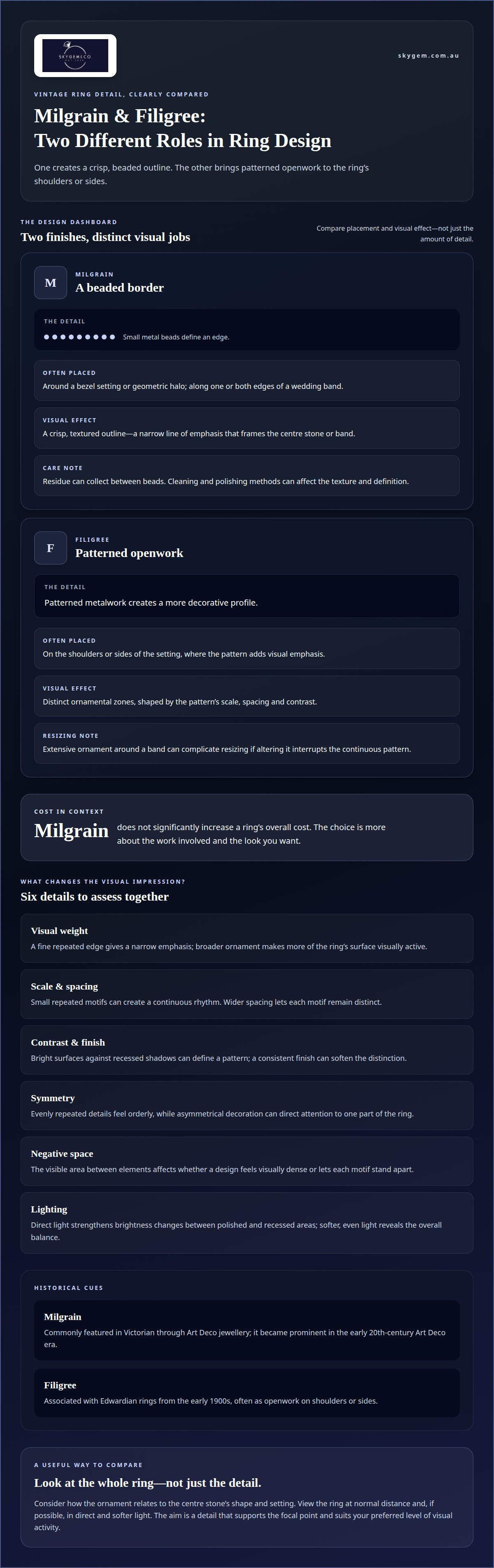
- Milgrain adds a beaded border and does not significantly increase a ring’s overall cost; filigree’s openwork creates a different level of visual detail.
- Look at where the ornament sits: milgrain often outlines settings, while filigree brings pattern to a ring’s shoulders and sides.
- Fine surface details need considered care. Cleaning and polishing methods can affect the texture and definition of milgrain.
- Choose ornament with the centre stone’s shape and setting in mind so the detail supports, rather than competes with, the focal point.
- Viewing the ring at normal distance can help clarify whether you prefer a defined border or more visible patterned metalwork.
Milgrain placement on wedding and engagement rings
Milgrain edges a ring setting with small metal beads, while filigree forms patterned metalwork. The placement of either detail affects the ring’s appearance, cleaning needs and potential for future resizing.
Milgrain Placement on Ring Styles
On an engagement ring, milgrain often outlines a bezel setting or geometric halo, framing the centre stone with a textured border. On a wedding band, it can run along one or both edges, defining the band without covering its central surface. These placements affect how the stone and band look together. A jeweller also assesses the gemstones and small settings before choosing a cleaning method.
Vintage-Inspired and Antique Rings
A vintage-inspired ring is a modern design that evokes an antique aesthetic; a genuine antique ring is an older piece. A design inspired by a 100-year-old ring can retain decorative character while using contemporary construction. That distinction matters for daily wear, since an antique ring may have worn prongs, fragile metal or chipped diamonds. Age alone doesn’t establish whether milgrain or filigree is original to a particular ring.
Styles and Eras Featuring Milgrain or Filigree
Victorian through Art Deco jewellery commonly features milgrain, which became prominent in the early 20th-century Art Deco era. Filigree is associated with Edwardian rings from the early 1900s, often appearing as openwork on shoulders or sides. Beaded borders suit geometric halos, while scrolling filigree creates a more patterned profile. These details can give an engagement ring a beautiful vintage character without making the centre stone the only point of interest.
Assessing Original Ring Detailing
To assess whether detailing is original, a jeweller examines its pattern, construction and wear across the ring. Consistent motifs on the shoulders, setting and band can indicate an integrated design; differences in finish or visible joins may point to later alterations. The assessment also considers whether milgrain beads remain distinct and whether small settings hold their gemstones securely. This helps inform suitable cleaning and repair.
Residue can collect between milgrain beads, so cleaning needs to reach those narrow spaces without disturbing small settings. Extensive filigree or engraving around the band can also complicate resizing, as altering the band may interrupt its continuous pattern. A jeweller considers the ornament’s position and construction before deciding how to clean, repair or resize an ornate ring.
Visual differences between milgrain and filigree
Compare the visual weight of each treatment rather than simply counting its details. A fine, repeated edge creates a narrow line of emphasis, while broader ornamental areas make more of the ring’s surface visually active. This changes the balance between the centre, the band and the surrounding metal, even when both details are finely crafted.
Contrast plays a central role. A bright finish against recessed shadows can make a design look more defined, while a consistent finish across the surface can soften the distinction between ornament and setting. The same pattern may look crisp in direct light and more restrained in diffuse light. The metal’s finish affects how strongly its details stand out.
Consider visual density, too. A small repeated motif can form a continuous rhythm around a setting, while a larger pattern gives the eye separate areas to explore. Neither approach is inherently more prominent; scale, spacing and contrast determine the effect. Choose based on whether you prefer an even visual frame or distinct decorative zones.
Symmetry can also change the impression. Repeated details arranged evenly around a centre create a formal, orderly appearance. Asymmetrical decoration adds movement and can direct attention to one part of the ring. Examine how the pattern relates to the overall silhouette, especially where the shoulders meet the setting.
Consider negative space, the visible metal or open area between decorative elements. Closely grouped details can make a ring feel visually dense, while wider spacing lets each motif remain distinct. In a compact design, spacing may matter more than the complexity of the pattern. That is why two rings with similar ornament can still feel markedly different.
Lighting offers another useful comparison. Under direct light, polished surfaces and recessed areas create stronger changes in brightness. Softer, even lighting reduces those shifts and reveals the design’s overall balance. If possible, view the ring in both conditions and note whether the detail remains legible without drawing attention away from the centre.
For a clear design decision, first identify the effect you want: a continuous visual rhythm, distinct ornamental zones or a more restrained surface. Then assess how spacing, symmetry and finish support that effect. This approach considers the ring as a complete composition and helps you choose a detail that matches your preferred level of visual activity.
Wear and durability of raised and recessed details
Restoration works best when it responds to the condition of the existing detail rather than treating the whole ring uniformly. A jeweller can inspect the milgrain pattern, noting where beads remain well defined and where they need attention. Wear limited to one section of a border may call for a local touch-up, while a longer affected area may need more extensive re-application.
Matching the original pattern is central to restoration. Bead size, spacing and continuity contribute to the ring’s visual character, so any repair should relate to the surrounding detail. On a border with repeated beads, a jeweller can compare the worn section with better-preserved areas. This helps the restored portion remain visually connected to the rest.
Raised details and recessed ornament also call for different restoration considerations. Milgrain creates a defined texture along a surface; engraved lines and openwork form patterns on or through the metal. Repair needs depend on the feature being restored. A jeweller assesses the ornament’s form and condition before deciding whether a local adjustment or broader restoration is appropriate.
A ring that combines several techniques benefits from a feature-by-feature assessment. For instance, milgrain bordering a setting may need different treatment from engraved shoulders on the same ring. Considering each detail separately helps preserve its distinct role and avoids treating every decorative element as if it had the same construction. The aim is to retain the design’s original visual balance.
Consider restoration in light of the ring’s intended appearance. You may prefer to preserve the softened character of an older piece, or have worn milgrain touched up to restore its definition. A jeweller can explain how refreshing the detail would affect the visible pattern. The choice is aesthetic as well as technical, since each option preserves different evidence of the ring’s history.
For a ring with a continuous border, a jeweller can assess how a local repair will look beside the untouched sections. A small restored area should sit coherently within the larger pattern; extensive work needs to account for the feature as a whole. This matters when milgrain follows a geometric outline, where consistency helps preserve the setting’s definition.
Before restoration, explain which details matter most to you, such as the original pattern, a crisp finish or the contrast between ornament and plain metal. That priority gives the jeweller a practical basis for discussing an approach. Careful assessment and targeted touch-ups can help retain intricate craftsmanship without assuming every worn detail needs the same intervention.
Choosing ornament to complement a centre stone
Start by considering how the centre stone’s outline relates to the surrounding metalwork. A cushion-cut diamond has softened corners, while an Asscher cut has a more geometric profile. Milgrain can trace a setting’s edge without adding a competing motif; filigree adds pattern to the shoulders or sides. The choice affects whether the stone or the ring’s ornament carries more visual emphasis.
For a traditional look, engraved shoulders and scrolled designs can complement an antique-style stone. An old mine diamond, for example, can sit in a setting with shoulder decoration that echoes its vintage appearance. The connection works best when the metalwork supports the stone’s outline rather than introducing unrelated shapes. Delicate scrolls create a different effect from a crisp, beaded border.
Art Deco-inspired designs offer another clear pairing. A step-cut centre stone can sit within a geometric halo, with milgrain outlining its angles. Contrasting coloured gemstones, such as sapphires or emeralds, can add colour to this structured composition. Here, the ornament frames the centre stone, which remains the principal focal point.
Filigree changes the balance by spreading detail across a larger area. Scrolled shoulders can draw the eye outward from a centre diamond, while geometric openwork can reinforce an angular stone shape. Extensive detailing may also provide finger coverage, making the centre stone appear larger in the overall design. This effect comes from the surrounding visual area, not a change to the stone itself.
Consider how the ring looks from above and from the side. A bezel setting with milgrain emphasises the stone’s perimeter; filigree shoulders reveal more intricate metalwork in profile. If both techniques appear together, giving each a distinct role helps maintain clarity. For example, a fine border can define the setting while restrained shoulder patterns add traditional character.
Contemporary techniques can reproduce traditional details without making every feature look antique. The key design decision is how the stone, setting and ornament work as a complete composition. Compare the centre stone’s shape with the direction of nearby lines, the pattern’s scale and the amount of visible metal. This helps you choose a ring where craftsmanship complements the gemstone rather than obscuring its defining features.
Comparing ring details at normal viewing distance
A ring’s overall design is often clearer at normal viewing distance than under close inspection. From about a hand’s length away, milgrain tends to read as a defined edge, while filigree reads as broader patterns across the shoulders. This distinction helps identify the dominant effect: a crisp outline around the setting or decorative metalwork extending beyond it.
Use the centre stone as a visual reference. On a diamond ring, a beaded border can frame the setting without competing with the stone’s outline. Filigree, by contrast, may draw attention to the shoulders or side profile. If the metalwork catches your eye before the diamond, its scale or contrast may be carrying more visual weight than you want.
Compare the ring from above, then turn it sideways. From above, note whether the setting’s border looks continuous and distinct. From the side, check whether engraving or openwork becomes a separate feature. A ring with milgrain around its setting and plain shoulders looks different from one with scrolling patterns along its sides.
Lighting also changes what appears prominent. Under direct light, tiny raised beads can create a sequence of bright points, while the recessed areas between them appear darker. In softer light, that contrast may be less apparent. Filigree patterns can likewise cast stronger shadows from the side than from above, so assess both views before deciding which detail defines the ring.
Finishing affects the impression, too. A polished border can make milgrain stand out against a smoother surface, while consistent finishing across the band can soften the contrast. For example, a geometric setting with defined edges may look more structured when its border remains distinct. The surrounding metal should support the centre stone rather than create competing lines.
For a useful comparison, look briefly, look away, then view the ring again from the same distance. Notice what you recognise first: the centre stone, the beaded outline or the patterned shoulders. Repeat with the ring facing up and in profile. This simple test separates close-up craftsmanship from the overall design impression.
Choose milgrain when you want a clearly outlined setting; choose filigree when visible shoulder patterns should contribute more of the ring’s character. If both details appear, consider whether each remains legible without overwhelming the centre. The strongest design is not necessarily the most intricate, but the one whose metalwork and stone form a coherent composition at normal viewing distance.
SkyGem & Co.
SkyGem & Co. can help you apply these design considerations when choosing an engagement ring and centre stone. If you’re deciding between a defined milgrain edge and more prominent filigree-style metalwork, consider how the setting’s outline and ornament work together. Its Solitaire, Halo and Trilogy Engagement Rings offer different setting contexts to compare, and a Lab-Grown Diamond is one centre-stone option.
Bring your preferred details and stone shape into the design discussion to clarify which elements should lead visually. Contact SkyGem & Co. to discuss your engagement ring choices.
Shape a design that feels distinctly yours
Choosing between milgrain and filigree detailing on a vintage ring is also an opportunity to decide what you want the piece to express. Consider whether its character should feel restrained, intricate or balanced between the two. That preference can guide a design conversation more clearly than choosing an ornament by name alone.
Before settling on a direction, identify what you want to lead: the centre stone, the ring’s silhouette or its decorative metalwork. Then consider how those priorities translate into a complete design. The aim is not to include every detail you admire, but to bring the chosen elements together in a coherent way that suits your taste and intended wear.
SkyGem & Co. can help you explore how setting style and centre stone work with your preferred detailing. A considered conversation can turn visual preferences into a personal, purposeful design direction.
Your preferred balance of ornament and stone can be the starting point for a ring that feels truly yours.
Frequently Asked Questions
How does Milgrain affect the cost of a ring?
Milgrain does not significantly increase a ring’s overall cost. The amount of detail and the ring’s broader construction still shape the work involved. For a useful comparison, consider two rings with the same centre stone and setting, then assess whether one includes ornament beyond its milgrain. This keeps the cost question focused on the complete design rather than attributing the ring’s overall value to one decorative feature.
Will milgrain wear off over time?
Milgrain can become smoother after years of hard wear, and a jeweller can touch up or re-apply worn areas. If a border looks uneven, describe which parts have changed and whether the ring has been polished before. That context helps the jeweller assess the remaining pattern and discuss suitable restoration, rather than assuming the entire border needs the same work.
Is milgrain the same as pavé or filigree?
No. These terms describe different features. Pavé refers to small gemstones set close together across a surface; milgrain and filigree refer to decorative metalwork. A single ring can combine these techniques, such as pavé-set stones alongside ornamented shoulders. When reviewing a design, identify which parts are gemstones and which are metal details. This clarifies the ring’s visual composition and the separate roles of its features.
Who Should Choose Milgrain?
Milgrain may suit someone who wants a vintage-inspired finish without making elaborate shoulder patterns the main feature. Consider it if you prefer an edge detail that supports the setting’s outline or if a geometric design needs a more defined finish. Factor in care, too: the detail can collect residue, and polishing requires care to preserve its texture. Choose it for the appearance and upkeep you value.
What is milgrain detailing on a vintage ring?
Milgrain is a decorative metal finish formed from a series of small beads. On a vintage-inspired ring, it can evoke traditional jewellery design, whether it outlines a setting or follows a band’s edge. When assessing a particular ring, look for consistency in the bead pattern and compare protected areas with exposed ones. This can help distinguish the intended design from areas changed through wear.
What is filigree detailing on a vintage ring?
Filigree is decorative metalwork arranged into fine, connected motifs. On a vintage-inspired ring, it can add detail to the shoulders or sides, shaping the view beyond the centre setting. If you’re considering an existing ring, check whether the pattern continues around the band. Continuous ornament can affect resizing, as changing the band may interrupt the design. Consider this practical point alongside the ring’s appearance.
How can you tell milgrain and filigree apart?
Inspect the ring from above and from the side, then follow the detail’s path. A jeweller can assess whether the ornament tracks an edge or forms a wider motif across the metal, and whether its pattern is consistent around the ring. For an older piece, they can also consider wear and signs of later alteration. This helps identify the design without relying on the ring’s age alone.
Disclaimer
This article is for general informational purposes only and may include AI-assisted content. Pricing, specifications, and availability are subject to change. For accurate advice and current information, please contact SkyGem & Co. directly. Nothing in this content constitutes professional or financial advice.