
Men's Diamond Wedding Band Styles: The 2026 Guide to Modern Masculinity

For the modern professional, a wedding ring is no longer a passive accessory but a deliberate statement of technical appreciation and personal identity. You likely want a piece that aligns with the quality of your timepiece collection, yet you might worry that exploring different men's diamond wedding band styles could lead to a ring that feels too fragile or overly decorative. It's a valid concern, especially when your lifestyle involves physical activity or high-stakes environments where durability is just as important as the aesthetic finish.
This guide will help you understand the intersection of precision manufacturing and stone security, ensuring you select a band that balances refined luxury with industrial-grade resilience. We'll examine the specific setting techniques that lock stones in place, the performance metrics of 2026's most durable metals, and how to choose a profile that feels both masculine and permanent. By focusing on the technical specifications of each design, you can invest in a piece that reflects your success without compromising on the longevity of the asset.
Key Takeaways
- Understand how the 2026 shift toward subtle diamond accents allows for a sophisticated aesthetic without compromising a masculine profile.
- Learn why technical setting choices, such as the flush or gypsy mount, are the engineering standard for securing stones during physical activity.
- Compare the performance metrics of platinum and 18K gold to identify which material best supports various men's diamond wedding band styles and lifestyle demands.
- Discover the "Watch Test" methodology for ensuring your band width and metal choice complement your luxury timepiece collection.
- Evaluate the benefits of a bespoke CAD design process in creating a hand-finished legacy piece that exceeds the structural integrity of off-the-shelf alternatives.
The Evolution of Men's Diamond Wedding Band Styles
The landscape of men's jewellery in 2026 has undergone a fundamental shift. While the history of wedding rings often prioritised simple, unadorned bands for men, the modern Australian groom now demands a fusion of structural integrity and aesthetic distinction. We've seen a move away from the purely functional toward men's diamond wedding band styles that serve as markers of both personal success and lifelong commitment. This transition is driven by a professional demographic that values high-performance materials and the precise application of gemstones to reflect a sophisticated lifestyle.
Diamonds have become the standard for those who view their wedding band as a permanent asset rather than a temporary accessory. In a market where gold has appreciated significantly over the last five years, the addition of GIA-certified natural white diamonds or high-quality lab-grown alternatives adds a layer of technical complexity and long-term value. For many, the ring acts as a psychological anchor; it's a representation of a milestone achieved and a future secured. It communicates a sense of quiet confidence, aligning the wearer’s personal milestones with a tangible, high-value object.
Subtle Refinement vs. Bold Statements
Modern design allows for a broad spectrum of expression. Minimalist professionals often gravitate toward single stone accents, where a solitaire diamond is flush-set into a brushed platinum band for a low-profile finish. Conversely, multi-stone designs and full pavé arrangements offer a high-impact look for those who want their ring to be a focal point. Black diamonds have also emerged as a popular industrial alternative, providing a matte, contemporary finish that pairs exceptionally well with titanium or darkened gold alloys.
Why Style Choice Impacts Longevity
Selecting between different men's diamond wedding band styles requires a technical understanding of stone security. A ring's longevity isn't just about the hardness of the diamond; it's about the setting's ability to withstand the rigours of daily wear. The 'Modern Masculine' ring style is a blend of industrial durability and refined luxury. Understanding how these setting styles dictate the ring's overall profile is essential for ensuring the piece remains a viable asset for decades. By choosing a design that respects the physical properties of the metal, you ensure the aesthetic remains intact.
Setting Techniques: Engineering Security and Style
Selecting from various men's diamond wedding band styles involves more than just visual preference; it requires a rigorous evaluation of the mechanical bond between the gemstone and the metal. For the professional whose daily routine includes physical activity or hands-on technical work, the setting technique is the primary determinant of the ring's longevity. A secure setting protects the diamond from the impact and abrasion inherent in an active lifestyle, ensuring the stone remains a permanent part of the band. When we discuss stone security, we're looking at how the design manages the physical forces applied to the ring during everyday wear.
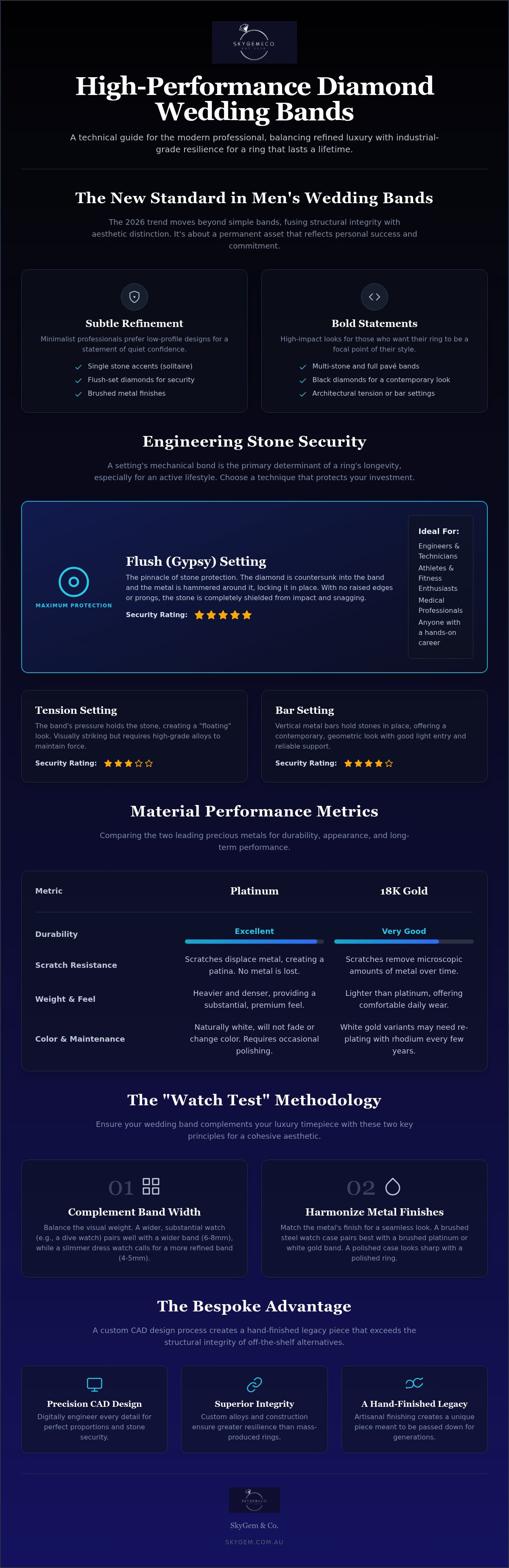
The flush setting, often referred to as the gypsy setting, represents the pinnacle of protection in modern jewellery. In this design, the diamond is countersunk directly into a precisely drilled hole within the band. The metal is then carefully hammered around the stone's perimeter to lock it in place. Because no prongs or raised edges exist, the diamond's girdle is completely shielded from external forces. This prevents snagging on clothing or equipment, making it the preferred choice for engineers, athletes, and medical professionals who require a low-profile solution. If you're unsure which mechanism best suits your daily environment, consulting with a specialist about a custom-made engagement ring in Melbourne can provide the technical clarity needed for a secure design.
For those who prefer a more architectural aesthetic, tension and bar settings offer a distinct profile that highlights the stone's geometry. Tension settings rely on the physical pressure of the band itself to hold the diamond, creating the illusion of a floating stone. While visually striking, these require high-grade alloys to maintain the necessary clamping force over time. Bar settings use thin vertical walls of metal between individual stones, combining a contemporary geometric look with reliable structural support. These methods allow for greater light entry into the stone while maintaining a level of security that traditional prong settings often lack in wider men's diamond wedding band styles.
The Flush Setting: Maximum Protection
By embedding the diamond directly into the metal, the flush setting eliminates the vulnerability of exposed prongs. This style ensures the stone remains level with the ring's surface, providing a streamlined finish that doesn't interfere with gloves or machinery. It's the most pragmatic choice for those who require a ring that is as resilient as it is refined, offering a clean aesthetic that doesn't compromise on durability.
Channel and Pavé: Elevating the Brilliance
Channel settings create a seamless path of light by securing a row of diamonds between two parallel walls of metal. This technique is particularly effective when using princess or baguette cuts, as their straight edges allow the stones to sit flush against one another for a continuous, brilliant line. While this offers excellent protection for the stones' edges, it does require a disciplined cleaning regimen. Dust and debris can accumulate within the recessed channel, potentially dulling the diamonds' brilliance if the ring isn't maintained regularly.
Materials and Diamonds: Selecting for Performance
The structural integrity of men's diamond wedding band styles depends heavily on the physical properties of the chosen metal. While aesthetic appeal is vital, the metal acts as the engineering foundation that secures each stone against the rigours of daily wear. Selecting the right material is a balance of density, maintenance requirements, and the specific setting technique used to house the diamonds. For the professional who views their ring as a long-term asset, understanding these material specifications is essential for ensuring the piece remains secure and visually consistent over time.
Platinum vs. White Gold for Diamond Settings
Platinum is the industry standard for high-security settings due to its extreme density and displacement properties. Unlike gold, which loses microscopic amounts of metal when scratched, platinum simply shifts; this means the prongs or walls holding your diamonds remain structurally sound over decades. In a professional setting, platinum develops a "patina of age," a matte finish that many men prefer for its understated, industrial look. White gold is an alloy that requires regular rhodium plating to maintain its brilliant white finish. While it offers a harder surface initially, it lacks the long-term material stability of platinum for stone retention. As of July 2026, with the price of gold at approximately $4,024.81 per troy ounce, platinum often represents a superior value proposition for those prioritising durability and weight.
Natural vs. Lab-Grown Diamonds
When evaluating the stones themselves, the choice between natural GIA-certified diamonds and lab-grown options is often a matter of heritage versus innovation. Physically, chemically, and optically, there's no difference between the two. Natural diamonds remain the choice for those who value rarity and a connection to geological history. However, the rise of lab-grown diamonds has fundamentally changed the value proposition for men's jewellery. Explore our guide to lab-grown diamonds to understand how these stones are engineered for maximum performance. This price differential allows for more complex men's diamond wedding band styles, such as full eternity designs or larger accent stones, without exceeding a standard budget. In 2026, a 1-carat lab-grown diamond costs between $800 and $1,500, which is significantly less than a natural stone of the same specifications.
Regardless of the diamond's origin, the quality of "meleé," the small accent stones used in bands, is critical. Many mass-produced rings use lower-grade accents that lack the precision cut required for maximum light return. We prioritise high-spec meleé to ensure that even the smallest diamonds contribute to the ring's overall brilliance and structural uniformity. A well-cut small diamond will always outperform a larger, poorly cut stone in both light performance and visual impact.
Matching Your Band to Your Lifestyle and Aesthetic
Integrating a wedding band into your existing professional attire requires a strategic approach to design. For many men, the ring is the only piece of jewellery worn daily alongside a luxury timepiece. The 'Watch Test' is a practical method for ensuring your ring complements your aesthetic; if you wear a brushed stainless steel watch, a satin-finished platinum or white gold band provides a cohesive, engineered look. Coordinating metal tones and finishes across your watch, cufflinks, and ring prevents visual conflict and reinforces a sense of deliberate, high-level style.
The physical dimensions of the band significantly impact the diamond's presence and the ring's overall character. While a 6mm band is the industry standard, moving to an 8mm profile provides a larger canvas for more complex men's diamond wedding band styles. A wider band allows for larger stones or multiple rows of channel-set diamonds without making the ring feel delicate. However, as width increases, the importance of a 'Comfort Fit' profile becomes paramount. A comfort-fit ring features a slightly domed interior, reducing the surface area in contact with the skin and allowing the band to slide over the knuckle with less friction, which is essential for all-day wear.
The Professional Aesthetic
Achieving a refined look often involves choosing finishes that highlight the diamond's brilliance through contrast. Satin or brushed finishes are particularly effective because they absorb light, allowing the sharp, refractive 'pop' of a flush-set diamond to stand out. Textured options, such as hammered or sandblasted finishes, add an artisanal quality that feels grounded and masculine. These choices ensure the ring remains a sophisticated accessory that functions effectively within both corporate and industrial environments.
The Active Lifestyle Checklist
For those with active lifestyles, the design must prioritise structural resilience over sheer ornamentation. Low-profile settings are essential for gym-goers and those in hands-on professions to prevent the ring from catching on equipment or clothing. Regular maintenance is a non-negotiable aspect of ownership; diamonds are magnets for skin oils and grease, which can dull their performance over time. A simple cleaning regimen keeps the stones sparkling, while annual professional inspections ensure that settings remain secure. Check our Wedding Rings Melbourne guide for more on choosing a piece that survives the rigours of an active life.
If you are ready to engineer a piece that perfectly matches your lifestyle and accessory collection, you can start your custom design consultation with our technical experts today to ensure every specification meets your requirements.
The Bespoke Advantage: Creating a Unique Legacy
While exploring various men's diamond wedding band styles, many professionals eventually realise that mass-produced retail options often fail to meet the rigorous standards of long-term durability. Off-the-shelf rings are typically manufactured using generic moulds that prioritise speed over structural precision. This lack of technical oversight can result in thin settings or poorly fitted stones that are prone to loss under physical stress. Choosing a bespoke path allows you to act as a project stakeholder, where every specification is tailored to your specific environment and aesthetic preferences.
The Design Consultation
Our process begins with a technical consultation that translates your daily requirements into a functional ring profile. We use high-detail CAD renders to provide a 360-degree visualisation of the piece before a single grain of metal is cast. This allows for precise adjustments to band thickness, stone depth, and setting security. Start your custom ring journey to see how industrial-grade software can bridge the gap between a conceptual idea and a tangible legacy.
Personalisation in bespoke design extends beyond the visible surface. Many clients choose to integrate hidden elements, such as a natural ruby or an Australian sapphire set into the interior of the band. These private markers of commitment don't interfere with the ring's external industrial aesthetic. This bespoke process is the only way to ensure that complex men's diamond wedding band styles remain functional and secure for a lifetime. Custom engravings are also executed with high-precision lasers or hand-gravers, providing a permanent record of the milestone that won't fade with decades of wear.
Quality Assurance and Certification
Structural integrity is maintained through a disciplined adherence to GIA standards, even for the smallest accent stones. While mass-market retailers often skip certification for melee diamonds, we ensure every stone meets strict clarity and cut benchmarks to guarantee uniform light performance. Hand-finishing remains the final, critical step in our manufacturing sequence. Unlike machine-polished rings, a hand-finished band allows a master jeweller to inspect every setting under high magnification, ensuring that prongs are perfectly tensioned and flush mounts are seamless. Bespoke manufacturing ensures the metal-to-stone ratio is optimised for permanent security. This level of technical oversight transforms a simple piece of jewellery into a resilient, high-value asset that truly reflects your personal success and commitment.
Engineering Your Permanent Legacy
Selecting a wedding band is a decision that impacts your daily comfort and your long-term investment. You've explored how various men's diamond wedding band styles rely on technical precision, from the protective nature of flush settings to the material density of platinum. By aligning your ring’s specifications with your professional lifestyle and accessory collection, you ensure the piece remains a functional and sophisticated asset. The shift toward diamond-accented designs in 2026 reflects a broader appreciation for pieces that balance industrial resilience with refined luxury.
At SkyGem & Co., we act as your technical consultants to bridge the gap between aesthetic desire and structural performance. Our specialists in Australia focus on GIA certified diamonds and hand-finished manufacturing to guarantee a result that lasts generations. Through our bespoke CAD design process, we optimize every setting for permanent stone security and individual comfort. This methodical approach ensures your ring is a unique asset rather than a mass-produced compromise.
The right ring is a reflection of your personal success and a symbol of a permanent commitment. We invite you to book a bespoke consultation at SkyGem & Co. to begin engineering your unique legacy. Your journey toward a refined, high-performance wedding band starts with a dedicated partnership focused on quality and precision.
Frequently Asked Questions
Can men wear diamond wedding bands every day?
Yes, men can wear diamond wedding bands daily. The key is choosing a design engineered for resilience. Selecting men's diamond wedding band styles that feature low-profile settings, such as flush or channel mounts, ensures the gemstones are protected from the impacts of an active lifestyle. These designs prevent the diamonds from catching on equipment or clothing. They provide a practical solution for permanent, everyday wear.
Which diamond cut is most popular for men's wedding rings?
Round brilliant diamonds are the most popular choice. They account for 74.08% of searches in 2026 due to their superior light performance. For those seeking a more geometric or industrial aesthetic, emerald and princess cuts are popular alternatives. These square shapes align well with wider band profiles. They offer a clean, architectural look that complements modern masculine design without being overly decorative.
Are lab-grown diamonds 'real' diamonds for a wedding band?
Yes, lab-grown diamonds are real diamonds. They are chemically, physically, and optically identical to natural stones. They offer the same hardness and brilliance, making them a high-performance choice for a wedding band. The primary difference lies in their origin. Lab diamonds are a product of modern engineering. Natural diamonds are valued for their geological heritage and rarity. Both are suitable for lifelong wear.
How do I clean a men's diamond wedding ring at home?
Clean your ring using warm water, a mild degreasing detergent, and a soft-bristled brush. This removes skin oils that dull the diamond's refractive performance. Oils and lotions accumulate on the stone's surface over time. A regular home cleaning ensures the ring stays bright. Pair this with an annual professional inspection to check the setting's structural integrity and stone security.
Is platinum better than gold for a diamond wedding band?
Platinum is generally better for diamond retention due to its density. This metal is highly secure because it doesn't lose mass when scratched; instead, the metal simply shifts. While 18K gold is a durable choice, it can lose microscopic amounts of metal through abrasion over decades. Platinum's weight and displacement properties make it the superior engineering choice for holding diamonds in place permanently.
What is a flush setting, and why is it recommended for men?
A flush setting is a design where the diamond is embedded directly into the metal band. It's recommended for men because it provides maximum protection for the stone's girdle. This setting eliminates raised prongs that can catch on clothing or tools. It results in a streamlined, industrial finish that is ideal for those with hands-on professions. It's the gold standard for balancing aesthetics with durability.
Will diamonds in a wedding band snag on my clothing?
No, diamonds won't snag if they're set using flush or channel techniques. These men's diamond wedding band styles ensure the stones sit level with or below the metal surface. This creates a smooth, snag-free profile. Snagging is typically caused by raised prongs. These are often avoided in masculine designs to prioritise a low-profile fit. A well-engineered ring should feel seamless on the hand.
How much should I expect to spend on a men's diamond wedding ring?
The total investment depends on your choice of metal weight and diamond origin. Lab-grown diamonds currently cost between 75% and 80% less than natural stones of identical quality. This allows for a more substantial design or a higher diamond count within a set budget. Band width also impacts the price. Wider profiles require more raw material. Bespoke manufacturing ensures you're paying for structural integrity and lifelong durability.
Disclaimer
This article is for general informational purposes only and may include AI-assisted content. Pricing, specifications, and availability are subject to change. For accurate advice and current information, please contact SkyGem & Co. directly. Nothing in this content constitutes professional or financial advice.